
MELC-102 · Lesson 9 of 12 · 27 min
Transformer sizing and protection
▶ Video coming soon A video version of this lesson is on the way.
Transformers appear on licensing exams in three ways: choosing the kVA rating for a load, calculating the rated currents on each side, and applying the Code's rules for the overcurrent protection and conductors on the primary and secondary. All three depend on the formulas from lesson 2, and the protection rules have a structure that is easy to apply once you see it. The rules for transformers are in Section 26 of the CE Code, and for dry-type transformers of 750 V and less the key rules are Rule 26-254 for overcurrent protection and Rule 26-256 for conductor sizing.
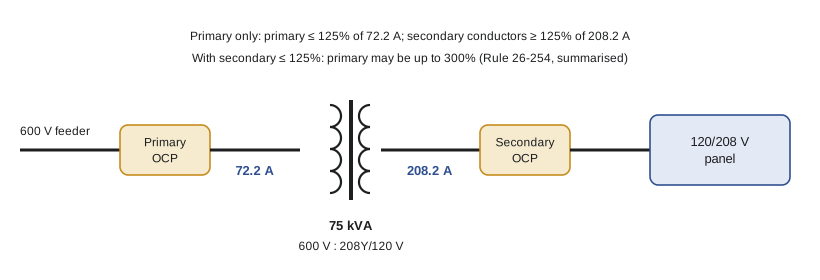
The running example is the Gaetz Avenue strip mall. The mall is fed at 347/600 V three-phase, which suits its rooftop units and lighting, but the dental clinic needs 120/208 V for its receptacles, equipment and most of its lighting. Parkland Valley installed a dry-type step-down transformer in the clinic's electrical room, fed from the mall's 600 V distribution, with a 120/208 V panel on the secondary. As always, the Code's wording is summarised, not quoted, and you must check the details in your own copy.
Choosing the kVA rating
A transformer is rated by its apparent power in kVA, because it must carry the current regardless of the power factor of the load. To choose a rating, find the load in kVA, add any allowance for growth the design calls for, and choose the next standard size up. Common three-phase dry-type ratings are 15, 30, 45, 75, 112.5, 150, 225 and 300 kVA. The clinic's calculated load from lesson 5 was about 61.5 kW; with the equipment power factors it is about 62 kVA, so the next standard size is 75 kVA, which also leaves some room for future equipment.
Rated currents
The rated current on each side follows directly from the kVA rating and the voltage. For a three-phase transformer, divide by the line-to-line voltage times the square root of three; for a single-phase transformer, divide by the voltage. Write both currents down before you touch the protection rules, because every rule is expressed as a share of them.
The ratio of the two currents is the inverse of the voltage ratio: 600 / 208 is 2.88, and 208.2 / 72.2 is also 2.88. That is a quick check that both numbers are right.
| Three-phase kVA | Rated current at 600 V | Rated current at 208 V |
|---|---|---|
| 30 | 28.9 A | 83.3 A |
| 45 | 43.3 A | 124.9 A |
| 75 | 72.2 A | 208.2 A |
| 112.5 | 108.3 A | 312.3 A |
| 150 | 144.3 A | 416.4 A |
How the protection rules are structured
Rule 26-254 gives two main ways to protect a dry-type transformer of 750 V or less. In the first, you protect the primary only, with an overcurrent device rated at not more than 125% of the rated primary current, and size the secondary conductors for at least 125% of the rated secondary current. The secondary then needs no separate overcurrent device for the transformer's sake. In the second, you protect the secondary with a device rated at not more than 125% of the rated secondary current, which allows the primary device to be much larger, up to 300% of the rated primary current. The larger primary device is useful because it rides through the high inrush current a transformer draws when it is energised.
| Method | Primary device (summarised) | Secondary device (summarised) | When it is useful |
|---|---|---|---|
| Primary protection only | Not more than 125% of rated primary current | Not required by the transformer rule if the secondary conductors are sized at 125% | Short secondary runs into a panel with a main breaker anyway |
| Primary and secondary protection | Up to 300% of rated primary current | Not more than 125% of rated secondary current | Large transformers with high inrush; feeders that need their own secondary protection |
Where 125% does not correspond to a standard overcurrent device rating, the rule permits the next higher standard rating in the cases it specifies. The rule also has conditions on the arrangement, including a limit on the combined length of primary and secondary conductors in some cases where the primary protection is above 125%. Those details are exam material; read them in your Code and add them to your lookup sheet.
Method 1 at the clinic
Worked problem
Primary protection only
Protect the clinic's 75 kVA transformer on the primary only. Find the maximum primary device rating and the minimum secondary conductor ampacity.
Show solution
- 125% of 72.2 A = 90.3 A. The next standard rating above 90.3 A is 100 A, if the next-higher provision applies; otherwise the device must not exceed 90.3 A, and a 90 A device would be used.
- Secondary conductors: at least 125% of 208.2 A = 260.3 A ampacity.
- The 120/208 V panel has its own main breaker, which protects the panel and the secondary conductors for their own sake.
Answer: A primary device of about 90 to 100 A, depending on the next-size provision; secondary conductors of at least 260 A ampacity.
Method 2 at the clinic
Worked problem
Primary and secondary protection
Protect both sides. Find the maximum secondary device and the maximum primary device.
Show solution
- Secondary: not more than 125% of 208.2 A = 260.3 A. A 250 A device is within that limit.
- Primary: up to 300% of 72.2 A = 216.6 A, so a primary device of up to 200 A is permitted (the next standard rating below 216.6 A).
- In practice, a 100 or 125 A primary breaker would usually be chosen for coordination, and checked against the transformer's inrush.
Answer: Secondary device up to 250 A; primary device up to about 200 A.
Why does the second method allow such a large primary device? Because the secondary device now protects the transformer against overload, and the primary device's job is mainly to protect against faults in the transformer and the primary conductors. A device rated at 125% of primary current can trip on the inrush current when the transformer is switched on, which can be several times the rated current for a few cycles. Raising the primary device lets the transformer energise reliably.
Sizing the conductors
Rule 26-256 requires the primary and secondary conductors of a dry-type transformer to have an ampacity of at least 125% of the rated primary and secondary currents. The rule also allows conductors to be sized for the calculated demand load instead, in which case they must be protected according to the conductor protection rules in Section 14. For exam questions, assume the 125% method unless the question gives a demand load and asks you to use it.
Worked problem
Conductors for the clinic transformer
Find the minimum conductor ampacities for the 75 kVA transformer using 125% of rated currents.
Show solution
- Primary: 1.25 × 72.2 = 90.3 A.
- Secondary: 1.25 × 208.2 = 260.3 A.
- Then size each conductor from the ampacity tables with corrections, as in lesson 6.
Answer: Primary at least 90.3 A; secondary at least 260.3 A.
Single-phase transformers
The same rules apply to single-phase transformers, with single-phase currents. At Hartley Farms, Parkland Valley installed a 25 kVA single-phase transformer to step 600 V down to 120/240 V for the shop's receptacles and lighting, fed from two lines of the farm's three-phase supply. The rated currents are 25 000 / 600 = 41.7 A on the primary and 25 000 / 240 = 104.2 A on the secondary.
Worked problem
The farm shop transformer
A 25 kVA single-phase 600 V to 120/240 V transformer is protected on the primary only. Find the maximum primary device and the minimum secondary conductor ampacity.
Show solution
- Primary: 125% of 41.7 = 52.1 A; the next standard rating above it, if the provision applies, would be 60 A.
- Secondary conductors: 125% of 104.2 = 130.2 A.
Answer: Primary device about 50 to 60 A; secondary conductors at least 130 A.
Reading the question
Transformer protection questions are easy to get wrong for one reason: they are easy to read wrong. The question may tell you there is a secondary main breaker, which points to the second method, or it may say the transformer feeds a panel through a short tap with no secondary device, which points to the first. It may ask for the maximum primary device, the minimum conductor ampacity, or the rating you would actually choose, and those are three different answers. Denise's rule is to underline three things before calculating: whether there is secondary protection, which side the question asks about, and whether it wants a maximum, a minimum or a choice.
Marcus adds one from his industrial work: check whether the voltages are line-to-line. A question about a 600 V to 120/240 V single-phase transformer fed from two lines of a 347/600 V system uses 600 V for the primary current, not 347 V. A question about a transformer with a 347 V primary connected line to neutral uses 347 V. Using the wrong one changes the primary current by a factor of 1.73 and every answer after it.
Worked problem
A full exam-style question
A 45 kVA three-phase transformer, 600 V delta primary to 208Y/120 V secondary, supplies a panel with a 150 A main breaker located 3 m away. What is the maximum primary device, and is the secondary breaker within the limit for the second method?
Show solution
- Rated currents: 45 000 / 1039 = 43.3 A primary; 45 000 / 360.3 = 124.9 A secondary.
- Secondary device limit: 125% of 124.9 = 156.1 A. The 150 A main breaker is within it.
- So the second method applies, and the primary device may be up to 300% of 43.3 = 129.9 A; a 125 A device is within that.
- Secondary conductors must still have at least 125% of 124.9 A = 156.1 A ampacity.
Answer: Primary device up to about 125 A; the 150 A secondary main qualifies.
Impedance and fault current
A transformer's nameplate impedance, given as a share of rated voltage, limits the fault current it can deliver on its secondary. A short circuit right at the secondary terminals draws the rated current divided by the per-unit impedance, assuming an infinite supply on the primary. That figure is used to check that the secondary panel and breakers have a high enough interrupting rating, which is a Code requirement for all overcurrent devices.
So the clinic's 120/208 V panel needs breakers with an interrupting rating comfortably above about 6 kA, which standard 10 kA breakers provide. Larger transformers, or ones with low impedance, can deliver much more, and the panel ratings must follow.
Other transformer considerations
Transformers feeding many electronic loads may need a K-factor rating to handle the extra heating from harmonic currents, the issue raised for neutrals in lesson 2. Transformers generate heat and need the ventilation and clearances their installation instructions and Section 26 require. Grounding and bonding of the secondary as a separately derived system is covered in MELC-104. For this course, the calculations are the focus: kVA, rated currents, protection and conductors.
Autotransformers, including the small buck-boost transformers used to correct a supply that is a little high or low, are a special case. Their windings are connected electrically between primary and secondary, so they are not separately derived systems, and Section 26 has its own requirements for them, including limits on where they may be used. A buck-boost transformer rated a few kVA can adjust the voltage of a much larger load, because only the buck or boost portion passes through the transformer's own windings. That surprising sizing is a favourite short-answer exam question, and the arithmetic is simple: the transformer's kVA is the load current times the buck or boost voltage, not the load voltage. Boosting a 208 V supply by 32 V for a 50 A load needs a transformer of only about 50 × 32 = 1.6 kVA per phase.
import math

def rated_currents(kva, v_pri, v_sec, phases=3):
    k = math.sqrt(3) if phases == 3 else 1
    return kva * 1000 / (k * v_pri), kva * 1000 / (k * v_sec)

def protection(kva, v_pri, v_sec, phases=3):
    ip, isec = rated_currents(kva, v_pri, v_sec, phases)
    return {
        'rated primary A': round(ip, 1),
        'rated secondary A': round(isec, 1),
        'primary only: max primary device A (125%)': round(1.25 * ip, 1),
        'with secondary device: max primary A (300%)': round(3.0 * ip, 1),
        'max secondary device A (125%)': round(1.25 * isec, 1),
        'min conductor ampacity pri / sec': (round(1.25 * ip, 1), round(1.25 * isec, 1)),
    }

for k, v in protection(75, 600, 208).items():
print(f'{k:45s} {v}')rated primary A 72.2 rated secondary A 208.2 primary only: max primary device A (125%) 90.2 with secondary device: max primary A (300%) 216.5 max secondary device A (125%) 260.2 min conductor ampacity pri / sec (90.2, 260.2)
Change the transformer to 112.5 kVA or to single-phase 25 kVA at 600 to 240 V and compare with the worked examples.
Common mistakes
MistakeSizing a transformer by kW instead of kVA.
InsteadTransformers carry apparent power; use kVA.
MistakeUsing the 300% primary limit without secondary protection.
InsteadThe 300% primary limit applies only when the secondary is protected at not more than 125%.
MistakeApplying multipliers to the wrong side's current.
InsteadPrimary limits use rated primary current; secondary limits use rated secondary current.
MistakeForgetting the conductor rule.
InsteadPrimary and secondary conductors need at least 125% of their rated currents, unless sized for demand with Section 14 protection.
MistakeIgnoring fault current on the secondary.
InsteadCheck breaker interrupting ratings against the transformer's available fault current.
Summary and key terms
- Choose the transformer rating in kVA, at or above the load kVA, as a standard size.
- Rated current = kVA × 1000 / (1.732 × V) for three-phase, or kVA × 1000 / V for single-phase.
- Primary protection only: primary device not more than 125% of rated primary current, secondary conductors at 125%.
- With secondary protection at not more than 125%, the primary device may be up to 300%.
- Conductors need at least 125% of rated current on each side; impedance limits secondary fault current.
- Rated current
- The current corresponding to a transformer's kVA rating at its rated voltage.
- Inrush current
- The brief high current drawn when a transformer is energised.
- Impedance (transformer)
- The share of rated voltage that drives rated current through a shorted secondary.
- Interrupting rating
- The highest fault current an overcurrent device can safely interrupt.
- K-factor
- A transformer rating for the heating effect of harmonic currents.
Practice problems
Work each problem on paper first, then reveal the answer to check.
Rated secondary current of a 45 kVA, 208 V three-phase transformer?
Show answer
45 000 / 360.3 = 124.9 A.
Maximum primary device (primary-only protection) for a transformer with 30 A rated primary current?
Show answer
125% = 37.5 A, then the next-size provision as the rule allows.
Minimum secondary conductor ampacity for 124.9 A rated secondary current?
Show answer
156.1 A.
Fault current at the secondary of a transformer with 300 A rated current and 5% impedance?
Show answer
300 / 0.05 = 6000 A.
Lesson quiz · 5 questions
Score 60% or more to complete this lesson.
Create a free account to save your progress, take quizzes and earn a certificate.