
MELC-102 · Lesson 1 of 12 · 26 min
Exam math refresher: Ohm's law and power
▶ Video coming soon A video version of this lesson is on the way.
Every Canadian electrical licensing exam is, underneath the code lookups, a mathematics exam. A master electrician candidate is expected to size a service, work out a demand load, choose a conductor, check a voltage drop, pick a transformer and protect a motor, and every one of those tasks ends in a number that has to be right. The arithmetic itself is not hard. What trips people up on exam day is a units slip, a forgotten square root of three, a power factor ignored, or a rounding decision made in the wrong direction. This course is about getting those numbers right, quickly, under exam conditions, with the Code open beside you.
This first lesson goes back to the foundations that every later calculation stands on: Ohm's law, the power equations, energy, efficiency and power factor. If you passed your Red Seal exam, you have seen all of this before. The point here is not to learn it for the first time but to make it automatic, so that on a timed exam you spend your minutes in the Code book, not wrestling with an equation you half remember.
A reminder that applies to the whole course: the CE Code is a copyrighted standard, and this course never reproduces its text or tables. When a lesson refers to a rule or a table, it gives the number and explains the idea in plain words. Any values shown in worked tables are illustrative unless the lesson says otherwise, and you should always check them against your own copy of the 2024 CE Code Part I and any amendments your province has made.
The study group
The course follows the same people you met in MELC-101. Priya Raman is a Red Seal construction electrician and lead hand at Parkland Valley Electric Ltd. in Red Deer, Alberta, and she is preparing for the Alberta Master Electrician Certificate exam. Her study partner Marcus Okafor came to Parkland Valley from industrial work and is strong on motors but rusty on dwelling rules. Their mentor, Denise Lafleur, is a retired safety codes officer who runs a Tuesday-night study group. Tyler Chen, a third-year apprentice, sits in and asks the questions apprentices ask, which turn out to be the questions examiners like too.
In the first calculation night, Denise puts a single question on the whiteboard: a 240 V water heater element is marked 4500 W; what current does it draw, and what is its resistance? Tyler reaches for his phone. Marcus does it in his head. Priya writes it out. Denise's point is that all three methods work at home, but only two of them work in an exam hall, and only one of them leaves a trail that lets you find your own mistake. Write it out.
Ohm's law and the power equations
Ohm's law relates voltage, current and resistance in a resistive circuit. Power is the rate at which energy is converted, and for a resistive load it is simply voltage times current. Combining the two gives the familiar set of power equations. You should be able to move between any two known quantities and the other two without thinking.
| You know | To find current | To find resistance | To find power |
|---|---|---|---|
| V and R | I = V / R | (given) | P = V² / R |
| V and I | (given) | R = V / I | P = V × I |
| P and V | I = P / V | R = V² / P | (given) |
| P and I | (given) | R = P / I² | (given) |
| P and R | I = √(P / R) | (given) | (given) |
Worked problem
The water heater element
A 240 V element is rated 4500 W. Find its current and resistance.
Show solution
- Current: I = P / V = 4500 / 240 = 18.75 A.
- Resistance: R = V² / P = 240² / 4500 = 57 600 / 4500 = 12.8 Ω.
- Check: I × R = 18.75 × 12.8 = 240 V. The numbers agree.
Answer: 18.75 A and 12.8 Ω.
A useful follow-up, and a favourite exam twist: what happens if the same element is connected to 208 V instead of 240 V, as happens when a residential water heater ends up in an apartment building fed from a 208Y/120 V system? The resistance does not change, so the power falls with the square of the voltage. The element now produces 208² / 12.8 = 3380 W, about three quarters of its rating. The water still gets hot, just more slowly, and the occupants complain about running out of hot water. The same square-law effect explains why a 240 V baseboard heater on a 208 V supply gives only about 75% of its nameplate output.
Energy, efficiency and cost
Energy is power multiplied by time. Utilities bill in kilowatt-hours, and exam questions sometimes ask for the energy used or the cost of running a load. Efficiency is the ratio of output power to input power, and it matters most for motors and transformers, where the electrical input is always larger than the useful output.
Worked problem
Grain dryer fan energy
At Hartley Farms, a grain-drying fan motor delivers 7.5 kW of mechanical output at an efficiency of 0.90. It runs 16 hours a day for 30 days. Find the electrical input power and the energy used.
Show solution
- Input power = output / efficiency = 7.5 / 0.90 = 8.33 kW.
- Energy = 8.33 kW × 16 h × 30 days = 4000 kWh.
- At an illustrative rate of 0.15 per kWh, the month costs about 600 in fan energy alone.
Answer: 8.33 kW input; 4000 kWh for the month.
See how the efficiency division always makes the input bigger than the output. A common slip is to multiply by the efficiency instead, which gives an input smaller than the output, a machine that creates energy. If your answer would win a Nobel Prize, check the direction of the efficiency correction.
Horsepower and kilowatts
Motor nameplates in Canada show kilowatts, horsepower or both, and the Code's motor tables list full-load currents by horsepower and by kilowatt. You need the conversion: one horsepower is about 746 W. Exam questions often give a motor in horsepower and expect you to find its input current, which needs the efficiency and power factor as well. Lesson 10 covers the Code's approach, which uses table full-load currents rather than nameplate calculations, but the arithmetic behind it starts here.
Power factor and apparent power
In AC circuits with motors, transformers, fluorescent and LED drivers and other inductive or electronic loads, the current is not perfectly in step with the voltage. The product of voltage and current then gives apparent power, measured in volt-amperes (VA), and only part of it is real power in watts. The ratio is the power factor. The rest is reactive power, measured in volt-amperes reactive (var), which flows back and forth without doing useful work but still heats conductors and loads transformers.
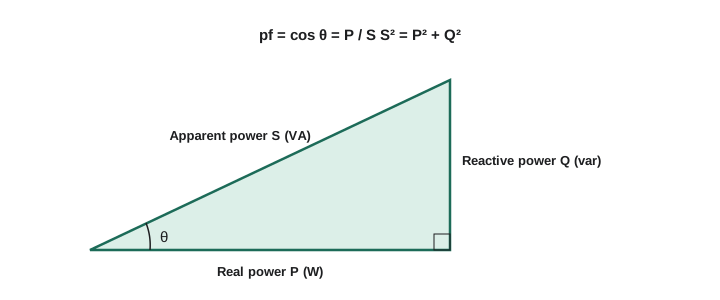
Why does this matter for code calculations? Conductors, breakers and transformers are sized by current, and current depends on apparent power, not real power. A load that draws 10 kW at a power factor of 0.80 draws the same current as a 12.5 kVA load, not a 10 kW one. Many Section 8 demand calculations are done in watts and treat the result as volt-amperes, which is the Code's simplification for resistive-dominated loads like dwellings. But when a question gives a power factor, use it.
Worked problem
Shop lighting and power factor
The Gaetz Avenue dental clinic has an LED lighting load of 3.6 kW at a power factor of 0.90 on a 120 V circuit group. Find the apparent power and total current.
Show solution
- S = P / pf = 3600 / 0.90 = 4000 VA.
- I = S / V = 4000 / 120 = 33.3 A, which would be split over several 15 A branch circuits.
- If you had ignored the power factor, you would have calculated 30 A and under-sized the circuits.
Answer: 4000 VA and about 33.3 A.
Series and parallel circuits
Licensing exams still include a few circuit questions: resistances in series and parallel, the current in a branch, the voltage across one element. In series, resistances add and the current is the same through all of them. In parallel, the voltage is the same across all of them and the reciprocals of resistance add. For two resistors in parallel, the product over the sum is the quickest route.
One practical use is the multi-wire branch circuit. On a 120/240 V circuit with two loads sharing a neutral, the neutral carries the difference between the two line currents. With loads of 12 A and 8 A on opposite lines, the neutral carries only 4 A. If the neutral opens, the two loads end up in series across 240 V, and the smaller load, which has the higher resistance, sees most of the voltage. That is the mechanism behind burned-out electronics when a shared neutral fails, and it is a classic exam explanation question.
Worked problem
The open neutral
Two 120 V loads share a neutral on a 120/240 V circuit: a 1200 W heater and a 300 W television. The neutral opens. What voltage appears across the television?
Show solution
- Heater resistance: 120² / 1200 = 12 Ω. Television resistance (treated as a resistor): 120² / 300 = 48 Ω.
- With the neutral open, they are in series across 240 V: total 60 Ω, current 240 / 60 = 4 A.
- Voltage across the television: 4 A × 48 Ω = 192 V. The television fails; the heater barely warms at 48 V.
Answer: About 192 V across the television.
Units, prefixes and rounding
Most exam mistakes in this course will not be conceptual. They will be units. Keep a short list of the conversions you use constantly and write units on every line of working. The CE Code uses SI units throughout: metres, square millimetres for conductor area on some tables, watts, volt-amperes and degrees Celsius. Conductor sizes are still given in AWG and kcmil for most installations, and you need to be comfortable with both.
| Quantity | Common conversion | Where it shows up |
|---|---|---|
| Power | 1 kW = 1000 W; 1 hp ≈ 746 W | Motors, heaters, service loads |
| Apparent power | 1 kVA = 1000 VA | Transformers, demand loads |
| Area | 1 m² ≈ 10.76 ft² | Dwelling floor areas in Section 8 |
| Length | 1 m ≈ 3.28 ft | Voltage drop runs, conduit lengths |
| Temperature | °F = °C × 9/5 + 32 | Ambient correction factors |
| Energy | 1 kWh = 3.6 MJ | Energy and cost questions |
Rounding deserves a word of its own because it changes answers. As a working habit, carry full precision through a calculation and round only the final answer. When you are choosing equipment, round in the safe direction: a calculated 46.2 A load needs a conductor and breaker rated at least 46.2 A, so you go up to the next standard size, never down. Some Code rules tell you explicitly when you may go up to the next standard overcurrent device size; those permissions are specific, and lessons 9 and 10 point them out.
A calculator you can run
The study group keeps a small script for checking power arithmetic. You can edit and run it right here: change the voltage, the wattage or the power factor and see how the current changes. The point is not to replace the exam calculator but to build intuition for how the quantities move together.
def load_current(watts, volts, pf=1.0, phases=1):
    # Current drawn by a load. Three-phase loads use the line-to-line voltage.
    va = watts / pf
    if phases == 3:
        return va / (volts * 3 ** 0.5)
    return va / volts

loads = [
    ('Water heater element', 4500, 240, 1.0, 1),
    ('Dental clinic lighting', 3600, 120, 0.90, 1),
    ('Grain dryer fan input', 8330, 600, 0.85, 3),
]
for name, w, v, pf, ph in loads:
print(f'{name:24s} {load_current(w, v, pf, ph):6.1f} A')Water heater element 18.8 A Dental clinic lighting 33.3 A Grain dryer fan input 9.4 A
Try changing the grain dryer fan's power factor from 0.85 to 0.95 and watch the current fall. That is the effect of power factor correction, which lesson 9 of MELC-105 returns to in detail.
Denise's three checks
Before the group moves on, Denise hands out the three checks she wants applied to every answer in the course. First, the units check: does the answer come out in the units the question asked for? Second, the size check: is the number plausible for the equipment? A dwelling service of 4000 A or a branch circuit of 0.4 A should make you stop. Third, the direction check: did every correction factor, efficiency and power factor push the answer the way it should, larger for inputs and currents, smaller for outputs and allowable capacities?
These checks take ten seconds each and catch most errors. Priya writes them on the inside cover of her code book, in the red tab section she reserves for her own lookup sheet.
Common mistakes
MistakeMultiplying by efficiency to find input power.
InsteadDivide output by efficiency; input is always larger than output.
MistakeUsing watts when the question gives a power factor.
InsteadConvert to volt-amperes with S = P / pf before finding current.
MistakeAssuming a 240 V heater gives full output on 208 V.
InsteadOutput scales with the square of voltage: about 75% at 208 V.
MistakeRounding intermediate results and then rounding again.
InsteadCarry full precision and round only the final answer, in the safe direction.
MistakeForgetting that an open shared neutral puts loads in series.
InsteadWork out each load's resistance and the series voltage split.
Summary and key terms
- Ohm's law and P = VI give every relationship between voltage, current, resistance and power.
- Energy is power times time; efficiency is output over input, so inputs are always larger.
- Apparent power in VA sets current; real power in W is VA times power factor.
- Resistive loads on a lower voltage lose power with the square of the voltage ratio.
- Write units on every line and round only the final answer, in the safe direction.
- Apparent power
- The product of voltage and current in an AC circuit, in volt-amperes.
- Power factor
- The ratio of real power to apparent power; the cosine of the phase angle.
- Reactive power
- Power that flows back and forth in inductive or capacitive loads without doing work, in var.
- Efficiency
- Useful output power divided by input power.
- Multi-wire branch circuit
- Two or more ungrounded conductors sharing one neutral.
Practice problems
Work each problem on paper first, then reveal the answer to check.
A 120 V, 1500 W heater: find its current and resistance.
Show answer
I = 1500 / 120 = 12.5 A; R = 120² / 1500 = 9.6 Ω.
A load draws 20 A at 240 V with a power factor of 0.85. Find the real power.
Show answer
P = 240 × 20 × 0.85 = 4080 W.
A 10 hp motor runs at 88% efficiency. What is its electrical input in kW?
Show answer
10 × 746 / 0.88 = 8477 W, about 8.48 kW.
Two loads of 15 A and 9 A share a neutral on opposite lines. What does the neutral carry?
Show answer
The difference: 6 A.
Lesson quiz · 5 questions
Score 60% or more to complete this lesson.
Create a free account to save your progress, take quizzes and earn a certificate.