
MELC-102 · Lesson 2 of 12 · 27 min
Single-phase and three-phase calculations
▶ Video coming soon A video version of this lesson is on the way.
Most of the services Priya has installed at Parkland Valley are 120/240 V single-phase: houses, small shops, farm yards. The master electrician exam assumes she can work just as fluently with three-phase systems, because commercial buildings, schools, hospitals, farms with large motors and every industrial plant run on them. In Alberta and across most of Canada, the common three-phase systems are 120/208 V wye for smaller commercial work and 347/600 V wye for larger buildings, with 600 V delta systems still found in older industrial plants. Each system has its own voltage relationships, and the exam expects you to move between them without hesitation.
This lesson covers the voltages and currents in single-phase and three-phase systems, the square root of three that appears in every three-phase formula, balanced and unbalanced loads, neutral currents and how to convert a load in kilowatts or kilovolt-amperes into a line current. These are the conversions that every later lesson depends on.
Single-phase three-wire systems
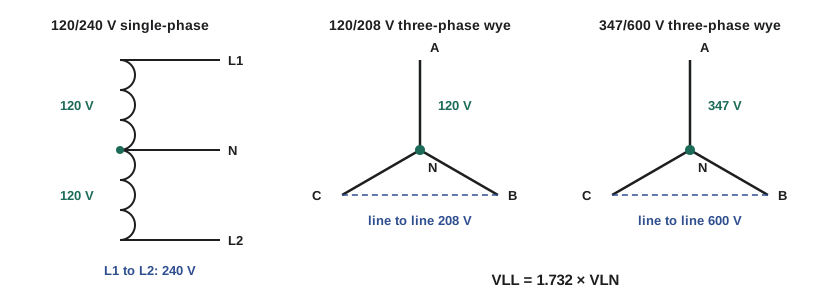
A 120/240 V single-phase service comes from a centre-tapped transformer secondary. The two line conductors are 240 V apart, and each is 120 V from the grounded neutral at the centre tap. Loads of 120 V connect from one line to neutral; 240 V loads such as ranges, dryers, water heaters and baseboard heaters connect line to line. The utility and the Code both expect the 120 V loads to be split roughly evenly between the two lines, so that the neutral carries only the difference.
For a 240 V load, the current is simply the power divided by 240. For a service calculated in watts, the Code's convention for a 120/240 V service is to divide the total calculated load by 240 V to get the service current, on the basis that the 120 V loads are balanced across the two lines. This is the single most common calculation on the exam, and lesson 3 builds on it.
Where the square root of three comes from
In a three-phase wye system, the three line-to-neutral voltages are equal in size and 120 degrees apart. The voltage between any two lines is the difference between two of those phasors, and geometry gives its size: the line-to-neutral voltage multiplied by the square root of three, about 1.732. That is why 120 V phase voltages give 208 V between lines, and 347 V phase voltages give 600 V.
For a balanced three-phase load, the total power is three times the power of one phase. Writing that in terms of the line-to-line voltage and the line current introduces the square root of three again. This one formula, used in both directions, answers most three-phase exam questions.
| System | Line to neutral | Line to line | Current per kVA (balanced) |
|---|---|---|---|
| 120/240 V single-phase | 120 V | 240 V | 4.17 A per kVA (÷ 240) |
| 120/208 V three-phase wye | 120 V | 208 V | 2.78 A per kVA (÷ 360) |
| 347/600 V three-phase wye | 347 V | 600 V | 0.96 A per kVA (÷ 1039) |
| 600 V three-phase delta | (no neutral) | 600 V | 0.96 A per kVA (÷ 1039) |
Those divisors are worth memorising: 240 for single-phase three-wire, 360 for 208 V three-phase, and 1039 for 600 V three-phase. A 100 kVA load is about 417 A at 120/240 V, 278 A at 208 V and 96 A at 600 V. The higher the voltage, the smaller the current for the same power, which is why larger buildings use 347/600 V.
Worked problem
Gaetz Avenue clinic service
The dental clinic at the Gaetz Avenue strip mall has a calculated demand load of 62 kVA on a 120/208 V three-phase supply. What is the line current?
Show solution
- I = S / (√3 × V) = 62 000 / (1.732 × 208).
- 1.732 × 208 = 360.3.
- I = 62 000 / 360.3 = 172 A.
Answer: About 172 A per line.
Worked problem
The same load at 600 V
If the same 62 kVA load were supplied at 347/600 V, what would the line current be?
Show solution
- I = 62 000 / (1.732 × 600) = 62 000 / 1039 = 59.7 A.
- The current is about a third of the 208 V value, so conductors, breakers and the service would all be much smaller.
Answer: About 60 A per line.
Delta systems
In a delta-connected system, the windings are connected end to end in a triangle, and each winding sits directly between two lines. The line-to-line voltage equals the winding voltage, but the line current is the winding current multiplied by the square root of three, because each line carries the phasor difference of two winding currents. The total power formula is the same as for wye: the square root of three times line voltage times line current.
Some older industrial plants use a 240 V delta with one winding centre-tapped to give 120/240 V for lighting. That arrangement has a high leg: the line opposite the centre tap is about 208 V to neutral, and connecting a 120 V load to it destroys the load. The Code requires that conductor to be identified, and exam questions occasionally ask for the high-leg voltage, which is 120 × 1.732.
Balanced and unbalanced loads
In a perfectly balanced three-phase four-wire system, the three phase currents are equal and 120 degrees apart, and the neutral current is zero. Real buildings are never perfectly balanced, so the neutral carries some current. For linear loads on a wye system, the neutral current can be calculated from the three line currents with a formula that every master candidate should be able to apply.
Worked problem
Neutral current at the clinic
The clinic's 208Y/120 V panel has line currents of 90 A, 70 A and 60 A from single-phase 120 V loads. Find the neutral current.
Show solution
- Sum of squares: 8100 + 4900 + 3600 = 16 600.
- Sum of products: 90 × 70 + 70 × 60 + 60 × 90 = 6300 + 4200 + 5400 = 15 900.
- Neutral current = √(16 600 − 15 900) = √700 = 26.5 A.
Answer: About 26.5 A.
Two cautions apply. First, the formula assumes linear loads. Electronic loads such as computers, LED drivers and variable-frequency drives draw distorted currents rich in the third harmonic, and third harmonics in the three phases add in the neutral instead of cancelling. In buildings full of electronic loads, the neutral can carry more current than any phase conductor. The Code addresses this in its rules on neutral conductor sizing and on counting neutrals as current-carrying conductors, which lesson 6 covers. Second, the formula gives the neutral of a wye system; for single-phase three-wire circuits, the neutral simply carries the difference of the two line currents, as lesson 1 showed.
Balancing loads across phases
On the job, balancing means assigning single-phase loads to lines so that the line currents are as close as possible. On the exam, balancing questions usually come as a list of loads to be distributed, and the answer is the heaviest line current, because that sets the service or feeder size. When single-phase loads are connected line to line on a three-phase system, each load draws current from two lines, which complicates the arithmetic. A practical method is to convert each load to its line-current contribution and add the contributions on each line.
Worked problem
Distributing heaters on 208 V
Three 208 V single-phase heaters of 5 kW each are connected one across each pair of lines of a 208Y/120 V system (A-B, B-C, C-A). What is each line current?
Show solution
- Each heater draws 5000 / 208 = 24.0 A.
- With three equal loads connected in delta, the load is balanced: total 15 kW.
- Line current = 15 000 / (1.732 × 208) = 41.6 A. That equals 24.0 × 1.732, as the delta relationship predicts.
Answer: About 41.6 A per line.
If only two of the three heaters were installed, the load would be unbalanced: the line shared by both heaters carries the phasor sum of two currents, about 41.6 A, while the other two lines carry 24 A each. Exams like that question because it tests whether you understand the phasor relationship or are simply plugging in the square root of three.
Kilowatts, kilovolt-amperes and power factor in three-phase
Everything from lesson 1 about power factor applies to three-phase loads. A three-phase motor drawing 40 kW at a power factor of 0.85 has an apparent power of 47.1 kVA, and the line current at 600 V is 47 100 / 1039 = 45.3 A. A transformer rated in kVA must carry the apparent power, not the real power, so kVA is the right figure for transformer sizing in lesson 9.
import math

def line_current(kva, volts, phases):
    # Line current for a balanced load given in kVA.
    if phases == 1:
        return kva * 1000 / volts
    return kva * 1000 / (math.sqrt(3) * volts)

def neutral_current(ia, ib, ic):
    # Neutral current in a wye system with linear single-phase loads.
    return math.sqrt(ia**2 + ib**2 + ic**2 - ia*ib - ib*ic - ic*ia)

for kva, v, ph in [(62, 208, 3), (62, 600, 3), (25, 240, 1)]:
    print(f'{kva} kVA at {v} V, {ph}-phase: {line_current(kva, v, ph):6.1f} A')
print(f'Neutral for 90, 70, 60 A: {neutral_current(90, 70, 60):.1f} A')62 kVA at 208 V, 3-phase: 172.1 A 62 kVA at 600 V, 3-phase: 59.7 A 25 kVA at 240 V, 1-phase: 104.2 A Neutral for 90, 70, 60 A: 26.5 A
A three-phase motor example
Marcus brings a problem from his oil sands days. A 75 kW conveyor motor runs at 600 V three-phase with an efficiency of 0.94 and a power factor of 0.88. What is the line current at full load? He works it from first principles, and then Denise shows how the Code would answer it from its motor tables instead, which lesson 10 explains.
Worked problem
Conveyor motor current from first principles
75 kW output, 600 V three-phase, efficiency 0.94, power factor 0.88.
Show solution
- Input real power = 75 / 0.94 = 79.8 kW.
- Apparent power = 79.8 / 0.88 = 90.7 kVA.
- Line current = 90 700 / 1039 = 87.3 A.
Answer: About 87 A. The Code's motor tables give a standard full-load current for sizing, which you use instead of this calculated value.
Common traps
Denise lists the traps she has seen candidates fall into on three-phase questions. Using the line-to-neutral voltage in the three-phase formula gives a current 1.732 times too large. Multiplying by 3 instead of the square root of 3 gives a current 1.732 times too small. Dividing a single-phase load by 208 when it is a 120 V load gives nonsense. And forgetting that a 208 V single-phase load on a three-phase system still draws its current from two lines leaves one line under-counted when balancing.
Her remedy is the same as in lesson 1: write the formula, write the units, and do the size check. A 62 kVA clinic drawing 517 A is wrong, because you used 120 V; one drawing 99 A is wrong, because you used 3 instead of 1.732; one drawing 172 A is plausible.
Checking calculations against the meter
Calculations become real when you can check them with a clamp meter. After the clinic opened, Priya took readings at the main panel on a busy weekday afternoon: 104 A, 96 A and 88 A on the three lines, and 15 A on the neutral. Those numbers sit comfortably below the calculated demand of 172 A, which is what she expected. Demand calculations are deliberately conservative, and a measured load well under the calculated value is normal. If the readings had been above the calculated demand, it would have meant either that loads had been added since the permit or that the calculation had missed something, and either would need a closer look before adding more circuits.
The readings also let her check the balance. The neutral formula with 104, 96 and 88 A gives about 14 A, close to the 15 A she measured, which tells her the loads are mostly linear. A neutral reading much higher than the formula predicts is the signature of harmonic currents from electronic loads, and in a dental clinic full of computers, imaging equipment and LED lighting, that is worth watching. Exams do not ask you to take meter readings, but questions that give measured currents and ask what they mean are common in the business and practical sections.
Common mistakes
MistakeUsing line-to-neutral voltage in the three-phase current formula.
InsteadUse line-to-line voltage with the square root of three: I = S / (1.732 × VLL).
MistakeMultiplying by 3 instead of the square root of 3.
InsteadThe factor for line voltage and line current is 1.732.
MistakeAssuming the neutral always carries the difference of two currents.
InsteadIn a three-phase wye, use the three-current neutral formula, and watch for harmonics.
MistakeTreating a 208 V single-phase load as if it drew from one line.
InsteadA line-to-line load draws current from both lines it connects to.
MistakeConnecting 120 V loads to the high leg of a centre-tapped delta.
InsteadThe high leg is about 208 V to neutral; it must be identified and never used for 120 V loads.
Summary and key terms
- In a wye system, line-to-line voltage is 1.732 times line-to-neutral voltage: 120/208 V and 347/600 V.
- Three-phase current: I = S / (1.732 × VLL); remember the divisors 360 for 208 V and 1039 for 600 V.
- Balanced 120/240 V service loads are divided by 240 V.
- Neutral current in a wye with linear loads comes from the three-current formula; harmonics can make it larger.
- Delta systems have line current 1.732 times winding current; a centre-tapped delta has a high leg.
- Wye
- A three-phase connection with each winding from a line to a common neutral point.
- Delta
- A three-phase connection with the windings connected end to end in a triangle.
- Line-to-line voltage
- The voltage between two ungrounded conductors.
- High leg
- The line of a centre-tapped delta system that is about 208 V to neutral.
- Balanced load
- A three-phase load drawing equal currents on all three lines.
Practice problems
Work each problem on paper first, then reveal the answer to check.
Find the line current for a 45 kVA balanced load at 208 V three-phase.
Show answer
45 000 / 360.3 = 124.9 A.
A 347/600 V panel serves a 30 kW lighting load at pf 0.95. Find the line current.
Show answer
S = 31.6 kVA; I = 31 600 / 1039 = 30.4 A.
Line currents are 50, 50 and 20 A on a wye system with linear loads. Find the neutral current.
Show answer
√(2500+2500+400−2500−1000−1000) = √900 = 30 A.
What is the high-leg voltage to neutral on a 240 V centre-tapped delta?
Show answer
120 × 1.732 = 208 V.
Lesson quiz · 5 questions
Score 60% or more to complete this lesson.
Create a free account to save your progress, take quizzes and earn a certificate.