
MELC-102 · Lesson 12 of 12 · 39 min
Mixed calculation practice set
▶ Video coming soon A video version of this lesson is on the way.
Three weeks before her exam date, Priya sits a timed calculation set at Denise's kitchen table: twelve mixed problems in ninety minutes, code book open, calculator only. It is the last lesson of this course, and it works the same way. Each problem below is the kind of question a Canadian master or contractor exam asks, drawn from the topics of lessons 1 to 11 and set in the jobs you have followed through the course. Try each one before reading the working. Then read the working even if you got it right, because the notes after each problem point out the trap the question was built around.
A reminder for the last time: every value that would come from a Code table is illustrative here and labelled as such. The methods are summarised from the 2024 CE Code Part I. Repeat these problems with your own code book open, replacing the illustrative values with the real ones, and you will have done a genuine exam rehearsal.
How to use a timed set
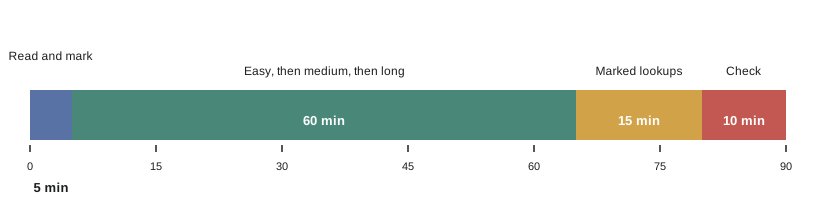
Denise's method for timed sets is simple. Read every question first and mark each one easy, medium or long. Do the easy ones first, because they bank marks and build confidence. Budget your time by marks: a question worth twice as much gets twice the minutes. Write your working in the same layout every time, so you can check it quickly. When a lookup takes more than two minutes, mark it, move on and come back. And leave ten minutes at the end to do the units, size and direction checks on every answer.
Problem 1: power and resistance
Worked problem
A hot tub heater on the wrong voltage
A hot tub heater is rated 5.5 kW at 240 V. It is installed in a condo fed at 208 V. What power does it produce, and what current does it draw?
Show solution
- Resistance: 240² / 5500 = 10.47 Ω.
- Power at 208 V: 208² / 10.47 = 4132 W.
- Current: 208 / 10.47 = 19.9 A.
Answer: About 4.13 kW and 19.9 A.
The trap: assuming the current stays the same as on 240 V (22.9 A). With a fixed resistance, a lower voltage means a lower current and much lower power.
Problem 2: three-phase current
Worked problem
A rooftop unit
A rooftop unit at the strip mall is rated 38 kVA at 600 V three-phase. Find its line current.
Show solution
- I = 38 000 / (1.732 × 600) = 38 000 / 1039 = 36.6 A.
Answer: 36.6 A.
The trap: dividing by 600 alone (63.3 A) or by 347 V (109.5 A or 63.2 A depending on the slip). Three-phase uses line-to-line voltage and the square root of three.
Problem 3: a single dwelling
Worked problem
A new acreage house
A new house has a main floor of 160 m² and a full-height basement of 160 m². It has an 18 kW electric furnace, a 4 kW air conditioner interlocked with the furnace, a 13 kW range, an 11.5 kW EV charger with no management system, a 6 kW dryer and a 4.5 kW water heater. Find the calculated load and minimum service ampacity.
Show solution
- Living area: 160 + 0.75 × 160 = 280 m². Basic load: 280 − 90 = 190 m², which is 3 blocks: 5000 + 3000 = 8000 W.
- Heating 18 kW: 10 000 + 0.75 × 8000 = 16 000 W. Air conditioning interlocked: only the larger, the heating, counts.
- Range 13 kW: 6000 + 0.40 × 1000 = 6400 W.
- EV at full value: 11 500 W. Other loads with a range: 0.25 × (6000 + 4500) = 2625 W.
- Total: 8000 + 16 000 + 6400 + 11 500 + 2625 = 44 525 W, above the 24 000 W minimum.
- Current: 44 525 / 240 = 185.5 A, so a 200 A service.
Answer: 44 525 W and 185.5 A minimum ampacity.
The traps: counting the basement at full area, adding the interlocked air conditioning, and putting the range at 6000 W without the 40% of the excess over 12 kW.
Problem 4: apartment units
Worked problem
A six-unit building
Six identical apartment units each have a load of 13 500 W excluding heating. Total heating for the building is 54 kW. House loads are 12 kW. Find the calculated load and the current at 208 V three-phase.
Show solution
- Units: 13 500 × (1.00 + 0.65 + 0.40 + 0.40 + 0.25 + 0.25) = 13 500 × 2.95 = 39 825 W.
- Heating: 10 000 + 0.75 × 44 000 = 43 000 W. House loads at 75%: 9000 W.
- Total: 39 825 + 43 000 + 9000 = 91 825 W.
- Current: 91 825 / 360.3 = 254.9 A.
Answer: 91 825 W and about 255 A.
The trap: applying the stepped factors to loads that still include heating, which would give a much smaller and wrong answer.
Problem 5: correction factors
Worked problem
Conductors in a hot space (illustrative values)
Six current-carrying conductors run in one conduit through a 40 °C ceiling space. Suppose the chosen conductor's 90 °C table ampacity is 55 A, its 75 °C value is 50 A, the 90 °C ambient factor at 40 °C is 0.91 and the factor for 4 to 6 conductors is 0.80. Terminations are 75 °C. What is the allowable ampacity?
Show solution
- Corrected from 90 °C: 55 × 0.91 × 0.80 = 40.0 A.
- Termination limit: 50 A. The corrected value is lower, so it governs.
Answer: 40.0 A with these illustrative values.
The trap: applying the corrections to the 75 °C value (36.4 A) when the insulation allows starting from 90 °C, or stopping at 55 A without corrections.
Problem 6: voltage drop
Worked problem
A detached garage feeder
A 120/240 V feeder to a detached shop carries 60 A over 75 m. The service drop is negligible. Find the maximum resistance per kilometre for a 3% drop, and choose from copper of about 1.0, 0.63 or 0.40 Ω/km.
Show solution
- Allowed: 3% of 240 = 7.2 V.
- R max = 7.2 × 1000 / (2 × 75 × 60) = 7200 / 9000 = 0.80 Ω/km.
- 1.0 Ω/km is too high; 0.63 Ω/km meets it: drop = 2 × 75 × 60 × 0.63 / 1000 = 5.7 V, 2.4%.
Answer: Maximum 0.80 Ω/km; the 0.63 Ω/km conductor works.
The trap: forgetting the 2 for single-phase, which halves the drop and makes a conductor that is too small look adequate.
Problem 7: conduit fill
Worked problem
A branch circuit conduit (illustrative areas)
Nine conductors of 9.0 mm² each plus a bonding conductor of 5.0 mm² go in a conduit. Suppose two trade sizes have internal areas of 190 mm² and 340 mm². Which is the smallest that meets the 40% fill limit?
Show solution
- Total area: 9 × 9.0 + 5.0 = 86 mm².
- 190 × 0.40 = 76 mm²: too small.
- 340 × 0.40 = 136 mm²: it fits.
Answer: The 340 mm² trade size, with these illustrative areas.
The trap: leaving out the bonding conductor, which would make the total 81 mm², still too big for the smaller conduit here, but in another question it could change the answer.
Problem 8: transformer protection
Worked problem
A 30 kVA transformer
A 30 kVA three-phase transformer, 600 V to 208Y/120 V, is protected on the primary only. Find the rated currents, the maximum primary device at 125% and the minimum secondary conductor ampacity.
Show solution
- Primary: 30 000 / 1039 = 28.9 A; secondary: 30 000 / 360.3 = 83.3 A.
- Primary device: 125% × 28.9 = 36.1 A, then the next-size provision if it applies.
- Secondary conductors: 125% × 83.3 = 104.1 A.
Answer: 28.9 A and 83.3 A; primary device about 36 A; secondary conductors at least 104 A.
The trap: using 300% on the primary when there is no secondary protection at 125%.
Problem 9: motors on a feeder
Worked problem
Three motors (illustrative table currents)
A feeder supplies three 600 V three-phase motors with illustrative table full-load currents of 34 A, 17 A and 11 A. Suppose the largest motor's maximum short-circuit device is 85 A. Find the minimum feeder ampacity and the maximum feeder device.
Show solution
- Ampacity: 1.25 × 34 + 17 + 11 = 42.5 + 28 = 70.5 A.
- Feeder device: 85 + 17 + 11 = 113 A maximum; choose a standard rating not above it, applying the rule's provisions.
Answer: 70.5 A minimum ampacity; feeder device up to 113 A.
The trap: 125% on all three motors (77.5 A), or adding the largest motor's full-load current instead of its device rating when sizing the feeder device.
Problem 10: overloads
Worked problem
Setting an overload
A motor's nameplate shows 22.5 A and a temperature rise of 40 °C; no service factor is marked. Its table full-load current is 22 A. What is the maximum overload setting?
Show solution
- A marked temperature rise of 40 °C or less allows 125%.
- Based on nameplate current: 1.25 × 22.5 = 28.1 A.
Answer: 28.1 A.
The traps: using 115% because no service factor is marked, and using the table current instead of the nameplate.
Problem 11: adding load to a service
Worked problem
A new walk-in cooler
A restaurant's 400 A, 120/208 V three-phase service has a recorded 12-month maximum demand of 105 kVA. A new walk-in cooler and freezer add 18 kVA. Is there capacity?
Show solution
- Capacity: 1.732 × 208 × 400 = 144 kVA.
- New demand: 105 + 18 = 123 kVA, below 144 kVA.
Answer: Yes, about 123 kVA against 144 kVA.
The trap: comparing kVA with amperes, or using 240 V for a three-phase 208 V service.
Problem 12: putting it together
Worked problem
A small commercial feeder (illustrative values)
A subpanel serves a 42 kVA balanced load at 208 V three-phase, 30 m from the main panel. The load includes 20 kVA of continuous lighting. Equipment is not marked for 100% continuous operation. Find the minimum overcurrent device rating and check the voltage drop with a copper conductor of about 0.40 Ω/km.
Show solution
- Current: 42 000 / 360.3 = 116.6 A.
- Continuous part: 20 000 / 360.3 = 55.5 A at 125% = 69.4 A; non-continuous part: 61.1 A. Device ≥ 69.4 + 61.1 = 130.5 A, so a 150 A device.
- Voltage drop: 1.732 × 30 × 116.6 × 0.40 / 1000 = 2.4 V, 1.2% of 208 V.
Answer: A device of at least 130.5 A (150 A standard); drop about 1.2%.
The trap: applying 125% to the whole load (145.7 A) when only part of it is continuous. Read whether the question says the whole load is continuous or only part.
Building your own sets
One timed set is a rehearsal; a dozen are a preparation. The study group writes new sets for each other every week, using the jobs in their own files: a farm shop Marcus wired, a duplex Priya roughed in, a strip-mall unit Tyler helped with. Writing a question is as useful as answering one, because it forces you to decide which conditions matter and where the trap is. Denise's rule for a good practice question is that it should have exactly one trap, stated fairly in the wording, and a single correct answer that a careful reader can reach with the code book and a calculator.
Keep a log of every question you get wrong, with the reason. After a few weeks, the log shows patterns. Priya's showed that most of her misses were continuous-load questions and three-phase single-line loads, so she spent her last two weeks on those. Marcus's showed basement areas and range allowances. Nobody's log showed arithmetic.
After the set
Priya finished in 82 minutes with eleven right. Her one miss was problem 12, where she applied 125% to the whole load. Denise's comment was the one she had made all course: the arithmetic was perfect; the reading was not. On the real exam, Priya underlined every phrase about continuous loads, interlocks, ranges, basements and secondary protection before calculating anything.
That is the habit this course has tried to build. The formulas are few: Ohm's law, power, the square root of three, the voltage drop formula and a handful of multipliers. The tables are in your code book. What earns the marks is reading the question precisely, choosing the right method, writing the working in a consistent layout and checking every answer for units, size and direction.
import math

answers = {
    'P1 hot tub at 208 V (W)': 208**2 / (240**2 / 5500),
    'P2 rooftop unit (A)': 38000 / (math.sqrt(3) * 600),
    'P3 acreage house (A)': (8000 + 16000 + 6400 + 11500 + 0.25 * 10500) / 240,
    'P4 six units (A)': (13500 * 2.95 + 43000 + 9000) / (math.sqrt(3) * 208),
    'P6 max ohms per km': 7.2 * 1000 / (2 * 75 * 60),
    'P8 secondary conductors (A)': 1.25 * 30000 / (math.sqrt(3) * 208),
    'P9 feeder ampacity (A)': 1.25 * 34 + 17 + 11,
    'P12 device (A)': 1.25 * 20000 / (math.sqrt(3) * 208) + 22000 / (math.sqrt(3) * 208),
}
for k, v in answers.items():
print(f'{k:30s} {v:9.1f}')P1 hot tub at 208 V (W) 4131.1 P2 rooftop unit (A) 36.6 P3 acreage house (A) 185.5 P4 six units (A) 254.9 P6 max ohms per km 0.8 P8 secondary conductors (A) 104.1 P9 feeder ampacity (A) 70.5 P12 device (A) 130.5
The script checks the arithmetic of the problems above. Change a value in any line to make your own variation, work it by hand, then run the script to check yourself.
Common mistakes
MistakeStarting to calculate before reading the whole question.
InsteadUnderline the conditions first: continuous, interlocked, range, basement, secondary protection.
MistakeSpending ten minutes on one lookup.
InsteadMark it, move on, and come back after the easy questions.
MistakeWriting working in a different layout each time.
InsteadUse one layout so errors stand out and checking is fast.
MistakeSkipping the final checks.
InsteadLeave time to check units, size and direction on every answer.
MistakeUsing remembered table values on the exam.
InsteadLook every value up in your own code book; memory drifts and editions change.
Summary and key terms
- Timed sets build speed: read all, do easy questions first, budget by marks, mark slow lookups.
- Most wrong answers come from misreading conditions, not from arithmetic.
- The same few formulas and multipliers solve almost every calculation on the exam.
- Write working in a consistent layout and check units, size and direction.
- Rehearse with your own code book so every table value is the real one.
- Timed set
- A practice exam done under exam time limits.
- Lookup
- Finding a rule or table value in the code book.
- Working
- The written steps of a calculation, which can earn part marks.
- Size check
- Asking whether an answer is plausible for the equipment.
- Direction check
- Asking whether each factor moved the answer the right way.
Practice problems
Work each problem on paper first, then reveal the answer to check.
A 4.5 kW, 240 V heater on 208 V: power?
Show answer
4500 × (208/240)² = 3380 W.
A 25 kVA load at 600 V three-phase: current?
Show answer
24.1 A.
Four identical units of 11 000 W (no heat): combined?
Show answer
11 000 × 2.45 = 26 950 W.
A continuous load of 32 A: minimum breaker not marked for 100%?
Show answer
40 A.
Lesson quiz · 5 questions
Score 60% or more to complete this lesson.
Create a free account to save your progress, take quizzes and earn a certificate.