
MELC-102 · Lesson 8 of 12 · 23 min
Box fill and conduit fill
▶ Video coming soon A video version of this lesson is on the way.
Two of the most practical calculations on the exam are also the ones electricians do least on paper: how many conductors fit in a box, and how many fit in a conduit. On the job, experience and a quick glance usually settle it. On the exam, and on inspections, the Code's rules settle it, and those rules are precise. Box fill protects conductors and connections from damage and overheating in a crowded box; conduit fill keeps conductors from being damaged when they are pulled in, and leaves room for heat to escape. Both questions have a clear method, and both are easy marks if you follow it.
This lesson covers the box fill rule, Rule 12-3034, with the tables that give box capacities and the space each conductor needs, and the conduit fill rules in Section 12 with the tables for conductor areas, raceway areas and allowable fill. The tables themselves are Code content and are not reproduced; the worked examples use illustrative values, clearly marked, and you should repeat each one with your own tables.
Why box fill matters
A box that is too full is hard to work in, which leads to nicked insulation and poor connections. It also traps heat from connections and devices. The box fill rule makes sure there is enough volume for the conductors, splices, devices and fittings in the box. It does this by giving each conductor size a volume allowance, giving each type of standard box a capacity, and telling you how to count what is in the box.
The method for box fill
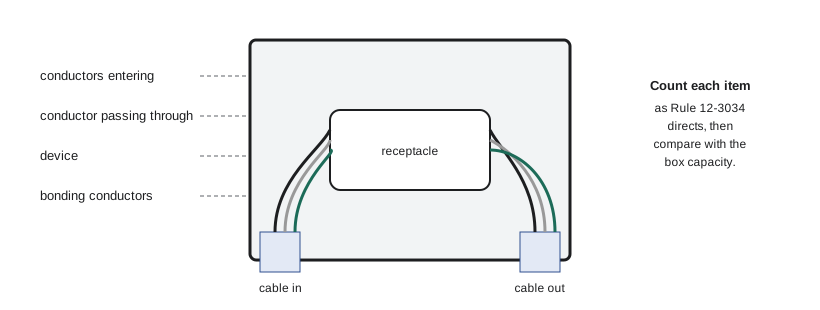
The method has three steps. First, find the box capacity: for standard boxes, the Code's table gives the usable volume of each box size and type; for non-standard boxes, the volume is marked on the box or calculated from its inside dimensions. Second, count the conductors and other items as the rule directs and multiply by the volume allowance for each conductor size, using the largest conductor size where the rule tells you to. Third, compare: the total volume needed must not exceed the box capacity. Extension rings and plaster rings add their own volume when they are marked or listed in the table.
The counting rules are where the marks are. Rule 12-3034 tells you how to count conductors that pass through the box without a splice, conductors that start or end in the box, short pigtails that stay inside the box, wiring devices such as receptacles and switches, cable clamps inside the box and bonding conductors. Each item has its own treatment, and they are not all counted the same way. Read the rule in your own Code and make a counting checklist, because exam questions describe boxes in sentences and expect you to translate each sentence into a count.
| Item in the box | How to treat it on your checklist |
|---|---|
| Each insulated conductor entering and ending or spliced in the box | Count it, at the volume for its size |
| A conductor passing through without a splice | Count it as the rule directs for unbroken conductors |
| Pigtails that do not leave the box | Check whether the rule counts them |
| Each wiring device (receptacle, switch) | Reduce the capacity or count it as conductor equivalents, as the rule directs |
| Internal cable clamps | Check the rule for clamps and fittings |
| Bonding conductors | Check how the rule counts them as a group |
Worked problem
A receptacle box at Aspen Ridge (illustrative values)
A device box holds a receptacle, two 14 AWG two-conductor cables with bonding conductors (one cable feeding in, one continuing on), with the line and neutral of the two cables spliced and pigtailed to the receptacle. Suppose, for this exercise, that the box capacity is 300 cm³, each 14 AWG conductor needs 25 cm³, the receptacle counts as two conductor volumes, the bonding conductors together count as one, and pigtails that stay in the box are not counted. Does it fit?
Show solution
- Insulated conductors entering: 2 cables × 2 = 4 conductors × 25 = 100 cm³.
- Receptacle: 2 × 25 = 50 cm³. Bonding conductors together: 25 cm³. Pigtails: 0.
- Total: 175 cm³, less than the 300 cm³ capacity.
Answer: It fits with these illustrative values. Redo it with your Code's volumes and counting rules.
The example is deliberately simple. On the exam, the boxes are crowded: a three-gang box with switches and a receptacle, conductors of two sizes, a travelling neutral, an extension ring. The method is the same; only the counting gets longer. Priya's habit is to sketch the box, list every conductor and device beside it, and only then turn to the tables.
Conduit fill: the idea
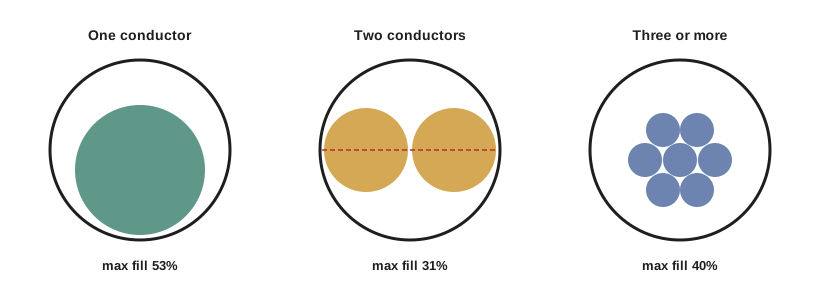
Conduit fill rules limit how much of a raceway's internal area the conductors may occupy. The limit depends on how many conductors there are, because one conductor can fill more of a round conduit than several can without jamming when pulled. The commonly applied limits are 53% of the conduit area for one conductor, 31% for two conductors and 40% for three or more. Two conductors get the lowest limit because two round cables side by side in a round tube can jam across the diameter during a pull.
| Number of conductors | Commonly applied maximum fill |
|---|---|
| 1 | 53% |
| 2 | 31% |
| 3 or more | 40% |
To use the limits, you need the cross-sectional area of each conductor including its insulation, which the Code tabulates by conductor type and size because insulation thickness varies, and the internal area of each trade size of conduit or tubing, which the Code also tabulates by raceway type because walls differ in thickness. Add up the conductor areas, then find the smallest raceway whose allowable fill area is at least that total.
Conduit fill: the method
Worked problem
Feeder conduit at the dental clinic (illustrative values)
A feeder needs four conductors of the same size and insulation type, each with an area of 85 mm² including insulation, plus a bonding conductor of 25 mm². Suppose the internal areas of two candidate trade sizes are 820 mm² and 1340 mm². Which size meets the 40% limit?
Show solution
- Total conductor area: 4 × 85 + 25 = 365 mm².
- Smaller conduit: 40% of 820 = 328 mm², less than 365. Too small.
- Larger conduit: 40% of 1340 = 536 mm², more than 365. It fits.
- Actual fill in the larger conduit: 365 / 1340 = 27%.
Answer: The larger trade size, with these illustrative areas.
Note that the bonding conductor counts in conduit fill, even though it does not count as a current-carrying conductor for ampacity correction. That difference catches people who have just done a lesson 6 question. Conduit fill is about physical space; every conductor in the raceway takes up space.
When all the conductors are the same size and type, some references give a table of the maximum number of conductors per trade size, which saves arithmetic. Your Code's appendix may include such tables, and they are quick to use, but they only apply when every conductor is the same; mixed sizes need the area method.
Long runs and bends
Fill limits are maximums, not targets. A conduit filled to 40% with many bends and a long run may be very hard to pull, and the pulling tension can damage insulation. Section 12 also limits the number of bends between pull points; check that rule in your Code. Good practice, and something examiners sometimes ask about qualitatively, is to stay well below the maximum fill on long or bend-heavy runs and to provide pull boxes where needed. The pull boxes have their own sizing rules, which depend on whether the pull is straight or angled and on the trade size of the largest raceway.
Worked problem
A pull box for a straight pull (illustrative rule)
Suppose a rule required a pull box for a straight pull to be at least 8 times the trade size of the largest raceway in length. For a 2-inch (53 mm) conduit, how long must the box be?
Show solution
- Length ≥ 8 × 53 mm = 424 mm (illustrative multiplier).
Answer: At least 424 mm with this illustrative multiplier; look up the actual multipliers in your Code for straight and angle pulls.
Cables in conduit and cable trays
Exam questions sometimes put a multi-conductor cable inside a conduit, for example a short section of armoured cable sleeved through a wall. For fill purposes, the cable is treated as one conductor with its overall diameter, so the one-conductor limit applies, but its area must be calculated from the overall diameter. Cable trays have their own fill rules in Section 12, based on the tray width and the cable diameters, and they are the subject of the occasional exam question for industrial candidates. Marcus remembers tray fill arguments from oil sands shutdowns; Priya has never filled a tray. Between them they cover both.
A crowded box at the clinic
The Tuesday-night group works one exam-style box together. At the Gaetz Avenue clinic, a three-gang box behind the reception desk holds two switches and a duplex receptacle. Four cables enter: a 12 AWG two-conductor cable feeding the receptacle circuit, a 12 AWG two-conductor cable continuing that circuit to the next outlet, a 14 AWG three-conductor cable feeding the lighting, and a 14 AWG two-conductor switch leg to the lights. Every cable has a bonding conductor, and the receptacle and both switches are bonded with pigtails.
Tyler starts counting conductors and stops at a question: which volume do the devices use, 12 AWG or 14 AWG? Denise sends him back to the rule, because that is precisely the kind of detail Rule 12-3034 settles and examiners test, along with whether the bonding conductors are counted individually or as a group and whether a three-gang box's capacity comes from the table or from adding three single-gang capacities. Once the group has read the rule and filled in their checklists, the count takes two minutes and the comparison with the box capacity takes ten seconds. The time goes into reading, not arithmetic, which is the pattern for every box fill question.
The group's answer, using their own code books, was that the box fitted with room to spare, but only because it was a deep three-gang box. A standard-depth box of the same width would not have held it, and the drawings had called for standard depth. That is a realistic outcome: box fill problems are usually found at rough-in, when the electrician tries to fold everything in and the inspector later counts.
Fill, heat and future capacity
Conduit fill limits are about pulling and space, but heat comes into it too. A conduit filled with many current-carrying conductors needs the ampacity corrections from lesson 6, and a designer often finds it cheaper to use two conduits than to upsize every conductor to make up for the bundling factor. Spare capacity is the other consideration: a feeder conduit filled to the maximum leaves no room for adding a conductor later, while one sized at 25 to 30% fill can take another circuit without a new raceway. Exams do not test spare capacity, but the master electrician running a business pays for it on every renovation.
A small fill calculator
import math

LIMITS = {1: 0.53, 2: 0.31}   # three or more conductors: 0.40

def fill_ok(conductor_areas_mm2, raceway_area_mm2):
    n = len(conductor_areas_mm2)
    limit = LIMITS.get(n, 0.40)
    used = sum(conductor_areas_mm2)
    return used <= limit * raceway_area_mm2, used / raceway_area_mm2, limit

# Illustrative areas only: use your Code's tables for conductor and raceway areas.
feeder = [85, 85, 85, 85, 25]
for size, area in [('trade size A', 820), ('trade size B', 1340)]:
    ok, frac, limit = fill_ok(feeder, area)
    print(f'{size}: fill {frac:.0%}, limit {limit:.0%}', 'OK' if ok else 'too full')

cable_d = 22.0   # overall diameter of a cable in mm (illustrative)
print('One cable area:', round(math.pi * cable_d ** 2 / 4), 'mm2')trade size A: fill 45%, limit 40% too full trade size B: fill 27%, limit 40% OK One cable area: 380 mm2
Exam habits
For box fill: sketch the box, list everything in it, apply the counting rules from your checklist, multiply by the right volumes, and compare with the capacity including any rings. For conduit fill: list every conductor including bonding conductors, use the area for the correct insulation type, choose the fill limit by the number of conductors, and find the smallest raceway that works. In both cases, use the tables for the exact box or raceway type the question names, because a steel box and a non-metallic box of the same nominal size do not have the same capacity, and EMT and rigid conduit of the same trade size do not have the same internal area.
Common mistakes
MistakeApplying the 40% limit to two conductors.
InsteadTwo conductors have the lowest limit; one has the highest.
MistakeLeaving the bonding conductor out of conduit fill.
InsteadEvery conductor in the raceway takes space; bonding conductors count for fill.
MistakeUsing the area of a different insulation type.
InsteadConductor areas depend on insulation; use the row for the type installed.
MistakeIgnoring the device in a box fill count.
InsteadDevices take box volume; apply the rule's treatment for them.
MistakeUsing one raceway type's internal area for another.
InsteadEMT, rigid and PVC of the same trade size have different internal areas.
Summary and key terms
- Rule 12-3034 sets box fill: box capacity must be at least the volume needed for the counted items.
- Counting rules treat conductors, pass-through conductors, devices, clamps and bonding conductors differently.
- Conduit fill limits are commonly 53% for one conductor, 31% for two and 40% for three or more.
- Add conductor areas including insulation and compare with the allowed share of the raceway's internal area.
- Bends, run length and pull boxes have their own rules; fill limits are maximums, not targets.
- Box fill
- The volume taken up by conductors, devices and fittings in a box.
- Trade size
- The nominal size designation of a conduit or tubing.
- Fill
- The share of a raceway's internal area occupied by conductors.
- Pull box
- A box installed to make pulling conductors easier on a long or bent run.
- Pigtail
- A short conductor joining a device to a splice inside a box.
Practice problems
Work each problem on paper first, then reveal the answer to check.
Three conductors of 30 mm² each in a raceway of 250 mm². Is the fill within 40%?
Show answer
90 / 250 = 36%: yes.
Two conductors totalling 70 mm² in a raceway of 200 mm²: within the limit?
Show answer
35% exceeds 31%: no.
Does a bonding conductor count toward conduit fill?
Show answer
Yes.
What is the area of a cable with a 20 mm overall diameter?
Show answer
π × 20² / 4 = 314 mm².
Lesson quiz · 5 questions
Score 60% or more to complete this lesson.
Create a free account to save your progress, take quizzes and earn a certificate.