
ACCT-352 · Lesson 8 of 12 · 24 min
S corporations
S corporations combine the limited liability and corporate form of a state-law corporation with the single level of tax of a partnership, and they are the most common form of corporation in the United States. But they are not partnerships: their eligibility rules are strict, their shareholders get basis only for their stock and for loans they make directly, their allocations must follow share ownership, and a few corporate-level taxes survive. This lesson covers S corporation eligibility and elections, how income passes through, shareholder basis and loss limits, distributions and the accumulated adjustments account, the taxes an S corporation can still owe, and how an election can end, using Brandt Aerial LLC's first year as an S corporation.
Eligibility and the election
A corporation can elect S status only if it is a domestic corporation, is not an ineligible corporation (such as a bank using the reserve method or an insurance company), has no more than 100 shareholders, has as shareholders only individuals who are US citizens or residents, estates, and certain trusts and tax-exempt organizations, and has only one class of stock. Members of a family, up to six generations from a common ancestor, are treated as one shareholder. Differences in voting rights are allowed, so an S corporation can issue voting and nonvoting common shares, but all shares must have identical rights to distributions and liquidation proceeds; the regulations disregard most commercial agreements and straight debt. The election on Form 2553 requires the consent of every shareholder and is due no later than two months and fifteen days after the beginning of the tax year it is to take effect, though the IRS grants relief for late elections with reasonable cause under Revenue Procedure 2013-30. Brandt Aerial LLC filed its election in February 2027, effective from 1 January.
How income passes through
An S corporation generally pays no federal income tax (section 1363). Instead, each shareholder takes into account his pro rata share of the corporation's items for the year (section 1366), computed per share per day, whether or not distributed. Items that could affect shareholders differently are separately stated on Schedule K-1: interest, dividends, capital gains, section 1231 gains, charitable contributions, section 179 deductions, foreign taxes and others; the rest are netted into ordinary business income. The character of each item is determined at the corporate level. An S corporation's ordinary income is qualified business income for its shareholders, and a shareholder who materially participates in the business has active, non-passive income that is also exempt from the net investment income tax. Wages paid to shareholder-employees are deductible by the corporation and reported on Form W-2, and the corporation files Form 1120-S by 15 March for a calendar year.
| Item | Effect on stock basis | Order |
|---|---|---|
| Ordinary income and separately stated income items, including tax-exempt income | Increase | 1 |
| Distributions (not taxable to the extent of basis) | Decrease | 2 |
| Nondeductible, non-capital expenses (fines, half of meals) | Decrease | 3 |
| Losses and deductions | Decrease, then debt basis | 4 |
| Later net income | Restores debt basis before stock basis | Following years |
| Suspended losses | Carried forward until basis is restored | Indefinite (lost on sale of all stock) |
Shareholder basis and loss limits
Each shareholder keeps track of stock basis, which starts with the cash and basis of property contributed (or, for Leah, the $4,000 basis from her section 351 exchange) and is adjusted every year under section 1367 in the order shown in the table. A shareholder who lends money directly to the corporation also has debt basis, equal to the loan's principal. A shareholder can deduct her share of losses only to the extent of stock basis plus debt basis; excess losses are suspended and carried forward indefinitely until basis is restored. Unlike a partner, an S corporation shareholder gets no basis for the corporation's debts to third parties, even if she guarantees them, until she actually pays. Losses that pass the basis test must then pass the at-risk, passive activity and excess business loss limits. Since 2021, shareholders who claim losses, receive distributions, dispose of stock or receive loan repayments must attach Form 7203 to show their basis computation.
Distributions and the accumulated adjustments account
An S corporation that has never been a C corporation, or that has no accumulated earnings and profits from C corporation years, distributes cash or property to shareholders tax-free up to their stock basis, and any excess is capital gain (section 1368(b)). If it has accumulated E&P from C years, distributions come first from the accumulated adjustments account (AAA), which tracks income taxed to shareholders during S years and is tax-free to the extent of basis; then from accumulated E&P as a taxable dividend; then from remaining basis; then as gain. The corporation can elect to distribute E&P first, for example to purge E&P that could cause passive income problems. Because all shares must carry identical distribution rights, distributions must be proportional to stockholding; disproportionate distributions risk being treated as a second class of stock, which would terminate the election. Distributions of appreciated property trigger gain at the corporate level under section 311(b), which passes through to the shareholders.
Taxes an S corporation can owe
Three corporate-level taxes survive. The built-in gains tax of section 1374 applies to a C corporation that converts to S status (or an S corporation that acquires assets from a C corporation in a carryover-basis transaction): if it sells assets during the five-year recognition period after conversion, it pays tax at 21 percent on the net recognized built-in gain, limited to the net unrealized built-in gain at conversion; the gain, net of the tax, also passes through to shareholders. The excess passive income tax of section 1375 applies at 21 percent to excess net passive income if a corporation with accumulated E&P from C years has passive investment income exceeding 25 percent of gross receipts, and three consecutive years of this terminate the election. LIFO recapture applies on conversion of a corporation that used LIFO inventory. An S corporation may also pay state taxes, including an elective pass-through entity tax (lesson 9), and it must withhold and pay employment taxes on wages.
Trusts can hold S corporation stock only in limited forms, which matters for estate planning. A grantor trust, including a revocable living trust, is treated as owned by the grantor, who is the shareholder for S purposes, and it can continue to hold the stock for two years after the grantor's death. A qualified subchapter S trust (QSST) must have only one income beneficiary, a US citizen or resident, to whom all income is distributed; the beneficiary elects QSST status and is taxed on the S corporation income. An electing small business trust (ESBT) can have several beneficiaries and accumulate income, but the trust pays tax on its share of S corporation income at the highest individual rate, 37 percent, and each potential current beneficiary counts toward the 100-shareholder limit and must be eligible. A trust for Nora holding gifted nonvoting shares, discussed in lesson 11, could qualify as a QSST if all of its income must be paid to her, or as an ESBT if the trustee is to have discretion. A trust that fails to qualify terminates the election, so the trust instrument must be drafted with these rules in mind.
Brandt Aerial LLC's first year
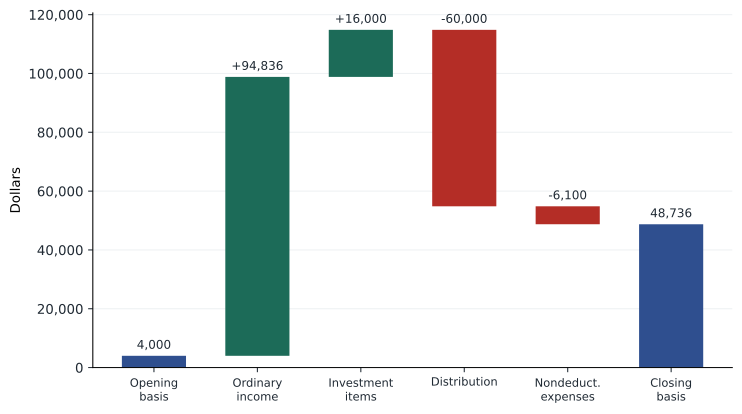
The program computes Leah's stock basis and the corporation's AAA at the end of 2027, the year in which Brandt Aerial LLC passed through $94,836 of ordinary business income, $4,000 of interest, $6,000 of qualified dividends and a $6,000 long-term capital gain, incurred $6,100 of nondeductible expenses and distributed $60,000 to Leah. Leah's opening basis is the $4,000 from her section 351 exchange. The program ignores the Iowa pass-through entity tax, which lesson 9 adds. Because the LLC was never a C corporation, it has no accumulated E&P and owes no built-in gains tax; the last line shows what that tax would be for a converted corporation.
# Brandt Aerial LLC (an S corporation): Leah's stock basis and AAA for 2027 (illustrative)
opening_basis = 4_000                       # from the section 351 deemed contribution
items = {"Ordinary business income (K-1 box 1)": 94_836,
         "Interest income (box 4)": 4_000,
         "Qualified dividends (box 5b)": 6_000,
         "Net long-term capital gain (box 8a)": 6_000}
nondeductible = 3_100 + 2_400 + 600         # meals half, club dues, fines (box 16c)
distributions = 60_000                      # cash Leah takes out in 2027 (box 16d)
basis = opening_basis
print(f"{'Opening stock basis':<44}{basis:>10,.2f}")
for k, v in items.items():
    basis += v
    print(f"  plus {k:<38}{v:>10,.2f}")
basis -= distributions                      # distributions reduce basis before losses
print(f"  less distributions (tax-free up to basis)  {-distributions:>10,.2f}")
basis -= nondeductible
print(f"  less nondeductible expenses                {-nondeductible:>10,.2f}")
print(f"{'Closing stock basis':<44}{basis:>10,.2f}")
aaa = sum(items.values()) - nondeductible - distributions   # AAA also starts at zero
print(f"{'Accumulated adjustments account (AAA)':<44}{aaa:>10,.2f}")
print()
# What if the S corporation had been a C corporation with unrealized gains (built-in gains)?
nubig = 120_000          # net unrealized built-in gain at conversion
sold_gain = 50_000       # built-in gain recognized in year 3 of the 5-year recognition period
print(f"Built-in gains tax at 21% in the recognition period: {0.21 * min(sold_gain, nubig):,.0f}")Opening stock basis 4,000.00 plus Ordinary business income (K-1 box 1) 94,836.00 plus Interest income (box 4) 4,000.00 plus Qualified dividends (box 5b) 6,000.00 plus Net long-term capital gain (box 8a) 6,000.00 less distributions (tax-free up to basis) -60,000.00 less nondeductible expenses -6,100.00 Closing stock basis 48,736.00 Accumulated adjustments account (AAA) 44,736.00 Built-in gains tax at 21% in the recognition period: 10,500
Leah's stock basis rises from $4,000 to $48,736: the pass-through income of $110,836 increases it, the $60,000 distribution reduces it, and the $6,100 of nondeductible expenses reduces it further. Because the distribution did not exceed her basis, it is tax-free; she is taxed instead on the $110,836 of income passed through to her, whether distributed or not. The AAA of $44,736 equals the income less the nondeductible expenses and the distribution, starting from zero; it matters only if the corporation ever acquires accumulated E&P, for example by merging with a C corporation. Had Brandt Aerial been a C corporation that converted to S status with a net unrealized built-in gain of $120,000, a $50,000 built-in gain recognized in the third year after conversion would cost $10,500 of corporate tax.
Terminating the election
An S election ends if the shareholders holding more than half of the shares revoke it, effective on the first day of the year if made by the 15th day of the third month or on a later date specified; if the corporation ceases to qualify, for example by issuing a second class of stock, admitting a partnership, a nonresident alien or a 101st shareholder; or if it has excess passive investment income for three consecutive years while it has accumulated E&P. Termination by disqualification is effective on the day of the terminating event, splitting the year into an S short year and a C short year. A corporation whose election terminates generally cannot re-elect for five years without IRS consent. The IRS can treat an inadvertent termination as not having occurred if the corporation corrects it promptly (section 1362(f)), and does so routinely for problems such as a shareholder trust that missed an election.
Worked problem
A loss year
Suppose Brandt Aerial LLC loses $70,000 in 2028 after losing its utility contract, and Leah lends it $15,000 during 2028 to pay suppliers. Her stock basis at the start of 2028 is $48,736 and the corporation makes no distributions in 2028. How much of the loss can she deduct?
Show solution
- Her stock basis of $48,736 absorbs the first $48,736 of the loss, reducing stock basis to zero.
- Her $15,000 loan gives her debt basis, which absorbs a further $15,000, reducing debt basis to zero.
- Her deductible loss is $63,736; the remaining $6,264 is suspended and carried forward until she restores basis by contributing capital, lending more or receiving future income.
- The deductible loss must still pass the at-risk rules (her stock and direct loan are at risk), the passive activity rules (she materially participates) and the excess business loss limit ($512,000 for joint filers in 2026), so it offsets Tomás's wages and other income.
- Future net income restores her debt basis before her stock basis, and repayment of the loan before debt basis is restored produces taxable gain.
Answer: She deducts $63,736 and carries forward $6,264.
Common mistakes
MistakeThinking a shareholder's guarantee of S corporation debt creates basis.
InsteadOnly loans made directly by the shareholder to the corporation create debt basis.
MistakeMaking disproportionate distributions.
InsteadAll shares must have identical distribution rights; disproportionate distributions risk a second class of stock.
MistakeFiling Form 2553 late without seeking relief.
InsteadRelief for late elections is available under Revenue Procedure 2013-30 if requested properly.
MistakeForgetting the built-in gains tax after a conversion from C status.
InsteadAssets sold within five years of conversion may bear 21 percent corporate tax on built-in gain.
MistakeTreating distributions in excess of basis as tax-free.
InsteadDistributions above stock basis are capital gain.
Summary and key terms
- S corporations need 100 or fewer eligible shareholders and one class of stock; the election is due within 2 months and 15 days.
- Items pass through pro rata per share per day and keep their character.
- Stock basis increases with income and decreases with distributions, nondeductible expenses and losses, in that order.
- Losses are limited to stock and direct debt basis, then the at-risk, passive and excess business loss rules.
- Distributions are tax-free up to basis; AAA matters only with accumulated E&P.
- Built-in gains, excess passive income and LIFO recapture taxes can apply at the corporate level.
- Elections terminate by revocation, disqualification or excess passive income; re-election waits five years.
- Leah's 2027 stock basis ends at $48,736 after a $60,000 tax-free distribution.
- Accumulated adjustments account (AAA)
- An account of income taxed to shareholders during S years, distributable tax-free.
- Stock basis
- A shareholder's basis in S corporation stock, adjusted annually under section 1367.
- Debt basis
- Basis from loans made directly by a shareholder to the S corporation.
- Built-in gains tax
- A 21 percent tax on gains recognized within five years of conversion from C status.
- Excess net passive income
- Passive income that triggers corporate tax when an S corporation has accumulated E&P.
- Form 7203
- The form on which shareholders compute S corporation stock and debt basis.
- Beneficiary
- A person entitled to benefit from property held by a trustee or a corporation's distributions.
Practice problems
Work each problem on paper first, then reveal the answer to check.
A shareholder has stock basis of $10,000 and her share of S corporation income is $30,000. She receives a $35,000 distribution. What is taxable?
Show answer
She is taxed on the $30,000 of income; the distribution is tax-free because basis is $40,000 before it.
Can an S corporation have voting and nonvoting shares?
Show answer
Yes; differences in voting rights alone do not create a second class of stock.
Name two corporate-level taxes an S corporation may owe.
Show answer
For example the built-in gains tax and the excess passive income tax.
Why is Leah's 2027 distribution tax-free?
Show answer
It does not exceed her stock basis after the year's income.
When is Form 1120-S due for a calendar-year corporation?
Show answer
By 15 March.
What happens if an S corporation admits a partnership as a shareholder?
Show answer
Its election terminates on that day.
What order applies to stock basis adjustments?
Show answer
Income items, then distributions, then nondeductible expenses, then losses.
In the loss example, how much of the loss is suspended?
Show answer
$6,264.
Lesson quiz · 5 questions
Score 60% or more to complete this lesson.
Create a free account to save your progress, take quizzes and earn a certificate.