
ACCT-352 · Lesson 10 of 12 · 24 min
International business: cross-border income and the global minimum tax
Even a small US business can find itself operating across borders: a contract in Manitoba, a supplier in Germany, a customer in Japan or an owner who moves abroad. International tax is a large specialty, but every accountant needs its basic framework: how the United States taxes its citizens, residents and domestic corporations on worldwide income, how foreign persons are taxed on US income, how treaties allocate taxing rights, how the foreign tax credit relieves double tax, how income earned through foreign corporations is taxed under the controlled foreign corporation rules as changed by the 2025 act, and how the global minimum tax and the 2026 'side-by-side' agreement affect US multinationals. This lesson covers that framework, with Brandt Aerial LLC's first contract in Canada as the example.
Who is taxed on what
The United States taxes its citizens and residents, and domestic corporations (those created or organized in the United States), on their worldwide income, whatever the source. Unusually, citizenship alone is enough: a US citizen living in Canada remains subject to US tax. Foreign persons are taxed only on US-source income, in two ways. Income effectively connected with a US trade or business (ECI) is taxed on a net basis at the regular rates, and a foreign corporation with a US branch also pays a branch profits tax of 30 percent (reduced by treaty, to 5 percent under the Canada-United States treaty) on earnings it does not reinvest. Fixed, determinable, annual or periodical (FDAP) income, such as dividends, interest, rents and royalties, is taxed at 30 percent of the gross amount by withholding at source, again reduced by treaty.
Treaties and permanent establishments
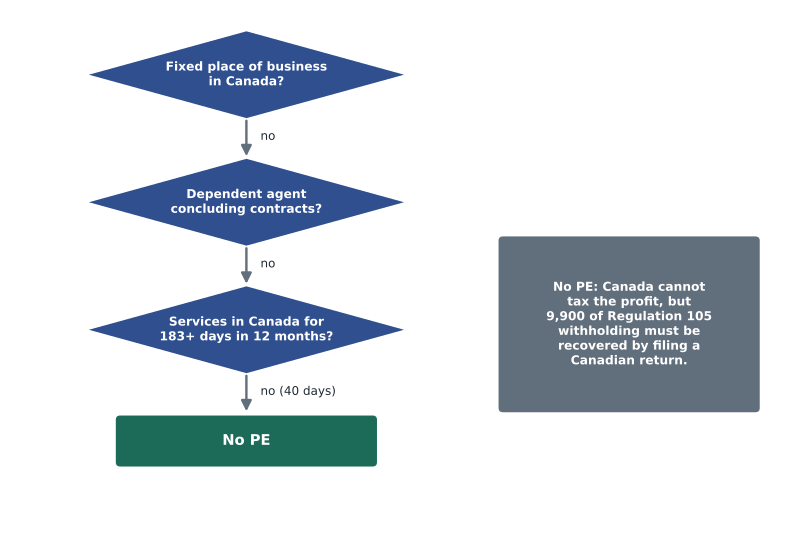
A tax treaty prevents double taxation by allocating taxing rights between the country of residence and the country of source. Under the business profits article (Article VII of the Canada-United States treaty), a resident of one country is taxed by the other on business profits only if they are attributable to a permanent establishment (PE) there: a fixed place of business such as an office, factory or workshop, a construction site lasting more than 12 months, or a dependent agent who habitually concludes contracts. The Canada-United States treaty also has a services PE rule: services performed in the other country by an individual present there for 183 days or more in a 12-month period, or for 183 days or more by the enterprise for the same or connected projects for customers there, can create a PE. Treaties also cap withholding taxes: under that treaty, 5 percent on dividends to a company owning at least 10 percent of the voting stock, 15 percent on other dividends, and generally nil on interest and on many royalties. A limitation on benefits article restricts treaty access to genuine residents.
| Type of payment to a foreign person | Rate without a treaty | Canada-US treaty rate | Note |
|---|---|---|---|
| Dividends to a company owning at least 10% of the votes | 30% | 5% | Article X |
| Other dividends | 30% | 15% | Article X |
| Portfolio interest | Exempt | Nil | Article XI |
| Royalties | 30% | Nil for many types | Article XII |
| Branch profits not reinvested | 30% | 5% | Article X |
| Business profits without a US PE | 30% on FDAP only; ECI taxed at regular rates | Not taxable | Article VII |
The foreign tax credit
A US person can credit foreign income taxes against US tax on the same income under sections 901 and 904, rather than deducting them. The credit is limited to the US tax on foreign-source income, computed separately for categories (baskets) of income such as general, passive, foreign branch and net CFC tested income, so high foreign taxes on one type of income cannot shelter low-taxed income of another. Excess credits carry back one year and forward ten, except in the NCTI basket. Taxes withheld by a foreign country that should not have been, such as Regulation 105 withholding refundable because a treaty exempts the income, are not creditable: the taxpayer must claim the refund from the foreign country. Foreign taxes paid by a partnership or S corporation pass through to the owners, who claim the credit on Form 1116.
Controlled foreign corporations and net CFC tested income
A foreign corporation is a controlled foreign corporation (CFC) if US shareholders, each owning at least 10 percent by vote or value, together own more than 50 percent. US shareholders of a CFC must include certain income currently, whether or not distributed. Subpart F income includes passive income and certain related-party sales and services income. Since 2018, US shareholders have also included global intangible low-taxed income (GILTI), renamed net CFC tested income (NCTI) by the 2025 act for tax years beginning after 2025. The 2025 act also repealed the exclusion for a 10 percent deemed return on tangible assets, so NCTI now covers nearly all active income of CFCs. A corporate US shareholder deducts 40 percent of NCTI under section 250, down from 50 percent, giving an effective rate of 12.6 percent before credits, and can claim a credit for 90 percent of the foreign taxes deemed paid, up from 80 percent. A taxpayer can elect to exclude high-taxed income, taxed abroad at more than 90 percent of the US rate (18.9 percent), from both Subpart F and NCTI. Dividends from 10 percent owned foreign corporations to US C corporations are exempt under the participation exemption of section 245A.
Foreign-derived income, BEAT, transfer pricing and reporting
A domestic C corporation that sells goods or services to foreign customers can deduct part of its foreign-derived deduction eligible income (FDDEI), formerly foreign-derived intangible income: the 2025 act set the section 250 deduction at 33.34 percent from 2026, an effective rate of about 14 percent, and removed the tangible asset return from the computation. S corporations and individuals cannot use it, nor the section 245A participation exemption, a point that can favor C corporations for export-heavy businesses. The base erosion and anti-abuse tax, at 10.5 percent from 2026, applies only to very large corporations. Section 482 lets the IRS reallocate income among related parties to reflect arm's length prices, with penalties for large adjustments unless contemporaneous documentation exists. US persons must file Form 5471 for interests in foreign corporations, Form 8865 for foreign partnerships, Form 8858 for foreign disregarded entities, FinCEN Form 114 (FBAR) for foreign financial accounts exceeding $10,000 in total and Form 8938 for specified foreign assets above thresholds; penalties start at $10,000 per form.
Brandt Aerial LLC's contract in Manitoba
In 2027, Brandt Aerial LLC inspects transmission lines in Manitoba for a Canadian utility, for a $66,000 fee. Its crew is in Canada for 40 days. The program computes the Regulation 105 withholding and tests the treaty's services PE rule, then considers a later year in which the business forms a Canadian subsidiary, a CFC, and checks the high-tax exclusion and the NCTI computation. It ends with the size test for the global minimum tax.
# Brandt Aerial LLC (S corporation) works in Manitoba: withholding, treaty relief and
# controlled foreign corporations (2026 rules; illustrative)
fee, days_in_canada = 66_000, 40
reg105 = 0.15 * fee                    # Canadian withholding on services rendered in Canada
pe = days_in_canada >= 183
print(f"Fee {fee:,}; Regulation 105 withholding 15%: {reg105:,.0f}")
print(f"Days in Canada {days_in_canada}: Canadian PE under the treaty? {pe}")
print("No PE: file a Canadian return to recover the withholding; no Canadian tax remains,")
print("so there is no foreign tax credit to claim on the US return.")
print()
# Later Brandt Aerial forms a Canadian subsidiary, a controlled foreign corporation (CFC)
profit, cdn_rate = 100_000, 0.27       # general Canadian corporate rate in Manitoba
foreign_tax = cdn_rate * profit
effective = foreign_tax / profit
high_tax_threshold = 0.90 * 0.21      # high-tax exception: foreign rate above 18.9%
print(f"Canadian subsidiary profit {profit:,}; Canadian tax {foreign_tax:,.0f} ({effective:.0%})")
print(f"High-tax exclusion available (rate above {high_tax_threshold:.1%})? {effective > high_tax_threshold}")
# Without the election: net CFC tested income for a corporate US shareholder
deduction = 0.40                       # section 250 deduction for NCTI from 2026
us_rate_on_ncti = 0.21 * (1 - deduction)
print(f"Effective US rate on NCTI for a C corporation: {us_rate_on_ncti:.1%} before credits")
credit_allowed = 0.90 * foreign_tax    # 90% of foreign taxes deemed paid from 2026
residual = max(0.0, 0.21 * (1 - deduction) * profit - credit_allowed)
print(f"Residual US tax after 90% deemed-paid credit: {residual:,.0f}")
print()
for g, revenue_eur in (("Brandt Aerial", 0.6e6), ("A multinational group", 2_000e6)):
print(f"{g:<22} revenue EUR {revenue_eur:>15,.0f}: within Pillar Two? {revenue_eur >= 750e6}")Fee 66,000; Regulation 105 withholding 15%: 9,900 Days in Canada 40: Canadian PE under the treaty? False No PE: file a Canadian return to recover the withholding; no Canadian tax remains, so there is no foreign tax credit to claim on the US return. Canadian subsidiary profit 100,000; Canadian tax 27,000 (27%) High-tax exclusion available (rate above 18.9%)? True Effective US rate on NCTI for a C corporation: 12.6% before credits Residual US tax after 90% deemed-paid credit: 0 Brandt Aerial revenue EUR 600,000: within Pillar Two? False A multinational group revenue EUR 2,000,000,000: within Pillar Two? True
The Canadian utility must withhold 15 percent of the $66,000 fee, $9,900, under Regulation 105, because the services were rendered in Canada, unless Brandt Aerial obtains a waiver in advance by showing that the treaty exempts the income. Forty days is far below the 183-day threshold and the business has no fixed place of business in Canada, so it has no PE and Canada cannot tax the profit. Brandt Aerial must file a Canadian return to recover the withholding, and because the Canadian tax is refundable, it is not a creditable foreign tax for Leah. If the business later forms a Canadian subsidiary earning $100,000 and paying Canadian tax at Manitoba's 27 percent general rate, the income is high-taxed and can be excluded from NCTI by election; even without the election, a C corporation shareholder would owe no residual US tax after the 90 percent deemed-paid credit. An S corporation shareholder, such as Leah, would include NCTI at individual rates without the deemed-paid credit unless she made a section 962 election or the high-tax exclusion applied, which is why the high-tax exclusion matters to S corporations with foreign subsidiaries.
The global minimum tax
The OECD/G20 Inclusive Framework's Pillar Two establishes a global minimum tax of 15 percent on the profits of multinational groups with consolidated revenue of at least €750 million, implemented through qualified domestic minimum top-up taxes, an income inclusion rule and an undertaxed profits rule. The United States did not adopt Pillar Two, and in June 2025 the G7 issued a statement supporting a 'side-by-side' approach that would exempt US-parented groups from the IIR and UTPR in recognition of US minimum taxes such as NCTI, after which a proposed retaliatory tax (section 899) was dropped from the 2025 act. On 5 January 2026, the Inclusive Framework agreed on the package: groups whose ultimate parent is in a jurisdiction with a qualified side-by-side regime, so far only the United States, are exempt from the IIR and UTPR for fiscal years beginning on or after 1 January 2026, if they elect the safe harbor, but remain subject to QDMTTs in the countries where they operate; the package also added a simplified effective tax rate safe harbor and a substance-based tax incentive safe harbor. US-parented groups remained fully subject to the rules for 2024 and 2025. None of this affects Brandt Aerial, but it affects every US multinational and its advisers.
Worked problem
Paying dividends from a Canadian subsidiary
Suppose the Canadian subsidiary in the program pays its $73,000 of after-tax profit to Brandt Aerial LLC as a dividend. The S corporation owns 100 percent of it, and the high-tax exclusion applied to its earnings. How is the dividend taxed?
Show solution
- The S corporation is not a C corporation, so it cannot use the section 245A participation exemption.
- Because the earnings were excluded from NCTI and Subpart F, they have not been previously taxed, and the dividend is taxable to Leah through the S corporation as a dividend.
- Canada is a treaty country, so it is a qualified dividend, taxed at 15 percent at the Brandts' income level.
- Canada withholds tax on the dividend, 5 percent under the treaty if the S corporation is treated as a company owning at least 10 percent of the votes, which passes through to Leah as a creditable foreign tax.
- The combined burden of 27 percent Canadian corporate tax, withholding and US dividend tax shows why US owners of foreign subsidiaries model the structure carefully before investing.
Answer: Taxable to Leah as a qualified dividend, with a credit for Canadian withholding tax.
Common mistakes
MistakeAssuming a US citizen living abroad owes no US tax.
InsteadCitizens are taxed on worldwide income wherever they live.
MistakeClaiming a foreign tax credit for refundable foreign withholding.
InsteadOnly compulsory, non-refundable foreign taxes are creditable.
MistakeAssuming S corporations get the same CFC benefits as C corporations.
InsteadS corporations cannot use section 245A, FDDEI or the corporate deemed-paid credit without a section 962 election.
MistakeMissing Form 5471 or FBAR filings.
InsteadPenalties start at $10,000 per form even when no tax is owed.
MistakeAssuming the side-by-side package removes all Pillar Two taxes for US groups.
InsteadQDMTTs in other countries still apply.
Summary and key terms
- US citizens, residents and domestic corporations are taxed on worldwide income.
- Foreign persons pay regular tax on ECI and 30 percent withholding on FDAP income, reduced by treaty.
- The foreign tax credit is limited by basket to US tax on foreign-source income.
- NCTI replaces GILTI from 2026: no QBAI exclusion, 40 percent deduction, 90 percent credit.
- High-taxed income can be excluded from NCTI and Subpart F.
- FDDEI and section 245A benefit C corporations only; BEAT is 10.5 percent from 2026.
- The 2026 side-by-side package exempts US-parented groups from the IIR and UTPR, but not QDMTTs.
- Brandt Aerial LLC has no Canadian PE but must recover $9,900 of Regulation 105 withholding.
- Effectively connected income (ECI)
- Income of a foreign person connected with a US trade or business, taxed at regular rates.
- FDAP income
- Fixed, determinable, annual or periodical income of foreign persons, subject to 30 percent withholding.
- Controlled foreign corporation (CFC)
- A foreign corporation more than 50 percent owned by US shareholders each owning at least 10 percent.
- Net CFC tested income (NCTI)
- The successor to GILTI from 2026, included currently by US shareholders of CFCs.
- FDDEI
- Foreign-derived deduction eligible income, whose deduction gives C corporations an effective 14 percent rate on export income.
- Section 962 election
- An election by an individual to be taxed like a corporation on CFC inclusions.
- Permanent establishment (PE)
- A fixed place of business or other presence through which an enterprise carries on business in a treaty country.
- Pillar Two
- The OECD/G20 global minimum tax of 15 percent for large multinational groups.
Practice problems
Work each problem on paper first, then reveal the answer to check.
A Canadian corporation receives $10,000 of dividends from a US company it owns 2 percent of. What US withholding applies?
Show answer
15 percent under the treaty, $1,500.
Why is Regulation 105 withholding not creditable for Leah?
Show answer
It is refundable because the treaty exempts the profit; she must claim the refund in Canada.
What is the effective US rate on NCTI for a C corporation from 2026, before credits?
Show answer
21% × (1 − 40%) = 12.6 percent.
What foreign tax rate makes income eligible for the high-tax exclusion?
Show answer
More than 18.9 percent (90 percent of 21 percent).
When must a US person file an FBAR?
Show answer
When foreign financial accounts total more than $10,000 at any time in the year.
Which entities can claim FDDEI?
Show answer
Domestic C corporations only.
What did the 5 January 2026 side-by-side package do?
Show answer
Exempted groups parented in qualified jurisdictions (the US) from the IIR and UTPR from 2026, while QDMTTs still apply.
In the program, what is the residual US tax on NCTI for a C corporation shareholder?
Show answer
Nil, because the 90 percent credit exceeds the US tax.
Lesson quiz · 5 questions
Score 60% or more to complete this lesson.
Create a free account to save your progress, take quizzes and earn a certificate.