
ACCT-352 · Lesson 7 of 12 · 23 min
Partnerships and LLCs
Partnerships, including most LLCs with two or more members, are the most flexible business entities in US tax law. Subchapter K treats a partnership partly as an aggregate of its partners, who are taxed on its income, and partly as an entity that computes its own income, makes elections and owns property with its own basis. The result is a sophisticated set of rules about contributions, allocations, debt, distributions and sales of interests. This lesson works through them using SkyGrid Data LLC, the two-member LLC that Leah and Dev Mehta formed in 2027 to process aerial survey data, which is taxed as a partnership by default.
Partnership classification and tax year
Under the check-the-box regulations, an unincorporated business entity with two or more owners is a partnership unless it elects to be taxed as a corporation. That includes general partnerships, limited partnerships, limited liability partnerships and multi-member LLCs. Publicly traded partnerships are generally taxed as corporations unless 90 percent of their income is qualifying passive or natural resource income. A partnership's tax year is determined by its partners: generally the tax year of the partners who own a majority of the interests, otherwise that of all its principal partners (those owning 5 percent or more), otherwise the year that produces the least aggregate deferral. Because Leah and Dev both use the calendar year, SkyGrid Data LLC must too. A partnership can adopt a different year only with a business purpose or by a section 444 election that requires a deposit to offset the deferral.
Forming a partnership: section 721
Section 721 provides that no gain or loss is recognized when partners contribute property to a partnership in exchange for an interest in it. Unlike section 351, there is no control requirement, so new partners can contribute property tax-free at any time. The contributing partner's basis in the interest (outside basis) equals the cash plus the adjusted basis of the property contributed (section 722), and the partnership's basis in the property (inside basis) equals the partner's basis (section 723); holding periods tack. Section 704(c) requires that built-in gain or loss on contributed property be allocated to the contributing partner when it is recognized, and that depreciation be allocated so as to account for the difference between book value and tax basis, using the traditional, curative or remedial method. A partner who receives an interest in exchange for services is taxed on the value of a capital interest, but under Revenue Procedure 93-27 the receipt of a profits interest, a right only to future profits and appreciation, is generally not taxable.
Operations: distributive shares, allocations and guaranteed payments
The partnership computes its income on Form 1065 and gives each partner a Schedule K-1 showing its distributive share of ordinary business income and of separately stated items that might affect partners differently, such as capital gains, section 1231 gains, dividends, interest, charitable contributions, section 179 deductions and foreign taxes (section 702). The partnership agreement determines the shares; under section 704(b) allocations are respected if they have substantial economic effect, which in practice means capital accounts kept under the regulations, liquidating distributions made in accordance with positive capital accounts, and a deficit restoration obligation or a qualified income offset. Otherwise items are allocated according to the partners' interests in the partnership. Payments to a partner for services or the use of capital that are determined without regard to partnership income are guaranteed payments under section 707(c): the partnership deducts them and the partner reports them as ordinary income, subject to self-employment tax, even if the partnership has a loss.
| Adjustment to outside basis | Effect | Section |
|---|---|---|
| Cash and adjusted basis of property contributed | Increase | 722 |
| Distributive share of income, including tax-exempt income | Increase | 705 |
| Increase in share of partnership liabilities | Increase (deemed contribution) | 752(a) |
| Distributions of cash and basis of property distributed | Decrease (not below zero) | 733 |
| Decrease in share of liabilities | Decrease (deemed distribution) | 752(b) |
| Distributive share of losses and nondeductible expenses | Decrease (losses limited to basis) | 705, 704(d) |
Partnership liabilities and loss limits
Under section 752, an increase in a partner's share of partnership liabilities is treated as a contribution of money, increasing outside basis, and a decrease as a distribution. Recourse liabilities are allocated to the partners who bear the economic risk of loss, as when they guarantee a loan; nonrecourse liabilities are allocated mainly in proportion to profits. Including debt in basis lets partners deduct losses financed by borrowing, a major advantage over S corporations, whose shareholders get basis only for loans they make personally. A partner's losses are limited first to outside basis (section 704(d)), then to the amount at risk (section 465, which generally excludes nonrecourse debt except qualified real estate financing), then by the passive activity rules (section 469) if the partner does not materially participate, and finally by the excess business loss limit (section 461(l)), which the 2025 act made permanent.
SkyGrid Data LLC's 2027 results
Leah contributes $30,000 of cash to SkyGrid Data LLC. Dev contributes servers and software with a fair market value of $30,000 and an adjusted basis of $12,000, so section 704(c) will allocate the first $18,000 of built-in gain, and the related depreciation differences, to him. The operating agreement pays Dev a guaranteed payment of $24,000 a year for his full-time work and splits everything else equally. In 2027 the LLC earns $70,000 of ordinary income before the guaranteed payment. It borrows $20,000 from a bank, guaranteed equally by both members, and distributes $8,000 to Leah.
# SkyGrid Data LLC, taxed as a partnership: Leah and Dev Mehta, 2027 (illustrative)
contrib = {"Leah": {"fmv": 30_000, "basis": 30_000},
           "Dev":  {"fmv": 30_000, "basis": 12_000}}   # servers and software; s. 704(c) gain 18,000
ordinary_before_gp = 70_000
guaranteed = {"Dev": 24_000}                            # s. 707(c), deductible by the partnership
ordinary = ordinary_before_gp - sum(guaranteed.values())
share = {"Leah": ordinary / 2, "Dev": ordinary / 2}
loan = 20_000                                            # recourse loan guaranteed equally
liab_share = {"Leah": loan / 2, "Dev": loan / 2}         # s. 752: adds to outside basis
dist = {"Leah": 8_000, "Dev": 0}
print(f"Ordinary business income after guaranteed payments: {ordinary:,}")
for p in ("Leah", "Dev"):
    outside = contrib[p]["basis"] + liab_share[p] + share[p] - dist[p]
    se_income = share[p] + guaranteed.get(p, 0)
    se_tax = 0.153 * 0.9235 * se_income
    print(f"{p:<5} K-1 ordinary {share[p]:>8,.0f}  guaranteed pmt {guaranteed.get(p, 0):>7,}"
          f"  outside basis {outside:>8,.0f}  SE tax {se_tax:>8,.2f}")
print(f"Built-in gain on Dev's contribution tracked under s. 704(c): {30_000 - 12_000:,}")
inside_basis = 30_000 + 12_000
print(f"Partnership's inside basis in contributed property: {inside_basis:,}")Ordinary business income after guaranteed payments: 46,000 Leah K-1 ordinary 23,000 guaranteed pmt 0 outside basis 55,000 SE tax 3,249.80 Dev K-1 ordinary 23,000 guaranteed pmt 24,000 outside basis 45,000 SE tax 6,640.89 Built-in gain on Dev's contribution tracked under s. 704(c): 18,000 Partnership's inside basis in contributed property: 42,000
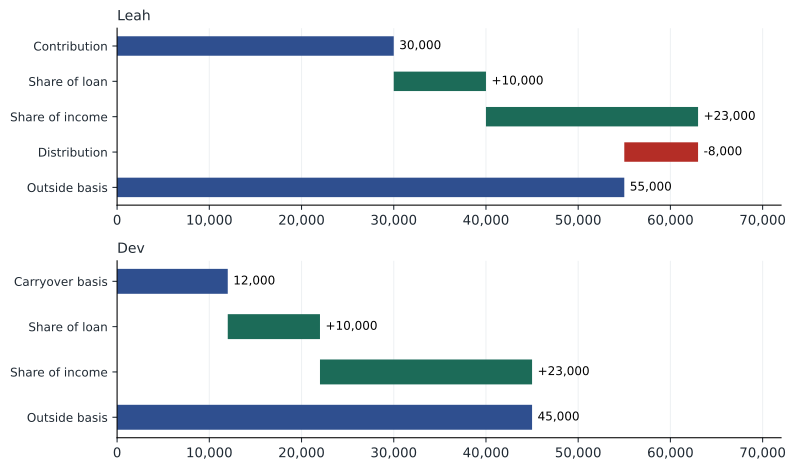
After the $24,000 guaranteed payment, SkyGrid Data LLC's ordinary business income is $46,000, so each member's Schedule K-1 shows $23,000. Dev also reports the guaranteed payment as ordinary income. Leah's outside basis is $55,000: her $30,000 contribution, her $10,000 share of the guaranteed loan and her $23,000 share of income, less the $8,000 distribution. Dev's is $45,000: his $12,000 carryover basis, $10,000 of debt and $23,000 of income. The guaranteed payment does not increase his basis because he received it in cash. Both members are active, so both pay self-employment tax: Leah $3,249.80 on her share, and Dev $6,640.89 on his share plus the guaranteed payment. Their shares of ordinary income, but not the guaranteed payment, are qualified business income. The partnership's inside basis in the contributed property is $42,000.
Distributions and sales of interests
Distributions are generally tax-free under section 731: a partner recognizes gain only if cash distributed (including a reduction in its share of liabilities) exceeds its outside basis, and recognizes loss only on a liquidating distribution of only cash, receivables and inventory. Property distributed takes a carryover basis, limited to the partner's outside basis. Section 751(b) and section 737 add complexity when distributions shift ordinary income assets among partners or when property is distributed within seven years of a contribution of built-in gain property. A partner who sells an interest recognizes capital gain or loss under section 741, except that the part of the price attributable to unrealized receivables and inventory, the 'hot assets' of section 751(a), is ordinary income. The buyer can get a basis adjustment to its share of partnership property under section 743(b) if the partnership has made a section 754 election, which is mandatory where there is a substantial built-in loss.
Self-employment tax, audits and reporting
General partners pay self-employment tax on their distributive shares of ordinary income and guaranteed payments; limited partners are exempt on their shares, though not on guaranteed payments for services, under section 1402(a)(13). The status of LLC members has never been settled by regulation, and courts have recently disagreed about whether the limited partner exception depends on state-law status or on a functional analysis of what the partner does, so members who manage or work in the business should expect to pay it. Partnerships are audited under the centralized regime enacted in 2015 and effective from 2018: the IRS deals with a partnership representative and can assess an imputed underpayment at the partnership level, unless the partnership elects to push adjustments out to its partners. A partnership with 100 or fewer eligible partners, such as individuals and C or S corporations, can elect out annually. Form 1065 is due on 15 March for calendar-year partnerships, with a six-month extension available, and late filing penalties are assessed per partner per month.
Why would Leah and Dev choose a partnership rather than a second S corporation for SkyGrid Data? A partnership let Dev contribute his appreciated servers and software tax-free without meeting an 80 percent control test, lets the members include the bank loan in their outside basis, allows Dev a guaranteed payment that reflects his full-time work without affecting the 50/50 split of other income, and could admit an investor with a preferred return or special allocations that an S corporation's single class of stock would not permit. The costs are self-employment tax on both members' shares of ordinary income, more complex accounting for capital accounts and section 704(c) allocations, and, if an investor joins, the centralized audit regime. If SkyGrid Data becomes highly profitable, the members could later elect S status for the LLC (if all members are eligible shareholders and the agreement is amended to give identical distribution rights) to reduce self-employment tax, or contribute their interests to a corporation under section 351. Both the partnership's ordinary income and an S corporation's would be qualified business income, so the QBI deduction does not favor one over the other, but guaranteed payments, like wages, are not QBI.
Worked problem
Leah sells her interest
At the start of 2030, Leah sells her interest in SkyGrid Data LLC to a new investor for $80,000 of cash. Her outside basis, including her $10,000 share of the bank loan, is $55,000, and her share of the partnership's unrealized receivables (cash-method receivables) is $6,000. What does she report?
Show solution
- Her amount realized includes the $80,000 cash plus relief from her $10,000 share of the liability: $90,000.
- Her total gain is $90,000 − $55,000 = $35,000.
- Under section 751(a), $6,000, the part attributable to unrealized receivables, is ordinary income.
- The remaining $29,000 is long-term capital gain under section 741, since she has held the interest more than a year.
- If SkyGrid Data LLC has a section 754 election in effect, the buyer gets a section 743(b) adjustment to its share of the partnership's assets.
Answer: $6,000 of ordinary income and $29,000 of long-term capital gain.
Common mistakes
MistakeLeaving liabilities out of outside basis.
InsteadA partner's share of partnership liabilities is part of outside basis under section 752.
MistakeTreating guaranteed payments as part of the distributive share.
InsteadGuaranteed payments are deductible by the partnership, ordinary income to the partner and not QBI.
MistakeAssuming a distribution of cash is always tax-free.
InsteadCash, including reductions in liabilities, in excess of outside basis produces gain.
MistakeIgnoring section 704(c) for contributed property.
InsteadBuilt-in gain on contributed property must be allocated to the contributing partner.
MistakeMissing the section 751 hot asset rules on a sale.
InsteadPart of the gain attributable to receivables and inventory is ordinary income.
Summary and key terms
- Multi-member LLCs and partnerships file Form 1065; partners report K-1 shares.
- Section 721 allows tax-free contributions with no control requirement.
- Allocations must have substantial economic effect under section 704(b).
- Outside basis includes a share of partnership liabilities.
- Losses are limited by basis, at-risk, passive activity and excess business loss rules.
- Guaranteed payments are deductible to the partnership and ordinary income to the partner.
- Section 751 makes part of the gain on a sale of an interest ordinary income.
- In 2027, Leah's K-1 shows $23,000 and her outside basis is $55,000.
- Outside basis
- A partner's basis in its partnership interest.
- Inside basis
- The partnership's basis in its assets.
- Distributive share
- A partner's share of partnership income, gain, loss and deduction.
- Guaranteed payment
- A payment to a partner for services or capital determined without regard to partnership income.
- Substantial economic effect
- The test that partnership allocations must meet to be respected under section 704(b).
- Hot assets
- Unrealized receivables and inventory, whose share of gain on a sale of an interest is ordinary under section 751.
- Partnership interest
- A partner's ownership interest in a partnership, treated as a capital asset.
Practice problems
Work each problem on paper first, then reveal the answer to check.
A partner contributes property with a basis of $20,000 and FMV of $50,000 and is allocated $10,000 of partnership debt. What is the outside basis?
Show answer
$20,000 + $10,000 = $30,000.
Why is Dev's guaranteed payment not added to his outside basis?
Show answer
He received it in cash; it is income but not an undistributed share.
A partner with outside basis of $12,000 receives a cash distribution of $15,000. What happens?
Show answer
She recognizes a $3,000 gain.
When are partnership allocations respected?
Show answer
When they have substantial economic effect, or accord with the partners' interests in the partnership.
When is Form 1065 due for a calendar-year partnership?
Show answer
15 March, with a six-month extension available.
Who pays self-employment tax on SkyGrid Data LLC's income?
Show answer
Both active members, on their shares and Dev on his guaranteed payment.
Which loss limits apply to a partner, in order?
Show answer
Basis, at-risk, passive activity and excess business loss.
In the example, how much of Leah's gain is ordinary income?
Show answer
$6,000.
Lesson quiz · 5 questions
Score 60% or more to complete this lesson.
Create a free account to save your progress, take quizzes and earn a certificate.