
ACCT-352 · Lesson 6 of 12 · 23 min
Forming, reorganizing and liquidating corporations
When Leah moved her sole proprietorship into a corporation, she transferred appreciated property, equipment and goodwill, in exchange for stock. A sale of the same property would be taxable, but section 351 lets owners incorporate a business without recognizing gain, on the theory that they have merely changed the form of their investment. Similar non-recognition rules apply to tax-free reorganizations under section 368 and to the liquidation of a subsidiary into its parent. This lesson covers forming a corporation under section 351, the capital structure choice between debt and equity, the taxation of complete liquidations, the main types of reorganization and the choice between selling stock and selling assets when a business is sold.
Section 351: forming a corporation
Section 351 provides that no gain or loss is recognized when one or more persons transfer property to a corporation solely in exchange for its stock if, immediately after the exchange, the transferors are in control of the corporation. Control, defined in section 368(c), means owning at least 80 percent of the total combined voting power and at least 80 percent of the shares of each other class. Property includes cash, equipment, real estate, inventory, receivables and intangibles such as goodwill, but not services: a person who receives stock for services is taxed on its value as compensation, and is not counted as a transferor of property unless he also transfers property of more than nominal value. When an LLC that has been disregarded elects to be taxed as a corporation, as Brandt Aerial LLC did, the regulations treat the owner as contributing the LLC's assets and liabilities to a new corporation in exchange for its stock, and section 351 applies to that deemed exchange.
Boot, liabilities and basis
A transferor who receives money or other property besides stock, called boot, recognizes gain (but not loss) up to the amount of boot received, under section 351(b); the character of the gain depends on the assets transferred, so boot allocated to equipment produces section 1245 recapture. The corporation's assumption of the transferor's liabilities is generally not boot (section 357(a)), with two exceptions: if the principal purpose of the assumption was tax avoidance or lacked a business purpose, all of the liabilities are boot (357(b)); and if the liabilities assumed exceed the total adjusted basis of the property transferred, the excess is gain (357(c)). The transferor's basis in the stock is the basis of the property transferred, decreased by boot and liabilities assumed and increased by gain recognized (section 358). The corporation's basis in the property is the transferor's basis plus any gain recognized (section 362), and both parties tack the transferor's holding period for capital and section 1231 assets.
| Rule | Result | Section |
|---|---|---|
| Control test | Transferors of property own at least 80% of votes and 80% of each other class | 351(a), 368(c) |
| Boot received | Gain recognized up to the boot (no loss) | 351(b) |
| Liabilities assumed | Not boot, unless tax avoidance or in excess of basis | 357(a), (b), (c) |
| Shareholder's stock basis | Basis of property − boot − liabilities + gain recognized | 358 |
| Corporation's asset basis | Transferor's basis + gain recognized | 362 |
| Stock issued for services | Ordinary income; services are not property | 351(d), 83 |
| Built-in losses imported | Basis limited to FMV unless the shareholder elects to reduce stock basis | 362(e)(2) |
Debt or equity?
A corporation's owners can finance it with stock or with loans. Interest on debt is deductible by the corporation (subject to section 163(j) for larger businesses) and repayment of principal is tax-free to the lender, while dividends are not deductible and are taxable to the extent of E&P. Owners of closely held corporations are therefore tempted to lend rather than invest, but if the 'debt' looks like equity (no fixed maturity, interest payable only from profits, subordination to all other creditors, a high debt-to-equity ratio, or advances in proportion to stockholdings), the IRS can reclassify it, denying the interest deduction and treating repayments as distributions. Equity also has an advantage for small businesses: under section 1244, an individual who is an original holder of small business corporation stock can deduct a loss on it as an ordinary loss up to $50,000 a year ($100,000 on a joint return), rather than as a capital loss limited to $3,000 a year against ordinary income.
Leah's section 351 exchange
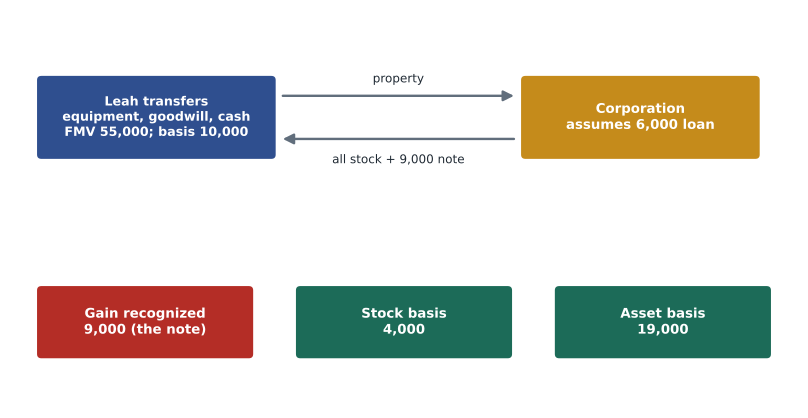
The program applies section 351 to the deemed contribution of Leah's sole proprietorship assets: drone equipment worth $14,000 with an adjusted basis of $9,000, goodwill worth $40,000 with no basis, and $1,000 of cash. The corporation assumes a $6,000 equipment loan and gives Leah a $9,000 note as well as all of its stock. The last lines look ten years ahead and compare selling the business, by having the corporation sell its assets and liquidate, as a C corporation and as an S corporation.
# Leah's assets move into a corporation: section 351 (illustrative figures)
assets = {"Drone equipment": (14_000, 9_000), "Goodwill": (40_000, 0), "Cash": (1_000, 1_000)}
liability_assumed = 6_000          # equipment loan taken over by the corporation
boot_note = 9_000                  # corporate note Leah receives besides 100% of the stock
fmv = sum(v for v, b in assets.values())
basis = sum(b for v, b in assets.values())
realized = fmv - basis
recognized = min(realized, boot_note)          # boot triggers gain up to the realized gain
excess_liab = max(0, liability_assumed - basis)   # s. 357(c)
stock_basis = basis - liability_assumed - boot_note + recognized + excess_liab
corp_basis = basis + recognized + excess_liab
print(f"FMV of property {fmv:,}; Leah's basis {basis:,}; realized gain {realized:,}")
print(f"Gain recognized because of the note (boot): {recognized:,}")
print(f"Liabilities in excess of basis (s. 357(c)): {excess_liab:,}")
print(f"Leah's basis in her stock:                   {stock_basis:,}")
print(f"Corporation's basis in the assets:           {corp_basis:,}")
print(f"Gain deferred in Leah's stock: {fmv - liability_assumed - boot_note - stock_basis:,}")
print()
# Ten years later: selling the business by liquidating a C corporation vs an S corporation
asset_fmv, asset_basis, sh_basis = 600_000, 250_000, 4_000
corp_gain = asset_fmv - asset_basis
c_tax = 0.21 * corp_gain
c_cash = asset_fmv - c_tax
c_sh_tax = 0.238 * (c_cash - sh_basis)         # 20% plus 3.8% NIIT on the liquidation gain
s_sh_tax = 0.20 * corp_gain                    # passes through once; no NIIT for an active owner (simplified)
print(f"C corporation: corporate tax {c_tax:,.0f} + shareholder tax {c_sh_tax:,.0f} = {c_tax + c_sh_tax:,.0f}")
print(f"S corporation: gain taxed once to Leah, about {s_sh_tax:,.0f}")FMV of property 55,000; Leah's basis 10,000; realized gain 45,000 Gain recognized because of the note (boot): 9,000 Liabilities in excess of basis (s. 357(c)): 0 Leah's basis in her stock: 4,000 Corporation's basis in the assets: 19,000 Gain deferred in Leah's stock: 36,000 C corporation: corporate tax 73,500 + shareholder tax 124,355 = 197,855 S corporation: gain taxed once to Leah, about 70,000
Leah realizes a $45,000 gain on the exchange but recognizes only $9,000, the boot. The $6,000 liability is not boot and does not exceed her $10,000 basis, so section 357(c) does not apply. Her stock basis is $10,000 − $6,000 − $9,000 + $9,000 = $4,000, and the corporation's basis in the assets is $10,000 + $9,000 = $19,000. The remaining $36,000 of gain is deferred in her stock. The second part shows why the entity matters at exit. If a C corporation sells assets worth $600,000 with a basis of $250,000 and liquidates, it pays $73,500 of corporate tax and Leah pays $124,355 on her liquidation gain, nearly $198,000 in total; through an S corporation, the gain passes through once and costs about $70,000 at the 20 percent rate (ignoring recapture taxed at ordinary rates).
Liquidations
In a complete liquidation, the corporation distributes all of its assets to its shareholders and dissolves. Under section 336, the corporation recognizes gain or loss as if it had sold each asset at fair market value (with limits on losses from property distributed to related persons or recently contributed with built-in losses). Under section 331, the shareholders treat the distribution as full payment for their stock and recognize capital gain or loss equal to the value received minus their stock basis. Assets received take a fair market value basis. A liquidation of a C corporation therefore produces two levels of tax. The exception is the liquidation of an 80 percent subsidiary into its parent corporation, which is tax-free to both under sections 332 and 337, with the parent taking the subsidiary's basis and tax attributes, such as NOLs, under sections 334(b) and 381.
Tax-free reorganizations
Section 368 lists the transactions that qualify as tax-free reorganizations: a statutory merger or consolidation (type A); an acquisition of a target's stock solely for voting stock of the acquirer (type B); an acquisition of substantially all of a target's assets for voting stock (type C); transfers of assets to a controlled corporation followed by distribution of its stock, which include spin-offs, split-offs and split-ups (type D, with section 355); a recapitalization (type E); a mere change in identity, form or place of organization (type F); and a bankruptcy reorganization (type G). Beyond the statutory definitions, judicial doctrines require continuity of interest (the target's shareholders must receive a substantial equity stake in the acquirer), continuity of business enterprise and a business purpose. Shareholders who exchange stock in a reorganization recognize gain only to the extent of boot (sections 354 and 356); the corporations recognize no gain (section 361); and bases carry over.
Selling a business: stock or assets
When a business is sold, the buyer and seller must decide whether to transfer stock or assets. Sellers of a C corporation usually prefer a stock sale, which produces a single level of tax at capital gain rates, possibly reduced by section 1202. Buyers usually prefer to buy assets, which gives them a cost basis for depreciation and amortization, including 15-year amortization of goodwill under section 197, and leaves the target's liabilities behind. For a C corporation, an asset sale followed by liquidation means double tax, so the price must compensate. For an S corporation, an asset sale is taxed once to the shareholders, though part of the gain may be ordinary recapture; and the parties can often get asset treatment for a stock sale by a joint election under section 338(h)(10) or section 336(e), which treats the S corporation as selling its assets and liquidating. Allocation of the price among asset classes, reported by both parties on Form 8594, determines how much is ordinary income and how much capital gain.
Worked problem
Forming a corporation with a service partner
Leah and Dev form a new corporation. Leah transfers equipment worth $75,000 with a basis of $30,000 for 75 shares. Dev receives 25 shares worth $25,000 for agreeing to write the corporation's software over the next year. Does section 351 apply?
Show solution
- Dev receives stock for services, which are not property, so he is not a transferor of property and is taxed on $25,000 of compensation income.
- Only Leah is a transferor of property, and she owns 75 percent of the stock immediately after the exchange, less than the 80 percent required.
- Section 351 therefore fails for Leah too: she recognizes her full $45,000 gain.
- If Dev also transferred property of more than nominal value (under the IRS's ruling guidelines, at least 10 percent of the value of the stock he receives for services), he would count as a transferor, the transferors would own 100 percent, and Leah's exchange would be tax-free; Dev would still be taxed on the stock received for services.
- Structuring the transaction before signing avoids an expensive surprise.
Answer: No: Leah recognizes her $45,000 gain and Dev has $25,000 of compensation income, unless Dev also contributes enough property.
Common mistakes
MistakeAssuming services count as property under section 351.
InsteadStock received for services is compensation, and the service provider does not count toward control unless he also transfers property.
MistakeIgnoring liabilities in excess of basis.
InsteadSection 357(c) taxes the excess as gain.
MistakeAssuming a liquidation is tax-free.
InsteadLiquidations are taxed at both corporate and shareholder levels, except a subsidiary liquidation into an 80 percent parent.
MistakeCalling owner loans debt without the features of debt.
InsteadLoans that look like equity can be reclassified; interest deductions and repayments are then at risk.
MistakeSelling C corporation assets without considering the second tax.
InsteadAn asset sale and liquidation taxes the gain twice; consider a stock sale or section 1202.
Summary and key terms
- Section 351 defers gain when transferors of property control the corporation (80 percent) afterwards.
- Boot triggers gain up to its amount; liabilities are not boot unless tax-motivated or in excess of basis.
- Stock basis is substituted; the corporation's asset basis carries over, increased by gain recognized.
- Debt can be reclassified as equity; section 1244 gives ordinary losses on small business stock.
- Liquidations are taxed twice, except subsidiary liquidations under section 332.
- Section 368 reorganizations defer gain if continuity and business purpose requirements are met.
- Buyers prefer assets; sellers of C corporations prefer stock; section 338(h)(10) can bridge the gap for S corporations.
- Leah's stock basis after her section 351 exchange is $4,000.
- Control (section 368(c))
- Ownership of at least 80 percent of the voting power and 80 percent of each other class of stock.
- Substituted basis
- A basis determined by reference to the basis of other property given up.
- Carryover basis
- A basis equal to the transferor's basis in the property.
- Section 1244 stock
- Small business stock on which an original individual holder may deduct losses as ordinary losses, within limits.
- Complete liquidation
- The distribution of all of a corporation's assets in exchange for its stock, taxed under sections 331 and 336.
- Section 338(h)(10) election
- A joint election treating a qualified stock purchase of an S corporation or subsidiary as an asset purchase.
- Boot
- Consideration other than shares of the acquiring corporation.
- Rollover
- A provision that lets property be transferred without immediate recognition of gain.
Practice problems
Work each problem on paper first, then reveal the answer to check.
A shareholder transfers property with a basis of $40,000 and FMV of $100,000 for stock and $15,000 cash. What gain is recognized?
Show answer
$15,000, the boot.
In the same exchange, what is the shareholder's basis in the stock?
Show answer
$40,000 − $15,000 + $15,000 = $40,000.
A transferor's property has a basis of $20,000 and the corporation assumes $35,000 of liabilities. What happens?
Show answer
She recognizes $15,000 of gain under section 357(c).
Which liquidation is tax-free to both parties?
Show answer
The liquidation of an 80 percent or more owned subsidiary into its parent.
Name three types of section 368 reorganization.
Show answer
For example type A merger, type B stock-for-stock, type C stock-for-assets, type E recapitalization, type F change in form.
Why do buyers prefer asset purchases?
Show answer
They get a cost basis for depreciation and section 197 amortization, and avoid the target's liabilities.
What is the deadline-free advantage of section 1244 stock?
Show answer
Losses on it are ordinary up to $50,000 a year, or $100,000 on a joint return.
In the liquidation comparison, what is the total tax for the C corporation?
Show answer
About $197,855.
Lesson quiz · 5 questions
Score 60% or more to complete this lesson.
Create a free account to save your progress, take quizzes and earn a certificate.