
ACCT-352 · Lesson 1 of 12 · 27 min
Business entities and how they are taxed
ACCT-351 taught the federal income taxation of individuals: wages, business and investment income, capital gains, deductions, credits and Form 1040. This course moves to the businesses that individuals own and the entities they use to own them. It covers how C corporations compute and pay tax, the special corporate taxes, how corporate distributions and redemptions are taxed, how individuals choose between operating as a sole proprietor, a C corporation, an S corporation or a partnership, how property moves into and out of corporations, the partnership rules of Subchapter K, the S corporation rules of Subchapter S, state and local taxation of businesses, the basics of cross-border business, the doctrines that limit aggressive planning, and the compliance calendar that ties it all together. The law is mainly the Internal Revenue Code, Treasury regulations, tax treaties, state statutes and the case law that interprets them, as changed most recently by the 2025 budget reconciliation act commonly called the One Big Beautiful Bill Act (OBBBA).
Tax law changes often and its application depends on facts. Rates and thresholds are those published for 2026, checked in October 2026, and the examples assume they apply unchanged to the 2027 year in which the invented business operates. Confirm current figures with the IRS, the Treasury or a qualified tax professional before relying on them.
We continue to follow the Brandt family from ACCT-351. Early in 2027 Leah Brandt leaves Red River Instruments to run her drone business full time after winning a three-year inspection contract with Northgate Utilities, an invented regional utility. On 1 January 2027 she forms Brandt Aerial LLC under Iowa law, transfers the assets of her sole proprietorship to it and files Form 2553 so that the LLC is taxed as an S corporation from its first day. She draws a salary as an employee of her company. During the year she and Dev Mehta, a software developer, also form SkyGrid Data LLC, a two-member LLC taxed as a partnership that processes aerial survey data. Before choosing S status, her accountant modeled Brandt Aerial as a C corporation, and lessons 2 to 4 use that model to teach the C corporation rules. Each lesson adds a piece, and lesson 12 assembles Brandt Aerial's Form 1120-S, the partnership's Schedule K-1 and the Brandts' 2027 joint return. All people, businesses and numbers are invented.
The main business entities
A business can be carried on directly by an individual, through a partnership with others, through a corporation, or through a trust. The legal form under state law determines who owns the business assets and who is liable for its debts, but the federal tax classification is partly elective. Since the check-the-box regulations of 1997 (Treas. Reg. sections 301.7701-1 to -3), an eligible entity that is not automatically a corporation can choose how it is taxed. A single-member LLC is disregarded by default, so its owner reports its income directly; a multi-member LLC is a partnership by default; and either can elect on Form 8832 to be taxed as a corporation. A corporation, or an LLC taxed as one, can then elect S corporation status on Form 2553 if it qualifies. State-law incorporation, by contrast, always produces a corporation for tax purposes.
| Entity | Liability of owners | Who pays income tax | Federal return |
|---|---|---|---|
| Sole proprietorship (or single-member LLC) | Unlimited (limited for an LLC) | The owner | Schedule C with Form 1040 |
| Partnership (or multi-member LLC) | Unlimited for general partners; limited for LLC members and limited partners | Each partner on a distributive share | Form 1065 with Schedules K-1 |
| C corporation | Limited | The corporation at 21%; shareholders on dividends | Form 1120 |
| S corporation | Limited | Shareholders on their pro rata shares (with few exceptions) | Form 1120-S with Schedules K-1 |
| Trust or estate | Trustee holds title | The trust, or beneficiaries on distributions | Form 1041 |
Sole proprietorships and single-member LLCs
A sole proprietorship is not a separate entity. The individual owns the assets and is personally liable for the debts. The profit is reported on Schedule C, taxed at the owner's graduated rates (up to 37 percent federally) and subject to self-employment tax of 15.3 percent on net earnings up to the Social Security wage base ($184,500 for 2026) and 2.9 percent above it, plus the additional 0.9 percent Medicare tax at higher incomes. The owner may deduct 20 percent of qualified business income under section 199A, which the 2025 act made permanent. A single-member LLC gives the owner limited liability under state law, but unless it elects otherwise it is disregarded for federal income tax and its profit is still reported on Schedule C. (It is treated as a separate entity for employment taxes and some excise taxes, so it may need its own employer identification number.) A business loss offsets other income, subject to the basis, at-risk, passive activity and excess business loss rules.
Partnerships
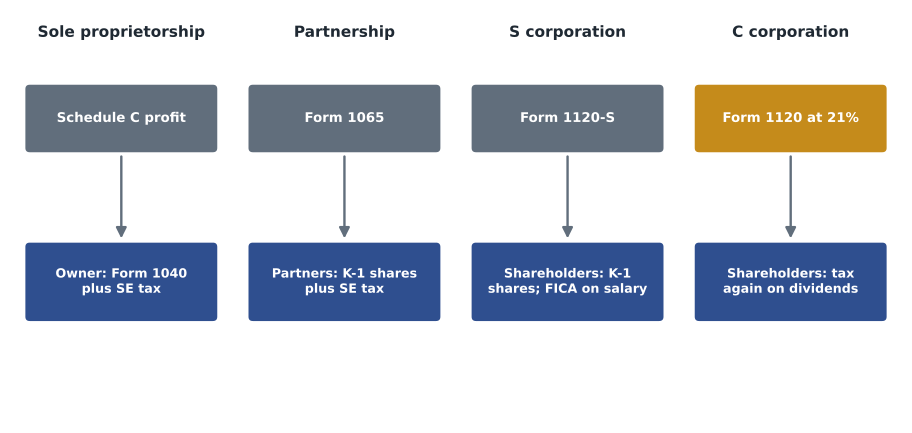
A partnership, including an LLC with two or more members that has not elected corporate status, is not a taxpayer. Under Subchapter K, the partnership computes its income and files Form 1065, and each partner reports a distributive share from Schedule K-1 whether or not cash is distributed. Partnerships are flexible: allocations can differ from ownership percentages if they have substantial economic effect, contributions and distributions of property are generally tax-free, and partners include their shares of partnership debt in the basis of their interests, which can let them deduct losses financed by borrowing. General partners and active LLC members generally pay self-employment tax on their shares of ordinary income. Lesson 7 covers partnerships in detail, including SkyGrid Data LLC.
Corporations
A corporation is a legal person separate from its shareholders. It owns its assets, it alone is liable for its debts unless a shareholder has guaranteed them, and a C corporation files Form 1120 and pays tax at a flat 21 percent rate, set by the Tax Cuts and Jobs Act of 2017 for tax years beginning after 2017 and not changed by the 2025 act. Shareholders are taxed again when profits are distributed as dividends, generally at the 0, 15 or 20 percent qualified dividend rates plus the 3.8 percent net investment income tax at higher incomes. This is the classic double tax. An S corporation is a corporation under state law that has elected to be taxed mainly as a flow-through: its income passes to its shareholders, who pay tax on it once, and later distributions of that income are generally tax-free.
The Code distinguishes several kinds of corporation. A C corporation is any corporation that has not elected S status; it may be closely held or publicly traded. A personal service corporation, whose principal activity is services in fields such as health, law, engineering, architecture, accounting, actuarial science, performing arts or consulting performed by employee-owners, faces some special rules. A closely held C corporation can be subject to the accumulated earnings tax if it retains earnings beyond its reasonable needs and to the personal holding company tax if it earns mostly passive income. Very large corporations are subject to the 15 percent corporate alternative minimum tax. Lesson 3 covers these taxes.
S corporation status is available only to a domestic corporation with no more than 100 shareholders (members of a family can count as one), whose shareholders are individuals who are US citizens or residents, estates and certain trusts and tax-exempt organizations, and which has only one class of stock (differences in voting rights alone are allowed). The election must be made by all shareholders on Form 2553, generally within two months and fifteen days after the start of the tax year in which it is to take effect. Brandt Aerial LLC qualifies: Leah, a US citizen, is its only member, and it has one class of membership interests. Lesson 8 covers S corporations in detail.
Trusts
A trust or estate is a separate taxpayer under Subchapter J. It files Form 1041 and pays tax on income it keeps, at compressed brackets that reach 37 percent at about $16,000 of taxable income, while income distributed to beneficiaries is deductible by the trust and taxed to them. Grantor trusts are disregarded and taxed to the person who created them. Trusts appear in business planning mainly as shareholders of S corporations (only grantor trusts, qualified subchapter S trusts and electing small business trusts may hold S stock) and as vehicles for transferring family businesses, discussed in lesson 11.
Double tax and the flow-through alternative
US corporate tax is not integrated. A C corporation pays 21 percent on its income, and its shareholders pay tax again on dividends, so $100 of profit paid out to a shareholder in the 15 percent qualified dividend bracket bears 21 + 79 × 0.15 = $32.85 of federal tax, and $39.80 at the top 20 percent rate plus the 3.8 percent net investment income tax, compared with up to 37 percent if the owner earned the income directly. Flow-through entities avoid the second layer: S corporations, partnerships and sole proprietorships are taxed once, at the owners' rates, and the qualified business income deduction lowers the top effective federal rate on their business income to 29.6 percent. The choice of entity therefore depends heavily on whether profits will be paid out or kept in the business, on payroll and self-employment taxes, and on the expected exit.
A first comparison
The program below compares $100,000 of profit earned by a single owner with no other income under three structures: a sole proprietorship, a C corporation that keeps the profit and later pays it out as a qualified dividend, and an S corporation that pays the owner a $50,000 salary. It uses the 2026 single brackets and $16,100 standard deduction and includes self-employment tax and payroll taxes, which are often the biggest difference between the structures.
# Sole proprietorship, C corporation or S corporation? $100,000 of profit, 2026 rules
# Single filer with no other income (illustrative; federal tax only)
BR = [(12_400, 0.10), (50_400, 0.12), (105_700, 0.22), (201_775, 0.24),
      (256_225, 0.32), (640_600, 0.35), (float('inf'), 0.37)]
STD = 16_100                                   # 2026 standard deduction, single

def bracket(x):
    tax, lo = 0.0, 0.0
    for hi, r in BR:
        if x > lo:
            tax += (min(x, hi) - lo) * r
        lo = hi
    return tax

profit = 100_000
# A. Sole proprietorship: self-employment tax plus income tax with the QBI deduction
se = 0.153 * 0.9235 * profit
agi = profit - se / 2
qbi = 0.20 * (profit - se / 2)
sole = bracket(agi - STD - qbi) + se
# B. C corporation keeps the profit: 21% now, 15% on a later qualified dividend
corp = 0.21 * profit
dividend = profit - corp
# qualified dividends fall in the 0% band up to 49,450 of taxable income (single, 2026)
taxable_div = max(0.0, dividend - STD)
later = 0.15 * max(0.0, taxable_div - 49_450)
# C. S corporation paying a $50,000 salary; the rest passes through
salary = 50_000
fica = 0.153 * salary                          # employee and employer halves
k1 = profit - salary - fica / 2                # employer half is deductible to the S corporation
s_qbi = 0.20 * k1
s_tax = bracket(salary + k1 - STD - s_qbi) + fica
print(f"Profit earned in the business                {profit:>10,.0f}")
print(f"A. Sole proprietor: income tax + SE tax      {sole:>10,.0f}  ({sole / profit:.1%})")
print(f"B. C corporation: corporate tax now          {corp:>10,.0f}  ({corp / profit:.1%})")
print(f"   Tax if the rest is paid as a dividend     {later:>10,.0f}")
print(f"   Total corporate and personal tax          {corp + later:>10,.0f}  ({(corp + later) / profit:.1%})")
print(f"C. S corporation, $50,000 salary: total {s_tax:>10,.0f} ({s_tax / profit:.1%})")Profit earned in the business 100,000 A. Sole proprietor: income tax + SE tax 21,656 (21.7%) B. C corporation: corporate tax now 21,000 (21.0%) Tax if the rest is paid as a dividend 2,018 Total corporate and personal tax 23,018 (23.0%) C. S corporation, $50,000 salary: total 17,947 (17.9%)
The sole proprietor pays $21,656, including $14,130 of self-employment tax. The C corporation pays $21,000 at once; if the remaining $79,000 is later paid out as a qualified dividend, the owner pays $2,018, for a total of $23,018, more than the proprietorship even though the dividend is taxed lightly. The S corporation is cheapest at $17,947, because only the $50,000 salary bears payroll tax while the remaining profit passes through free of employment taxes and still earns the QBI deduction. That payroll tax saving is the main reason so many small US businesses elect S status, and it is why the IRS insists that S corporation owners who work in the business pay themselves reasonable compensation, a topic for lessons 5 and 11.
Choosing an entity
Tax is only one factor in choosing an entity, but the tax factors are well known. In favor of a C corporation are the flat 21 percent rate on profits retained for growth, the possibility of excluding gain on qualified small business stock under section 1202 when the business is sold, fewer restrictions on who can own shares and on classes of stock, and tax-favored fringe benefits for owner-employees. In favor of an S corporation are a single level of tax, pass-through of losses, the QBI deduction and the payroll tax saving on profits above a reasonable salary. A partnership or multi-member LLC adds flexibility in allocations, inclusion of entity debt in owners' basis and tax-free distributions of property, but its active owners generally pay self-employment tax on all of their shares. State taxes, the expected exit, and investors' preferences (venture investors often require a C corporation) also matter.
| Factor | Sole proprietorship | C corporation | S corporation |
|---|---|---|---|
| Tax on profit kept in the business | Owner's rates, up to 37% less QBI | 21% | Shareholders' rates less QBI |
| Losses | Offset other income, subject to limits | Trapped as net operating losses | Pass through, limited to basis |
| Employment taxes | SE tax on all profit | Payroll tax on salary only; dividends taxed again | Payroll tax on reasonable salary only |
| Sale of the business | Asset sale, single tax | Possible section 1202 exclusion; double tax on asset sales | Single tax; basis step-up for the buyer possible |
| Compliance | Schedule C | Form 1120, payroll | Form 1120-S, payroll, basis tracking |
Worked problem
A start-up loss
Dev Mehta expects his software venture to lose $40,000 in its first year and earn $90,000 a year afterwards. He and his spouse also have $85,000 of wages in the first year. Should he start as a C corporation or as an S corporation?
Show solution
- In a C corporation, the $40,000 is a net operating loss that can only offset 80 percent of the corporation's future taxable income, saving 21 percent, or $8,400, later.
- In an S corporation, the loss passes through to his joint return, if he has enough stock and debt basis and the at-risk and passive activity rules allow it, offsetting wages taxed at 12 percent.
- The S corporation loss saves about $4,800 at 12 percent now, versus $8,400 later in the C corporation; the C corporation saves more in total but only once it is profitable.
- The bigger long-run question is whether profits will be reinvested (favoring a C corporation and section 1202) or paid out (favoring an S corporation).
Answer: It depends on the time horizon: the S corporation gives an immediate saving from the loss; the C corporation gives a larger but deferred saving and suits reinvestment.
Common mistakes
MistakeThinking a C corporation's 21 percent rate always beats individual rates.
InsteadDividends are taxed again; a C corporation wins mainly when profits are retained for years.
MistakeAssuming an LLC is a type of tax entity.
InsteadAn LLC is a state-law entity; it is taxed as a disregarded entity, partnership, C corporation or S corporation depending on its members and elections.
MistakeElecting S status late or with an ineligible shareholder.
InsteadForm 2553 must be filed within two months and 15 days of the start of the year, and a nonresident alien shareholder or second class of stock disqualifies the corporation.
MistakeAssuming S corporation losses are always deductible.
InsteadThey are limited by stock and debt basis, the at-risk rules, the passive activity rules and the excess business loss limit.
MistakeIgnoring payroll taxes when comparing entities.
InsteadSelf-employment and payroll taxes often matter more than income tax rates for small businesses.
Summary and key terms
- Check-the-box rules let eligible entities choose to be disregarded, a partnership or a corporation.
- Sole proprietors and partners are taxed once at their own rates and pay self-employment tax.
- C corporations pay 21 percent and shareholders are taxed again on dividends.
- S corporations are flow-through corporations with no more than 100 eligible shareholders and one class of stock.
- The QBI deduction of 20 percent, made permanent in 2025, benefits pass-through business income.
- US corporate tax is not integrated; flow-through entities avoid the double tax.
- S corporations save payroll tax on profit above a reasonable salary.
- Brandt Aerial LLC is taxed as an S corporation owned by Leah from 1 January 2027.
- C corporation
- A corporation taxed under Subchapter C at 21 percent, with shareholders taxed on dividends.
- S corporation
- A small business corporation that has elected under Subchapter S to pass its income through to shareholders.
- Check-the-box regulations
- Regulations letting eligible entities choose their federal tax classification.
- Disregarded entity
- A single-owner entity ignored for income tax, whose activities are reported by its owner.
- Qualified business income (QBI) deduction
- A deduction of up to 20 percent of pass-through business income under section 199A.
- Double tax
- Taxation of corporate profit once at the corporate level and again when distributed to shareholders.
- Integration
- The principle that income should bear similar total tax whether earned directly or through a corporation.
- Flow-through
- Taxation of an entity's income directly to its owners rather than to the entity.
Practice problems
Work each problem on paper first, then reveal the answer to check.
Name three requirements for S corporation status.
Show answer
No more than 100 shareholders, only eligible shareholders (US citizens or residents, estates, certain trusts), one class of stock, domestic corporation.
In the comparison program, how much self-employment tax does the sole proprietor pay?
Show answer
About $14,130: 15.3% × 92.35% × $100,000.
Why does the C corporation in the program pay more total tax than the sole proprietor?
Show answer
The profit is taxed at 21 percent and again as a dividend, while the proprietor gets the QBI deduction.
How is a two-member LLC taxed if it makes no election?
Show answer
As a partnership, filing Form 1065.
Can a corporation with a nonresident alien shareholder be an S corporation?
Show answer
No.
Why might a start-up expecting losses prefer an S corporation?
Show answer
Losses pass through to the owners, who may use them immediately against other income.
Which trusts may hold S corporation stock?
Show answer
Grantor trusts, qualified subchapter S trusts and electing small business trusts, among others.
What is the federal tax on $100 of C corporation profit paid out to a shareholder in the 20 percent bracket subject to NIIT?
Show answer
$21 + $79 × 23.8% = $39.80.
Lesson quiz · 5 questions
Score 60% or more to complete this lesson.
Create a free account to save your progress, take quizzes and earn a certificate.