
ACCT-352 · Lesson 2 of 12 · 23 min
Computing C corporation taxable income
A corporation computes taxable income as gross income minus allowable deductions (section 63), using most of the same rules as an individual: gross income under section 61, business deductions under section 162, depreciation under sections 167 and 168, and the capital gain and loss rules. The differences are in the details. A corporation has no standard deduction, no personal credits and no preferential rate for capital gains; it can deduct state income taxes without the SALT cap; it gets a special deduction for dividends received from other domestic corporations; and its capital losses and charitable contributions are limited in ways that differ from individuals. In practice, every corporate return begins with the financial statements and reconciles book income to taxable income on Schedule M-1 or, for corporations with total assets of $10 million or more, the more detailed Schedule M-3. This lesson walks through that reconciliation for the C corporation model of Brandt Aerial.
Tax year and accounting method
A C corporation may use the calendar year or any fiscal year it adopts on its first return, but a personal service corporation must generally use the calendar year, and changes require IRS approval or an automatic change procedure. Most C corporations must use the accrual method; small businesses whose average annual gross receipts for the prior three years are under an inflation-adjusted threshold (about $31 million for 2025) may use the cash method and are exempt from inventory accounting rules, the uniform capitalization rules and the business interest limit. The model Brandt Aerial corporation uses the calendar year and, because it keeps accrual-basis books, the accrual method.
From book income to taxable income
Schedule M-1 starts with net income per books, adds back federal income tax expense, adds income taxed but not recorded on the books and expenses recorded on the books but not deductible, and subtracts income recorded on the books but not taxable and deductions not charged against book income. Some differences are permanent: the nondeductible half of business meals, all entertainment since 2018, club dues, fines and penalties paid to a government, lobbying expenses, life insurance premiums where the corporation is the beneficiary, and tax-exempt interest never enter taxable income. Others are temporary: book depreciation is replaced by tax depreciation, book reserves for bad debts and warranties are replaced by deductions when the debts become worthless or the costs are paid, and prepaid income may be taxed when received. Temporary differences create deferred taxes under ASC 740, covered in ACCT-212.
| Adjustment | Direction | Authority | Type |
|---|---|---|---|
| Federal income tax expense | Add back | Section 275 | Permanent |
| Book depreciation in excess of tax depreciation | Add back (or subtract the excess of tax over book) | Sections 167, 168, 179 | Temporary |
| 50% of business meals; all entertainment | Add back | Section 274(a), (n) | Permanent |
| Club dues | Add back | Section 274(a)(3) | Permanent |
| Fines and penalties paid to a government | Add back | Section 162(f) | Permanent |
| Book bad debt reserve | Add back; deduct actual write-offs | Section 166 | Temporary |
| Tax-exempt interest | Subtract | Section 103 | Permanent |
| Charitable contributions above the limits | Add back and carry forward | Section 170(b)(2) | Timing |
| Dividends received deduction | Subtract (special deduction) | Sections 243 to 246A | Permanent |
Depreciation: MACRS, bonus and section 179
Depreciation follows the rules covered in ACCT-351 lesson 7: the modified accelerated cost recovery system (MACRS) assigns property to recovery classes, the half-year or mid-quarter convention applies, and section 1245 recapture arises on disposal. The 2025 act made 100 percent bonus depreciation permanent for qualified property acquired after 19 January 2025, and section 179 lets a business expense up to $2,560,000 of equipment for 2026, phased out above $4,090,000 of purchases and limited to business taxable income. A corporation can elect out of bonus depreciation class by class. Electing out is sometimes sensible for a C corporation that would otherwise create a net operating loss, because post-2017 losses can offset only 80 percent of future taxable income. In the model, Brandt Aerial takes bonus depreciation on its van but elects out for its 7-year drones and sensors.
Larger corporations face more disclosure. Schedule M-3 requires a line-by-line reconciliation that separates temporary and permanent differences and ties book income to the audited financial statements, and corporations with assets of $10 million or more that issue audited statements must also file Schedule UTP to list uncertain tax positions for which they have recorded a reserve under ASC 740. The IRS uses these schedules to select returns for examination. Even a small corporation filing Schedule M-1 benefits from a reconciliation working paper that ties every adjustment to a ledger account and a Code section, keeps the continuity of tax basis by asset, carryforwards of NOLs, capital losses and charitable contributions, and records elections such as the election out of bonus depreciation, which is made on a timely filed return and cannot easily be revoked.
Special deductions
After computing taxable income before special deductions, a corporation subtracts the dividends received deduction (DRD) and any net operating loss deduction. The DRD under section 243 is 50 percent of dividends from domestic corporations owned less than 20 percent, 65 percent if owned 20 percent or more, and 100 percent from members of the same affiliated group (80 percent or more). The 50 and 65 percent deductions are limited to that percentage of taxable income computed without the DRD, unless the dividends create or increase a net operating loss, and the stock must be held for more than 45 days. Net operating losses arising after 2017 carry forward indefinitely but can offset only 80 percent of taxable income computed without the NOL deduction; carrybacks are generally not allowed except for farming losses. Charitable contributions are deductible only above 1 percent of taxable income (a new floor from 2026) and up to 10 percent, with excess carried forward five years.
Capital gains and losses of a corporation
A corporation has no preferential rate for capital gains: net capital gains are taxed at 21 percent like other income. Capital losses, however, are restricted. A corporation can deduct capital losses only against capital gains, with no $3,000 allowance against ordinary income, and a net capital loss is carried back three years and forward five years as a short-term capital loss. Gains on depreciable business property held more than one year are section 1231 gains, subject to section 1245 recapture for equipment, and net section 1231 losses are ordinary. Corporations recognize a further 20 percent of the straight-line recapture on real property as ordinary income under section 291.
The model corporation's Schedule M-1
The model C corporation's 2027 financial statements show income before federal income tax of $118,400, after paying Leah a salary of $70,000 and the employer's payroll taxes. That figure includes $4,000 of interest, $6,000 of dividends from domestic public companies held more than 45 days, and a $6,000 gain on shares held more than a year. The books deduct $46,000 of depreciation, $6,200 of business meals, $2,400 of club dues and $600 of fines. During the year the corporation bought $160,000 of drones and sensors (7-year MACRS property) and a $35,000 cargo van (5-year property), and it holds the equipment Leah contributed, depreciated on her carryover basis. The program computes tax depreciation and the reconciliation, using 2026 rules as the latest available.
# Brandt Aerial as a C corporation: from book income to taxable income (Schedule M-1),
# year ending 31 December 2027, using 2026 rules (all figures invented)
book_income = 118_400          # income before federal income tax, after Leah's $70,000 salary
book_depreciation = 46_000
# Tax depreciation (Form 4562): 100% bonus on the van (5-year property); the corporation
# elects out of bonus for 7-year property and uses MACRS 200% DB, half-year (14.29%)
tax_dep = {"Van, 100% bonus depreciation": 35_000,
           "Drones and sensors, 7-year MACRS (14.29%)": 160_000 * 0.1429,
           "Equipment contributed by Leah (carryover basis)": 1_800}
m1_add = {"Book depreciation": book_depreciation,
          "50% of business meals (s. 274(n))": 3_100,
          "Club dues (s. 274(a)(3))": 2_400,
          "Fines paid to a government (s. 162(f))": 600}
m1_sub = {"Tax depreciation": sum(tax_dep.values())}
for k, v in tax_dep.items():
    print(f"  {k:<50}{v:>11,.2f}")
before_special = book_income + sum(m1_add.values()) - sum(m1_sub.values())
print(f"{'Net income per books, before federal tax':<52}{book_income:>11,.2f}")
for k, v in m1_add.items():
    print(f"  add {k:<46}{v:>11,.2f}")
for k, v in m1_sub.items():
    print(f"  subtract {k:<41}{-v:>11,.2f}")
print(f"{'Taxable income before special deductions':<52}{before_special:>11,.2f}")
dividends = 6_000              # from domestic corporations owned less than 20%
drd = 0.50 * dividends         # 50% dividends received deduction (s. 243)
taxable = before_special - drd
print(f"{"  less dividends received deduction (50%)":<52}{-drd:>11,.2f}")
print(f"{'Taxable income (Form 1120, line 30)':<52}{taxable:>11,.2f}")
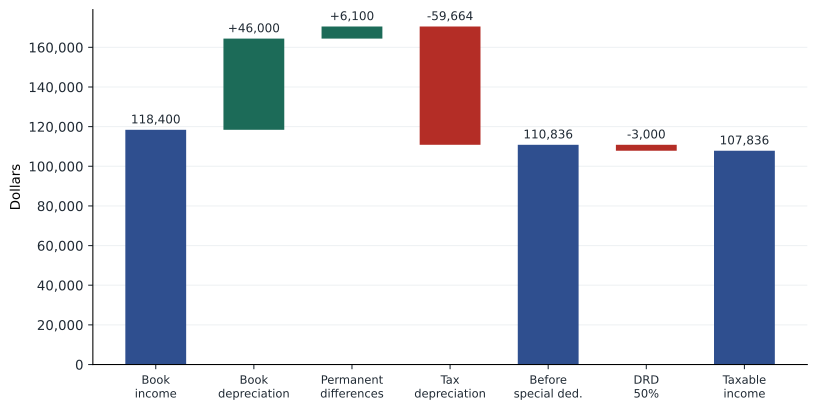
print(f"{'Federal income tax at 21%':<52}{0.21 * taxable:>11,.2f}")Van, 100% bonus depreciation 35,000.00 Drones and sensors, 7-year MACRS (14.29%) 22,864.00 Equipment contributed by Leah (carryover basis) 1,800.00 Net income per books, before federal tax 118,400.00 add Book depreciation 46,000.00 add 50% of business meals (s. 274(n)) 3,100.00 add Club dues (s. 274(a)(3)) 2,400.00 add Fines paid to a government (s. 162(f)) 600.00 subtract Tax depreciation -59,664.00 Taxable income before special deductions 110,836.00 less dividends received deduction (50%) -3,000.00 Taxable income (Form 1120, line 30) 107,836.00 Federal income tax at 21% 22,645.56
Tax depreciation of $59,664 exceeds book depreciation by $13,664, and the permanent differences add $6,100, so taxable income before special deductions is $110,836. The 50 percent DRD of $3,000 brings taxable income to $107,836 and federal tax at 21 percent to $22,645.56. Note that the $6,000 capital gain is fully taxable at 21 percent and the dividends are only half taxed, so the corporation's effective rate on its investment income differs from its rate on business income even though the statutory rate is flat. The interest and dividends will also matter in lesson 3, because a closely held corporation with too much passive income can face the personal holding company tax.
Interest, start-up costs and other limits
Business interest of a corporation is limited by section 163(j) to business interest income plus 30 percent of adjusted taxable income. The 2025 act restored the EBITDA-based definition of adjusted taxable income, adding back depreciation and amortization, for tax years beginning after 2024 and made it permanent, which raises the limit for capital-intensive businesses. Disallowed interest carries forward indefinitely. Small businesses that meet the gross receipts test (the same threshold that allows the cash method) are exempt, as the model Brandt Aerial corporation is. A corporation can deduct up to $5,000 of start-up expenditures and $5,000 of organizational expenditures in its first year, each reduced by the amount over $50,000, and amortize the rest over 180 months. Domestic research and experimental expenditures are again deductible immediately under new section 174A for amounts paid after 2024, while foreign research must still be amortized over 15 years.
Worked problem
Using a net operating loss
Suppose the model C corporation has a net operating loss of $90,000 in 2028 and taxable income before any NOL deduction of $100,000 in 2029. How much of the loss can it use in 2029 and what tax does it pay?
Show solution
- Post-2017 losses cannot be carried back, so the 2028 NOL can only be carried forward.
- In 2029 the NOL deduction is limited to 80% × $100,000 = $80,000.
- Taxable income is $100,000 − $80,000 = $20,000, and tax is 21% × $20,000 = $4,200.
- The remaining $10,000 of NOL carries forward indefinitely.
- This is why the corporation elected out of bonus depreciation on its 7-year property in the model: deductions that create NOLs can lose value under the 80 percent limit.
Answer: It deducts $80,000, pays $4,200 and carries $10,000 forward.
Common mistakes
MistakeForgetting to add back federal income tax expense on Schedule M-1.
InsteadFederal income tax is not deductible.
MistakeTaxing a corporation's net capital gain at 15 percent.
InsteadCorporations pay 21 percent on capital gains.
MistakeDeducting all charitable contributions.
InsteadCorporate contributions are deductible only above 1 percent and up to 10 percent of taxable income from 2026.
MistakeApplying the 50 percent DRD to dividends from an 85 percent-owned subsidiary.
InsteadAffiliated group dividends get a 100 percent DRD; 20 to 80 percent ownership gets 65 percent.
MistakeAssuming a corporation can deduct capital losses against business income.
InsteadCorporate capital losses offset only capital gains, with a three-year carryback and five-year carryforward.
Summary and key terms
- Corporate taxable income is gross income minus deductions, with no standard deduction or rate preference for gains.
- Schedule M-1 (or M-3) reconciles book income to taxable income.
- Permanent differences include half of meals, entertainment, club dues, fines and federal tax.
- Tax depreciation replaces book depreciation; 100 percent bonus depreciation is permanent.
- The DRD is 50, 65 or 100 percent depending on ownership.
- Post-2017 NOLs carry forward indefinitely but offset only 80 percent of taxable income.
- Section 163(j) limits interest to 30 percent of EBITDA-based adjusted taxable income for larger businesses.
- The model corporation's 2027 taxable income is $107,836 and its federal tax $22,645.56.
- Schedule M-1
- The Form 1120 schedule reconciling book income to taxable income for smaller corporations.
- Schedule M-3
- The detailed reconciliation required of corporations with total assets of $10 million or more.
- Dividends received deduction (DRD)
- A corporation's deduction of 50, 65 or 100 percent of dividends from domestic corporations.
- Net operating loss (NOL)
- An excess of deductions over income, carried forward to offset up to 80 percent of future taxable income.
- Bonus depreciation
- An immediate deduction of 100 percent of the cost of qualified property acquired after 19 January 2025.
- Section 163(j)
- The limit on business interest expense to 30 percent of adjusted taxable income plus interest income.
- Permanent difference
- A difference between book and taxable income that never reverses.
- Temporary difference
- A difference in timing between book and taxable income that reverses in later years.
Practice problems
Work each problem on paper first, then reveal the answer to check.
In the program, how much more tax depreciation than book depreciation does the corporation claim?
Show answer
$59,664 − $46,000 = $13,664.
What would tax depreciation be if the corporation had not elected out of bonus on the drones?
Show answer
$35,000 + $160,000 + $1,800 = $196,800, producing a loss.
A corporation has taxable income of $200,000 before charitable deductions and gives $25,000. How much can it deduct in 2026?
Show answer
The contribution is deductible above $2,000 (1%) up to $20,000 (10%); the excess carries forward.
Why is the DRD only 50 percent for Brandt Aerial's dividends?
Show answer
It owns less than 20 percent of the paying corporations.
How long can a corporation carry forward a net capital loss?
Show answer
Five years, as a short-term capital loss.
Name two items on Schedule M-1 that create permanent differences.
Show answer
For example 50% of meals, entertainment, club dues, fines or tax-exempt interest.
Is the model corporation subject to the section 163(j) limit? Why?
Show answer
No; it meets the small business gross receipts test.
Can a 2028 NOL be carried back to 2027?
Show answer
No; post-2017 NOLs generally carry forward only.
Lesson quiz · 5 questions
Score 60% or more to complete this lesson.
Create a free account to save your progress, take quizzes and earn a certificate.