
ACCT-352 · Lesson 8 of 12 · 26 min
Trusts and estates
Trusts are a familiar part of Canadian tax planning for families who own private corporations. A discretionary family trust can hold the growth shares of a business after an estate freeze, protect assets, provide for children and spread the future gain on a sale among several beneficiaries' lifetime capital gains exemptions. Estates are trusts too, created by a death, and the way an estate is taxed matters greatly to the families of owner-managers. This lesson explains how trusts are created and taxed, the flow-through of income to beneficiaries, the attribution rules that limit income splitting through trusts, the 21-year deemed disposition rule, the taxation of estates and the expanded trust reporting rules, using the Brandt Family Trust that Leah's accountant recommends for the estate freeze discussed in lesson 11.
What a trust is
A trust is not a legal person but a relationship: a settlor transfers property to a trustee, who holds legal title and administers it for the benefit of beneficiaries according to the trust's terms. A valid trust requires the three certainties: certainty of intention to create a trust, certainty of the property subject to it, and certainty of the beneficiaries or objects. An inter vivos trust is created during the settlor's lifetime; a testamentary trust arises on death, usually under a will. Discretionary trusts give the trustees discretion to decide which beneficiaries receive income or capital and when; non-discretionary trusts fix the shares. Special types include spousal or common-law partner trusts, alter ego and joint partner trusts for settlors aged 65 or older, qualified disability trusts, and graduated rate estates. A bare trust, in which the trustee has no powers or responsibilities except to hold title and act on the beneficiary's instructions, is generally ignored for income tax purposes, though it now has reporting obligations.
How trusts are taxed
Subsection 104(2) deems a trust to be an individual, so it computes income under the ordinary rules and files a T3 return. A trust's income that is paid or payable to a beneficiary in the year is deductible by the trust under subsection 104(6) and included in the beneficiary's income under subsection 104(13); income is payable if the beneficiary is entitled in the year to enforce payment. The trust can designate amounts as taxable dividends (subsection 104(19)) or taxable capital gains (subsection 104(21)) so that they keep their character, giving beneficiaries the dividend tax credit and the capital gains inclusion rate. Income the trust keeps is taxed in the trust: at the top federal rate of 33 per cent for most inter vivos trusts, and at graduated rates only for a graduated rate estate during its first 36 months and for a qualified disability trust. Trusts get no basic personal amount. They are subject to the alternative minimum tax, the tax on split income rules apply to amounts allocated to individual beneficiaries, and trusts generally must use a calendar year.
| Type of trust | How income kept in the trust is taxed | Notes |
|---|---|---|
| Inter vivos discretionary family trust | Top federal rate, 33% | 21-year rule; TOSI on allocations to family members |
| Graduated rate estate (first 36 months) | Graduated rates | Losses can be carried back to the deceased's final return under subsection 164(6) |
| Spousal or common-law partner trust | Top rate | Rollover on transfer at death; deemed disposition on the spouse's death |
| Alter ego or joint partner trust | Top rate | Rollover on transfer by settlor aged 65+; deemed disposition at death |
| Qualified disability trust | Graduated rates | For beneficiaries eligible for the disability tax credit |
| Bare trust | Ignored: income is the beneficiary's | T3 and Schedule 15 reporting from the 2026 taxation year unless exempt |
Attribution and the use of trusts for income splitting
Because income allocated to a beneficiary is taxed at the beneficiary's rates, trusts were once widely used to split income with family members in low brackets. Several rules now limit that. The attribution rules in sections 74.1 to 74.5 attribute income from property transferred or lent, directly or through a trust, to a spouse or a minor child back to the transferor, and section 74.4 attributes deemed interest when property is transferred to a corporation in which a spouse or minor is a specified shareholder, unless the corporation is a small business corporation. Subsection 75(2) attributes income and capital gains to the person who contributed property to a trust if the property can revert to that person, or if that person can decide who receives it or must consent to its disposition. Most importantly, the tax on split income (TOSI) in section 120.4, broadened in 2018, taxes dividends from private corporations and certain other income received by family members, directly or through a trust, at the top marginal rate unless an exclusion applies. Lesson 11 examines TOSI; the program in this lesson shows its effect.
The 21-year rule
Because trusts do not die, a trust could otherwise hold appreciating property for generations without the deemed disposition that occurs on an individual's death. Subsection 104(4) therefore deems most personal trusts to dispose of their capital property, and certain other property, at fair market value on every 21st anniversary of the trust's creation, taxing the accrued gain in the trust at the top rate. Trustees normally plan for the 21st anniversary years in advance, usually by distributing the property to Canadian-resident capital beneficiaries before that date. Subsection 107(2) allows such a distribution at the trust's cost, so the gain is deferred until the beneficiary disposes of the property; distributions to non-resident beneficiaries do not qualify. Anti-avoidance rules stop trusts from restarting the clock by transferring property to a new trust, and the 2025 federal budget proposed to extend them to indirect transfers between trusts.
Estates and post-mortem planning
When an individual dies, subsection 70(5) deems him or her to have disposed of all capital property immediately before death at fair market value, unless the property passes to a spouse, common-law partner or spousal trust, when subsection 70(6) allows a rollover at cost. The tax is reported on the deceased's final T1 return. The estate then becomes a separate trust; for its first 36 months it can be a graduated rate estate (GRE), taxed at graduated rates, with an off-calendar year-end and the ability to make charitable donations that can be claimed on the final return. For owner-managers, the deemed disposition of private company shares at death creates a risk of double tax: the deceased pays tax on the capital gain on the shares, and the estate or heirs pay tax again as dividends when the corporation's assets are distributed. Post-mortem planning addresses this, either through a 'pipeline' that extracts the corporation's value as a return of capital using the high cost base of the shares, or by having the corporation redeem the estate's shares in the GRE's first year and carrying the resulting capital loss back to the final return under subsection 164(6).
Trusts that hold private company shares also interact with the alternative minimum tax and the capital gains rules. The 2024 AMT changes raised the AMT rate and broadened its base, and while most trusts were brought into the regime, some, such as graduated rate estates and certain trusts holding employee ownership interests, are exempt. When a trust allocates a capital gain on QSBC shares to beneficiaries, each beneficiary can claim the lifetime capital gains exemption on his or her share, which is a central purpose of a family trust in an estate freeze, but TOSI applies to gains allocated to minors on non-arm's length dispositions, and each beneficiary's AMT position must be checked.
The Brandt Family Trust
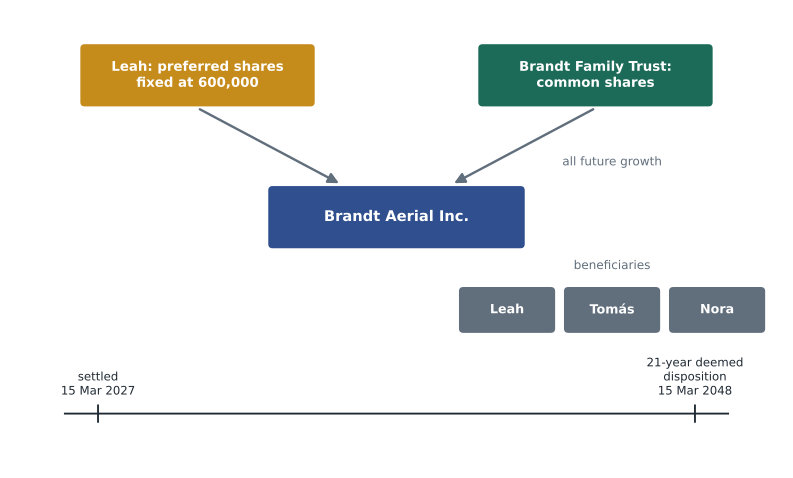
In lesson 11, Leah freezes the value of Brandt Aerial Inc. at $600,000 and the Brandt Family Trust, a discretionary trust settled on 15 March 2027 with a $100 silver coin by Leah's brother, subscribes for new common shares. The beneficiaries are Leah, Tomás, Nora and any future children; the trustees are Leah, Tomás and Leah's brother. Suppose that in a later year the corporation pays the trust a $30,000 non-eligible dividend. The program compares the tax if the trust keeps it, or allocates it to Leah, to Tomás or to Nora, applying TOSI where it applies. It then computes the 21st anniversary of the trust and the gain that would be deemed realized if the business grew at 8 per cent a year.
# The Brandt Family Trust: where should a $30,000 non-eligible dividend be taxed?
# 2026 federal and Manitoba rules (illustrative)
FED = [(58_523, 0.14), (117_045, 0.205), (181_440, 0.26), (258_482, 0.29), (float('inf'), 0.33)]
MB = [(47_000, 0.108), (100_000, 0.1275), (float('inf'), 0.174)]

def bracket(x, br):
    tax, lo = 0.0, 0.0
    for hi, r in br:
        if x > lo:
            tax += (min(x, hi) - lo) * r
        lo = hi
    return tax

def tax_on(other_income, dividend, tosi=False, credits=True):
    """Federal + Manitoba tax caused by adding a non-eligible dividend."""
    def total(div):
        g = 1.15 * div
        if tosi:   # split income: top rates, only the dividend tax credit
            return (0.33 + 0.174) * g - (0.090301 + 0.007835) * g
        x = other_income + g
        fed = bracket(x, FED) - (0.14 * 16_452 if credits else 0) - 0.090301 * g
        mb = bracket(x, MB) - (0.108 * 15_780 if credits else 0) - 0.007835 * g
        return max(0, fed) + max(0, mb)
    return total(dividend) - (0 if tosi else total(0))

div = 30_000
cases = [("Kept in the trust (top rate, no credits)", tax_on(10**7, div, credits=False)),
         ("Paid to Leah (excluded business, other income 70,000)", tax_on(70_000, div)),
         ("Paid to Tomas, TOSI applies (not active 20 hours a week)", tax_on(38_000, div, tosi=True)),
         ("Paid to Tomas if TOSI did not apply", tax_on(38_000, div)),
         ("Paid to Nora, age 7: TOSI applies", tax_on(0, div, tosi=True))]
for name, t in cases:
    print(f"{name:<58}{t:>10,.0f}  ({t / div:.1%})")
print()
# The 21-year rule: deemed disposition of the trust's shares at fair market value
from datetime import date
settled = date(2027, 3, 15)
deemed = date(settled.year + 21, settled.month, settled.day)
growth = 0.08
value = 600_000                 # value frozen in Leah's preferred shares
common = 0.0
for _ in range(21):
    common = (value + common) * (1 + growth) - value
print(f"Trust settled {settled.isoformat()}; deemed disposition on {deemed.isoformat()}")
print(f"If the business grows 8% a year, growth on the common shares by then: {common:,.0f}")
print(f"Taxable capital gain at one-half inclusion: {common / 2:,.0f}")Kept in the trust (top rate, no credits) 14,002 (46.7%) Paid to Leah (excluded business, other income 70,000) 8,295 (27.6%) Paid to Tomas, TOSI applies (not active 20 hours a week) 14,002 (46.7%) Paid to Tomas if TOSI did not apply 6,576 (21.9%) Paid to Nora, age 7: TOSI applies 14,002 (46.7%) Trust settled 2027-03-15; deemed disposition on 2048-03-15 If the business grows 8% a year, growth on the common shares by then: 2,420,300 Taxable capital gain at one-half inclusion: 1,210,150
If the trust keeps the dividend, it pays $14,002, 46.7 per cent, the top Manitoba rate on non-eligible dividends. Allocating it to Tomás or Nora gives exactly the same result, because TOSI taxes split income at the top rate with only the dividend tax credit. TOSI does not apply to Leah, because Brandt Aerial Inc. is an excluded business for her: she works in it actively and regularly, more than 20 hours a week. Her tax on the dividend, on top of her $70,000 salary, is $8,295 or 27.6 per cent. If TOSI did not apply to Tomás, whose income is $38,000, he would pay only $6,576; the difference, about $7,400 a year, is what the 2018 TOSI amendments took away. The trust remains useful for the estate freeze and for multiplying the lifetime capital gains exemption on a sale, but not for splitting dividend income with family members who are not active in the business. The 21-year deemed disposition would fall on 15 March 2048, when growth of about $2.4 million on the common shares would produce a taxable capital gain of about $1.2 million, unless the trustees distribute the shares to Canadian-resident beneficiaries before then.
Trust reporting
Trusts must file a T3 return within 90 days after the end of their taxation year, by 31 March for a calendar-year trust. Since the 2023 taxation year, most express trusts must file even if they have no income and must include Schedule 15, which reports the identity, address, date of birth, residence and taxpayer identification number of every settlor, trustee, beneficiary and person who can exert control over the trust. Bare trusts were brought into the regime in 2023, but after widespread confusion the CRA exempted them for 2023, 2024 and 2025. Revised rules, released in draft in August 2025, were enacted by Bill C-15, which received royal assent on 26 March 2026; they apply bare trust reporting from taxation years ending on or after 31 December 2026, with first returns due by 31 March 2027, and exempt many common arrangements, such as a parent on title to an adult child's home and joint spousal accounts. The penalty for late filing is $25 a day, from a minimum of $100 to a maximum of $2,500; knowingly or through gross negligence failing to file brings an additional penalty of the greater of $2,500 and 5 per cent of the highest value of the trust's property in the year.
Worked problem
Planning for the 21st anniversary
Using the program's projection, what tax would the Brandt Family Trust pay at its 21st anniversary, and how can the trustees avoid it?
Show solution
- On 15 March 2048 the trust would be deemed to dispose of its common shares at fair market value.
- The accrued gain would be about $2,420,300, a taxable capital gain of about $1,210,150, taxed in the trust at the top Manitoba rate of 50.4 per cent: roughly $610,000 of tax, with no cash from a sale to pay it.
- If the trustees distribute the shares to Canadian-resident capital beneficiaries before that date, subsection 107(2) lets the trust transfer them at its cost, deferring the gain until the beneficiaries sell or die.
- The trustees must consider whether the beneficiaries are ready to own the shares, whether TOSI or attribution could apply to them, and whether the corporation's shares can first be reorganized to protect the family, for example by distributing shares with limited rights.
- If the shares are QSBC shares, a sale before 2048 allocated among beneficiaries could instead use several lifetime capital gains exemptions.
Answer: About $610,000 of tax in 2048 unless the trustees distribute the shares to Canadian-resident beneficiaries under subsection 107(2) first.
Common mistakes
MistakeAssuming income kept in a family trust is taxed at the beneficiaries' rates.
InsteadRetained income of an inter vivos trust is taxed at the top rate; only income paid or payable to beneficiaries is taxed to them.
MistakeAllocating private company dividends to adult children who do not work in the business, expecting low tax.
InsteadTOSI taxes them at the top rate unless an exclusion applies.
MistakeLetting a trust reach its 21st anniversary unplanned.
InsteadThe deemed disposition taxes accrued gains in the trust at the top rate.
MistakeSettling a trust with property the settlor can get back.
InsteadSubsection 75(2) attributes income and gains to the contributor.
MistakeAssuming bare trusts never need to file.
InsteadBare trusts must report from the 2026 taxation year unless an exemption applies.
Summary and key terms
- A trust is a relationship in which trustees hold property for beneficiaries; it is taxed as an individual.
- Income paid or payable to beneficiaries is deducted by the trust and taxed to them, keeping its character by designation.
- Inter vivos trusts pay tax at the top rate; GREs and qualified disability trusts at graduated rates.
- Attribution rules and TOSI limit income splitting through trusts.
- Most trusts are deemed to dispose of capital property every 21 years.
- Death triggers a deemed disposition unless property passes to a spouse or spousal trust.
- Post-mortem pipelines or subsection 164(6) loss carrybacks prevent double tax on private company shares.
- Bare trusts must report from the 2026 taxation year under Bill C-15, subject to exemptions.
- Settlor
- The person who creates a trust by transferring property to a trustee.
- Graduated rate estate (GRE)
- An estate taxed at graduated rates for up to 36 months after death.
- Paid or payable
- Income a beneficiary is entitled to enforce payment of in the year, deductible by the trust.
- 21-year rule
- The deemed disposition of a trust's capital property every 21 years.
- Tax on split income (TOSI)
- Top-rate tax on certain income received by family members from private businesses.
- Bare trust
- An arrangement in which the trustee only holds title for the beneficiary, now subject to reporting.
- Pipeline
- Post-mortem planning that extracts corporate value as a return of capital to avoid double tax.
- Beneficiary
- A person entitled to benefit from property held by a trustee or a corporation's distributions.
Practice problems
Work each problem on paper first, then reveal the answer to check.
A trust earns $20,000 of interest and pays $12,000 to a beneficiary. How much does each include?
Show answer
The beneficiary includes $12,000; the trust is taxed on $8,000 at the top rate.
Which trusts are taxed at graduated rates?
Show answer
Graduated rate estates (first 36 months) and qualified disability trusts.
What does subsection 104(19) do?
Show answer
Lets a trust designate taxable dividends so the beneficiary gets the gross-up and credit.
Why does TOSI not apply to dividends allocated to Leah?
Show answer
Brandt Aerial Inc. is an excluded business for her because she works in it actively more than 20 hours a week.
When must a calendar-year trust file its T3?
Show answer
By 31 March.
What is the purpose of the 21-year rule?
Show answer
To prevent trusts from deferring tax on accrued gains indefinitely.
How can a GRE help avoid double tax on private company shares?
Show answer
By redeeming shares in its first year and carrying the capital loss back to the final return under subsection 164(6).
In the program, how much tax does Tomás save if TOSI does not apply?
Show answer
About $14,002 − $6,576 = $7,426.
Lesson quiz · 5 questions
Score 60% or more to complete this lesson.
Create a free account to save your progress, take quizzes and earn a certificate.