
ACCT-352 · Lesson 4 of 12 · 23 min
Corporate distributions: dividends, earnings and profits, and redemptions
Once a C corporation has paid tax on its profits, the second layer of tax arrives when it distributes them. Subchapter C determines how much of a distribution is a dividend, how much is a tax-free return of the shareholder's investment and how much is capital gain, using a tax measure of the corporation's capacity to pay dividends called earnings and profits (E&P). It also decides when a corporation's purchase of its own stock, a redemption, is treated as a sale by the shareholder and when it is treated as a dividend, and when payments that are not labeled dividends, such as excessive salaries or personal use of company property, are constructive dividends. This lesson covers those rules, computes the model Brandt Aerial corporation's E&P and illustrates the double tax on distributed profits.
Earnings and profits
Earnings and profits is not defined in the Code, but section 312 and the regulations describe the adjustments that turn taxable income into an economic measure of the corporation's ability to pay dividends. Current E&P starts with taxable income and adds back items that were excluded or deducted for tax but do not reduce economic income, such as tax-exempt interest, the dividends received deduction, life insurance proceeds and the excess of accelerated tax depreciation over depreciation computed under the alternative depreciation system (straight-line over longer lives). It subtracts items that reduce economic income but are not deductible, such as federal income tax, the nondeductible half of meals, fines, excess capital losses and excess charitable contributions. Accumulated E&P is the total of current E&P for all years since 1913, less distributions out of E&P. The corporation must report its E&P on Form 5452 when it makes non-dividend distributions.
How distributions are classified
Under section 301, a distribution of money or property by a corporation to a shareholder with respect to its stock is a dividend to the extent of E&P, then a tax-free return of the shareholder's basis in the stock, then gain from the sale of the stock. Section 316 orders the sources: a distribution comes first from current E&P, determined at the end of the year without reduction for distributions during the year, and then from accumulated E&P in reverse chronological order. If current E&P is positive, distributions are dividends up to that amount even if accumulated E&P is negative; if current E&P is negative, it is prorated through the year and netted against accumulated E&P at the date of each distribution. Individual shareholders pay tax on qualified dividends at 0, 15 or 20 percent, plus the 3.8 percent net investment income tax when modified AGI exceeds $250,000 for joint filers, if they hold the stock for more than 60 days in the 121-day period around the ex-dividend date.
Property distributions and constructive dividends
When a corporation distributes property other than money, the shareholder has a distribution equal to the property's fair market value and takes that value as basis. Under section 311(b), the corporation recognizes gain as if it had sold the property at fair market value, though it cannot recognize a loss, so distributing appreciated property triggers tax at both levels. Payments to or for shareholders that are not formally declared as dividends can be constructive dividends: a corporation's payment of a shareholder's personal expenses, personal use of a company car or aircraft, a below-market loan to a shareholder (section 7872), a bargain sale of corporate property, or salary to a shareholder-employee that exceeds reasonable compensation for the services. Constructive dividends are nondeductible to the corporation and taxable to the shareholder to the extent of E&P, so they cost more than a properly structured salary or dividend.
| Account | What it measures | Effect of a distribution |
|---|---|---|
| Current E&P | Economic income of the year | Dividend to the extent of current E&P, even with an accumulated deficit |
| Accumulated E&P | Undistributed E&P of earlier years | Dividend after current E&P is used |
| Stock basis | The shareholder's investment | Tax-free return of capital after E&P is exhausted |
| Excess over basis | Gain | Capital gain from a deemed sale of stock |
| Appreciated property distributed | Built-in gain | Corporate gain under section 311(b) plus a dividend at FMV |
Stock redemptions
A redemption is a corporation's acquisition of its own stock from a shareholder in exchange for property. Section 302 treats a redemption as a sale or exchange, so the shareholder recovers basis and reports capital gain, only if it meets one of four tests; otherwise it is a section 301 distribution, taxed as a dividend to the extent of E&P with no basis recovery. The tests are: a redemption not essentially equivalent to a dividend, which requires a meaningful reduction in the shareholder's interest (section 302(b)(1)); a substantially disproportionate redemption, after which the shareholder owns less than 50 percent of the voting power and less than 80 percent of the percentage of voting and common stock owned before (302(b)(2)); a complete termination of the shareholder's interest (302(b)(3)); and a partial liquidation for a non-corporate shareholder (302(b)(4)). Ownership is measured with the constructive ownership rules of section 318, which attribute stock among family members, between entities and their owners, and through options, although family attribution can be waived in a complete termination if the shareholder keeps no interest except as a creditor for ten years.
Section 1202 and other ways out
The double tax on C corporation profits can sometimes be avoided altogether on a sale. Section 1202 lets a non-corporate shareholder exclude gain on qualified small business stock: stock originally issued by a domestic C corporation with gross assets below the limit when issued, which uses at least 80 percent of its assets in an active business other than excluded fields such as health, law, engineering, architecture, accounting, consulting, financial services and hospitality. For stock issued after 4 July 2025, the 2025 act raised the gross assets limit from $50 million to $75 million and the per-issuer cap from $10 million to $15 million (both indexed), and introduced a tiered exclusion of 50 percent after three years, 75 percent after four and 100 percent after five years of holding. Whether a drone inspection business is a qualified trade, or a service business in an excluded field such as engineering, is a real question for Brandt Aerial, and one reason its owners chose S status instead.
Distributions of the corporation's own stock follow different rules. Under section 305, a stock dividend, such as a distribution of additional common shares to common shareholders, is generally tax-free, and the shareholder allocates basis between the old and new shares. It is taxable, however, if any shareholder can elect to receive cash or property instead, if some shareholders receive property while others increase their proportionate interests, or if preferred stock is distributed to some common shareholders and common to others. Preferred stock received tax-free can be 'section 306 stock': if it is later sold or redeemed, the proceeds may be ordinary income rather than capital gain, to stop shareholders from bailing out corporate earnings at capital gain rates through a tax-free stock dividend followed by a sale. Corporations also distribute value through stock buybacks, which since 2023 bear a 1 percent excise tax under section 4501 when the corporation is publicly traded, a rule that does not affect closely held businesses such as the model Brandt Aerial.
The model corporation's E&P and distributions
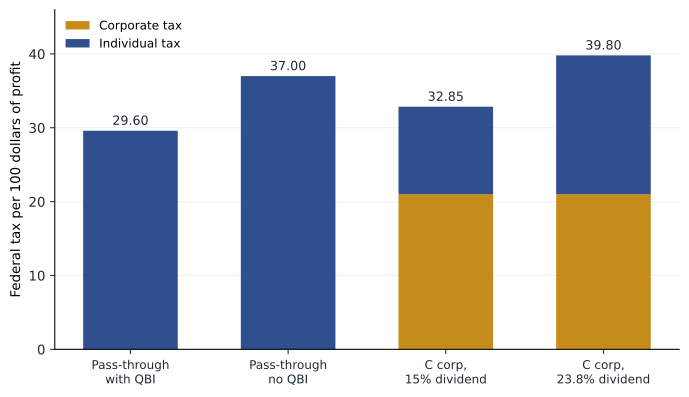
The program computes the model corporation's current E&P for 2027 from its taxable income, assuming $21,500 of depreciation under the alternative depreciation system, and classifies two possible distributions to Leah, whose stock basis is assumed to be $25,000 in the C corporation model. It then computes the total federal tax on $100 of corporate profit paid out as a qualified dividend, and applies the substantially disproportionate test to two possible redemptions from a shareholder who owns 60 of 100 shares.
# Brandt Aerial as a C corporation: earnings and profits and a distribution to Leah
# (2027 using 2026 rules, illustrative)
taxable = 107_836
federal_tax = 0.21 * taxable
adjustments = {
    "Add back the dividends received deduction": 3_000,
    "Add back tax depreciation in excess of ADS straight-line": 59_664 - 21_500,
    "Subtract federal income tax": -federal_tax,
    "Subtract nondeductible meals, dues and fines": -(3_100 + 2_400 + 600),
}
current_ep = taxable + sum(adjustments.values())
print(f"{'Taxable income':<58}{taxable:>11,.2f}")
for k, v in adjustments.items():
    print(f"  {k:<56}{v:>11,.2f}")
print(f"{'Current earnings and profits for 2027':<58}{current_ep:>11,.2f}")

def classify(distribution, current, accumulated, basis):
    """Section 301: dividend to the extent of E&P, then return of basis, then capital gain."""
    dividend = min(distribution, max(0.0, current) + max(0.0, accumulated))
    rest = distribution - dividend
    return dividend, min(rest, basis), max(0.0, rest - basis)

for amount in (40_000, 150_000):
    d, rb, g = classify(amount, current_ep, 0.0, basis=25_000)
    print(f"Distribution {amount:>8,}: dividend {d:>10,.2f}  return of basis {rb:>9,.2f}  gain {g:>9,.2f}")
print()
# Total tax on $100 of corporate profit paid out as a qualified dividend
for rate_name, personal in (("15% bracket", 0.15), ("20% + 3.8% NIIT", 0.238)):
    corp = 21.0
    div = 100 - corp
    total = corp + div * personal
    print(f"$100 of profit, dividend taxed at {rate_name:<16}: total tax {total:5.2f}")
print()
# Section 302(b)(2): is a redemption substantially disproportionate?
def disproportionate(before_mine, before_total, redeemed):
    pct_before = before_mine / before_total
    pct_after = (before_mine - redeemed) / (before_total - redeemed)
    ok = pct_after < 0.50 and pct_after < 0.80 * pct_before
    return pct_before, pct_after, ok
for redeemed in (20, 30):
    b, a, ok = disproportionate(60, 100, redeemed)
print(f"Redeem {redeemed} of 60 shares (of 100): {b:.0%} -> {a:.1%} sale treatment: {ok}")Taxable income 107,836.00 Add back the dividends received deduction 3,000.00 Add back tax depreciation in excess of ADS straight-line 38,164.00 Subtract federal income tax -22,645.56 Subtract nondeductible meals, dues and fines -6,100.00 Current earnings and profits for 2027 120,254.44 Distribution 40,000: dividend 40,000.00 return of basis 0.00 gain 0.00 Distribution 150,000: dividend 120,254.44 return of basis 25,000.00 gain 4,745.56 $100 of profit, dividend taxed at 15% bracket : total tax 32.85 $100 of profit, dividend taxed at 20% + 3.8% NIIT : total tax 39.80 Redeem 20 of 60 shares (of 100): 60% -> 50.0% sale treatment: False Redeem 30 of 60 shares (of 100): 60% -> 42.9% sale treatment: True
Current E&P is $120,254.44, higher than taxable income because the DRD and the excess of tax over ADS depreciation are added back, partly offset by the federal tax and the nondeductible expenses. A $40,000 distribution is entirely a dividend. A $150,000 distribution would be a dividend of $120,254.44, a tax-free return of Leah's $25,000 basis and a $4,745.56 capital gain. Profit paid out to a shareholder in the 15 percent bracket bears $32.85 of federal tax per $100, and $39.80 at the top rates, against a top individual rate of 37 percent or 29.6 percent after the QBI deduction for pass-through income. Redeeming 20 of the shareholder's 60 shares leaves her with exactly 50 percent, which fails the 'less than 50 percent' test, so the redemption would be a dividend; redeeming 30 leaves 42.9 percent, below both 50 percent and 80 percent of 60 percent (48 percent), so it is a sale.
Worked problem
A constructive dividend
In the C corporation model, the corporation pays $12,000 for a family vacation for Leah, Tomás and Nora and deducts it as travel. On examination, the IRS treats it as a constructive dividend. What is the cost?
Show solution
- The $12,000 is not an ordinary and necessary business expense, so the deduction is disallowed: corporate tax rises by 21% × $12,000 = $2,520.
- The payment is a distribution with respect to Leah's stock and, with ample E&P, a dividend to her.
- If it is a qualified dividend taxed at 15 percent, Leah owes $1,800 more.
- A 20 percent accuracy-related penalty may apply to each underpayment, plus interest.
- Total extra tax is about $4,320 before penalties, compared with nothing had Leah paid for the trip from after-tax salary or a declared dividend recorded properly.
Answer: About $4,320 of extra federal tax, plus possible penalties and interest.
Common mistakes
MistakeTreating every distribution as a dividend.
InsteadDistributions are dividends only to the extent of E&P; then basis is recovered, then gain.
MistakeUsing retained earnings per the books as E&P.
InsteadE&P is a tax measure with its own adjustments.
MistakeAssuming any redemption is a capital transaction.
InsteadA redemption is a sale only if it meets a section 302(b) test, applying section 318 attribution.
MistakeForgetting the corporation's gain on a property distribution.
InsteadSection 311(b) taxes the corporation on appreciated property it distributes.
MistakeDeducting a shareholder's personal expenses as a business expense.
InsteadThey are constructive dividends: nondeductible and taxable to the shareholder.
Summary and key terms
- Distributions are dividends to the extent of current, then accumulated, E&P.
- E&P adjusts taxable income toward economic income.
- Distributions above E&P recover stock basis and then produce capital gain.
- Distributing appreciated property triggers corporate gain under section 311(b).
- Constructive dividends are nondeductible and taxable to shareholders.
- Redemptions are sales only if they meet a section 302(b) test.
- Section 1202 can exclude gain on qualified small business stock, with new tiers after 4 July 2025.
- The model corporation's 2027 current E&P is $120,254.44.
- Earnings and profits (E&P)
- A tax measure of a corporation's capacity to pay dividends.
- Current E&P
- E&P of the current year, determined at year-end without reduction for distributions.
- Constructive dividend
- An informal distribution of value to a shareholder treated as a dividend.
- Redemption
- A corporation's acquisition of its own stock from a shareholder.
- Substantially disproportionate redemption
- A redemption leaving the shareholder with less than 50 percent of votes and less than 80 percent of the prior percentage.
- Qualified small business stock
- Stock of a qualifying C corporation whose gain may be excluded under section 1202.
- Constructive ownership
- Attribution of ownership of shares held by related persons or entities.
Practice problems
Work each problem on paper first, then reveal the answer to check.
A corporation has current E&P of $30,000 and an accumulated deficit of $50,000. It distributes $20,000. How is it taxed?
Show answer
As a dividend, because current E&P covers it.
A shareholder with $10,000 basis receives a $40,000 distribution from a corporation with $15,000 of E&P. Classify it.
Show answer
$15,000 dividend, $10,000 return of basis and $15,000 capital gain.
Why is the DRD added back in computing E&P?
Show answer
It reduces taxable income but not the corporation's economic income.
A corporation distributes land worth $80,000 with a basis of $30,000. What are the tax results?
Show answer
The corporation recognizes $50,000 of gain; the shareholder has an $80,000 distribution and an $80,000 basis in the land.
Leah owns 60 of 100 shares; her father owns 20. For section 302 purposes, how many does she own?
Show answer
80, because her father's shares are attributed to her under section 318.
In the program, how much of a $150,000 distribution is capital gain?
Show answer
$4,745.56.
What holding period is required for qualified dividend treatment?
Show answer
More than 60 days in the 121-day period beginning 60 days before the ex-dividend date.
Why might a drone inspection company's stock fail to qualify under section 1202?
Show answer
Its business may be treated as a service in an excluded field such as engineering or consulting.
Lesson quiz · 5 questions
Score 60% or more to complete this lesson.
Create a free account to save your progress, take quizzes and earn a certificate.