
ACCT-352 · Lesson 9 of 12 · 24 min
State and local taxation of businesses
Federal income tax is only part of a business's tax burden. States and localities levy corporate and individual income taxes, sales and use taxes, gross receipts taxes, franchise taxes and property taxes, each with its own rules about which businesses they can reach. Since the Supreme Court's decision in South Dakota v. Wayfair, Inc. (2018), businesses can owe sales tax in states where they have no physical presence, and the federal cap on individual deductions for state and local taxes has led most states to offer elective pass-through entity taxes. This lesson covers nexus for income and sales taxes, the taxability of services, apportionment of income among states, the taxation of pass-through entities and their owners, and pass-through entity taxes, using Brandt Aerial LLC's work in Iowa, Nebraska and Minnesota.
Nexus for income taxes
A state can tax a business's income only if the business has nexus with the state and the tax is fairly apportioned, under the Commerce Clause and the Due Process Clause. Physical presence, such as employees, property or inventory in the state, always creates nexus. Many states now also assert 'economic' or 'factor presence' nexus for income tax when a business's sales into the state exceed a threshold, often $500,000. A federal statute, Public Law 86-272 (1959), prohibits a state from imposing a net income tax on a business whose only activity in the state is soliciting orders for tangible personal property that are approved and shipped from outside the state; it does not protect sellers of services or intangibles, and states have narrowed it for internet activities. Brandt Aerial LLC's crews fly inspection missions in Nebraska and Minnesota, so it has physical presence nexus there in any year it works in those states, and P.L. 86-272 does not help because it sells services.
Sales and use tax after Wayfair
Forty-five states and the District of Columbia levy sales taxes, and thousands of localities add their own. A sales tax is imposed on retail sales of tangible personal property and specified services delivered in the state, collected by the seller from the buyer; a complementary use tax applies to items bought from sellers who did not collect it. For decades, Quill Corp. v. North Dakota (1992) held that a state could require only sellers with physical presence to collect its tax. Wayfair overruled Quill and upheld South Dakota's economic nexus law, which required remote sellers with more than $100,000 of sales or 200 transactions in the state each year to collect. Every state with a sales tax now has a similar law; most use a $100,000 threshold and many have dropped the transaction count. Marketplace facilitator laws require platforms to collect on sales made through them. Iowa levies a 6 percent state sales tax, plus local option taxes of up to 1 percent in most jurisdictions.
| Tax | Nexus standard | Base | Example |
|---|---|---|---|
| Corporate or individual income tax | Physical presence; often economic nexus above a sales threshold; P.L. 86-272 protection for sellers of goods only | Apportioned net income | Iowa 5.5%/7.1% corporate; 3.8% individual |
| Sales and use tax | Physical presence or economic nexus (often $100,000 of sales) | Retail sales of goods and enumerated services | Iowa 6% plus local option |
| Gross receipts tax | Usually economic nexus | Gross receipts, with few deductions | Ohio commercial activity tax; Washington B&O tax |
| Franchise or margin tax | Doing business in the state | Capital, net worth or margin | Texas margin tax |
| Pass-through entity tax (elective) | Entity doing business in the state | Owners' shares of state-sourced income | Iowa PTET at 3.8% |
Are services taxable?
Whether a service is subject to sales tax depends entirely on state law, and states differ widely. A few states, such as Hawaii, New Mexico and South Dakota, tax most services; most states tax only services they enumerate, such as repairs, installation, cleaning, telecommunications or digital products; and some tax very few. Iowa is unusual in taxing a long list of enumerated services, and businesses must check whether their services are on it in each state where they work; whether aerial photography, mapping or inspection is taxable in a particular state is exactly the kind of question that requires a current review of the statute and the state's guidance. A business that sells taxable services must register with each state where it has nexus, collect tax at the rate of the location where the service is delivered (destination sourcing in most states), file returns and keep exemption certificates for exempt sales to resellers or exempt organizations. Brandt Aerial LLC's sales into Nebraska and Minnesota are well under $100,000, but physical presence from its crews, not economic nexus, is what matters for a service business that works on site.
Apportioning income among states
A business taxable in more than one state divides its income among them by apportionment. The traditional formula of the Uniform Division of Income for Tax Purposes Act averaged three factors, property, payroll and sales, but most states, including Iowa, Nebraska and Minnesota, now use a single sales factor, which reduces the tax on in-state employers and shifts it to businesses selling into the state. States also differ on how to source receipts from services: older rules used the location where the income-producing activity was performed (cost of performance), while most states now use market-based sourcing, assigning receipts to the state where the customer receives the benefit of the service. A throwback rule, in states that have one, reassigns sales to states where the seller is not taxable back to the seller's home state. Many states require unitary groups of related corporations to file combined reports. The model treats Brandt Aerial's receipts as sourced to the state where each client's facilities are located, which matches both sourcing methods for on-site inspection work.
Pass-through entities and their owners
S corporations and partnerships generally pay no state income tax themselves, but their owners owe tax to each state from which the entity's income is sourced. A resident of Iowa is taxed by Iowa on all of her income, wherever earned, with a credit for income tax paid to other states on the same income. A nonresident owner must file returns in each state where the entity has apportioned income, or the entity may file a composite return or withhold tax on the owner's behalf, as most states allow or require. Several states, including New York, California, Tennessee and Texas, impose entity-level taxes on S corporations or LLCs regardless of the flow-through treatment. Iowa taxes individuals at a flat 3.8 percent from 2025, following reforms that replaced its graduated rates, and it decoupled from some federal provisions, so Iowa taxable income can differ from federal adjusted gross income.
Pass-through entity taxes
The Tax Cuts and Jobs Act capped an individual's itemized deduction for state and local taxes at $10,000 from 2018. States responded by enacting elective pass-through entity taxes (PTETs): the S corporation or partnership elects to pay state income tax on its owners' shares of income, deducts the tax in computing its federal ordinary income, and the owners receive a state credit or exclusion. The IRS confirmed in notice 2020-75 that such entity-level taxes are deductible by the entity and do not count against the owners' SALT cap. The 2025 act raised the cap to $40,000 for 2025 and $40,400 for 2026, phasing down toward $10,000 for taxpayers with modified AGI above $500,000 ($505,000 for 2026), and left PTETs intact, so they remain valuable for owners who are subject to the phase-down or who take the standard deduction. Iowa's PTET, available since 2022, imposes tax at the top individual rate, 3.8 percent from 2025, on electing entities, with a credit for the owners. The Brandts take the standard deduction, so without the PTET they would get no federal benefit from the Iowa tax on their business income.
Brandt Aerial LLC's states and its PTET
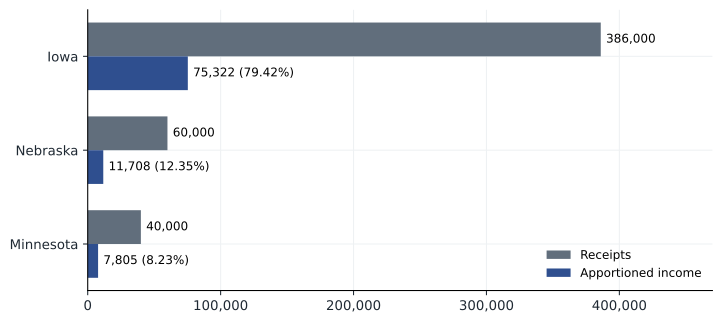
Brandt Aerial LLC's 2027 receipts are $386,000 from Iowa clients, $60,000 from Nebraska and $40,000 from Minnesota. The program apportions its $94,836 of ordinary business income with a single sales factor, computes Iowa's PTET on the Iowa share, simplifying Iowa's rules for resident owners, and estimates the federal tax saved by deducting it at the entity level. It also checks the $100,000 sales tax threshold in each state.
# Brandt Aerial LLC (S corporation): apportionment and Iowa's pass-through entity tax, 2027
# using 2026 rates (illustrative; single sales factor, market-based sourcing assumed)
receipts = {"Iowa": 386_000, "Nebraska": 60_000, "Minnesota": 40_000}
total = sum(receipts.values())
business_income = 94_836
for state, r in receipts.items():
    print(f"{state:<10} receipts {r:>8,}  factor {r / total:7.2%}  apportioned income {business_income * r / total:>10,.2f}")
iowa_income = business_income * receipts["Iowa"] / total
ptet = 0.038 * iowa_income                     # Iowa's flat individual rate for 2026
print(f"Iowa PTET at 3.8% paid by the S corporation:        {ptet:>10,.2f}")
k1_after = business_income - ptet              # deductible in computing federal ordinary income
federal_saving = 0.22 * ptet                   # the Brandts' marginal federal rate
print(f"K-1 ordinary income after deducting the PTET:      {k1_after:>10,.2f}")
print(f"Federal tax saved at 22% (they take the standard deduction): {federal_saving:,.2f}")
print("Without the election, Iowa tax paid personally would give no federal benefit")
print("because the Brandts do not itemize.")
print()
# Economic nexus for sales tax after Wayfair: a common threshold is $100,000 of sales
for state, r in receipts.items():
print(f"{state:<10} sales into the state {r:>8,}: over $100,000? {r > 100_000}")Iowa receipts 386,000 factor 79.42% apportioned income 75,322.42 Nebraska receipts 60,000 factor 12.35% apportioned income 11,708.15 Minnesota receipts 40,000 factor 8.23% apportioned income 7,805.43 Iowa PTET at 3.8% paid by the S corporation: 2,862.25 K-1 ordinary income after deducting the PTET: 91,973.75 Federal tax saved at 22% (they take the standard deduction): 629.70 Without the election, Iowa tax paid personally would give no federal benefit because the Brandts do not itemize. Iowa sales into the state 386,000: over $100,000? True Nebraska sales into the state 60,000: over $100,000? False Minnesota sales into the state 40,000: over $100,000? False
Under a single sales factor, 79.42 percent of the business income, $75,322, is apportioned to Iowa, 12.35 percent to Nebraska and 8.23 percent to Minnesota. Iowa's PTET at 3.8 percent is $2,862.25, which reduces the S corporation's federal ordinary income to $91,973.75 and saves the Brandts about $630 of federal tax at their 22 percent marginal rate; without the election, Leah would pay the same Iowa tax personally with no federal deduction because the Brandts do not itemize. Leah must also file nonresident returns in Nebraska and Minnesota for her shares of income apportioned there, unless the corporation files composite returns, and Iowa will credit her for those taxes. None of the states' sales exceed $100,000 except Iowa, but Brandt Aerial's on-site work gives it physical presence nexus in all three, so if any of its services are taxable in those states, it must register and collect.
Worked problem
Filing in Nebraska
Leah's share of Brandt Aerial LLC's income apportioned to Nebraska is $11,708. Assume Nebraska taxes it at a flat 5 percent for illustration. What filings and credits are involved?
Show solution
- Leah is a nonresident of Nebraska with Nebraska-source income from the S corporation, so either she files a Nebraska nonresident return or Brandt Aerial LLC files a composite return or withholds on her behalf.
- Nebraska tax at the assumed 5 percent is about $585.
- Iowa taxes Leah on all of her income, including the $11,708, but gives her a credit for the Nebraska tax, limited to the Iowa tax on that income (3.8% × $11,708 = about $445).
- Because Nebraska's assumed rate exceeds Iowa's, about $140 of Nebraska tax is not creditable and is an extra cost of working there.
- If the corporation elected a Nebraska PTET, it might deduct that tax federally too; each state's rules must be checked.
Answer: A Nebraska nonresident or composite return, about $585 of Nebraska tax, and an Iowa credit of about $445.
Common mistakes
MistakeAssuming a business with no office in a state cannot owe its taxes.
InsteadPhysical presence of crews or economic nexus can create nexus without an office.
MistakeAssuming services are never subject to sales tax.
InsteadMany states tax enumerated services; Iowa taxes a long list.
MistakeRelying on P.L. 86-272 for a service business.
InsteadIt protects only solicitation of orders for tangible personal property.
MistakeForgetting nonresident filings for S corporation owners.
InsteadOwners must file in each state where the entity's income is apportioned, unless a composite return is filed.
MistakePaying state tax personally when a PTET election would make it deductible.
InsteadPTETs remain deductible at the entity level after the 2025 act.
Summary and key terms
- States can tax a business only with nexus; physical presence or economic nexus can suffice.
- Wayfair (2018) allows economic nexus for sales tax, commonly above $100,000 of sales.
- Taxation of services varies widely by state.
- Most states apportion income by a single sales factor with market-based sourcing.
- Owners of pass-through entities file in each state where income is apportioned; residents get credits for other states' taxes.
- PTETs make state tax deductible at the entity level, avoiding the SALT cap.
- Iowa taxes individuals at a flat 3.8 percent and offers a PTET at that rate.
- Brandt Aerial LLC's Iowa PTET is $2,862.25, saving about $630 of federal tax.
- Nexus
- A connection sufficient for a state to impose a tax on a business.
- Economic nexus
- Nexus based on sales or receipts in a state rather than physical presence.
- Apportionment
- Division of a multistate business's income among the states that tax it.
- Market-based sourcing
- Assigning receipts from services to the state where the customer receives the benefit.
- Pass-through entity tax (PTET)
- An elective state income tax paid by a partnership or S corporation on its owners' income.
- Composite return
- A state return filed by an entity on behalf of its nonresident owners.
- Use tax
- A tax on goods or services used in a jurisdiction when sales tax was not collected on their purchase.
Practice problems
Work each problem on paper first, then reveal the answer to check.
Under Wayfair, what threshold did South Dakota's law use?
Show answer
$100,000 of sales or 200 transactions per year.
Does P.L. 86-272 protect a consulting firm that sends staff into a state?
Show answer
No; it protects only solicitation of orders for tangible personal property.
A business has 30 percent of its receipts from Nebraska. Under a single sales factor, what share of its income does Nebraska tax?
Show answer
30 percent.
What did IRS notice 2020-75 confirm?
Show answer
That entity-level state taxes paid by partnerships and S corporations are deductible by the entity and not subject to the owners' SALT cap.
What is the 2026 SALT cap and where does the phase-down begin?
Show answer
$40,400, phasing down above $505,000 of modified AGI.
Why does the PTET save the Brandts federal tax?
Show answer
The tax is deducted by the S corporation, while state tax paid personally would give no benefit to a family taking the standard deduction.
What is a throwback rule?
Show answer
A rule assigning sales into states where the seller is not taxable back to the seller's state.
In the program, what share of the income is apportioned to Iowa?
Show answer
79.42 percent, $75,322.
Lesson quiz · 5 questions
Score 60% or more to complete this lesson.
Create a free account to save your progress, take quizzes and earn a certificate.