
ACCT-352 · Lesson 11 of 12 · 24 min
Tax planning, anti-abuse doctrines and ethics
Every lesson in this course has involved choices that change the tax owed: which entity to use, how much salary to pay, how to structure a sale, whether to elect a pass-through entity tax. Taxpayers are entitled to arrange their affairs to minimize tax, but that entitlement has limits. Judicial doctrines such as business purpose, substance over form and the step transaction doctrine, now joined by the codified economic substance doctrine, deny the benefits of transactions that comply with the letter of the Code but not its purpose. Disclosure rules require taxpayers and advisers to report listed and reportable transactions, and professional standards govern what tax practitioners may advise and sign. This lesson examines these limits, the reasonable compensation problem in more depth, and the gift and estate planning that owners of family businesses consider.
Planning, avoidance and evasion
Three ideas need to be kept apart. Tax planning uses the Code as Congress intended: electing S status, contributing to a retirement plan, taking bonus depreciation. Tax avoidance uses the Code in ways that comply with its words but defeat its purpose, and its benefits may be denied by judicial doctrines or specific rules. Tax evasion is a willful attempt to evade tax, such as hiding income or claiming fictitious deductions; it is a felony under section 7201, punishable by fines and up to five years in prison, and civil fraud carries a 75 percent penalty. The classic statement that taxpayers may reduce their taxes by legal means comes from Judge Learned Hand in Helvering v. Gregory (2d Cir. 1934); but in the same case the Supreme Court (Gregory v. Helvering, 1935) denied a tax-free reorganization because the transaction had no business purpose beyond tax, beginning the judicial anti-abuse doctrines.
Judicial doctrines and economic substance
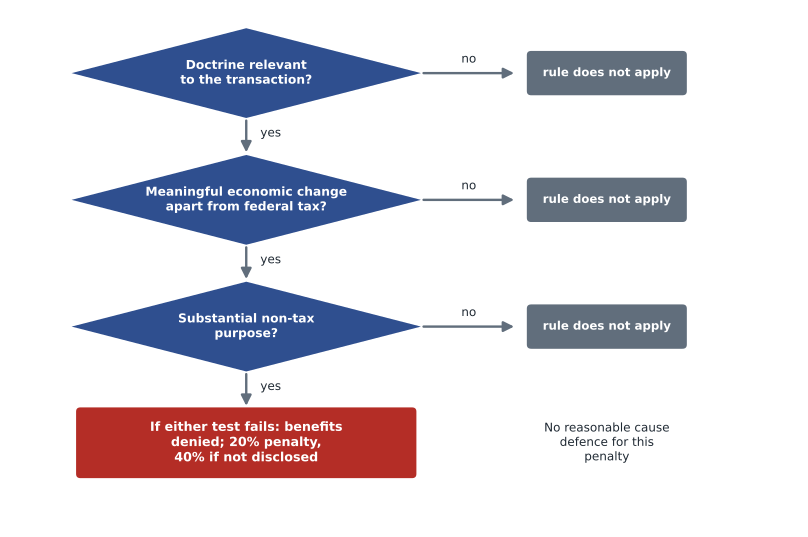
Courts have developed several overlapping doctrines. The business purpose doctrine (Gregory v. Helvering) denies benefits to transactions undertaken only for tax reasons. The substance over form doctrine taxes the economic reality rather than the legal form. The step transaction doctrine collapses a series of formally separate steps into a single transaction when they were prearranged parts of one plan. The sham transaction doctrine disregards transactions that did not actually occur as described. In 2010, Congress codified the economic substance doctrine in section 7701(o): when the doctrine is relevant, a transaction has economic substance only if it changes the taxpayer's economic position in a meaningful way apart from federal income tax effects and the taxpayer has a substantial purpose, apart from federal income tax effects, for entering into it. A strict-liability penalty of 20 percent of the underpayment, 40 percent if the transaction was not adequately disclosed, applies to transactions that lack economic substance, with no reasonable cause defense.
The doctrines apply most often to complex shelters, but owner-managed businesses meet them too. A series of steps designed to convert ordinary income into capital gain, to create artificial losses, or to shift income to a related party in a lower bracket can be collapsed or disregarded. Related-party rules in the Code reinforce the doctrines: section 267 disallows losses on sales between related parties and matches deductions for accrued expenses owed to related cash-basis taxpayers to the year of payment, section 482 reallocates income among commonly controlled businesses, and the reasonable compensation rules discussed in lesson 5 stop S corporation owners from disguising wages as distributions and C corporation owners from disguising dividends as wages.
Reasonable compensation revisited
Because the reasonable compensation rule is enforced through employment taxes, the stakes in an IRS challenge include not only the unpaid Social Security and Medicare tax but also failure-to-deposit and failure-to-pay penalties, interest and, potentially, the trust fund recovery penalty on responsible persons. The IRS's position, and the Watson decision, make clear that labeling payments as distributions does not settle their character; what matters is whether they are compensation for services. The program in this lesson quantifies the cost of a reclassification of Leah's 2027 distributions. Advisers usually recommend a written compensation policy that cites market data, the owner's duties and hours, and the company's profitability, approved annually by the board, and a salary that rises with the business. Paying a reasonable salary is not just defensive: it also increases the 401(k) and Social Security benefit base, while the QBI deduction falls only modestly.
| Doctrine or rule | What it does | Example |
|---|---|---|
| Business purpose | Denies benefits of transactions with no purpose beyond tax | Gregory v. Helvering (1935) |
| Step transaction | Collapses prearranged steps into one transaction | A planned contribution, sale and liquidation |
| Substance over form | Taxes economic reality instead of legal form | A "loan" that is really equity |
| Economic substance (section 7701(o)) | Requires a meaningful economic change and a substantial non-tax purpose | Strict-liability 20 or 40 percent penalty |
| Reasonable compensation | Recharacterizes S distributions as wages, or excessive C wages as dividends | Watson (8th Cir. 2012) |
Gift and estate planning for a family business
The 2025 act made the federal estate and gift tax basic exclusion amount permanent at $15 million per person for 2026, indexed for inflation thereafter, with a 40 percent rate above it; married couples can combine their exclusions through portability. Few family businesses will pay federal estate tax at that level, though some states levy their own estate or inheritance taxes with lower exemptions (Iowa repealed its inheritance tax for deaths after 2024). Planning therefore focuses on income tax as much as transfer tax. Property held at death receives a basis equal to its fair market value under section 1014, erasing the built-in gain, which makes it attractive to hold appreciated assets until death. Lifetime gifts, by contrast, carry over the donor's basis. Owners who wish to shift future growth to children typically give nonvoting S corporation shares, which are allowed because differences in voting rights do not create a second class of stock, to the children directly or to a trust that qualifies as an S shareholder, using the $19,000 annual exclusion per donee for 2026 and part of the lifetime exclusion. Appraisers apply discounts for lack of control and marketability to minority, nonvoting interests, which the IRS scrutinizes.
The Brandts' numbers
The program first quantifies the reasonable compensation risk from lesson 5: the extra tax if the IRS reclassified $40,000 of Leah's 2027 distributions as wages, treating $110,000 rather than $70,000 as her reasonable pay. It then values a gift of 30 percent of Brandt Aerial's equity, in nonvoting shares, to a trust for Nora when the company is worth $600,000, applying an assumed 25 percent discount for lack of control and marketability, and compares the taxable gift with the annual exclusion and the basic exclusion amount.
# Reasonable compensation: what happens if the IRS reclassifies S corporation distributions
# as wages? (2026 rates; illustrative)
salary, distributions = 70_000, 60_000
reclassified = 40_000                  # IRS argues reasonable pay was $110,000
fica = 0.153 * reclassified            # employer and employee shares, below the wage base
k1_reduction = fica / 2                # employer half is deductible to the S corporation
income_tax_change = -0.22 * 0.80 * k1_reduction   # QBI reduces the benefit of the deduction (approx.)
underpayment = fica + income_tax_change
ftd_penalty = 0.10 * fica                # failure-to-deposit penalty tier for deposits made late (s. 6656)
print(f"Wages reclassified from distributions:        {reclassified:>10,.2f}")
print(f"Additional Social Security and Medicare tax:  {fica:>10,.2f}")
print(f"Income tax change from the deduction (approx.): {income_tax_change:>8,.2f}")
print(f"Net additional tax:                           {underpayment:>10,.2f}")
print(f"Failure-to-deposit penalty at the 10% tier:   {ftd_penalty:>10,.2f}")
print("Interest also runs from the original due dates of the payroll returns.")
print()
# Gifting nonvoting S corporation shares to a trust for Nora (estate planning)
company_value = 600_000
nonvoting_fraction = 0.30
discount = 0.25                        # assumed discount for lack of control and marketability
gift_value = company_value * nonvoting_fraction * (1 - discount)
annual_exclusion = 19_000
print(f"Value of 30% nonvoting shares after a {discount:.0%} discount: {gift_value:,.0f}")
print(f"Taxable gift after the annual exclusion: {gift_value - annual_exclusion:,.0f}"
f" (uses part of the $15,000,000 basic exclusion; no gift tax payable)")Wages reclassified from distributions: 40,000.00 Additional Social Security and Medicare tax: 6,120.00 Income tax change from the deduction (approx.): -538.56 Net additional tax: 5,581.44 Failure-to-deposit penalty at the 10% tier: 612.00 Interest also runs from the original due dates of the payroll returns. Value of 30% nonvoting shares after a 25% discount: 135,000 Taxable gift after the annual exclusion: 116,000 (uses part of the $15,000,000 basic exclusion; no gift tax payable)
Reclassifying $40,000 of distributions as wages would cost $6,120 of Social Security and Medicare tax. The corporation would deduct the employer half, reducing Leah's pass-through income and her income tax by about $539 after allowing for the QBI deduction, for a net cost of about $5,581, plus a failure-to-deposit penalty of up to 10 percent, $612, and interest from the original due dates. The gift of nonvoting shares is valued at $135,000 after the assumed discount, and after the $19,000 annual exclusion the taxable gift of $116,000 is reported on Form 709 and uses a small part of Leah's $15 million basic exclusion, so no gift tax is payable. Nora's trust takes Leah's basis in the gifted shares, and the future growth on them is out of Leah's estate.
Listed and reportable transactions
Taxpayers must disclose reportable transactions on Form 8886 with their returns under section 6011: listed transactions identified by the IRS as abusive and substantially similar ones; transactions of interest; confidential transactions; transactions with contractual protection; and certain loss transactions. Material advisors must also disclose them on Form 8918 and keep lists of their clients (sections 6111 and 6112). The penalty for failing to disclose a reportable transaction under section 6707A is 75 percent of the tax decrease, within minimum and maximum amounts that are higher for listed transactions, and the statute of limitations stays open for undisclosed listed transactions. Recent listed transactions have included certain conservation easement syndications and, under final regulations issued in January 2025, certain micro-captive insurance arrangements that small businesses were marketed as a way to deduct premiums paid to a captive insurer owned by the business's owners.
Professional standards in tax practice
Practitioners who represent taxpayers before the IRS are governed by Circular 230 (31 CFR Part 10), which requires due diligence as to accuracy (section 10.22), sets standards for return positions, prohibiting a practitioner from signing a return or advising a position lacking a reasonable basis or that is unreasonable or frivolous (section 10.34), requires competence (section 10.35) and imposes standards for written advice (section 10.37). After Loving v. IRS (D.C. Cir. 2014), the IRS cannot regulate unenrolled preparers' return preparation through Circular 230. CPAs are also bound by the AICPA Statements on Standards for Tax Services, revised effective 1 January 2024, and by state boards of accountancy. Section 6694 imposes preparer penalties for understatements due to unreasonable positions (the greater of $1,000 and 50 percent of the income derived from the engagement) and for willful or reckless conduct (the greater of $5,000 and 75 percent), and section 6701 penalizes aiding and abetting understatements.
Worked problem
A micro-captive pitch
A promoter tells Leah that Brandt Aerial LLC could pay $150,000 a year of premiums to a captive insurance company owned by the Brandts, deduct them, and let the captive pay tax only on its investment income. The 'insurance' covers risks such as loss of a key client that the business has never insured. What should her accountant advise?
Show solution
- Arrangements in which a business pays premiums to a captive owned by its owners, covering implausible risks at inflated prices, are the type identified as listed transactions or transactions of interest by the January 2025 final regulations.
- If the arrangement lacked economic substance or was not genuine insurance, the $150,000 deduction would be disallowed, costing the Brandts about $36,000 of federal tax at a 24 percent marginal rate, plus interest.
- A 20 percent accuracy-related penalty, or 40 percent if the transaction lacked economic substance and was not disclosed, could apply, and failing to file Form 8886 would bring a separate section 6707A penalty.
- Under Circular 230 and the SSTS, the accountant cannot recommend a position without the required level of support and must advise the client of the penalty exposure.
- Unless the business has real, insurable risks priced at arm's length and the captive operates as a genuine insurer, the advice should be to decline.
Answer: Decline: the arrangement fits a listed pattern and risks disallowance, penalties and disclosure failures.
Common mistakes
MistakeAssuming a transaction that follows the letter of the Code is safe.
InsteadJudicial doctrines and section 7701(o) can deny benefits of transactions without economic substance.
MistakePaying a minimal salary and large S corporation distributions.
InsteadDistributions can be reclassified as wages, with employment taxes, penalties and interest.
MistakeIgnoring basis when choosing between gifts and bequests.
InsteadGifts carry over basis; bequests get a step-up to FMV under section 1014.
MistakeFailing to file Form 8886 for a listed transaction.
InsteadThe section 6707A penalty applies and the statute of limitations stays open.
MistakeSigning a return with a position lacking a reasonable basis.
InsteadCircular 230 section 10.34 and section 6694 prohibit and penalize unreasonable positions.
Summary and key terms
- Planning is legal, avoidance can be defeated by doctrines, evasion is a felony.
- Business purpose, step transaction, substance over form and sham doctrines limit avoidance.
- Section 7701(o) requires a meaningful economic change and a substantial non-tax purpose, with strict-liability penalties.
- Reasonable compensation must be paid to S corporation shareholder-employees.
- The estate and gift exclusion is $15 million for 2026, made permanent by the 2025 act.
- Listed and reportable transactions must be disclosed on Form 8886.
- Circular 230, the AICPA SSTS and section 6694 govern practitioners.
- A $40,000 reclassification would cost Brandt Aerial about $5,581 plus penalties.
- Economic substance doctrine
- The doctrine, codified in section 7701(o), denying benefits of transactions lacking economic substance.
- Step transaction doctrine
- A doctrine that collapses prearranged steps into a single transaction.
- Listed transaction
- A transaction the IRS has identified as abusive, which must be disclosed.
- Circular 230
- The regulations governing practice before the IRS.
- Basic exclusion amount
- The amount of lifetime gifts and estate exempt from federal transfer tax, $15 million for 2026.
- Stepped-up basis
- The fair market value basis given to property acquired from a decedent under section 1014.
- Tax avoidance
- Reducing tax by means that comply with the words of the law but may defeat its purpose.
- Tax evasion
- Deliberately misrepresenting facts to reduce tax, a criminal offense.
Practice problems
Work each problem on paper first, then reveal the answer to check.
State the two prongs of the codified economic substance test.
Show answer
A meaningful change in economic position apart from federal income tax effects, and a substantial non-tax purpose.
What penalty applies to a transaction lacking economic substance?
Show answer
20 percent of the underpayment, or 40 percent if not disclosed, with no reasonable cause defense.
Why is Leah's reasonable salary also a benefit to her?
Show answer
It raises her 401(k) and Social Security benefit base.
Why might the Brandts prefer to hold appreciated assets until death?
Show answer
Section 1014 steps up basis to FMV, eliminating the built-in gain.
What is the 2026 annual gift tax exclusion?
Show answer
$19,000 per donee.
What did Loving v. IRS decide?
Show answer
That the IRS could not regulate unenrolled return preparers under Circular 230.
What is the preparer penalty for an unreasonable position?
Show answer
The greater of $1,000 and 50 percent of the income from the engagement.
In the program, what is the taxable gift after the annual exclusion?
Show answer
$116,000.
Lesson quiz · 5 questions
Score 60% or more to complete this lesson.
Create a free account to save your progress, take quizzes and earn a certificate.