
ACCT-352 · Lesson 3 of 12 · 23 min
Corporate tax rates, minimum taxes and penalty taxes
The federal tax rate on C corporations is simple: a flat 21 percent of taxable income under section 11, with no graduated brackets. The complexity lies elsewhere: in state corporate income taxes, in the special taxes that stop closely held corporations from being used to shelter income at the corporate rate, and in the minimum taxes that apply to very large corporations. This lesson explains the rate structure and its history, the deduction for state taxes, the accumulated earnings tax and the personal holding company tax, the corporate alternative minimum tax, the controlled group rules and corporate estimated tax, and computes the model Brandt Aerial corporation's 2027 federal and Iowa income tax.
The flat 21 percent rate
Section 11 imposes tax at 21 percent on the taxable income of every corporation. Before 2018, corporations paid graduated rates from 15 percent on the first $50,000 to 35 percent, with surtaxes that removed the lower brackets for larger corporations and a flat 35 percent rate for personal service corporations. The Tax Cuts and Jobs Act replaced all of that with a single rate, which the 2025 act left unchanged. Because the rate is flat, many rules that once mattered, such as the requirement that a controlled group share a single set of lower brackets, now matter only for the items that are still shared. A flat rate also means that the timing of deductions matters less for a C corporation than for an individual whose bracket changes from year to year, except where losses are limited.
| Tax | Rate | Applies to | Code section |
|---|---|---|---|
| Regular corporate income tax | 21% | Taxable income of every C corporation | 11 |
| Accumulated earnings tax | 20% | Accumulated taxable income beyond reasonable business needs | 531 |
| Personal holding company tax | 20% | Undistributed personal holding company income | 541 |
| Corporate alternative minimum tax | 15% | Adjusted financial statement income of corporations averaging over $1 billion | 55 |
| Base erosion and anti-abuse tax | 10.5% from 2026 | Large corporations with deductible payments to foreign affiliates | 59A |
| State corporate income tax (Iowa, 2026) | 5.5% to $100,000, 7.1% above | Iowa taxable income | Iowa Code ch. 422 |
State corporate income taxes
Forty-four states and the District of Columbia levy corporate income taxes, at top rates from about 2 to 11.5 percent, and a few levy gross receipts taxes instead. Most start from federal taxable income and then make their own adjustments, for example adding back bonus depreciation where the state has decoupled from it. A corporation doing business in several states apportions its income among them, most commonly today by a single sales factor; lesson 9 covers nexus and apportionment. Iowa taxes corporate income at 5.5 percent on the first $100,000 and 7.1 percent above that for tax years beginning in 2026; scheduled reductions did not take effect for 2026 because state revenue did not reach the trigger. Unlike individuals, whose deduction for state and local taxes is capped, a corporation deducts state income taxes in full as a business expense, which reduces the combined rate.
The small business deduction
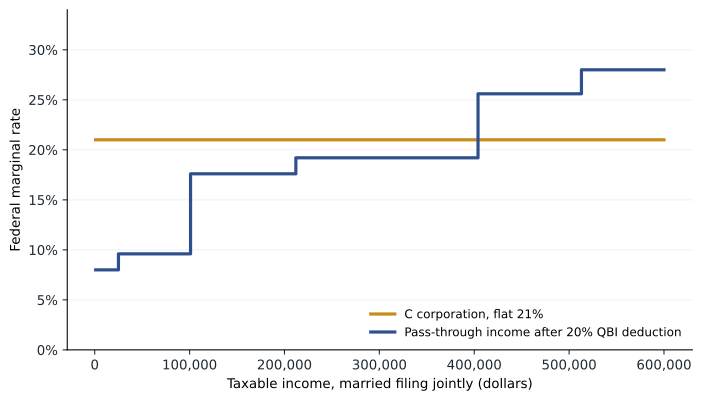
Unlike Canada, the United States gives small C corporations no reduced rate. Instead, the main tax preference for small businesses runs through flow-through entities: the qualified business income deduction of section 199A, which the 2025 act made permanent at 20 percent, with wider phase-in ranges for the wage and property limits and a minimum $400 deduction from 2026 for taxpayers with at least $1,000 of qualified business income from active businesses. Small C corporations do benefit from simpler accounting rules, exemption from the business interest limit and the possibility of a section 1202 exclusion for their shareholders on a sale. A personal service corporation pays the same 21 percent rate as other corporations, but its owner-employees must still be paid reasonable compensation, and the passive activity rules restrict the losses it can deduct.
Special taxes on closely held corporations
Because the 21 percent corporate rate is lower than the top individual rates, the Code has long contained two penalty taxes to stop owners from leaving profits in a corporation simply to avoid personal tax. The accumulated earnings tax of section 531 is 20 percent of accumulated taxable income, roughly the year's taxable income adjusted toward economic income, minus dividends paid and an accumulated earnings credit. The credit lets every corporation accumulate at least $250,000 ($150,000 for corporations whose principal function is services in health, law, engineering, architecture, accounting, actuarial science, performing arts or consulting) and more if it can show reasonable business needs, such as working capital, expansion, debt retirement or self-insurance. The personal holding company tax of section 541 is 20 percent of undistributed personal holding company income. It applies if five or fewer individuals own more than half of the stock by value at any time during the last half of the year and at least 60 percent of adjusted ordinary gross income is passive income such as dividends, interest, royalties and certain rents, or income from personal service contracts that name a 25 percent shareholder. Both taxes are avoided by paying dividends.
Two other regimes affect larger corporations. The corporate alternative minimum tax, enacted in 2022, imposes a 15 percent minimum tax on adjusted financial statement income for corporations whose average annual adjusted financial statement income over three years exceeds $1 billion (or $100 million for US members of foreign-parented groups above the $1 billion test). The base erosion and anti-abuse tax applies to corporations with average gross receipts of $500 million or more that make large deductible payments to foreign related parties; the 2025 act set its rate at 10.5 percent for tax years beginning after 2025. Members of a controlled group of corporations must share certain items, such as one accumulated earnings credit and the section 179 limit, and aggregate their gross receipts for the small business tests.
Whether a C corporation's 21 percent rate is attractive depends on what happens to the profits next. If they are reinvested in the business for many years, the corporation defers the difference between 21 percent and the owner's marginal rate, and on a sale the shareholder may exclude gain under section 1202. If they are paid out each year, the second layer of tax usually makes the C corporation more expensive than a pass-through. Many owner-managed C corporations therefore pay out most of their profit as deductible salaries and bonuses, but the IRS can challenge compensation that is unreasonably high and treat the excess as a nondeductible dividend: the mirror image of the S corporation problem of compensation that is too low. Lessons 4, 5 and 11 return to these choices.
The model corporation's federal and Iowa tax
The program computes the model corporation's 2027 Iowa and federal income tax from the taxable income determined in lesson 2, applying the 2026 rates. It assumes Iowa taxable income equals federal taxable income before the deduction for state tax, a simplification, then deducts the Iowa tax in computing federal tax. It also projects the corporation's accumulated earnings if it keeps most of its profits, and confirms that the corporate alternative minimum tax does not apply.
# Brandt Aerial as a C corporation: federal and Iowa income tax for 2027 using 2026 rates
taxable = 107_836
federal = 0.21 * taxable

def iowa_corporate(x):
    """Iowa corporate rates for tax years beginning in 2026: 5.5% to $100,000, 7.1% above."""
    return 0.055 * min(x, 100_000) + 0.071 * max(0, x - 100_000)

state = iowa_corporate(taxable)           # assumes Iowa taxable income equals federal
deductible_state = state                  # state income tax is deductible federally
federal_after = 0.21 * (taxable - deductible_state)
print(f"Federal taxable income before state tax       {taxable:>11,.2f}")
print(f"Iowa corporate income tax                     {state:>11,.2f}")
print(f"Federal tax after deducting Iowa tax (21%)    {federal_after:>11,.2f}")
print(f"Combined federal and Iowa tax                 {federal_after + state:>11,.2f}")
print(f"Combined rate on income before both taxes     {(federal_after + state) / taxable:.2%}")
print()
# Accumulated earnings tax: 20% on accumulated taxable income beyond reasonable needs;
# the minimum credit shelters $250,000 of accumulated earnings ($150,000 for listed service fields)
retained = [86_000, 140_000, 190_000, 240_000]
total = 0
for yr, r in zip(range(2027, 2031), retained):
    total += r
    over = max(0, total - 250_000)
    print(f"{yr}: accumulated earnings {total:>9,}  above the $250,000 credit {over:>9,}")
print("Above the credit, the corporation must show reasonable business needs or face 20% AET.")
print()
print("Corporate alternative minimum tax applies only if average annual adjusted financial")
avg_afsi = 120_000
print(f"statement income exceeds $1 billion; Brandt Aerial's is about {avg_afsi:,}: CAMT does not apply.")Federal taxable income before state tax 107,836.00 Iowa corporate income tax 6,056.36 Federal tax after deducting Iowa tax (21%) 21,373.73 Combined federal and Iowa tax 27,430.08 Combined rate on income before both taxes 25.44% 2027: accumulated earnings 86,000 above the $250,000 credit 0 2028: accumulated earnings 226,000 above the $250,000 credit 0 2029: accumulated earnings 416,000 above the $250,000 credit 166,000 2030: accumulated earnings 656,000 above the $250,000 credit 406,000 Above the credit, the corporation must show reasonable business needs or face 20% AET. Corporate alternative minimum tax applies only if average annual adjusted financial statement income exceeds $1 billion; Brandt Aerial's is about 120,000: CAMT does not apply.
Iowa tax is $6,056.36, and deducting it reduces federal tax to $21,373.73, so the combined rate is about 25.4 percent rather than the 26.5 percent the two statutory rates would suggest. The projection shows why the accumulated earnings tax matters to owner-managed C corporations: if Brandt Aerial kept most of its profits, its accumulated earnings would pass the $250,000 credit in 2029, after which the IRS could assess the 20 percent tax on accumulations it could not justify by business needs. Plans for new equipment, a second crew or a building, documented in board minutes, are the usual defense. The corporate alternative minimum tax is irrelevant to a business of this size.
Corporate estimated tax
Corporations must pay estimated tax in four installments, due on the 15th day of the 4th, 6th, 9th and 12th months of the tax year (15 April, 15 June, 15 September and 15 December for a calendar-year corporation), if they expect to owe $500 or more. Each installment should be 25 percent of the lesser of the current year's tax and the prior year's tax, but the prior-year safe harbor is unavailable if the prior year was a short year or showed no tax, and a large corporation (one with taxable income of $1 million or more in any of the three preceding years) can use the prior-year amount only for its first installment. Underpayments bear an addition to tax computed like interest. A new corporation such as the model Brandt Aerial must therefore estimate its first year's tax carefully.
Worked problem
The personal holding company tax
Suppose that instead of operating a business, a corporation wholly owned by Leah holds investments that earn $90,000 of dividends and interest in a year, its only income, and it pays no dividends. Its taxable income after the DRD and expenses is $80,000. What penalty tax applies?
Show solution
- Leah owns more than 50 percent of the stock, so the stock ownership test is met.
- All of its income is passive, so more than 60 percent of adjusted ordinary gross income is personal holding company income: it is a personal holding company.
- Undistributed personal holding company income is roughly taxable income adjusted for federal tax, the DRD and other items, minus dividends paid: approximately $80,000 less federal tax of $16,800, or $63,200.
- The PHC tax is 20% × $63,200 = $12,640, on top of the regular tax.
- Paying dividends of $63,200 during the year, or within the first 3½ months of the next year (up to limits), or by a deficiency dividend after a determination, avoids the tax.
Answer: About $12,640 of PHC tax unless the corporation pays dividends.
Common mistakes
MistakeThinking small C corporations get lower graduated rates.
InsteadGraduated corporate rates were repealed for years after 2017; all C corporations pay 21 percent.
MistakeIgnoring the accumulated earnings tax because the corporation is small.
InsteadAccumulations above $250,000 must be justified by reasonable business needs.
MistakeAssuming the PHC tax applies only to holding companies.
InsteadAny closely held corporation whose income is at least 60 percent passive can be a PHC.
MistakeForgetting that state tax is deductible to a corporation.
InsteadCorporations deduct state income taxes without the SALT cap, lowering the combined rate.
MistakePaying corporate estimated tax only at year-end.
InsteadInstallments are due in the 4th, 6th, 9th and 12th months; underpayments bear an addition to tax.
Summary and key terms
- C corporations pay a flat 21 percent federal rate.
- Small C corporations get no reduced rate; the QBI deduction favors pass-throughs.
- Iowa's 2026 corporate rates are 5.5 percent to $100,000 and 7.1 percent above.
- State income taxes are deductible by corporations.
- The accumulated earnings tax is 20 percent on unjustified accumulations above the credit.
- The personal holding company tax is 20 percent on undistributed passive income of closely held corporations.
- The 15 percent CAMT applies only to corporations averaging over $1 billion of book income.
- The model corporation's combined federal and Iowa tax is $27,430.08.
- Accumulated earnings tax
- A 20 percent tax on a corporation's accumulated taxable income beyond reasonable business needs.
- Personal holding company
- A closely held corporation whose income is mostly passive, subject to a 20 percent tax on undistributed income.
- Corporate alternative minimum tax (CAMT)
- A 15 percent minimum tax on adjusted financial statement income of very large corporations.
- Controlled group
- Corporations under common control that must share certain tax benefits.
- Personal service corporation
- A corporation whose principal activity is services in listed fields performed by employee-owners.
- Accumulated earnings credit
- The amount a corporation may accumulate free of the accumulated earnings tax, at least $250,000 or $150,000.
- Effective rate
- The combined federal and provincial or state rate actually applied to a type of income.
Practice problems
Work each problem on paper first, then reveal the answer to check.
What was the top federal corporate rate before 2018, and what is it now?
Show answer
35 percent; 21 percent.
In the program, what is the combined federal and Iowa rate?
Show answer
About 25.44%.
A closely held corporation has accumulated $400,000 of earnings and pays no dividends. When is it at risk of the accumulated earnings tax?
Show answer
When accumulations above $250,000 exceed its reasonable business needs.
What two tests make a corporation a personal holding company?
Show answer
More than 50 percent of value owned by five or fewer individuals in the last half of the year, and 60 percent or more of adjusted ordinary gross income from PHC income.
Why can a C corporation deduct Iowa income tax in full?
Show answer
State income tax is a business expense; the SALT cap applies only to individuals.
When are a corporation's estimated tax installments due?
Show answer
On the 15th day of the 4th, 6th, 9th and 12th months of the tax year.
Which corporations are subject to the CAMT?
Show answer
Those whose average annual adjusted financial statement income exceeds $1 billion.
In the PHC example, how can the corporation avoid the tax?
Show answer
By paying dividends equal to its undistributed PHC income.
Lesson quiz · 5 questions
Score 60% or more to complete this lesson.
Create a free account to save your progress, take quizzes and earn a certificate.