
ACCT-352 · Lesson 5 of 12 · 23 min
Choosing an entity: sole proprietorship, S corporation or C corporation
The choice of entity is one of the most consequential tax decisions a business owner makes, and it is not made once: owners revisit it as the business grows, takes on investors or approaches a sale. This lesson brings together the rules from lessons 1 to 4 and compares the three main choices for the Brandts' business, using their actual 2027 numbers: operating as a sole proprietorship (or single-member LLC), electing S corporation status and paying Leah a salary, or operating as a C corporation. It then examines the factors that decide the comparison in practice: payroll and self-employment taxes, the qualified business income deduction, reasonable compensation, fringe benefits and retirement plans, retention of profits, and the expected exit.
The building blocks of the comparison
Four sets of rules drive the comparison. First, self-employment tax: a sole proprietor or active partner pays 15.3 percent on 92.35 percent of net earnings up to the $184,500 Social Security wage base for 2026, and 2.9 percent above it. Second, payroll tax: an S or C corporation pays its owner-employee a salary on which the corporation and the employee each pay 7.65 percent, but distributions of S corporation profit and dividends from a C corporation bear no employment tax. Third, the qualified business income deduction of 20 percent applies to a sole proprietor's net profit and to S corporation and partnership income, but not to wages, guaranteed payments or C corporation dividends. Fourth, the C corporation pays 21 percent and its shareholders pay tax again on dividends, while flow-through income is taxed once at the owners' rates.
| Structure | Income tax base | Employment taxes | Main advantage |
|---|---|---|---|
| Sole proprietorship | All net profit, less half of SE tax, less QBI deduction | SE tax on all net earnings | Simplicity |
| S corporation | Salary plus pass-through income, less QBI deduction on the pass-through part | FICA on reasonable salary only | Payroll tax saving |
| C corporation | 21% at the corporate level; dividends taxed again | FICA on salary only | Low rate on retained profits; section 1202 |
| Partnership (multi-member LLC) | Distributive shares, less QBI deduction | SE tax on general partners' and active members' shares | Flexibility in allocations and distributions |
The Brandts' comparison
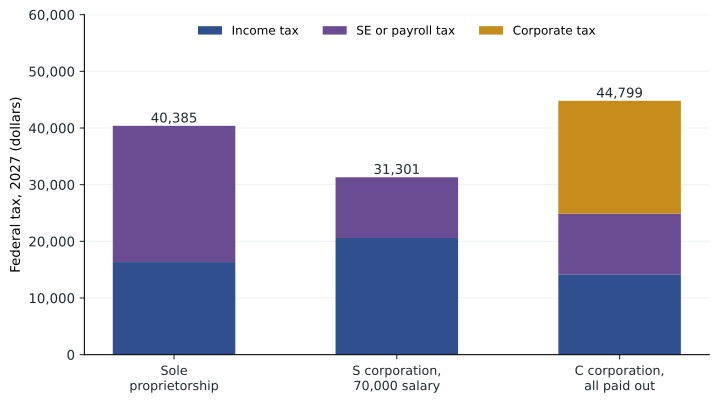
The program computes the Brandts' total federal tax for 2027 under each structure, using the business income determined in lesson 2 before any payment to Leah, $170,191, and 2026 rates. Tomás's wages of $38,000 and the standard deduction and child tax credit are the same in every case. For the S and C corporations, Leah is paid a $70,000 salary. The C corporation is assumed to pay out all of its after-tax profit as qualified dividends, which is the worst case for it; the investment income in the corporation is left out to keep the comparison clean. The final lines vary Leah's S corporation salary.
# Sole proprietorship, S corporation or C corporation? The Brandts' 2027 federal tax using
# 2026 rules, married filing jointly (illustrative). Tomas earns $38,000 of wages.
BR = [(24_800, 0.10), (100_800, 0.12), (211_400, 0.22), (403_550, 0.24),
      (512_450, 0.32), (768_700, 0.35), (float('inf'), 0.37)]
PRE_PAY = 170_191              # active business income before paying Leah anything
TOMAS, STD, CTC = 38_000, 32_200, 2_200

def bracket(x):
    tax, lo = 0.0, 0.0
    for hi, r in BR:
        if x > lo:
            tax += (min(x, hi) - lo) * r
        lo = hi
    return tax

def qualified_div_tax(ordinary_taxable, qd):
    zero = max(0.0, min(qd, 98_900 - ordinary_taxable))
    return 0.15 * (qd - zero)                      # 20% band starts far higher

def sole_prop():
    se = 0.153 * 0.9235 * PRE_PAY                  # below the $184,500 wage base
    agi = TOMAS + PRE_PAY - se / 2
    qbi = 0.20 * (PRE_PAY - se / 2)
    income_tax = bracket(agi - STD - qbi) - CTC
    return {"income tax": income_tax, "payroll/SE tax": se, "corporate tax": 0.0}

def s_corp(salary=70_000):
    fica = 0.153 * salary                          # employee 7.65% + employer 7.65%
    k1 = PRE_PAY - salary - fica / 2
    qbi = 0.20 * k1
    income_tax = bracket(TOMAS + salary + k1 - STD - qbi) - CTC
    return {"income tax": income_tax, "payroll/SE tax": fica, "corporate tax": 0.0}

def c_corp(salary=70_000):
    fica = 0.153 * salary
    corp_income = PRE_PAY - salary - fica / 2
    corp_tax = 0.21 * corp_income
    dividend = corp_income - corp_tax              # all paid out as qualified dividends
    ordinary = TOMAS + salary - STD
    income_tax = bracket(ordinary) + qualified_div_tax(ordinary, dividend) - CTC
    return {"income tax": income_tax, "payroll/SE tax": fica, "corporate tax": corp_tax}

for name, f in (("Sole proprietorship (Schedule C)", sole_prop),
                ("S corporation, $70,000 salary", s_corp),
                ("C corporation, $70,000 salary, rest paid out", c_corp)):
    r = f()
    total = sum(r.values())
    print(f"{name:<46} income {r['income tax']:>9,.0f}  payroll/SE {r['payroll/SE tax']:>7,.0f}"
          f"  corporate {r['corporate tax']:>7,.0f}  total {total:>8,.0f}")
print()
for salary in (50_000, 70_000, 100_000, 140_000):
print(f"S corporation salary {salary:>8,}: total federal tax {sum(s_corp(salary).values()):>9,.0f}")Sole proprietorship (Schedule C) income 16,337 payroll/SE 24,047 corporate 0 total 40,385 S corporation, $70,000 salary income 20,591 payroll/SE 10,710 corporate 0 total 31,301 C corporation, $70,000 salary, rest paid out income 14,173 payroll/SE 10,710 corporate 19,916 total 44,799 S corporation salary 50,000: total federal tax 27,630 S corporation salary 70,000: total federal tax 31,301 S corporation salary 100,000: total federal tax 36,807 S corporation salary 140,000: total federal tax 44,149
The S corporation is clearly cheapest: $31,301 of federal tax, against $40,385 for the sole proprietorship and $44,799 for the C corporation that pays out its profits. The S corporation saves $13,337 of employment taxes compared with the proprietorship, because only the $70,000 salary bears FICA ($10,710) instead of self-employment tax on all of the profit ($24,047), partly offset by higher income tax because the QBI deduction no longer applies to the salary portion. The C corporation is most expensive because the dividends are taxed again, although at only 15 percent. The final lines show how sensitive the S corporation result is to Leah's salary: each extra $10,000 of salary costs about $1,800 of tax. The temptation is to pay a very low salary, which is exactly what the reasonable compensation rules address.
Reasonable compensation
An S corporation shareholder who performs more than minor services for the corporation must be paid reasonable compensation before receiving non-wage distributions. The Code does not say so directly; the IRS relies on the definition of wages in the employment tax provisions, Revenue Ruling 74-44 and a long line of cases that recharacterize distributions as wages when the salary is unreasonably low. The leading modern case, David E. Watson, P.C. v. United States (8th Cir. 2012), involved an Iowa accountant who paid himself $24,000 a year through his S corporation while taking much larger distributions; the court upheld the IRS's finding that about $91,000 was reasonable. Factors include training and experience, duties and responsibilities, time devoted to the business, what comparable businesses pay for similar services, and the proportion of revenue generated by the owner's personal services. A salary supported by market data and documented annually is the best defense.
QBI, fringe benefits and retirement plans
Several other differences matter. The QBI deduction is 20 percent of qualified business income, limited to 20 percent of taxable income minus net capital gain. Above a threshold ($201,750 single, $403,500 joint for 2026), the deduction is limited by W-2 wages paid by the business and the basis of its depreciable property, phased in over $75,000 ($150,000 joint) under the 2025 act's wider ranges, and income from specified service trades or businesses, such as health, law, consulting and financial services, is phased out entirely. Fringe benefits favor the C corporation: a shareholder owning more than 2 percent of an S corporation is treated like a partner, so health insurance premiums paid for him are added to W-2 wages (though deductible on his return as self-employed health insurance) and he cannot use a cafeteria plan. Retirement plans favor paying wages: 401(k) deferrals, $24,500 for 2026, and employer contributions in an S or C corporation are based on W-2 wages, while a sole proprietor's contributions are based on net self-employment earnings.
Retaining profits and planning the exit
The comparison changes if profits are retained rather than paid out. A C corporation keeping $100 of profit pays $21, while an S corporation's owners in the 24 percent bracket pay $24 less the QBI deduction's effect, about $19.20, plus nothing on retention; the difference is small at middle incomes but grows for owners in the 35 or 37 percent brackets. The exit also matters. A buyer usually wants to buy assets and get a stepped-up basis; an S corporation's asset sale is taxed once to the shareholders, while a C corporation's asset sale is taxed to the corporation and again when the proceeds are distributed, as lesson 6 shows. A C corporation whose stock qualifies under section 1202 can be sold with the gain partly or wholly excluded. Converting from C to S status later is possible but triggers the built-in gains tax on appreciation present at conversion if assets are sold within five years (lesson 8), while revoking S status bars a new election for five years.
Two other differences complete the comparison. First, the net investment income tax of 3.8 percent applies to C corporation dividends received by shareholders with modified AGI above $250,000 (joint) but not to S corporation or partnership business income of owners who materially participate, which widens the gap for high-income owners. Second, state taxes vary: a C corporation pays state corporate income tax, which it can deduct federally, and its shareholders pay state tax again on dividends; an S corporation's income is taxed once at the owners' state rates, and an elective pass-through entity tax can make that state tax deductible federally, as lesson 9 explains. A few states, such as New York City and California, impose entity-level taxes on S corporations that reduce the advantage, and a few, such as Tennessee and Texas, tax LLCs and S corporations at the entity level under franchise or margin taxes. Because Iowa offers a PTET and taxes individuals at a flat 3.8 percent, the state picture reinforces the S corporation choice for the Brandts. Finally, all of these comparisons are sensitive to the facts: a much more profitable business, a plan to sell within a few years, or outside investors could change the answer, so the choice should be revisited as the business grows.
Worked problem
Setting a reasonable salary
Leah's accountant gathers salary data for operations managers of small inspection firms who also handle sales and fly missions. Invented survey data suggest $85,000 to $110,000. Leah's 2027 salary is $70,000. Compare the tax of raising it to $100,000 with the risk of keeping it at $70,000.
Show solution
- From the program, total federal tax rises from $31,301 at a $70,000 salary to $36,807 at $100,000, a cost of $5,506 a year.
- A $70,000 salary is below the range suggested by market data for someone with her duties, so the IRS could argue that part of her $60,000 of distributions is wages.
- If it reclassified $30,000, the corporation would owe the unpaid FICA of about $4,590, plus failure-to-deposit penalties and interest, and might lose the ability to file amended payroll returns without penalty.
- Raising the salary to about $90,000 to $100,000 and documenting the market data would cost $3,600 to $5,500 a year but greatly reduce the risk.
- Higher wages also increase her 401(k) contribution base and reduce QBI only slightly.
Answer: A salary of about $90,000 to $100,000, supported by market data, costs a few thousand dollars a year but substantially reduces the reasonable compensation risk.
Common mistakes
MistakeAssuming the S corporation is always cheapest.
InsteadIts advantage depends on a reasonable salary and on whether profits are paid out; a C corporation may suit retained earnings and a section 1202 exit.
MistakePaying an S corporation owner no salary.
InsteadThe IRS can reclassify distributions as wages; pay reasonable compensation.
MistakeForgetting the QBI deduction does not apply to wages.
InsteadHigher salaries reduce QBI and the deduction.
MistakeTreating health insurance for a 2 percent S shareholder as a tax-free fringe benefit.
InsteadPremiums are included in W-2 wages, then deductible as self-employed health insurance.
MistakeComparing entities without considering the exit.
InsteadAsset sales from C corporations face double tax; S corporations and section 1202 stock may not.
Summary and key terms
- Self-employment tax, payroll tax, the QBI deduction and the corporate double tax drive the comparison.
- For the Brandts, the S corporation costs $31,301, the sole proprietorship $40,385 and the C corporation $44,799.
- The S corporation's saving comes from avoiding employment taxes on profit above salary.
- S corporation owners must be paid reasonable compensation, as in Watson.
- Above the thresholds, the QBI deduction is limited by wages and property and phased out for specified services.
- More-than-2-per-cent S shareholders lose tax-free fringe benefits.
- Retention of profits and the exit can favor a C corporation.
- Leah's 2027 salary is $70,000; the market data suggest raising it.
- Reasonable compensation
- The salary an S corporation must pay a shareholder-employee for services before non-wage distributions.
- Self-employment tax
- Social Security and Medicare tax on net earnings from self-employment.
- FICA
- Social Security and Medicare taxes on wages, paid half by the employer and half by the employee.
- Specified service trade or business
- A business in fields such as health, law or consulting whose income loses the QBI deduction above the thresholds.
- More-than-2-per-cent shareholder
- An S corporation shareholder treated like a partner for fringe benefits.
- Built-in gains tax
- Corporate-level tax on appreciation present when a C corporation converts to S status, recognized within five years.
- Owner-manager
- An individual who owns and runs a private corporation.
Practice problems
Work each problem on paper first, then reveal the answer to check.
In the program, how much employment tax does the S corporation save compared with the sole proprietorship?
Show answer
$24,047 − $10,710 = $13,337.
Why does the S corporation pay more income tax than the sole proprietorship in the program?
Show answer
The QBI deduction does not apply to the $70,000 salary.
What is the 2026 Social Security wage base?
Show answer
$184,500.
Name three factors in determining reasonable compensation.
Show answer
For example training and experience, duties, time devoted, comparable pay and the revenue generated by the owner's services.
In Watson, what salary did the taxpayer pay himself and what did the court find reasonable?
Show answer
$24,000; about $91,000.
When is the QBI deduction limited by W-2 wages?
Show answer
When taxable income exceeds $201,750 (single) or $403,500 (joint) for 2026, phased in over $75,000 or $150,000.
In the program, what is the cost of raising Leah's salary from $70,000 to $100,000?
Show answer
$5,506.
Why might a business planning a sale in ten years choose a C corporation?
Show answer
For the possible section 1202 exclusion and the low 21 percent rate on reinvested profits.
Lesson quiz · 5 questions
Score 60% or more to complete this lesson.
Create a free account to save your progress, take quizzes and earn a certificate.