
ACCT-352 · Lesson 7 of 12 · 24 min
Partnerships
Partnerships are widely used in Canada for professional firms, real estate and resource ventures, joint ventures between corporations, and investment funds structured as limited partnerships. The tax treatment rests on a simple idea: a partnership is not a taxpayer, but its income is computed as though it were a separate person and then allocated to the partners. That idea produces a body of rules about computing partnership income, allocating it, tracking each partner's adjusted cost base, limiting losses, moving property into and out of partnerships, and reporting. This lesson works through them using SkyGrid Data, the general partnership that Leah and Dev Mehta formed in 2027 to process aerial survey data.
What is a partnership?
The Act does not define a partnership, so the courts look to provincial partnership law: in Manitoba, as elsewhere, a partnership is the relation that subsists between persons carrying on a business in common with a view to profit. The Supreme Court of Canada in Backman v. Canada (2001) and Spire Freezers Ltd. v. Canada (2001) confirmed that all three elements, a business, carried on in common and with a view to profit, must be present, and that a partnership agreement alone does not create one. Co-ownership of property, for example two people jointly owning a rental building, is not by itself a partnership, and a joint venture, in which parties cooperate on a specific project but each reports its own share of revenue and expenses, is treated differently. A general partnership exposes each partner to unlimited, joint liability; a limited partnership, registered under provincial law, limits the liability of limited partners who take no part in management; and a limited liability partnership protects professional partners from liability for each other's negligence.
Computing and allocating partnership income
Subsection 96(1) computes the partnership's income as if the partnership were a separate person resident in Canada and its fiscal period were its taxation year. Revenues and expenses are determined at the partnership level, the partnership claims CCA on its depreciable property, and capital gains, dividends, foreign income and other items keep their character as they pass to the partners. Each partner then includes its share of the income for the fiscal period ending in its taxation year. A partnership with any individual partners generally must use a 31 December fiscal year-end. The partnership agreement normally determines the shares, and it can allocate different items in different proportions, but subsection 103(1) lets the CRA reallocate income where the principal reason for an allocation was to reduce tax, and subsection 103(1.1) where an allocation is not reasonable having regard to the partners' capital, work and other factors. Salaries or draws paid to partners are not expenses of the partnership: they are simply a way of allocating income. Donations and political contributions made by the partnership flow out to the partners, who claim the credits or deductions.
The adjusted cost base of a partnership interest
A partner's interest in a partnership is capital property with an adjusted cost base that changes every year. Under section 53, the ACB is increased by contributions of capital and by the partner's share of income, including the full amount of capital gains (both halves), at the end of the fiscal period; it is reduced by drawings and by the partner's share of losses. Unlike the US rules, a partner's share of partnership debt is not added to the ACB. When a partner sells the interest, the capital gain is the proceeds minus the ACB at that time; to avoid double counting, income allocated to the partner for a fiscal period that has not yet ended is added to the ACB just before the sale. If the ACB of a limited partner, or of a partner who is not actively engaged in the business, becomes negative at the end of a fiscal period, subsection 40(3.1) deems the negative amount to be a capital gain immediately; a general partner who is actively engaged pays tax on a negative ACB only when the interest is disposed of.
| Adjustment to ACB | Effect | Timing |
|---|---|---|
| Capital contributed | Increase | When contributed |
| Share of income, including the full capital gain | Increase | End of the fiscal period |
| Drawings | Decrease | When received |
| Share of losses | Decrease | End of the fiscal period |
| Share of partnership debt | No effect | Not applicable |
| Negative ACB of a limited or inactive partner | Deemed capital gain; ACB reset to nil | End of the fiscal period |
Limited partners and losses
Limited partnerships have long been used as tax shelters, because partnership losses flow through to the partners. Subsection 96(2.1) limits the losses a limited partner can deduct to its 'at-risk amount', which is broadly the ACB of its interest plus its share of current income, minus amounts owed to the partnership and any guarantees or protections against loss. Losses denied by the at-risk rule become limited partnership losses that can be carried forward indefinitely and deducted when the at-risk amount increases. A general partner who is actively engaged is not subject to the at-risk rules and can deduct its share of losses against other income, but bears unlimited liability. Corporate partners face one more limit, from lesson 3: the small business deduction on income earned through a partnership is limited to the corporation's share of a single business limit for the partnership.
SkyGrid Data's 2027 income
Leah contributes $30,000 of cash to SkyGrid Data. Dev contributes servers and software with a fair market value of $30,000 and a cost of $12,000, and the partners jointly elect under subsection 97(2) to transfer them at $12,000, so Dev defers his $18,000 gain. The partnership agreement gives Dev a priority allocation of the first $24,000 of income each year in recognition of his full-time work and splits the rest equally. In 2027 the partnership earns $140,000 of revenue and has $70,000 of expenses, including CCA. Leah draws $8,000 and Dev $24,000. The partnership also borrows $20,000 from a bank.
# SkyGrid Data, a Manitoba general partnership of Leah and Dev Mehta, 2027 (illustrative)
contrib = {"Leah": {"cash": 30_000, "fmv": 30_000, "acb": 30_000},
           # Dev's servers and software: FMV 30,000, cost 12,000, s. 97(2) election at 12,000
           "Dev":  {"cash": 0, "fmv": 30_000, "acb": 12_000}}
revenue, expenses = 140_000, 70_000          # expenses include CCA; partners' draws excluded
income = revenue - expenses                  # computed as if the partnership were a person
priority_to_dev = 24_000                     # agreement: first 24,000 to Dev for his full-time work
residual = income - priority_to_dev
shares = {"Leah": residual / 2, "Dev": priority_to_dev + residual / 2}
draws = {"Leah": 8_000, "Dev": 24_000}
loan = 20_000                                # bank loan to the partnership: not part of ACB
print(f"Partnership income for the fiscal period ending 31 December 2027: {income:,}")
for p in ("Leah", "Dev"):
    acb = contrib[p]["acb"] + shares[p] - draws[p]
    print(f"{p:<5} share of income {shares[p]:>9,.0f}  drawings {draws[p]:>7,}  ACB at year end {acb:>9,.0f}")
print(f"Deferred gain on Dev's property (FMV 30,000 - elected 12,000): {30_000 - 12_000:,}")
info_return_needed = (revenue + expenses) > 2_000_000
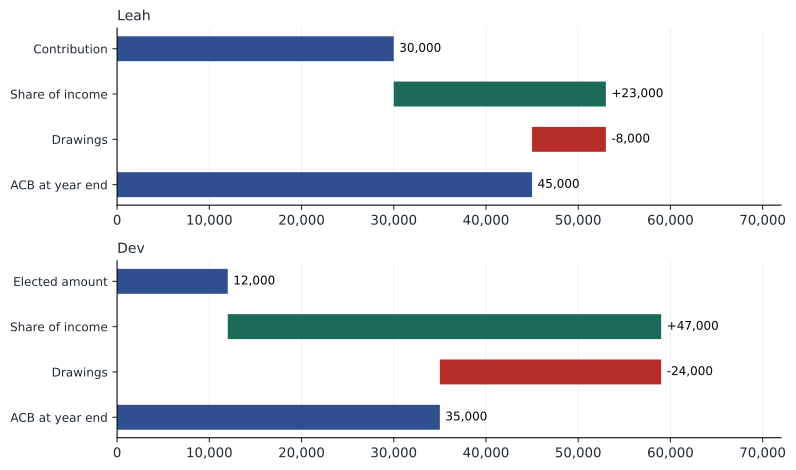
print(f"T5013 partnership information return required by the $2 million test: {info_return_needed}")Partnership income for the fiscal period ending 31 December 2027: 70,000 Leah share of income 23,000 drawings 8,000 ACB at year end 45,000 Dev share of income 47,000 drawings 24,000 ACB at year end 35,000 Deferred gain on Dev's property (FMV 30,000 - elected 12,000): 18,000 T5013 partnership information return required by the $2 million test: False
SkyGrid Data's income of $70,000 is computed at the partnership level. Dev's share is $47,000: his $24,000 priority allocation plus half of the remaining $46,000; Leah's is $23,000. Both include their shares in their 2027 returns, whatever they drew. Leah's ACB rises from $30,000 to $45,000, net of her $8,000 of drawings; Dev's rises from $12,000 to $35,000 after he draws his $24,000. The $20,000 bank loan does not affect either ACB. Dev's $18,000 deferred gain remains in the partnership property: because the partnership acquired it at $12,000, a later sale at $30,000 would produce a gain at the partnership level, allocated under the agreement, which is why partnership agreements often allocate such pre-contribution gains back to the contributor. Finally, because the partnership's revenue and expenses total only $210,000, its assets are well under $5 million and its partners are individuals, it is not required to file a T5013 partnership information return unless the CRA asks for one, though it must still give its partners the information to report their shares.
Property transfers into and out of partnerships
A transfer of property to a partnership is a disposition at fair market value under subsection 97(1) unless the partners elect under subsection 97(2), which works much like section 85: a Canadian partnership and all of its members can jointly elect an amount between the property's tax value and its fair market value, provided the transferor receives an interest in the partnership. Withdrawing property from a partnership, or winding it up, is a disposition at fair market value by the partnership, with the gain allocated to the partners, unless section 98 provides a rollover. Subsection 98(3) allows a partnership that ceases to exist to distribute its property to the partners in proportion to their interests on a rollover basis, and subsection 98(5) allows one partner to continue the business as a proprietor. Section 85(2) and subsection 85(3) allow a partnership to transfer its property to a corporation on a rollover basis and then wind up, a common route when a partnership business incorporates. A partner who sells an interest has a capital gain or loss, but section 100 converts part of the gain to full inclusion if the interest is sold to a tax-exempt or non-resident person.
Reporting and filing
A partnership must file a T5013 partnership information return for a fiscal period if at the end of the period the total of the absolute values of its revenues and expenses exceeds $2 million, or its assets exceed $5 million; or if at any time during the period it is a tiered partnership, has a corporation or trust as a partner, has invested in flow-through shares or has incurred resource expenses renounced to it; or if the CRA requests it. The return is due by 31 March after the calendar year for partnerships whose members are all individuals, five months after the fiscal period ends if all members are corporations, and the earlier of the two dates otherwise. Each partner receives a T5013 slip. A partnership is also a person for GST/HST purposes, so it registers and files GST returns in its own name, as SkyGrid Data must once its taxable supplies exceed $30,000.
Partnerships are common when two corporations or professionals combine their efforts, and corporate partners face special issues. Specified partnership income rules, from lesson 3, limit the small business deduction a corporate partner can claim on its share of partnership income to its share of a single $500,000 business limit for the partnership, unless another partner assigns part of its limit. A partnership with corporate partners must file a T5013 regardless of size. When a business carried on in partnership grows, partners often incorporate, either each partner transferring its interest to its own corporation, or the partnership transferring its assets to a new corporation under subsection 85(2) and winding up under subsection 85(3). SkyGrid Data could later follow that route if Leah and Dev want to keep profits in a corporation at the small business rate.
Worked problem
Dev leaves the partnership
At the start of 2030, Dev sells his interest in SkyGrid Data to Leah for $70,000. By then his ACB has become $30,000 after his shares of 2028 and 2029 income and his drawings. What are the tax consequences for Dev and Leah, and what happens to the partnership?
Show solution
- Dev disposes of capital property: proceeds $70,000 minus ACB $30,000 is a $40,000 capital gain, of which $20,000 is a taxable capital gain.
- Leah's ACB for the interest she buys is $70,000; added to her own interest, her total ACB rises.
- With only one partner left, the partnership ceases to exist. Subsection 98(5) lets Leah carry on the business as a proprietor and acquire its property on a rollover basis if she does so within three months, or she can transfer the business to Brandt Aerial Inc. under section 85.
- If the partnership had a large pre-contribution gain on Dev's servers, it would remain in the property's tax cost and be taxed when the business sells it.
Answer: Dev reports a $20,000 taxable capital gain; the partnership ends and Leah continues the business.
Common mistakes
MistakeTreating a partner's salary as a partnership expense.
InsteadPayments to partners are allocations of income, not deductions.
MistakeIncluding only the taxable half of capital gains in a partner's ACB.
InsteadThe full gain is added to ACB.
MistakeAdding partnership debt to ACB.
InsteadCanadian ACB excludes the partner's share of debt.
MistakeForgetting that a negative ACB of a limited partner is taxed immediately.
InsteadSubsection 40(3.1) deems a capital gain at the end of the fiscal period.
MistakeTransferring property to a partnership without a subsection 97(2) election.
InsteadWithout the election, the transfer is at fair market value.
Summary and key terms
- A partnership is not a taxpayer; income is computed as if it were a person and allocated to partners.
- Partners include their shares whether or not distributed; draws are not deductible.
- Allocations follow the agreement but can be reallocated if tax-motivated or unreasonable.
- ACB increases with contributions and income and decreases with drawings and losses; debt is excluded.
- Limited partners are subject to the at-risk rules and are taxed on negative ACB.
- Subsection 97(2) and section 98 provide rollovers into and out of partnerships.
- T5013 returns are required above $2 million of revenue plus expenses or $5 million of assets, among other tests.
- In 2027, Leah's share of SkyGrid Data's income is $23,000 and her ACB is $45,000.
- At-risk amount
- The amount a limited partner can lose, which limits deductible partnership losses.
- Limited partnership loss
- A loss denied by the at-risk rules, carried forward indefinitely.
- Negative ACB
- An ACB below zero, deemed a capital gain for limited and inactive partners.
- Subsection 97(2) election
- A joint election that lets property be transferred to a Canadian partnership at an elected amount.
- T5013
- The partnership information return and the slip given to each partner.
- Fiscal period
- The period for which a partnership computes its income, generally ending 31 December if it has individual partners.
- Partnership interest
- A partner's ownership interest in a partnership, treated as a capital asset.
Practice problems
Work each problem on paper first, then reveal the answer to check.
A partner contributes $50,000, is allocated $20,000 of income including a $6,000 capital gain and draws $15,000. What is the ACB?
Show answer
$50,000 + $20,000 − $15,000 = $55,000; the full gain is included.
Why does the partnership not deduct Dev's $24,000 draw?
Show answer
Payments to partners are allocations of income, not expenses.
A limited partner's ACB is negative $8,000 at the end of a fiscal period. What happens?
Show answer
An $8,000 capital gain is deemed realized and the ACB is reset to nil.
Which election lets property be transferred to a partnership at its tax cost?
Show answer
Subsection 97(2).
Does SkyGrid Data need to file a T5013 for 2027? Why?
Show answer
No; it is under the $2 million and $5 million thresholds, has only individual partners and no other trigger applies, unless the CRA requests it.
Can the CRA reallocate partnership income?
Show answer
Yes, under section 103 if an allocation is tax-motivated or unreasonable.
What must a limited partner have to deduct losses?
Show answer
Enough at-risk amount.
In the example, what is Dev's taxable capital gain on selling his interest?
Show answer
$20,000.
Lesson quiz · 5 questions
Score 60% or more to complete this lesson.
Create a free account to save your progress, take quizzes and earn a certificate.