
ACCT-352 · Lesson 6 of 12 · 25 min
Rollovers, share transactions and reorganizations
When Leah moved her proprietorship into Brandt Aerial Inc., she transferred property to a corporation she controls. Without a special rule, section 69 would deem her to have sold the property at fair market value, triggering recapture on the equipment and a gain on the goodwill she had built, even though she received no cash and still owns the business through her shares. The Act therefore provides rollovers: provisions that let property move between taxpayers at a value that defers the tax until a later sale. This lesson explains the section 85 rollover in detail, the rules that protect the tax base when shares are redeemed or sold to related corporations, the main reorganization provisions, and the choice between selling the shares and selling the assets of a business, including the lifetime capital gains exemption.
Section 85: transferring property to a corporation
Section 85 allows a taxpayer and a taxable Canadian corporation to elect jointly an amount, the elected amount, that is deemed to be the transferor's proceeds of disposition and the corporation's cost of the property. Eligible property includes capital property (such as shares, land held as capital property and goodwill), depreciable property, inventory other than real property, and resource properties, but not real property inventory or, for non-residents, most property other than taxable Canadian property used in a Canadian business. The corporation must issue at least one share to the transferor as part of the consideration; it may also give non-share consideration, known as boot, such as cash or a promissory note. The election is made on form T2057 by the earliest filing due date of the parties for the year of the transfer; a late election can be filed within three years with a penalty of one-quarter of one per cent of the deferred gain per month, to a maximum of $8,000.
Limits on the elected amount and the cost of consideration
The elected amount for each property is subject to limits. It cannot exceed the property's fair market value. It cannot be less than the fair market value of the boot received for that property, so taking more boot than the property's tax value triggers income or gain. And it cannot be less than the lesser of the property's fair market value and its tax value: the adjusted cost base for capital property, the cost amount for inventory, and for depreciable property the least of the undepreciated capital cost of the class, the property's cost and its fair market value. Within those limits the parties choose. Electing at the tax value defers all of the gain; electing higher triggers part of it, which can be useful to use losses, a capital gains exemption or a low tax bracket. The cost of the consideration received follows: boot takes a cost equal to its fair market value; preferred shares take the lesser of their fair market value and the elected amount minus boot; and common shares take whatever remains.
| Rule | Limit or result | Provision |
|---|---|---|
| Maximum elected amount | Fair market value of the property | 85(1)(c) |
| Minimum elected amount (boot test) | Fair market value of boot received | 85(1)(b) |
| Minimum elected amount (tax value) | Lesser of FMV and ACB, cost amount or, for depreciable property, UCC, cost and FMV | 85(1)(c.1), (e) |
| Cost of boot | Its fair market value | 85(1)(f) |
| Cost of preferred shares | Lesser of their FMV and elected amount minus boot | 85(1)(g) |
| Cost of common shares | Elected amount minus boot minus cost of preferred shares | 85(1)(h) |
| Paid-up capital of new shares | Ground down to elected amount minus boot | 85(2.1) |
| Benefit to a related person | Elected amount increased by the benefit | 85(1)(e.2) |
Paid-up capital and the benefit rule
Two protective rules complete section 85. First, the paid-up capital of the shares issued is ground down under subsection 85(2.1) to the elected amount minus boot. Without the grind, Leah could take back shares with a legal stated capital equal to the full $45,000 value of her business and then have the corporation return that capital to her tax-free, extracting the deferred gain as a return of capital. Second, if the fair market value of the consideration received is less than the value of the property transferred and it is reasonable to regard the difference as a benefit the transferor wished to confer on a related person, paragraph 85(1)(e.2) increases the elected amount by the benefit, taxing the transferor without giving the related person any extra cost. Transfers in estate freezes and similar plans therefore usually include a price adjustment clause, under which the consideration is adjusted if the CRA successfully challenges the valuation.
Leah's section 85 transfer
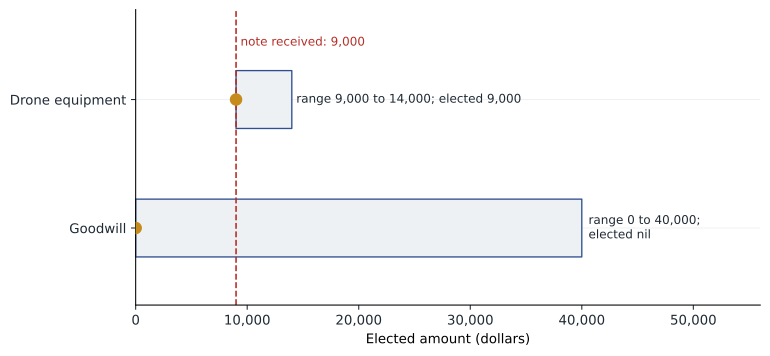
The program applies section 85 to the transfer of Leah's proprietorship assets on 1 January 2027: drone equipment in class 8 with a fair market value of $14,000, a capital cost of $15,000 and an undepreciated capital cost of $9,000, and goodwill worth $40,000 with no tax cost. Leah takes back a $9,000 note and common shares. The receivables were collected before the transfer, so no section 22 election is needed. The last lines anticipate a later transaction: the redemption of preferred shares under section 84(3).
# Leah transfers Brandt Aerial's assets to Brandt Aerial Inc. under section 85 (illustrative)
assets = {  # name: (fair market value, tax cost, UCC or nil, elected amount)
    "Class 8 drone equipment": (14_000, 15_000, 9_000, 9_000),
    "Goodwill (class 14.1)": (40_000, 0, 0, 0),
}
boot = 9_000                     # promissory note from the corporation
fmv = sum(a[0] for a in assets.values())
elected = sum(a[3] for a in assets.values())
for name, (v, cost, ucc, ea) in assets.items():
    low = min(v, cost, ucc) if ucc else 0
    print(f"{name:<26} FMV {v:>7,}  elected {ea:>7,}  (allowed range {low:,} to {v:,})")
assert elected >= boot, "boot above the elected amount triggers immediate income or gain"
proceeds_income = 0              # elected = UCC and nil: no recapture, no gain for Leah
share_cost = elected - boot      # cost of shares taken back
stated_capital = fmv - boot      # legal stated capital added for the common shares
puc_grind = max(0, stated_capital - (elected - boot))   # s. 85(2.1)
print(f"Total FMV transferred {fmv:,}; total elected {elected:,}; boot {boot:,}")
print(f"Income or gain to Leah now:            {proceeds_income:>8,}")
print(f"Cost of the note:                      {boot:>8,}")
print(f"Cost (ACB) of the common shares:       {share_cost:>8,}")
print(f"Stated capital {stated_capital:,}, ground down by {puc_grind:,}: PUC {stated_capital - puc_grind:,}")
print(f"Gain deferred until the shares are sold: {fmv - elected:,}")
print()
# Later: the corporation redeems preferred shares; section 84(3) deemed dividend
redemption, puc, acb = 100_000, 1, 1
deemed_div = redemption - puc
proceeds = redemption - deemed_div
print(f"Redemption of preferred shares for {redemption:,}: deemed dividend {deemed_div:,},"
f" proceeds of disposition {proceeds:,}, capital gain {proceeds - acb:,}")Class 8 drone equipment FMV 14,000 elected 9,000 (allowed range 9,000 to 14,000) Goodwill (class 14.1) FMV 40,000 elected 0 (allowed range 0 to 40,000) Total FMV transferred 54,000; total elected 9,000; boot 9,000 Income or gain to Leah now: 0 Cost of the note: 9,000 Cost (ACB) of the common shares: 0 Stated capital 45,000, ground down by 45,000: PUC 0 Gain deferred until the shares are sold: 45,000 Redemption of preferred shares for 100,000: deemed dividend 99,999, proceeds of disposition 1, capital gain 0
Electing $9,000 for the equipment and nil for the goodwill gives a total elected amount of $9,000, exactly equal to the boot, so Leah recognizes no income. The note costs her $9,000 and the corporation can repay it to her tax-free. Her common shares have an adjusted cost base of nil, and their paid-up capital is ground down from the $45,000 stated capital to nil, so the entire $45,000 of value in the shares is a deferred gain that will be taxed when she sells them or is deemed to dispose of them, or as a dividend if the corporation repurchases them. The corporation's cost for the equipment is $9,000, but because Leah's original capital cost was $15,000, subsection 13(7) preserves that capital cost for recapture purposes while the corporation claims CCA on $9,000. Goodwill enters class 14.1 at nil. The redemption example shows that when a corporation redeems shares for more than their paid-up capital, the excess is a deemed dividend under subsection 84(3), and only the paid-up capital is proceeds of disposition for capital gains purposes.
Redemptions, section 84.1 and surplus stripping
When a corporation redeems, acquires or cancels its shares, subsection 84(3) deems it to have paid a dividend equal to the amount paid minus the paid-up capital of the shares. The shareholder's proceeds of disposition exclude the deemed dividend, so a capital loss can arise if the shares' adjusted cost base exceeds their paid-up capital. Because dividends are generally taxed more heavily than capital gains, and because capital gains may be sheltered by the lifetime capital gains exemption, owners have long tried to convert corporate surplus into capital gains, a practice called surplus stripping. Section 84.1 blocks the most direct route: when an individual sells shares of a Canadian corporation to another corporation with which he or she does not deal at arm's length, and the two corporations are connected afterwards, boot in excess of the greater of the paid-up capital and a modified adjusted cost base of the shares is a deemed dividend, and the paid-up capital of new shares is ground down. Amendments enacted in 2021 and refined in 2024 allow genuine intergenerational transfers of a business to a corporation controlled by the owner's children to be treated as capital gains if strict conditions about transferring control and management are met. Subsection 55(2), discussed in lesson 2, polices the corporate equivalent.
Reorganizations: section 86, amalgamations and wind-ups
Several other provisions allow corporations to be reorganized without tax. Section 86 applies when a shareholder exchanges all of the shares of one class for other shares (and possibly boot) in the course of a reorganization of capital; it is the usual vehicle for an estate freeze, discussed in lesson 11. Section 51 allows a tax-free conversion of shares or debt into shares of the same corporation. Section 87 allows two or more taxable Canadian corporations to amalgamate into a new corporation that inherits their tax accounts, such as UCC, losses (subject to the acquisition of control rules), RDTOH, GRIP and CDA, while their shareholders exchange their shares tax-free. Subsection 88(1) allows a parent to wind up a wholly owned (90 per cent or more) subsidiary on a rollover basis, and to 'bump' the cost of non-depreciable capital property such as land and shares of other corporations up to its fair market value at the time control was acquired, which is valuable after a share purchase.
Selling a business: shares or assets
When an owner-manager sells a business, the parties must decide whether the buyer will acquire the shares of the corporation or its assets. Vendors usually prefer a share sale: the gain is a capital gain taxed at half the normal rate, the corporation's liabilities and history go with it, and an individual vendor may shelter up to $1,275,000 of gain for 2026 with the lifetime capital gains exemption if the shares are qualified small business corporation (QSBC) shares. QSBC status requires that at the time of sale all or substantially all (90 per cent or more) of the corporation's assets by fair market value be used principally in an active business carried on primarily in Canada; that throughout the 24 months before the sale more than 50 per cent of its assets met that test; and that no one other than the vendor or a related person owned the shares during those 24 months. Buyers usually prefer an asset purchase, which gives them a cost base equal to the price for CCA and leaves unknown liabilities behind. The price usually reflects these preferences. Before a share sale, a corporation can pay a dividend out of its 'safe income' to reduce the gain, and owners often 'purify' a corporation of passive assets to meet the 90 per cent test.
Worked problem
Selling the shares of Brandt Aerial Inc.
Suppose that in 2037 Leah sells all of the shares of Brandt Aerial Inc. to an arm's length buyer for $2,000,000. Her adjusted cost base is nil, the shares are QSBC shares, and she has not used her lifetime capital gains exemption. Using 2026 figures, roughly what tax does she pay, and how would an asset sale compare?
Show solution
- The capital gain is $2,000,000 − $0 = $2,000,000.
- The LCGE, assumed to be $1,275,000 as for 2026, shelters that amount, leaving a $725,000 gain, of which one-half, $362,500, is a taxable capital gain.
- At the top Manitoba rate of 50.4 per cent, tax is about $182,700, an effective rate of about 9 per cent on the whole gain. The alternative minimum tax may also apply, because 30 per cent of the gain eligible for the exemption is included in the AMT base, though most AMT can be recovered over seven years.
- In an asset sale, the corporation would pay tax on recaptured CCA and on the taxable half of the gain on goodwill, the after-tax proceeds would be trapped in the corporation, and Leah would pay further tax on dividends when she withdrew them; the LCGE would not apply because she sold no shares.
- This is why vendors of CCPCs bargain hard for a share sale.
Answer: About $182,700 of tax on a share sale, plus possible AMT, against much more on an asset sale.
Common mistakes
MistakeTaking boot greater than the elected amount.
InsteadThe elected amount must be at least the boot, so excess boot triggers income or gain.
MistakeForgetting the paid-up capital grind.
InsteadPUC of shares issued on a section 85 transfer is ground down to the elected amount minus boot.
MistakeMissing the T2057 filing deadline.
InsteadLate elections are allowed for three years but with a penalty.
MistakeTreating the full redemption price as proceeds of disposition.
InsteadThe excess over PUC is a deemed dividend under subsection 84(3).
MistakeAssuming all private company shares qualify for the LCGE.
InsteadQSBC status requires the 90 per cent asset test at sale, the 50 per cent test for 24 months and the holding period test.
Summary and key terms
- Section 85 lets property be transferred to a corporation at an elected amount, deferring gain.
- The elected amount lies between the greater of boot and tax value and fair market value.
- Boot costs its FMV; preferred shares take the lesser of FMV and elected amount minus boot; common shares take the rest.
- PUC is ground down under subsection 85(2.1); benefits to related persons increase the elected amount.
- Redemptions produce deemed dividends equal to the excess over PUC.
- Section 84.1 converts boot from non-arm's length share sales into dividends, with intergenerational exceptions.
- Sections 86, 87 and 88 allow share exchanges, amalgamations and wind-ups without tax.
- The LCGE of $1,275,000 for 2026 applies to gains on QSBC shares.
- Elected amount
- The amount jointly elected under section 85, deemed to be the transferor's proceeds and the corporation's cost.
- Paid-up capital (PUC)
- The stated capital of a class of shares, adjusted for tax purposes, which can be returned tax-free.
- Deemed dividend
- An amount treated as a dividend by the Act, such as the excess of a redemption payment over PUC.
- Surplus stripping
- Extracting corporate surplus as capital gains or tax-free amounts instead of taxable dividends.
- Qualified small business corporation (QSBC) share
- A share of a small business corporation that meets the asset and holding period tests for the LCGE.
- Amalgamation
- A merger of two or more corporations into one under corporate law, governed for tax by section 87.
- Boot
- Consideration other than shares of the acquiring corporation.
- Rollover
- A provision that lets property be transferred without immediate recognition of gain.
Practice problems
Work each problem on paper first, then reveal the answer to check.
A taxpayer transfers land with an ACB of $100,000 and FMV of $300,000 to her corporation for a $120,000 note and shares. What is the minimum elected amount?
Show answer
$120,000, the boot, since it exceeds the ACB.
In the same transfer, if she elects $120,000, what is the cost of her shares?
Show answer
Nil: elected amount $120,000 minus boot $120,000.
Why is the PUC of Leah's shares ground down to nil?
Show answer
Otherwise she could withdraw the deferred gain as a tax-free return of capital.
A corporation redeems shares with PUC of $10 and ACB of $50,000 for $200,000. What are the tax results?
Show answer
Deemed dividend $199,990; proceeds $10; capital loss $49,990 (subject to the stop-loss rules).
What does section 84.1 prevent?
Show answer
Extracting corporate surplus tax-free or as capital gains by selling shares to a related corporation.
State the three QSBC tests.
Show answer
90 per cent active business asset test at the time of sale; 50 per cent test throughout 24 months; 24-month holding period test.
Why does subsection 13(7) matter in Leah's transfer?
Show answer
It preserves her original $15,000 capital cost for recapture while the corporation claims CCA on $9,000.
In the share sale example, how much of the $2,000,000 gain is a taxable capital gain after the LCGE?
Show answer
$362,500.
Lesson quiz · 5 questions
Score 60% or more to complete this lesson.
Create a free account to save your progress, take quizzes and earn a certificate.