
ACCT-352 · Lesson 5 of 12 · 23 min
Integration and owner-manager remuneration
Every year the owner-manager of a CCPC decides how to take money out of the company: as salary or bonus, as dividends, as a repayment of shareholder loans or paid-up capital, or not at all, leaving it in the corporation to grow. The decision depends on integration, the principle introduced in lesson 1, and on many non-tax factors: retirement savings, CPP, government benefits, the needs of the business and the family. This lesson measures how well integration works under 2026 rates, compares salary and dividends for Leah, and explains the shareholder benefit and loan rules that apply when owners take money out informally.
Measuring integration
Integration is perfect when the corporate tax rate equals the rate assumed by the gross-up, and the combined federal and provincial dividend tax credit equals the gross-up. The 15 per cent gross-up on non-eligible dividends assumes a corporate rate of 15 ÷ 115 = 13.04 per cent; the 38 per cent gross-up on eligible dividends assumes 38 ÷ 138 = 27.54 per cent. Actual rates differ, so integration is imperfect. In Manitoba for 2026, $100 of small business income bears $9 of corporate tax, and the $91 non-eligible dividend bears tax at the top personal rate on such dividends of 46.67 per cent, or $42.47, for a total of $51.47, compared with $50.40 if the same $100 were paid as salary to a top-rate individual. $100 of general rate income bears $27 of corporate tax, and the $73 eligible dividend bears tax at 37.78 per cent, or $27.58, for a total of $54.58. Paying out income from a Manitoba corporation therefore costs slightly more than earning it directly, about one percentage point on small business income and four on general rate income. What makes incorporation worthwhile is deferral, not a permanent saving.
| Type of income | Corporate tax | Personal tax at top rate | Total; versus 50.40 earned directly |
|---|---|---|---|
| $100 of small business income paid as a non-eligible dividend | 9.00 | 42.47 | 51.47; cost 1.07 |
| $100 of general rate income paid as an eligible dividend | 27.00 | 27.58 | 54.58; cost 4.18 |
| $100 of investment income paid as a non-eligible dividend (after refund) | 20.00 | 37.34 | 57.34; cost 6.94 |
| $100 paid as salary (deductible to the corporation) | 0.00 | 50.40 | 50.40 plus CPP on salary up to the limits |
Salary or dividends: the tax factors
Salary is deductible to the corporation and taxed to the employee as employment income; dividends are paid from after-tax corporate income and taxed with the gross-up and credit. If integration were perfect, the total tax would be the same either way. The differences come from imperfect integration and from several other effects. Salary creates RRSP contribution room equal to 18 per cent of the previous year's earned income, up to $33,810 for 2026, while dividends create none. Salary requires CPP contributions from both the employee and the corporation, 5.95 per cent each on earnings up to $74,600 and a further 4 per cent each on earnings up to $85,000 for 2026, which cost money now but buy a retirement pension. An owner who controls more than 40 per cent of the voting shares is not in insurable employment, so no EI premiums are paid. Salary qualifies for the Canada employment amount and the child care expense deduction; dividends do not count as earned income for either. Dividends are simpler, need no payroll remittances and can be timed freely, but the gross-up inflates net income, which can reduce income-tested benefits such as the Canada child benefit and the OAS pension.
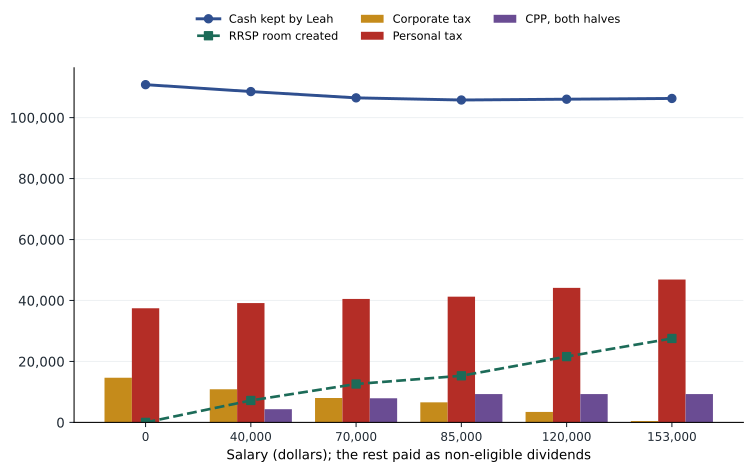
# Salary or dividends? Leah's remuneration from Brandt Aerial Inc. (2026 rules, illustrative)
# Active business income before paying Leah: 162,906.75; all within the business limit.
FED = [(58_523, 0.14), (117_045, 0.205), (181_440, 0.26), (258_482, 0.29), (float('inf'), 0.33)]
MB = [(47_000, 0.108), (100_000, 0.1275), (float('inf'), 0.174)]
PRE_PAY = 162_906.75

def bracket(x, br):
    tax, lo = 0.0, 0.0
    for hi, r in br:
        if x > lo:
            tax += (min(x, hi) - lo) * r
        lo = hi
    return tax

def cpp(salary):
    """Employee (or employer) CPP and CPP2 contributions for 2026."""
    cpp1 = 0.0595 * max(0.0, min(salary, 74_600) - 3_500)
    cpp2 = 0.04 * max(0.0, min(salary, 85_000) - 74_600)
    return cpp1, cpp2

def plan(salary):
    cpp1, cpp2 = cpp(salary)
    employer = cpp1 + cpp2
    corp_income = PRE_PAY - salary - employer          # deductible to the corporation
    corp_tax = 0.09 * corp_income
    dividend = corp_income - corp_tax                   # paid out as non-eligible dividends
    grossed = 1.15 * dividend
    enhanced = cpp1 / 5.95 + cpp2                       # deductible part of CPP
    base_cpp = cpp1 * 4.95 / 5.95                       # credit part of CPP
    taxable = salary - enhanced + grossed
    fed = bracket(taxable, FED) - 0.14 * (16_452 + base_cpp + (1_501 if salary else 0)) - 0.090301 * grossed
    mb = bracket(taxable, MB) - 0.108 * (15_780 + base_cpp) - 0.007835 * grossed
    personal = max(0.0, fed) + max(0.0, mb)
    cash = salary - cpp1 - cpp2 + dividend - personal
    rrsp_room = min(0.18 * salary, 33_810)
    return corp_tax, dividend, personal, employer + cpp1 + cpp2, cash, rrsp_room

print(f"{'Salary':>9} {'Corp tax':>9} {'Dividend':>9} {'Pers. tax':>9} {'CPP both':>9} {'Cash to Leah':>12} {'RRSP room':>9}")
for s in (0, 40_000, 70_000, 85_000, 120_000, 153_000):
    ct, d, pt, c, cash, room = plan(s)
    print(f"{s:>9,} {ct:>9,.0f} {d:>9,.0f} {pt:>9,.0f} {c:>9,.0f} {cash:>12,.0f} {room:>9,.0f}")
print("Cash to Leah = salary + dividends - her CPP - her income tax; CPP both = employee + employer.") Salary Corp tax Dividend Pers. tax CPP both Cash to Leah RRSP room
0 14,662 148,245 37,443 0 110,802 0
40,000 10,866 109,869 39,164 4,344 108,533 7,200
70,000 8,006 80,944 40,514 7,914 106,474 12,600
85,000 6,593 66,667 41,252 9,293 105,768 15,300
120,000 3,443 34,817 44,140 9,293 106,030 21,600
153,000 473 4,787 46,863 9,293 106,277 27,540
Cash to Leah = salary + dividends - her CPP - her income tax; CPP both = employee + employer.The table shows the cash Leah keeps from Brandt Aerial Inc.'s $162,906.75 of active income before her pay, under different salaries, if everything not paid as salary is paid out as non-eligible dividends. With no salary, she keeps $110,802; with a $70,000 salary, $106,474; with the maximum-CPP salary of $85,000 or more, about $106,000. The all-dividend plan leaves the most cash this year because it avoids CPP, which costs $7,914 a year at a $70,000 salary when both halves are counted. But the comparison is incomplete. A $70,000 salary buys a larger CPP pension and $12,600 of RRSP room, and RRSP contributions are deductible at Leah's marginal rate and grow tax-free. A salary near $85,000 maximizes CPP and creates $15,300 of RRSP room. Many advisers therefore recommend a salary at least equal to the CPP maximum pensionable earnings, or the amount that maximizes RRSP room, with dividends on top; others prefer dividends and private savings. Leah chose a $70,000 salary for 2027, a middle course, and will revisit it each year.
Other remuneration techniques
Several other techniques round out an owner-manager's plan. A bonus accrued at year-end is deductible to the corporation in that year if it is paid within 180 days, so it can reduce active business income to the business limit while being taxed to the employee only when received. Reasonable salaries can be paid to family members who work in the business; section 67 denies deductions for unreasonable amounts, though the CRA generally does not challenge salaries and bonuses paid to active shareholder-managers who are Canadian residents. An individual pension plan, a defined benefit plan for one member, can provide larger tax-deferred contributions than an RRSP for owners over about 40. A private health services plan lets the corporation pay family medical and dental costs as a deductible expense that is not a taxable benefit. Finally, money can be returned to shareholders tax-free as a repayment of loans they made to the corporation or as a reduction of paid-up capital.
Shareholder benefits and loans
Owners sometimes take value out of their corporations without formal salaries or dividends, for example by using a company car, having the company pay personal bills or borrowing from it. Subsection 15(1) includes in a shareholder's income the value of any benefit conferred on the shareholder by the corporation, and because the corporation cannot deduct it, the benefit is taxed twice: an expensive result compared with a salary or dividend. Subsection 15(2) includes in a shareholder's income a loan from the corporation unless it is repaid within one year after the end of the corporation's taxation year in which it was made and is not part of a series of loans and repayments, or it falls within narrow exceptions for employees who are not specified shareholders, such as loans to buy a home, a car for work or shares of the employer. A later repayment is deductible in the year repaid. If a loan is not included under subsection 15(2), section 80.4 imputes interest at the prescribed rate, 3 per cent for the first quarter of 2026, less interest actually paid within 30 days after the year-end.
Choosing a remuneration policy
No single mix suits every owner. A useful sequence is to start with the cash the owner needs for personal spending, decide how much salary is wanted for CPP and RRSP purposes, pay any bonus needed to keep active income within the business limit, and take the rest of the needed cash as dividends, first eligible dividends up to GRIP and dividends that recover refundable tax, then non-eligible dividends, leaving surplus profit in the corporation. The owner should consider the effect of dividends on income-tested benefits, the alternative minimum tax on large dividends or capital gains, the tax on split income if family members receive dividends (lesson 11), and the risk of the passive income grind if surplus is invested. Leah's plan for 2027 pays her a $70,000 salary, $26,000 of taxable dividends that recover all of the refundable tax, and a $3,000 capital dividend, and leaves the rest of the year's after-tax profit in the corporation to fund equipment for the second year of the utility contract.
Retirement planning is part of the remuneration decision. An owner who takes mostly dividends builds no RRSP room and a smaller CPP pension, so retirement savings accumulate inside the corporation instead, taxed at investment income rates and subject to the passive income grind once they are large. An owner who takes a salary builds RRSP room and CPP entitlements, and can also join an individual pension plan funded by deductible corporate contributions. Neither approach is right for everyone: the choice depends on the owner's age, the expected return on investments, the likelihood of selling the shares (and whether the lifetime capital gains exemption can be used), and how much flexibility the owner wants to vary income from year to year. Advisers often model the alternatives over the owner's lifetime rather than year by year.
Worked problem
A shareholder loan
On 1 March 2027, Brandt Aerial Inc. lends Leah $40,000, interest-free, to help buy a family car. The corporation's year ends on 31 December. What are the tax consequences if she repays the loan on 15 November 2028, and if she has not repaid it by 31 December 2028?
Show solution
- The loan was made in the corporation's 2027 taxation year, so it is excluded from Leah's income under subsection 15(2.6) only if repaid by 31 December 2028, one year after that year-end.
- If she repays it on 15 November 2028, there is no income inclusion, but section 80.4 deems a benefit for each year the loan is outstanding: at a 3 per cent prescribed rate, about $40,000 × 3% × 10/12 = $1,000 for 2027 and about $1,050 for 2028, unless she pays interest at that rate within 30 days after each year-end.
- If she has not repaid it by 31 December 2028, the full $40,000 is included in her 2027 income, requiring a reassessment, and no section 80.4 benefit applies.
- When she later repays, she can deduct the $40,000 in the year of repayment under paragraph 20(1)(j).
- A loan to buy a car is excepted only for employees who are not specified shareholders, so the exception does not help Leah.
Answer: Repaid on time: only a deemed interest benefit of about $1,000 a year; not repaid: $40,000 included in 2027 income, deductible when repaid.
Common mistakes
MistakeAssuming dividends always beat salary because there is no CPP.
InsteadCPP buys a pension and salary creates RRSP room; compare total lifetime outcomes.
MistakePaying non-eligible dividends while leaving ERDTOH unrecovered.
InsteadEligible dividends recover ERDTOH; plan dividends to recover all refundable tax.
MistakeLeaving a shareholder loan outstanding past the repayment deadline.
InsteadIt is included in income for the year it was made unless repaid within one year after that year-end.
MistakeIgnoring the effect of grossed-up dividends on income-tested benefits.
InsteadGrossed-up dividends raise net income, which can reduce the Canada child benefit and OAS.
MistakeThinking integration means incorporation saves tax permanently.
InsteadIntegration in Manitoba produces a slight cost on paid-out income; the benefit is deferral.
Summary and key terms
- Perfect integration requires corporate rates of 13.04 per cent (non-eligible) and 27.54 per cent (eligible).
- In Manitoba, paid-out small business income bears 51.47 per cent at top rates, versus 50.40 earned directly.
- Salary is deductible, creates RRSP room and requires CPP; dividends do not.
- Owners with more than 40 per cent of the votes pay no EI.
- Bonuses accrued at year-end are deductible if paid within 180 days.
- Shareholder benefits are taxed twice; shareholder loans are included unless repaid within a year after year-end.
- Deemed interest at the prescribed rate applies to low-interest loans that are not included in income.
- Leah's 2027 plan: $70,000 salary, $26,000 of taxable dividends and a $3,000 capital dividend.
- Perfect integration
- A situation in which income bears the same total tax whether earned directly or through a corporation.
- Shareholder benefit
- A benefit conferred on a shareholder by a corporation, taxable under subsection 15(1) and not deductible to the corporation.
- Shareholder loan
- A loan from a corporation to a shareholder, included in income under subsection 15(2) unless an exception applies.
- Prescribed rate
- The interest rate set quarterly by regulation for deemed interest and related rules.
- Individual pension plan
- A defined benefit pension plan for one member, usually an owner-manager.
- Private health services plan
- A plan through which a corporation pays medical and dental costs that are not a taxable benefit.
- Owner-manager
- An individual who owns and runs a private corporation.
Practice problems
Work each problem on paper first, then reveal the answer to check.
What corporate rate is assumed by the 15 per cent gross-up?
Show answer
15 ÷ 115 = 13.04 per cent.
Compute the total tax on $100 of Manitoba general rate income paid out as an eligible dividend at the top rate.
Show answer
$27 + $73 × 37.78% = $54.58.
How much RRSP room does a $70,000 salary create?
Show answer
18% × $70,000 = $12,600 (for the following year).
Why does Leah pay no EI premiums?
Show answer
She controls more than 40 per cent of the voting shares, so her employment is not insurable.
A corporation with a 30 June year-end lends its shareholder $25,000 on 1 August 2026. By when must it be repaid to avoid inclusion?
Show answer
By 30 June 2028, one year after the end of the 2027 taxation year in which the loan was made.
When is a year-end bonus deductible in the year accrued?
Show answer
When it is paid within 180 days after the year-end.
In the program, how much cash does Leah keep with no salary?
Show answer
$110,802.
Why might an owner pay a salary of $85,000 or more in 2026?
Show answer
To maximize CPP contributions and pension, and create $15,300 of RRSP room.
Lesson quiz · 5 questions
Score 60% or more to complete this lesson.
Create a free account to save your progress, take quizzes and earn a certificate.