
ACCT-352 · Lesson 4 of 12 · 25 min
Investment income, refundable taxes and dividend accounts
If a CCPC's investment income were taxed at the 9 per cent small business rate, or even the 27 per cent general rate, an individual in the top bracket could save or defer a great deal of tax by holding a portfolio in a corporation instead of personally. The Act prevents this with a set of refundable taxes. Investment income earned by a CCPC is taxed at a high rate, part of which is refunded when the corporation pays taxable dividends to its shareholders, who then pay personal tax on them. The aim is that income flowing through the corporation bears about the same total tax as if the shareholder had earned it directly, and that holding investments in a corporation produces little deferral. This lesson explains the refundable tax system, the two refundable dividend tax on hand accounts, Part IV tax on dividends, and the accounts that determine which kinds of dividends a corporation may pay: the general rate income pool and the capital dividend account.
Aggregate investment income and the refundable portion of Part I tax
Aggregate investment income (AII), defined in subsection 129(4), is a CCPC's income from property, such as interest, rents, royalties and portfolio income, plus its taxable capital gains minus net capital losses deducted in the year. It excludes dividends deductible under section 112, which are dealt with by Part IV tax, and property income that is incidental to an active business, such as interest on a business's trade receivables or short-term deposits of working capital. Income from a specified investment business, such as renting out a few properties without more than five full-time employees, is property income for this purpose. As lesson 3 showed, AII is taxed federally at 38⅔ per cent: the 28 per cent net rate after the abatement plus the 10⅔ per cent additional refundable tax. In Manitoba, with a 12 per cent provincial rate, the combined rate is 50⅔ per cent, close to the top personal rate of 50.4 per cent. Of the federal tax, 30⅔ per cent of AII is added to the non-eligible refundable dividend tax on hand (NERDTOH) account and refunded later.
Part IV tax on dividends received
Dividends received by a corporation from taxable Canadian corporations are deducted under section 112, but a private corporation (and certain other corporations) must pay Part IV tax of 38⅓ per cent on two kinds of dividends. The first is portfolio dividends: dividends from corporations to which the recipient is not connected, meaning it holds 10 per cent or less of the votes and value, as with Brandt Aerial Inc.'s dividends from its Canadian equity ETF. The second is dividends from connected corporations, but only to the extent that the paying corporation received a dividend refund because of the dividend. Part IV tax is fully refundable: it is added to the eligible RDTOH account if it relates to eligible dividends received and to NERDTOH otherwise, and is recovered when the recipient pays dividends. Its purpose is to stop a holding corporation from deferring tax on portfolio dividends that would be taxed immediately in the hands of an individual shareholder.
The refundable dividend tax on hand accounts
Since 2019, a corporation keeps two RDTOH accounts. Eligible RDTOH (ERDTOH) receives Part IV tax on eligible dividends received. Non-eligible RDTOH (NERDTOH) receives the refundable portion of Part I tax on AII and Part IV tax on non-eligible dividends received. When the corporation pays taxable dividends, it receives a dividend refund of 38⅓ per cent of those dividends, limited by the balances: eligible dividends can draw only on ERDTOH, while non-eligible dividends draw first on NERDTOH and then on any ERDTOH left. The split was introduced to stop corporations from using refundable tax generated by investment income to pay eligible dividends, which carry a larger dividend tax credit. The 2025 federal budget added another restriction for taxation years beginning on or after 4 November 2025: a dividend refund is suspended when the dividend is paid to an affiliated corporation whose balance-due day falls after the payer's, closing a technique that used staggered year-ends in tiered corporate structures to defer refundable tax.
| Account | What adds to it | What it allows |
|---|---|---|
| Eligible RDTOH | Part IV tax on eligible dividends received | A refund of 38⅓% of eligible or other dividends paid |
| Non-eligible RDTOH | 30⅔% of AII (limited); Part IV tax on non-eligible dividends received | A refund of 38⅓% of non-eligible dividends paid |
| General rate income pool (GRIP) | 72% of income taxed at the general rate; eligible dividends received | Designating dividends as eligible dividends |
| Capital dividend account (CDA) | Non-taxable half of capital gains; capital dividends received; life insurance proceeds | Tax-free capital dividends, by election |
| Paid-up capital (PUC) | Stated capital of shares, adjusted for tax | Tax-free return of capital to shareholders |
Eligible dividends and the general rate income pool
A dividend is an eligible dividend only if the paying corporation designates it as one, by notifying shareholders in writing at or before the time of payment. A CCPC may designate eligible dividends up to its general rate income pool (GRIP), which broadly represents 72 per cent of its taxable income that was taxed at the general rate (the after-tax amount at a 28 per cent combined rate), plus eligible dividends it received from other corporations. Income taxed at the small business rate or as investment income does not enter GRIP. A non-CCPC, such as a public corporation, may pay eligible dividends freely unless it has a low rate income pool (LRIP), for example from income it earned while it was a CCPC, in which case it must pay non-eligible dividends first. Designating too much as eligible creates an excessive eligible dividend designation, taxed under Part III.1 at 20 per cent (30 per cent if it was not inadvertent), unless the corporation elects to treat the excess as a separate non-eligible dividend.
Capital dividends
The capital dividend account (CDA), defined in subsection 89(1), tracks amounts a private corporation received tax-free that should also reach its shareholders tax-free. Its main components are the non-taxable half of capital gains minus the non-allowable half of capital losses, capital dividends received from other corporations, and life insurance proceeds received on a death minus the policy's adjusted cost basis. A corporation pays a capital dividend by filing an election on form T2054 on or before the earlier of the payment date and the date any part of the dividend becomes payable, with a certified copy of the directors' resolution. The shareholder receives it free of tax. If the election exceeds the CDA balance, Part III tax of 60 per cent of the excess applies unless the corporation elects to treat the excess as a taxable dividend. Because the CDA is reduced by capital losses as well as increased by gains, many advisers pay out capital dividends soon after a gain is realized, before a later loss reduces the account.
Two further rules protect the system. The stop-loss rules reduce a corporation's loss on the disposition of shares by tax-free dividends it previously received on them, such as dividends deducted under section 112 or capital dividends, so that a corporation cannot receive a tax-free dividend that strips value from a subsidiary and then claim a capital loss for the resulting drop in value. And subsection 55(2), mentioned in lesson 2, treats an intercorporate dividend as proceeds of disposition or a capital gain if one of its purposes was to reduce a capital gain significantly and it exceeds the payer's 'safe income' attributable to the shares, broadly the retained earnings on which tax has already been paid. Advisers therefore compute safe income before paying large intercorporate dividends in reorganizations or before a sale.
Brandt Aerial Inc.'s accounts and dividends for 2027
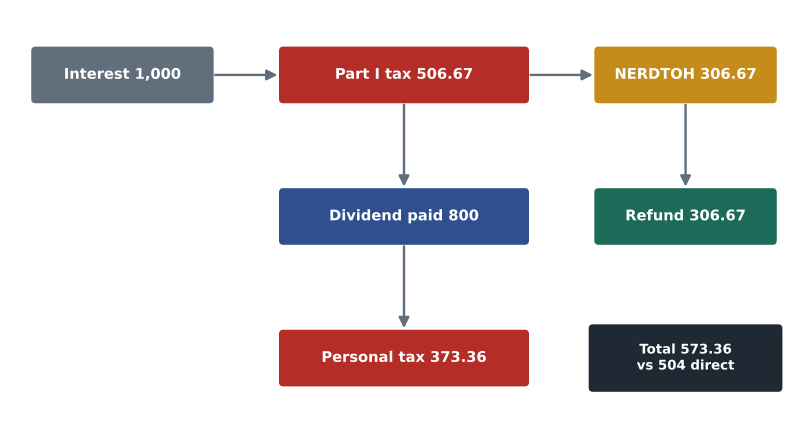
The program computes Brandt Aerial Inc.'s refundable taxes and dividend accounts for 2027 from the figures in lessons 2 and 3. Leah then has the corporation pay her three dividends before year-end: a $6,000 eligible dividend, a $20,000 non-eligible dividend and a $3,000 capital dividend. The last part of the program compares $1,000 of interest earned in the corporation and paid out as a dividend with the same interest earned personally at the top Manitoba rates.
# Brandt Aerial Inc.: refundable taxes and dividend accounts for 2027 (2026 rules, illustrative)
aii, taxable_income, sbd_income = 7_000, 95_950, 88_950
eligible_portfolio_divs = 6_000          # from public Canadian corporations (not connected)
taxable_capital_gain, capital_gain = 3_000, 6_000

RATE_383 = 0.38 + 1 / 300                                  # 38 1/3%
part_iv = RATE_383 * eligible_portfolio_divs
nerdtoh = min((0.30 + 2 / 300) * aii,                      # 30 2/3% of AII
              (0.30 + 2 / 300) * (taxable_income - sbd_income))
erdtoh = part_iv                                          # Part IV on eligible dividends
grip = 0.72 * max(0, taxable_income - sbd_income - aii) + eligible_portfolio_divs
cda = capital_gain - taxable_capital_gain                 # non-taxable half of the gain
print(f"Part IV tax on portfolio dividends (38 1/3%)   {part_iv:>10,.2f}")
print(f"Eligible RDTOH at year end                      {erdtoh:>10,.2f}")
print(f"Non-eligible RDTOH at year end                  {nerdtoh:>10,.2f}")
print(f"General rate income pool (GRIP)                 {grip:>10,.2f}")
print(f"Capital dividend account (CDA)                  {cda:>10,.2f}")
print()
# Dividends paid to Leah in 2027
eligible_paid, nonelig_paid, capital_div = 6_000, 20_000, cda
refund_e = min(RATE_383 * eligible_paid, erdtoh)             # 38 1/3% of eligible dividends
left_e = erdtoh - refund_e
refund_n = min(RATE_383 * nonelig_paid, nerdtoh + left_e)            # non-eligible: NERDTOH first, then ERDTOH
print(f"Eligible dividend paid (within GRIP)            {eligible_paid:>10,.2f}  refund {refund_e:>9,.2f}")
print(f"Non-eligible dividend paid                      {nonelig_paid:>10,.2f}  refund {refund_n:>9,.2f}")
print(f"Capital dividend paid (election on form T2054)  {capital_div:>10,.2f}  refund {0:>9,.2f}")
print(f"Total dividend refund                           {refund_e + refund_n:>10,.2f}")
print()
# Integration of $1,000 of interest earned in the corporation versus personally
corp_rate = 0.38 - 0.10 + (0.10 + 2 / 300) + 0.12      # federal 38 2/3% plus Manitoba 12%
corp_tax = 1_000 * corp_rate
refund = 1_000 * (0.30 + 2 / 300)
dividend = 1_000 - corp_tax + refund
top_nonelig = 0.4667                                     # top Manitoba combined rate, other dividends
personal_on_div = dividend * top_nonelig
print(f"{'Interest earned in the corporation':<50}{1_000:>9,.2f}")
print(f"{'Corporate tax (' + format(corp_rate, '.2%') + '), before refund':<50}{corp_tax:>9,.2f}")
print(f"Dividend refund when paid out                     {refund:>9,.2f}")
print(f"Non-eligible dividend paid                        {dividend:>9,.2f}")
print(f"Personal tax at the top rate (46.67%)            {personal_on_div:>9,.2f}")
print(f"Total tax through the corporation                 {corp_tax - refund + personal_on_div:>9,.2f}")
print(f"Tax if earned personally at the top rate (50.4%) {504:>9,.2f}")Part IV tax on portfolio dividends (38 1/3%) 2,300.00 Eligible RDTOH at year end 2,300.00 Non-eligible RDTOH at year end 2,146.67 General rate income pool (GRIP) 6,000.00 Capital dividend account (CDA) 3,000.00 Eligible dividend paid (within GRIP) 6,000.00 refund 2,300.00 Non-eligible dividend paid 20,000.00 refund 2,146.67 Capital dividend paid (election on form T2054) 3,000.00 refund 0.00 Total dividend refund 4,446.67 Interest earned in the corporation 1,000.00 Corporate tax (50.67%), before refund 506.67 Dividend refund when paid out 306.67 Non-eligible dividend paid 800.00 Personal tax at the top rate (46.67%) 373.36 Total tax through the corporation 573.36 Tax if earned personally at the top rate (50.4%) 504.00
Part IV tax on the $6,000 of portfolio dividends is $2,300, all of it added to ERDTOH because the dividends were eligible. NERDTOH receives 30⅔ per cent of the $7,000 of AII, $2,146.67. GRIP is $6,000, consisting only of the eligible dividends received, since none of the corporation's income was taxed at the general rate. The capital dividend account is $3,000. Paying a $6,000 eligible dividend recovers all of ERDTOH, and the $20,000 non-eligible dividend recovers all of NERDTOH, so the corporation receives a total dividend refund of $4,446.67, which reduces its tax payable for 2027. The final comparison shows a quirk of Manitoba's rates: $1,000 of interest earned through the corporation and paid out bears $573.36 of total tax, compared with $504 if Leah earned it directly. Integration of investment income is imperfect where the provincial corporate rate on investment income is high relative to the dividend tax credit, so holding interest-bearing investments in a Manitoba CCPC costs tax in the long run unless the deferral, which here is negative, is outweighed by other considerations.
Worked problem
Dividends through a holding corporation
Suppose Leah owns Brandt Aerial Inc. through a holding corporation, Brandt Holdings Inc., instead of directly, and Brandt Aerial Inc. pays its $6,000 eligible and $20,000 non-eligible dividends to Brandt Holdings, receiving the $4,446.67 dividend refund. What does Brandt Holdings pay?
Show solution
- Brandt Holdings owns all of the shares, so it is connected with Brandt Aerial Inc.
- The dividends are deductible by Brandt Holdings under section 112, so they bear no Part I tax.
- Because they are from a connected corporation, Part IV tax equals Brandt Holdings' share of the payer's dividend refund: $2,300 on the eligible dividend and $2,146.67 on the non-eligible dividend, $4,446.67 in total.
- Brandt Holdings adds $2,300 to its ERDTOH and $2,146.67 to its NERDTOH, and recovers them when it pays dividends to Leah. The eligible dividend also adds $6,000 to its GRIP.
- The refundable tax simply moves up the chain: no tax is saved or lost until dividends reach an individual.
Answer: Part IV tax of $4,446.67, all refundable when Brandt Holdings pays dividends.
Common mistakes
MistakeIncluding portfolio dividends in AII.
InsteadDividends deductible under section 112 are excluded from AII and taxed under Part IV instead.
MistakeRecovering NERDTOH with eligible dividends.
InsteadEligible dividends draw only on ERDTOH.
MistakeDesignating dividends as eligible without enough GRIP.
InsteadExcess designations attract Part III.1 tax unless an election is made.
MistakePaying a capital dividend without filing form T2054 first.
InsteadThe election must be filed by the earlier of the payment date and the date it becomes payable.
MistakeThinking the dividend refund reduces the shareholder's tax.
InsteadThe refund reduces the corporation's tax; the shareholder pays tax on the dividend.
Summary and key terms
- CCPC investment income bears high corporate tax, part of which is refunded when dividends are paid.
- AII includes interest, rents, royalties and taxable capital gains but not dividends deductible under section 112.
- Part IV tax of 38⅓ per cent applies to portfolio dividends and connected dividends that generated a refund.
- ERDTOH is recovered by any taxable dividend; NERDTOH only by non-eligible dividends.
- The dividend refund is 38⅓ per cent of taxable dividends paid, limited by the RDTOH balances.
- Eligible dividends require GRIP for a CCPC; excess designations are taxed.
- Capital dividends from the CDA are tax-free, by election on form T2054.
- Brandt Aerial Inc. recovers $4,446.67 of refundable tax by paying $26,000 of taxable dividends.
- Aggregate investment income (AII)
- A CCPC's property income and net taxable capital gains, excluding deductible dividends.
- Part IV tax
- A refundable 38⅓ per cent tax on portfolio dividends and certain connected dividends received by private corporations.
- Refundable dividend tax on hand (RDTOH)
- The pool of refundable taxes recovered by paying taxable dividends, split into eligible and non-eligible accounts.
- Dividend refund
- A refund of 38⅓ per cent of taxable dividends paid, limited by RDTOH.
- General rate income pool (GRIP)
- The pool of income taxed at the general rate from which a CCPC may pay eligible dividends.
- Capital dividend account (CDA)
- The pool of tax-free amounts that a private corporation can pay as capital dividends.
- Connected corporation
- A corporation controlled by the recipient or in which it holds more than 10 per cent of the votes and value.
- Constructive ownership
- Attribution of ownership of shares held by related persons or entities.
Practice problems
Work each problem on paper first, then reveal the answer to check.
A CCPC earns $10,000 of interest. How much is added to NERDTOH?
Show answer
30⅔% × $10,000 = $3,066.67 (subject to the limits).
A private corporation receives $9,000 of eligible portfolio dividends. What is its Part IV tax?
Show answer
38⅓% × $9,000 = $3,450.
Why does Brandt Aerial Inc. have GRIP even though none of its income was taxed at the general rate?
Show answer
Eligible dividends it received are added to GRIP.
Brandt Aerial Inc. realizes a $10,000 capital gain in 2028 and a $4,000 capital loss in 2029 before paying a capital dividend. What is the effect on its CDA?
Show answer
It rises by $5,000 and then falls by $2,000, leaving $3,000 more than before.
What is the penalty for an excessive capital dividend election?
Show answer
Part III tax of 60 per cent of the excess, unless an election treats it as a taxable dividend.
In the program, what is the total dividend refund?
Show answer
$4,446.67.
Which dividends can recover NERDTOH?
Show answer
Only non-eligible dividends.
Why is holding interest-bearing investments in a Manitoba CCPC costly at top rates?
Show answer
Total tax through the corporation, about 57.3 per cent, exceeds the 50.4 per cent personal rate.
Lesson quiz · 5 questions
Score 60% or more to complete this lesson.
Create a free account to save your progress, take quizzes and earn a certificate.