
ACCT-352 · Lesson 3 of 12 · 24 min
Corporate tax rates and the small business deduction
Once taxable income is known, Part I tax is computed by starting with a basic federal rate and applying a series of abatements, reductions and additions that depend on where the income was earned, what kind of income it is and what kind of corporation earned it. The result is a set of effective rates that every Canadian tax adviser knows by heart: about 9 per cent on a CCPC's active business income within the business limit in Manitoba, 27 per cent on income above the limit, and just over 50 per cent, partly refundable, on a CCPC's investment income. This lesson builds those rates from the statute, explains the small business deduction in detail, including the rules that share and reduce the business limit, and computes Brandt Aerial Inc.'s 2027 Part I tax.
Building the federal rate
Section 123 imposes a basic federal rate of 38 per cent on taxable income. Section 124 then deducts an abatement of 10 per cent of taxable income earned in a province, to make room for provincial tax; income not earned in any province, such as the profit of a foreign branch, does not get it. Section 123.4 deducts a general rate reduction of 13 per cent of 'full rate taxable income', which excludes income that benefits from the small business deduction, the investment income of a CCPC and certain other income. The result is the general federal rate of 38 − 10 − 13 = 15 per cent that applies to most corporate income. Section 125 then provides the small business deduction of 19 per cent on a CCPC's qualifying active business income, giving 38 − 10 − 19 = 9 per cent. Section 123.3 adds a refundable tax of 10⅔ per cent on a CCPC's aggregate investment income, which does not get the general rate reduction, so the federal rate on that income is 38 − 10 + 10⅔ = 38⅔ per cent.
| Type of income | Federal rate | Manitoba rate | Combined |
|---|---|---|---|
| CCPC active business income up to the business limit | 9% | 0% | 9% |
| General active business income (above the limit, or non-CCPC) | 15% | 12% | 27% |
| Manufacturing and processing income above the limit | 15% | 12% | 27% |
| CCPC aggregate investment income (before the refund) | 38⅔% | 12% | 50⅔% |
| Personal services business income | 33% | 12% | 45% |
| Profit of a foreign permanent establishment (not earned in a province) | 25% | 0% | 25% before foreign tax credits |
Provincial tax and allocating income among provinces
Every province and territory levies its own corporate income tax, with a lower rate for income eligible for the small business deduction and a higher general rate. Except in Quebec and Alberta, which administer their own corporate taxes, provincial tax is calculated on the T2 return and collected by the CRA. A corporation with a permanent establishment in more than one province allocates its taxable income among them under Regulation 402, generally by averaging the proportion of its gross revenue and the proportion of its salaries and wages attributable to each province. Manitoba's rates for 2026 are 0 per cent on income within the $500,000 small business limit and 12 per cent on other income; the province's 2026 budget, tabled on 24 March 2026, left them unchanged. Brandt Aerial Inc. has a permanent establishment only in Manitoba, so all of its taxable income is allocated there, even though it has clients in other provinces.
The small business deduction
The small business deduction in subsection 125(1) is 19 per cent of the least of three amounts: the corporation's income from active businesses carried on in Canada (net of losses from such businesses); its taxable income, minus amounts related to foreign income that is sheltered by foreign tax credits; and its business limit for the year. The business limit is $500,000, prorated for a short taxation year and shared among associated corporations. Only a corporation that was a CCPC throughout the year qualifies. An active business is any business other than a specified investment business or a personal services business. A specified investment business is one whose principal purpose is to earn income from property, such as interest, dividends, rents or royalties, unless it employs more than five full-time employees in the business throughout the year. A personal services business is one in which an 'incorporated employee' provides services that would otherwise make him or her an employee of the client, and its income is taxed at 33 per cent federally with almost no deductions, to remove any advantage from incorporating an employment relationship.
Sharing and reducing the business limit
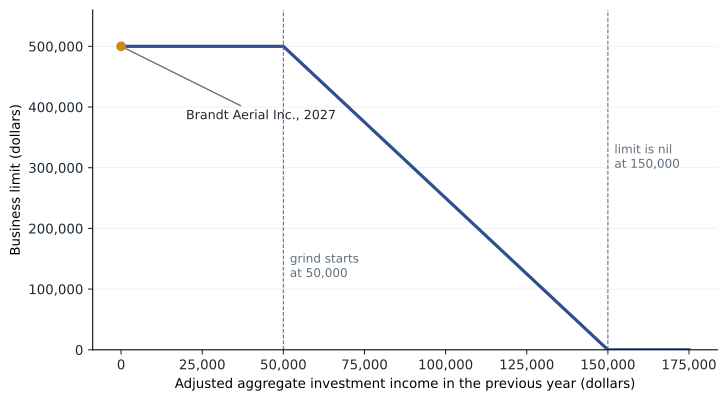
Associated corporations must share one business limit, allocating it among themselves on Schedule 23. Under section 256, corporations are associated if one controls the other, if both are controlled by the same person or group, or if they are controlled by related persons who also own cross-holdings of at least 25 per cent; control includes de jure control and, under subsection 256(5.1), de facto control through economic dependence or influence. The rules prevent an owner from multiplying the $500,000 limit by splitting a business among several corporations. The business limit is also ground down in two ways. Under the taxable capital grind, it is reduced on a straight-line basis as the taxable capital employed in Canada of the corporation and its associated corporations in the previous year rises from $10 million to $50 million. Under the passive income grind introduced in 2018, it is reduced by $5 for every $1 of adjusted aggregate investment income (AAII) above $50,000 in the previous year, reaching zero at $150,000. The larger of the two reductions applies. The passive income grind discourages CCPCs from accumulating large portfolios with income taxed at the small business rate.
Two further rules close gaps. Specified corporate income rules, introduced in 2016, deny the small business deduction on income a CCPC earns from providing services or property to another private corporation in which it, a shareholder or a non-arm's length person holds a direct or indirect interest, unless the other corporation assigns part of its own business limit. Specified partnership income rules similarly limit the small business deduction on income a corporate partner earns through a partnership to its share of a single $500,000 limit for the partnership. These rules prevent professionals from multiplying the business limit through partnerships of professional corporations.
The business limit interacts with planning in ways that become clearer in later lessons. Because income above the limit is taxed at 27 per cent and can be paid out as eligible dividends, while income within the limit is taxed at 9 per cent and paid out as non-eligible dividends, owner-managers often pay salaries or bonuses that bring active income down to the business limit; a bonus accrued at year-end is deductible if paid within 180 days. Because investment income reduces next year's limit, some owners hold investments in a separate holding company, but the holding company is associated and its income counts, so that does not escape the grind; investing in growth assets that defer income, or contributing to an individual pension plan, does. These choices are revisited in lessons 4, 5 and 11.
Brandt Aerial Inc.'s Part I tax
The program computes Brandt Aerial Inc.'s federal and Manitoba Part I tax for 2027 from the amounts determined in lesson 2, applying the 2026 rates. The corporation is new, so its prior-year AAII is nil and its taxable capital is far below $10 million: the full business limit is available. The program also shows what would happen to the business limit in a later year if the corporation accumulated a large investment portfolio.
# Brandt Aerial Inc.: Part I tax for 2027 using 2026 rates (illustrative)
taxable_income = 95_950
adbi = 88_950                  # active business income carried on in Canada
aii = 7_000                    # aggregate investment income: interest 4,000 + TCG 3,000
business_limit = 500_000       # not shared: no associated corporations

def reduced_limit(limit, prior_aaii, prior_taxable_capital):
    """Business limit after the passive income and taxable capital grinds (s. 125(5.1))."""
    passive = 5 * max(0, prior_aaii - 50_000)
    capital = limit * max(0, prior_taxable_capital - 10_000_000) / 40_000_000
    return max(0, limit - max(passive, capital))

limit = reduced_limit(business_limit, prior_aaii=0, prior_taxable_capital=900_000)
sbd_income = min(adbi, taxable_income, limit)
base = 0.38 * taxable_income
abatement = 0.10 * taxable_income
sbd = 0.19 * sbd_income
grr = 0.13 * max(0, taxable_income - sbd_income - aii)
art = (0.10 + 2 / 300) * min(aii, taxable_income - sbd_income)
federal = base - abatement - sbd - grr + art
manitoba = 0.0 * sbd_income + 0.12 * (taxable_income - sbd_income)
rows = [("Basic tax 38%", base), ("Federal abatement 10%", -abatement),
        ("Small business deduction 19%", -sbd), ("General rate reduction 13%", -grr if grr else 0.0),
        ("Additional refundable tax 10 2/3%", art), ("Federal Part I tax", federal),
        ("Manitoba tax (0% small business, 12% other)", manitoba),
        ("Total Part I tax", federal + manitoba)]
print(f"Business limit available: {limit:,.0f}; income eligible for the SBD: {sbd_income:,.0f}")
for k, v in rows:
    print(f"{k:<46}{v:>12,.2f}")
print(f"Average rate on taxable income: {(federal + manitoba) / taxable_income:.2%}")
print()
print("Business limit in a later year, by prior-year adjusted aggregate investment income")
for aaii in (40_000, 50_000, 80_000, 120_000, 150_000):
print(f" AAII {aaii:>8,}: business limit {reduced_limit(500_000, aaii, 900_000):>9,.0f}")Business limit available: 500,000; income eligible for the SBD: 88,950 Basic tax 38% 36,461.00 Federal abatement 10% -9,595.00 Small business deduction 19% -16,900.50 General rate reduction 13% 0.00 Additional refundable tax 10 2/3% 746.67 Federal Part I tax 10,712.17 Manitoba tax (0% small business, 12% other) 840.00 Total Part I tax 11,552.17 Average rate on taxable income: 12.04% Business limit in a later year, by prior-year adjusted aggregate investment income AAII 40,000: business limit 500,000 AAII 50,000: business limit 500,000 AAII 80,000: business limit 350,000 AAII 120,000: business limit 150,000 AAII 150,000: business limit 0
Because all of the active business income of $88,950 is within the business limit, the general rate reduction applies to nothing, and federal tax is 9 per cent of $88,950 plus 38⅔ per cent of the $7,000 of investment income: $10,712.17. Manitoba adds 12 per cent of the investment income, $840, for total Part I tax of $11,552.17, an average rate of 12 per cent on taxable income. The second part of the output shows how the passive income grind works: if the corporation's adjusted aggregate investment income in a year reached $80,000, its business limit in the following year would fall to $350,000; at $150,000 it would disappear. With $88,950 of active income Brandt Aerial Inc. is far from the limit today, but if it grows and keeps a large portfolio of passive investments, the grind could push some of its active income into the 27 per cent bracket.
Other rate adjustments
A few other features complete the picture. Manufacturing and processing profits get a deduction that equals the general rate reduction, so it adds nothing federally today but still affects some provincial rates. Corporations that manufacture qualifying zero-emission technology pay half the normal federal rates, 7.5 per cent and 4.5 per cent, for taxation years beginning before 2032, phasing out by 2035. A corporation's foreign tax credits, investment tax credits for scientific research and certain other credits reduce its Part I tax. Finally, the federal small business rate has been cut repeatedly, from 11 per cent in 2015 to 9 per cent since 2019, and the business limit has been $500,000 since 2009; neither is indexed to inflation.
Worked problem
Associated corporations
In 2029 Leah forms a second corporation, Brandt Training Inc., wholly owned by her, to run drone pilot courses. For 2029, Brandt Aerial Inc. expects active business income of $420,000 and Brandt Training Inc. $150,000. How much more tax does association cost, and how should the business limit be allocated?
Show solution
- Leah controls both corporations, so they are associated under paragraph 256(1)(b) and must share one $500,000 business limit.
- Their combined active business income is $570,000, so $70,000 will be taxed at the general rate however the limit is allocated.
- The extra tax is $70,000 × (27% − 9%) = $12,600 a year compared with two separate limits.
- Allocating $420,000 to Brandt Aerial Inc. and $80,000 to Brandt Training Inc. on Schedule 23 shelters all of Brandt Aerial's income; the training company pays 27 per cent on $70,000. Any allocation that uses the whole limit gives the same total tax this year, but the choice affects each company's GRIP and the type of dividends it can pay.
Answer: About $12,600 a year of extra tax; allocate $420,000 to Brandt Aerial Inc. and $80,000 to Brandt Training Inc.
Common mistakes
MistakeApplying the 9 per cent rate to all of a CCPC's income.
InsteadOnly active business income in Canada up to the business limit qualifies; investment income bears 50⅔ per cent before refunds.
MistakeGiving each associated corporation a full $500,000 limit.
InsteadAssociated corporations share one limit, allocated on Schedule 23.
MistakeForgetting that the passive income grind uses the previous year's AAII.
InsteadInvestment income this year reduces next year's business limit.
MistakeTreating an incorporated employee's income as active business income.
InsteadA personal services business is taxed at 33 per cent federally and gets no small business deduction.
MistakeUsing the abatement for income of a foreign branch.
InsteadThe 10 per cent abatement applies only to income earned in a province.
Summary and key terms
- The federal rate is built from 38 per cent less a 10 per cent abatement and a 13 per cent general rate reduction: 15 per cent.
- The small business deduction of 19 per cent reduces the rate on qualifying active business income to 9 per cent.
- Manitoba's combined rates are 9 per cent (small business) and 27 per cent (general) for 2026.
- A CCPC's investment income bears 50⅔ per cent in Manitoba before the dividend refund.
- Associated corporations share one $500,000 business limit.
- The limit is ground down by taxable capital from $10 million to $50 million and by AAII from $50,000 to $150,000.
- Personal services business income is taxed at 33 per cent federally.
- Brandt Aerial Inc.'s 2027 Part I tax is $11,552.17.
- General rate reduction
- A 13 per cent reduction of federal tax on full rate taxable income.
- Federal abatement
- A 10 per cent reduction of federal tax on income earned in a province.
- Business limit
- The $500,000 of active business income eligible for the small business deduction, shared among associated corporations.
- Associated corporations
- Corporations related through control under section 256, which must share one business limit.
- Adjusted aggregate investment income (AAII)
- A CCPC's passive income measure used in the passive income grind of the business limit.
- Specified investment business
- A business whose principal purpose is earning property income, with five or fewer full-time employees.
- Personal services business
- A business of providing services through a corporation where the individual would otherwise be an employee of the client.
- Effective rate
- The combined federal and provincial or state rate actually applied to a type of income.
Practice problems
Work each problem on paper first, then reveal the answer to check.
Compute the federal rate on a CCPC's active business income above the business limit.
Show answer
38% − 10% − 13% = 15%.
What is the combined Manitoba rate on income a CCPC earns from a specified investment business?
Show answer
38⅔% federal + 12% Manitoba = 50⅔% before the refund.
A CCPC had AAII of $100,000 last year and taxable capital of $5 million. What is its business limit?
Show answer
$500,000 − 5 × $50,000 = $250,000.
A CCPC's associated group had taxable capital of $30 million last year. What is the taxable capital grind?
Show answer
$500,000 × ($30M − $10M) / $40M = $250,000, leaving a $250,000 limit (if larger than the passive grind).
Why does the passive income grind exist?
Show answer
To limit the deferral available on investment income funded by low-taxed active income.
Name two ways corporations can be associated.
Show answer
For example one controls the other, or both are controlled by the same person or group.
What federal rate applies to personal services business income?
Show answer
33 per cent (38 − 10 + 5).
In the associated corporations example, what is the annual cost of association?
Show answer
$70,000 × 18% = $12,600.
Lesson quiz · 5 questions
Score 60% or more to complete this lesson.
Create a free account to save your progress, take quizzes and earn a certificate.