
ACCT-352 · Lesson 2 of 12 · 24 min
Computing corporate net income and taxable income
A corporation computes its income with the same rules as an individual. Division B of Part I applies section 3 and the source rules: business income is profit under section 9, adjusted by the specific inclusions in section 12 and the limits in sections 18 to 20, and capital gains are computed under subdivision c. Division C then subtracts the deductions that turn net income into taxable income. The differences from personal tax are in the details. A corporation has no employment income, its donations are deductions rather than credits, dividends it receives from other Canadian corporations are generally deductible, and its income is almost always business income or income from property. In practice, every corporate tax computation begins with the financial statements and works from accounting income to net income for tax purposes on Schedule 1 of the T2 return. This lesson walks through that reconciliation for Brandt Aerial Inc.'s first year.
The taxation year
A corporation's taxation year is its fiscal period, which cannot exceed 53 weeks. A new corporation may choose any year-end for its first return, but once chosen, it can change it only with the CRA's permission, which is given for sound business reasons and not to defer tax. An acquisition of control, an amalgamation and certain other events create a deemed year-end. Brandt Aerial Inc. chooses 31 December so that its year matches Leah's personal year, which simplifies planning of salaries and dividends. Income is computed on the accrual basis following well-accepted business principles, which normally means accounting standards for private enterprises (ASPE) or IFRS, except where the Act provides otherwise.
From accounting income to net income for tax purposes
Schedule 1 starts with net income or loss after tax from the financial statements, which the CRA requires in the standard General Index of Financial Information (GIFI) format, and adds back the income tax expense, since tax is not deductible in computing itself. It then adds amounts that were deducted in the accounts but are not deductible for tax, subtracts amounts that are deductible for tax but were not deducted in the accounts, and adjusts income that is recognized differently. Some differences are permanent: half of meal and entertainment costs, golf and recreational club dues, fines and penalties, political contributions and the non-taxable half of a capital gain never enter taxable income. Others are temporary: amortization is replaced by capital cost allowance, accounting reserves for warranties or bad debts are replaced by the reserves the Act allows, and revenue received in advance may be taxed at a different time. Temporary differences give rise to deferred tax in the accounts, a topic covered in ACCT-212.
| Adjustment | Direction | Authority | Type |
|---|---|---|---|
| Provision for income taxes | Add back | Not deductible in computing income | Permanent |
| Amortization of capital assets | Add back | Paragraph 18(1)(b); CCA allowed instead | Temporary |
| Capital cost allowance | Deduct | Paragraph 20(1)(a) and Schedule 8 | Temporary |
| 50% of meals and entertainment | Add back | Section 67.1 | Permanent |
| Club dues and recreational facilities | Add back | Paragraph 18(1)(l) | Permanent |
| Fines and penalties | Add back | Section 67.6 | Permanent |
| Accounting reserves (warranty, contingencies) | Add back | Paragraph 18(1)(e) | Temporary |
| Accounting gain on disposal; taxable capital gain | Deduct; add | Subdivision c | Permanent for the untaxed half |
| Charitable donations | Add back, then deduct in Division C | Section 110.1 | Timing of the deduction |
Capital cost allowance and the accelerated investment incentive
Capital cost allowance works exactly as in ACCT-351 lesson 7: depreciable property is pooled in classes, each class is written down on a declining balance at its prescribed rate, the half-year rule normally limits the first-year claim, and recapture or a terminal loss arises when a class is disposed of. Two features are worth repeating for corporations. First, CCA is discretionary: a corporation may claim less than the maximum and preserve the undepreciated capital cost for later years, which is useful when the deduction would only create a loss or would save tax at 9 per cent this year when a higher rate is expected later. Second, the accelerated investment incentive, extended by the 2025 federal budget and enacted by Bill C-15 in March 2026, suspends the half-year rule and multiplies the normal first-year rate by 1.5 for most eligible property, though property acquired from a non-arm's length person who previously owned it, such as the equipment Leah transferred to her corporation, does not qualify.
Two practical points about Schedule 1 deserve emphasis. First, the CRA's systems compare the GIFI financial data with the tax return, so unusual reconciling items invite questions; a clear working paper that ties every adjustment to a ledger account and a provision of the Act is the best defence in a review. Second, many reconciling items recur every year, so a well-built Schedule 1 template, with the continuity of reserves, UCC by class, carryforward balances and the capital dividend account, saves time and reduces errors. Brandt Aerial Inc. is a small corporation, but its first-year schedules will be the starting point for every later return, which is why its accountant documents the opening UCC of the transferred equipment and the elected amounts under section 85 so carefully.
Division C: from net income to taxable income
Division C allows a corporation several deductions. The most important is section 112, which lets a corporation deduct taxable dividends received from taxable Canadian corporations, so that profits taxed once at the corporate level are not taxed again as they move up a chain of corporations. Portfolio dividends from public companies and dividends from connected corporations that received a dividend refund are subject to Part IV tax instead, as lesson 4 explains, and subsection 55(2) can recharacterize an intercorporate dividend as a capital gain when it is used to strip value out of a corporation before a sale. Section 110.1 allows charitable donations as a deduction, limited to 75 per cent of net income with a five-year carryforward. Section 111 allows loss carryovers: non-capital losses can be carried back three years and forward twenty, and net capital losses back three years and forward indefinitely, but only against taxable capital gains. After an acquisition of control, losses are restricted: net capital losses expire, and non-capital losses from a business can be used only against income from the same or a similar business that continues with a reasonable expectation of profit.
Capital gains and losses of a corporation
A corporation includes one-half of its capital gains in income, like an individual; the March 2025 cancellation of the proposed increase in the inclusion rate applied to corporations as well. The non-taxable half is added to the capital dividend account and can be paid to shareholders tax-free, which preserves integration for gains (lesson 4). Allowable capital losses offset only taxable capital gains, and a net capital loss can be carried back three years or forward indefinitely. The superficial loss rule denies a corporation's loss when it, or an affiliated person, reacquires the property within 30 days, and the stop-loss rules reduce a corporation's loss on shares by tax-free dividends previously received on them.
Brandt Aerial Inc.'s Schedule 1
Brandt Aerial Inc.'s 2027 financial statements show income before income taxes of $118,400, after paying Leah a salary of $70,000 and the employer's share of CPP. That figure includes $4,000 of interest on a term deposit, $6,000 of eligible dividends from a Canadian equity ETF bought with surplus cash, and a $6,000 accounting gain on ETF units sold in the autumn. The accounts deduct $46,000 of amortization, $6,200 of meals with clients and crews, $2,400 of golf club dues and $600 of fines. During the year the corporation bought $160,000 of drones and sensors (class 8) and a $35,000 cargo van (class 10), and it holds the class 8 equipment Leah transferred to it, with a UCC of $9,000. The program computes CCA and the reconciliation, using 2026 rules as the latest available.
# Brandt Aerial Inc.: from accounting income to taxable income (Schedule 1), year ending
# 31 December 2027, using 2026 rules (all figures invented)
book_income = 118_400          # income before income taxes, after Leah's $70,000 salary
add_backs = {
    "Amortization per the financial statements": 46_000,
    "50% of meals and entertainment (s. 67.1)": 3_100,
    "Golf club dues (s. 18(1)(l))": 2_400,
    "Traffic and municipal fines (s. 67.6)": 600,
}
# Capital cost allowance (Schedule 8): accelerated investment incentive at 1.5x the
# normal first-year rate; transferred equipment does not qualify (previously owned by Leah)
cca_classes = [("Class 8 drones and sensors bought in 2027", 160_000, 0.20, 1.5),
               ("Class 10 cargo van bought in 2027", 35_000, 0.30, 1.5),
               ("Class 8 equipment transferred from Leah", 9_000, 0.20, 1.0)]
cca = 0.0
for name, cost, rate, factor in cca_classes:
    claim = cost * rate * factor
    cca += claim
    print(f"  CCA {name:<44}{claim:>10,.2f}")
deductions = {"Capital cost allowance": cca,
              "Accounting gain on ETF units sold": 6_000}
additions_tcg = {"Taxable capital gain (1/2 of the 6,000 gain)": 3_000}

net_income = book_income + sum(add_backs.values()) - sum(deductions.values()) + sum(additions_tcg.values())
print(f"{'Net income before taxes per books':<50}{book_income:>12,.2f}")
for k, v in add_backs.items():
    print(f"  add {k:<44}{v:>12,.2f}")
for k, v in deductions.items():
    print(f"  deduct {k:<41}{-v:>12,.2f}")
for k, v in additions_tcg.items():
    print(f"  add {k:<44}{v:>12,.2f}")
print(f"{'Net income for tax purposes':<50}{net_income:>12,.2f}")
div_112 = 6_000                # eligible dividends from taxable Canadian corporations
taxable_income = net_income - div_112
print(f"{"  deduct taxable dividends received (s. 112)":<50}{-div_112:>12,.2f}")
print(f"{'Taxable income':<50}{taxable_income:>12,.2f}")
interest, tcg = 4_000, 3_000
adbi = net_income - interest - div_112 - tcg
print(f"{'  of which active business income':<50}{adbi:>12,.2f}")
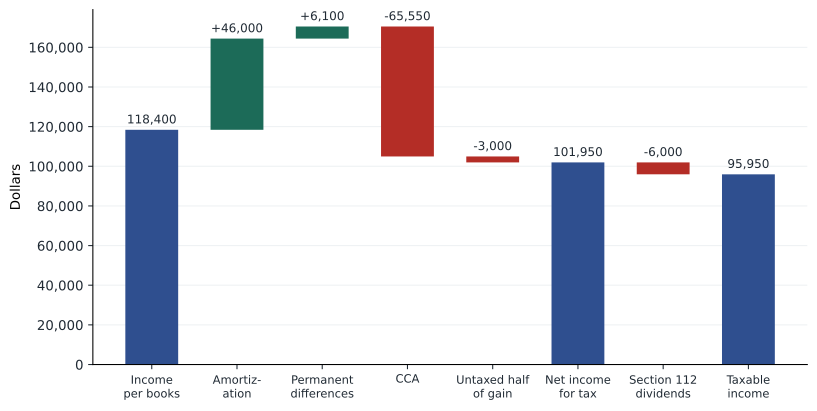
print(f"{' of which aggregate investment income':<50}{interest + tcg:>12,.2f}")CCA Class 8 drones and sensors bought in 2027 48,000.00 CCA Class 10 cargo van bought in 2027 15,750.00 CCA Class 8 equipment transferred from Leah 1,800.00 Net income before taxes per books 118,400.00 add Amortization per the financial statements 46,000.00 add 50% of meals and entertainment (s. 67.1) 3,100.00 add Golf club dues (s. 18(1)(l)) 2,400.00 add Traffic and municipal fines (s. 67.6) 600.00 deduct Capital cost allowance -65,550.00 deduct Accounting gain on ETF units sold -6,000.00 add Taxable capital gain (1/2 of the 6,000 gain) 3,000.00 Net income for tax purposes 101,950.00 deduct taxable dividends received (s. 112) -6,000.00 Taxable income 95,950.00 of which active business income 88,950.00 of which aggregate investment income 7,000.00
CCA of $65,550 replaces $46,000 of amortization, so the accelerated investment incentive adds $19,550 of deductions in the first year. The permanent differences add $6,100, and replacing the $6,000 accounting gain with the $3,000 taxable capital gain removes $3,000. Net income for tax purposes is $101,950, and deducting the $6,000 of dividends under section 112 leaves taxable income of $95,950. The last two lines split taxable income into the parts that will be taxed differently in lesson 3: $88,950 of active business income, eligible for the small business deduction, and $7,000 of aggregate investment income (the interest and the taxable capital gain), which bears a higher, partly refundable rate. The dividends, although deducted under section 112, will attract Part IV tax in lesson 4.
Interest deductibility and other limits
Interest on money borrowed to earn business or property income is deductible under paragraph 20(1)(c), but several limits apply to corporations. The thin capitalization rules deny interest on debts owed to specified non-residents that exceed 1.5 times the corporation's equity. The excessive interest and financing expenses limitation (EIFEL), in force for taxation years beginning on or after 1 October 2023, limits net interest and financing expenses to 30 per cent of adjusted taxable income, a tax version of EBITDA; CCPCs that, with associated corporations, have taxable capital employed in Canada under $50 million, and groups with net interest expense under $1 million, are excluded, so Brandt Aerial Inc. is unaffected. Incorporation costs are added to class 14.1 with the first $3,000 deductible immediately, and expenses of issuing shares or borrowing money are deductible over five years.
Worked problem
Carrying back a loss
Suppose a lost contract leaves Brandt Aerial Inc. with a non-capital loss of $30,000 in 2028. Its 2027 taxable income was $95,950, of which $88,950 was active business income taxed at the 9 per cent small business rate, and it expects strong profits from 2029. Should it carry the loss back?
Show solution
- A non-capital loss can be carried back to any of the three preceding years by filing form T2A with the 2028 return.
- Carried back to 2027, the loss reduces taxable income from $95,950 to $65,950; the reduction comes out of active business income taxed at 9 per cent.
- The refund is about 9% × $30,000 = $2,700, received soon after the 2028 return is assessed.
- Carrying it forward instead would save tax at whatever rate applies in 2029; if income above the $500,000 business limit is expected, the saving could be 27 per cent, but that is uncertain and later.
- The corporation can choose how much to carry back, so it can carry back enough to recover the 9 per cent tax and keep the rest for later years.
Answer: Carrying back saves about $2,700 now; a partial carryback can preserve some loss for later.
Common mistakes
MistakeStarting Schedule 1 from income after tax without adding back the tax provision.
InsteadTax is not deductible; add back current and deferred tax expense.
MistakeIncluding the full accounting gain in income.
InsteadRemove the accounting gain and add the taxable capital gain (one-half).
MistakeClaiming a credit for corporate donations.
InsteadCorporations deduct donations under section 110.1, up to 75 per cent of net income.
MistakeForgetting that dividends deducted under section 112 may still bear Part IV tax.
InsteadPortfolio dividends are deducted in Division C but taxed under Part IV until paid out.
MistakeClaiming the maximum CCA automatically.
InsteadCCA is discretionary; claiming less can preserve UCC for higher-rate years or avoid creating losses.
Summary and key terms
- Corporations compute net income under Division B and taxable income under Division C, like individuals.
- Schedule 1 reconciles accounting income to net income for tax purposes.
- Permanent differences include half of meals, club dues, fines and the untaxed half of gains.
- CCA replaces amortization; the accelerated investment incentive raises first-year claims.
- Section 112 deducts dividends from taxable Canadian corporations.
- Non-capital losses carry back 3 years and forward 20; net capital losses only offset taxable capital gains.
- EIFEL and thin capitalization limit interest for large or foreign-financed corporations.
- Brandt Aerial Inc.'s 2027 taxable income is $95,950: $88,950 active, $7,000 investment.
- Schedule 1
- The T2 schedule reconciling net income per the financial statements to net income for tax purposes.
- GIFI
- The General Index of Financial Information, the CRA's standard format for financial statement data.
- Section 112 deduction
- The Division C deduction for taxable dividends received from taxable Canadian corporations.
- Non-capital loss
- A loss from business or property and other non-capital items, carried back 3 years and forward 20.
- Accelerated investment incentive
- An enhanced first-year CCA claim of 1.5 times the normal rate with no half-year rule.
- EIFEL
- The excessive interest and financing expenses limitation, restricting net interest to 30 per cent of adjusted taxable income.
- Permanent difference
- A difference between book and taxable income that never reverses.
- Temporary difference
- A difference in timing between book and taxable income that reverses in later years.
Practice problems
Work each problem on paper first, then reveal the answer to check.
In the program, how much more CCA than amortization does Brandt Aerial Inc. claim?
Show answer
$65,550 − $46,000 = $19,550.
What would CCA on the class 8 additions be without the accelerated investment incentive?
Show answer
$160,000 × 20% × ½ = $16,000 instead of $48,000.
A corporation has net income of $40,000 and makes a $35,000 donation. How much can it deduct this year?
Show answer
75% × $40,000 = $30,000; $5,000 carries forward five years.
Why is the taxable capital gain added but the accounting gain deducted on Schedule 1?
Show answer
The accounts include the full gain; only one-half is taxable.
Which loss carryover can be used only against taxable capital gains?
Show answer
A net capital loss.
Name two items added back on Schedule 1 that create permanent differences.
Show answer
For example 50% of meals, club dues, fines or political contributions.
Is Brandt Aerial Inc. subject to EIFEL? Why?
Show answer
No; it is a CCPC with taxable capital well under $50 million.
What happens to non-capital losses on an acquisition of control?
Show answer
They can be used only against income from the same or a similar business carried on with a reasonable expectation of profit.
Lesson quiz · 5 questions
Score 60% or more to complete this lesson.
Create a free account to save your progress, take quizzes and earn a certificate.