
ACCT-352 · Lesson 11 of 12 · 26 min
Tax planning, anti-avoidance rules and ethics
Every lesson in this course has involved choices that change the tax owed: whether to incorporate, how to pay the owner, what to elect under section 85, where to hold investments. Taxpayers are entitled to arrange their affairs to minimize tax, but that entitlement has limits. Specific anti-avoidance rules block particular techniques, the general anti-avoidance rule (GAAR) catches transactions that comply with the words of the Act but abuse its purpose, mandatory disclosure rules require taxpayers and advisers to report certain transactions, and professional codes of conduct govern what accountants may advise and sign. This lesson examines these limits and two planning techniques that every owner-manager's adviser considers: the estate freeze and income splitting, now heavily restricted by the tax on split income.
Planning, avoidance and evasion
Three ideas need to be kept apart. Tax planning uses the Act as Parliament intended: contributing to an RRSP, claiming the small business deduction, electing under section 85 to defer a gain on incorporation. Tax avoidance uses the Act in ways that comply with its words but defeat its purpose, and it is legal unless a specific rule or GAAR applies. Tax evasion is deliberately misrepresenting facts to reduce tax, such as hiding income or inventing expenses; it is a crime under section 239, punishable by fines of 50 to 200 per cent of the tax evaded and up to five years in prison. The starting point in Canadian law is still the principle from the Duke of Westminster case (1936) that taxpayers may order their affairs to reduce tax, and the Supreme Court of Canada rejected a general business purpose test in Stubart Investments (1984). Parliament responded in 1988 by enacting GAAR in section 245.
The general anti-avoidance rule
Section 245 denies the tax benefit of an avoidance transaction that results in a misuse or abuse of the provisions of the Act. The Supreme Court of Canada set out the framework in Canada Trustco Mortgage Co. v. Canada (2005): first, there must be a tax benefit, a reduction, avoidance or deferral of tax; second, the transaction giving rise to it must be an avoidance transaction, one not undertaken primarily for bona fide non-tax purposes; third, the transaction must be abusive, meaning that it frustrates the object, spirit and purpose of the provisions relied on. The CRA bears the burden on abuse. Later cases refined the test: Copthorne Holdings (2011) applied GAAR to a series that preserved paid-up capital, Alta Energy (2021) declined to apply it to treaty shopping, and Deans Knight Income Corp. (2023) applied it to a loss-trading transaction that achieved the result the acquisition of control rules were designed to prevent.
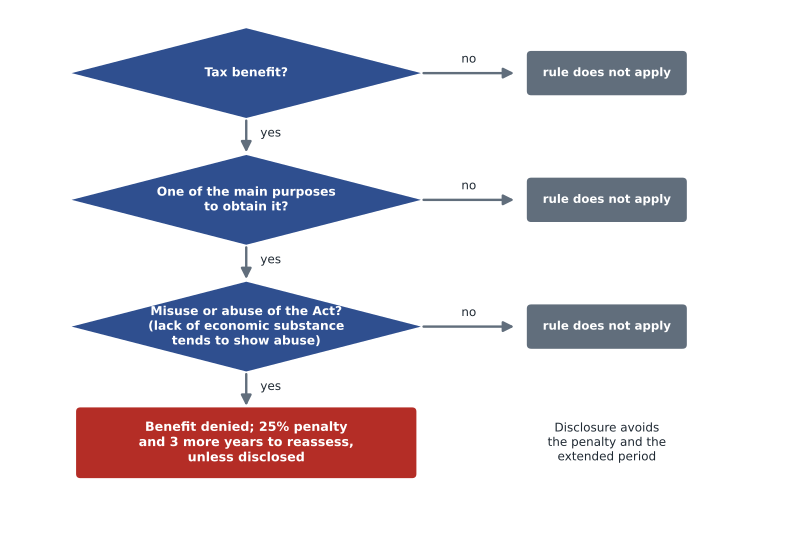
Parliament amended GAAR substantially in 2024, effective for transactions on or after 1 January 2024. The amendments added a preamble stating that GAAR applies whether or not the tax planning strategy was foreseeable, lowered the avoidance transaction threshold from a primary purpose to 'one of the main purposes' of obtaining a tax benefit, provided that a significant lack of economic substance tends to indicate abuse, imposed a penalty of 25 per cent of the tax benefit when GAAR applies unless the transaction was disclosed to the CRA in advance, and extended the reassessment period by three years for GAAR assessments unless the transaction was disclosed. As a result, disclosure, either as a reportable transaction or voluntarily, has become an important part of managing GAAR risk for any aggressive plan.
Specific anti-avoidance rules and the tax on split income
Many specific rules covered in this course are anti-avoidance rules: the attribution rules, subsections 15(1) and 15(2), the paid-up capital grind, section 84.1, subsection 55(2), the associated corporation rules and the passive income grind. The most important for owner-managers is the tax on split income (TOSI) in section 120.4, extended in 2018 from minors to adults. It taxes 'split income' of a 'specified individual' at the top marginal rate, with only the dividend tax credit and no personal credits. Split income includes taxable dividends from private corporations, income from partnerships and trusts derived from a related business, and certain capital gains and interest. Amounts are excluded if they come from an excluded business (one in which the individual was actively engaged on a regular, continuous and substantial basis, deemed if he or she worked at least an average of 20 hours a week during the year or any five prior years); from excluded shares (shares representing at least 10 per cent of the votes and value of a corporation owned by an individual aged 25 or older, provided the corporation is not a professional corporation, less than 90 per cent of its business income comes from services and its income is not derived from a related business); as a reasonable return for individuals aged 25 or older, based on their contributions of labour, property and risk; or, for spouses of business owners aged 65 or older, from amounts that would be excluded for the owner. Gains on qualified small business corporation shares are excluded except for minors selling to non-arm's length persons.
| TOSI exclusion | Who can use it | Key condition | |
|---|---|---|---|
| Excluded business | Any individual aged 18 or older | Actively engaged on a regular, continuous and substantial basis (20 hours a week safe harbour) in the year or any five prior years | Leah, who runs Brandt Aerial Inc. |
| Excluded shares | Individuals aged 25 or older | At least 10% of votes and value; not a professional corporation; under 90% of business income from services | Not available for Brandt Aerial Inc., a services business |
| Reasonable return | Individuals aged 25 or older (stricter test for 18 to 24) | Reasonable having regard to work, property contributed, risk and past returns | A spouse who guarantees the company's loans |
| Spouse of owner aged 65 or older | Spouses and common-law partners | The amount would be excluded for the owner | Retirement income splitting |
| Capital gains on QSBC shares | Adults; minors only on arm's length sales | Shares qualify for the LCGE | Sale of the business to a third party |
Estate freezes
An estate freeze fixes the value of an owner's interest in a corporation at its current fair market value and passes future growth to the next generation or a family trust. In a typical section 86 freeze, the owner exchanges all of his or her common shares for fixed-value preferred shares that are redeemable and retractable at the current value of the business, carry a dividend entitlement and often voting control; the exchange is tax-free under section 86 if the preferred shares' value equals the common shares' value. A family trust, or the children, then subscribe for new common shares for a nominal amount. The owner's tax at death is limited to the gain accrued to the date of the freeze, the future growth accrues to the trust's beneficiaries, and if the shares are QSBC shares, a future sale can use the lifetime capital gains exemptions of several beneficiaries. The risks are well known: if the preferred shares are worth less than the common shares given up, subsection 86(2) taxes the benefit conferred on related persons, so freezes use independent valuations and price adjustment clauses; corporate attribution under section 74.4 can apply if a spouse or minor child is a beneficiary unless the corporation remains a small business corporation; TOSI limits dividends to family members; and the trust's 21-year rule must be managed.
The Brandt freeze
Suppose that in 2027 Brandt Aerial Inc. is worth $600,000 and Leah's common shares have a nil adjusted cost base from the section 85 transfer. She exchanges them under section 86 for 600,000 voting preferred shares redeemable at $1 each, and the Brandt Family Trust subscribes for 100 new common shares for $100. The program projects the value of the business over 25 years at 8 per cent growth, compares Leah's deemed gain at death with and without the freeze, shows the effect of multiplying the lifetime capital gains exemption on a later sale, and computes the new GAAR penalty on a hypothetical $50,000 tax benefit.
# An estate freeze of Brandt Aerial Inc. in favour of the Brandt Family Trust (illustrative)
value_now = 600_000            # FMV of Leah's common shares when frozen (section 86 exchange)
acb_common = 0                 # from the section 85 transfer (lesson 6)
growth, years = 0.08, 25       # assumed growth until Leah's death
value_at_death = value_now * (1 + growth) ** years
top_cg_rate = 0.252            # top federal + Manitoba rate on capital gains (one-half inclusion)
no_freeze_gain = value_at_death - acb_common
freeze_gain = value_now - acb_common      # preferred shares stay at the frozen value
print(f"Value of the business in {years} years at {growth:.0%} growth: {value_at_death:,.0f}")
print(f"Deemed gain at Leah's death without a freeze: {no_freeze_gain:>12,.0f}  tax {no_freeze_gain * top_cg_rate:>11,.0f}")
print(f"Deemed gain at Leah's death with the freeze:  {freeze_gain:>12,.0f}  tax {freeze_gain * top_cg_rate:>11,.0f}")
print(f"Growth shifted to the trust's common shares: {value_at_death - value_now:,.0f}")
print("(The trust's own 21-year deemed disposition and any sale must be planned for separately.)")
print()
# Lifetime capital gains exemption on a sale of qualified small business corporation shares
lcge = 1_275_000
gain_on_sale = 3_000_000
for n in (1, 3):
    sheltered = min(gain_on_sale, n * lcge)
    print(f"Gain {gain_on_sale:,} allocated to {n} individual(s): sheltered by the LCGE {sheltered:,}")
print()
# GAAR penalty since 2024: 25% of the tax benefit, unless the transaction was disclosed
tax_benefit = 50_000
for disclosed in (False, True):
    penalty = 0 if disclosed else 0.25 * tax_benefit
print(f"GAAR applies, tax benefit {tax_benefit:,}, disclosed: {disclosed} penalty {penalty:,.0f}")Value of the business in 25 years at 8% growth: 4,109,085 Deemed gain at Leah's death without a freeze: 4,109,085 tax 1,035,489 Deemed gain at Leah's death with the freeze: 600,000 tax 151,200 Growth shifted to the trust's common shares: 3,509,085 (The trust's own 21-year deemed disposition and any sale must be planned for separately.) Gain 3,000,000 allocated to 1 individual(s): sheltered by the LCGE 1,275,000 Gain 3,000,000 allocated to 3 individual(s): sheltered by the LCGE 3,000,000 GAAR applies, tax benefit 50,000, disclosed: False penalty 12,500 GAAR applies, tax benefit 50,000, disclosed: True penalty 0
Without a freeze, a business growing at 8 per cent a year would be worth about $4.1 million in 25 years, and Leah's estate would face a deemed capital gain of that amount at her death, costing about $1.04 million at the top capital gains rate. With the freeze, her deemed gain is limited to $600,000, about $151,200 of tax, and the $3.5 million of growth belongs to the trust's common shares. On a sale of the business, allocating a $3 million gain on QSBC shares among three adult beneficiaries could shelter it entirely with three lifetime capital gains exemptions, compared with $1,275,000 for Leah alone, although allocations to Nora while she is a minor would be caught by TOSI unless the sale is to an arm's length buyer, and the trustees must consider the alternative minimum tax. The final lines show the 2024 GAAR penalty: a $12,500 penalty on a $50,000 tax benefit, avoided entirely if the transaction is disclosed in advance, which is now a central consideration in deciding whether to proceed with an aggressive plan.
Mandatory disclosure
Since June 2023, expanded mandatory disclosure rules require taxpayers, promoters and advisers to report three kinds of transactions on form RC312 or RC3133. Reportable transactions are avoidance transactions with at least one generic hallmark: a contingent fee arrangement, a confidentiality protection or contractual protection such as insurance against the tax benefit being denied. Notifiable transactions are transactions the Minister has designated, such as certain manipulations of CCPC status or straddle loss creations, and substantially similar ones. Uncertain tax treatments must be reported by corporations with assets of $50 million or more whose audited financial statements reflect uncertainty about their tax treatment. Penalties for failure to report can be substantial, the reassessment period does not start until the required information return is filed, and a promoter or adviser who fails to report also faces penalties.
Professional ethics in tax practice
CPAs who practise tax are bound by their provincial CPA codes of professional conduct, which require integrity, due care, objectivity and confidentiality, and prohibit them from associating with information they know or should know is false or misleading. They may advocate a client's position where there is reasonable support for it, but may not take part in evasion or sign a return they know to be false. Under the CPA codes and the law, they must keep client information confidential, although the CRA's powers to compel information (section 231.2) override confidentiality except for solicitor-client privilege, which does not protect accountants' advice. Section 163.2 imposes civil penalties on third parties: a planner penalty, the greater of $1,000 and the planner's gross entitlements, for making false statements in a plan or arrangement, and a preparer penalty for participating in a false statement, with a culpability standard of knowledge or circumstances amounting to culpable conduct. A client who discovers past errors can correct them through the CRA's Voluntary Disclosures Program, revised in 2025, which may grant penalty relief and partial interest relief if the disclosure is voluntary and complete.
Worked problem
Dividends to Tomás
Leah's accountant suggests issuing Tomás 10 per cent of Brandt Aerial Inc.'s voting shares so that he can receive $30,000 of dividends a year taxed at his low rates. Tomás, aged 40, works part time as a dental hygienist and helps with Brandt Aerial's bookkeeping about 8 hours a week. Would TOSI apply, and what could change the result?
Show solution
- Dividends from a private corporation received by Tomás, a related adult, are split income unless an exclusion applies.
- Excluded business: he is not actively engaged on a regular, continuous and substantial basis; 8 hours a week is well below the 20-hour safe harbour, and he has not met it in five prior years.
- Excluded shares: he is over 25 and would hold at least 10 per cent of the votes and value, but Brandt Aerial Inc. earns all of its business income from services, so the shares cannot be excluded shares.
- Reasonable return: a return for his bookkeeping might justify a modest amount, but not $30,000 of dividends on shares he did not pay for.
- TOSI would therefore tax the dividends at the top rate, $14,002 on $30,000 as the lesson 8 program showed. Paying Tomás a reasonable salary for his bookkeeping, deductible to the corporation, is the better way to recognize his work; if he later worked 20 hours a week in the business, the excluded business exception would apply.
Answer: TOSI would apply; a reasonable salary for his work, or more involvement in the business, is the alternative.
Common mistakes
MistakeAssuming a transaction that complies with the words of the Act is safe from GAAR.
InsteadGAAR denies benefits of abusive avoidance transactions; the 2024 amendments lowered the purpose test.
MistakeIssuing shares to adult family members expecting low-rate dividends.
InsteadTOSI applies unless an exclusion such as excluded shares or excluded business is met.
MistakeUsing an estate freeze without a valuation and price adjustment clause.
InsteadUndervalued preferred shares can trigger a benefit under subsection 86(2).
MistakeFailing to disclose a transaction with a contingent fee or contractual protection.
InsteadReportable transaction rules require disclosure; the reassessment period stays open.
MistakeThinking accountant-client communications are privileged from the CRA.
InsteadOnly solicitor-client privilege protects communications; the CRA can compel accountants' records.
Summary and key terms
- Planning is legal, avoidance is legal unless a rule applies, evasion is a crime.
- GAAR denies tax benefits of avoidance transactions that misuse or abuse the Act (Canada Trustco).
- The 2024 GAAR amendments added a 'one of the main purposes' test, economic substance, a 25 per cent penalty and an extended reassessment period.
- TOSI taxes split income at the top rate unless an exclusion applies.
- An estate freeze fixes the owner's value and shifts growth to a trust or children.
- Mandatory disclosure covers reportable and notifiable transactions and uncertain tax treatments.
- CPA codes, section 163.2 penalties and the VDP govern advisers and corrections.
- Leah's freeze could save about $884,000 of tax at death on projected growth.
- General anti-avoidance rule (GAAR)
- Section 245, denying the tax benefit of abusive avoidance transactions.
- Avoidance transaction
- A transaction one of the main purposes of which is to obtain a tax benefit (since 2024).
- Estate freeze
- A reorganization that fixes the owner's value in a corporation and passes future growth to others.
- Excluded business
- A business in which an individual is actively engaged on a regular, continuous and substantial basis, excluded from TOSI.
- Excluded shares
- Shares meeting the votes, value, age and business tests that exclude dividends from TOSI.
- Reportable transaction
- An avoidance transaction with a generic hallmark that must be disclosed to the CRA.
- Voluntary Disclosures Program
- A CRA program offering relief to taxpayers who correct non-compliance voluntarily.
- Tax avoidance
- Reducing tax by means that comply with the words of the law but may defeat its purpose.
- Tax evasion
- Deliberately misrepresenting facts to reduce tax, a criminal offence.
Practice problems
Work each problem on paper first, then reveal the answer to check.
State the three steps of the GAAR analysis.
Show answer
A tax benefit; an avoidance transaction; misuse or abuse of the Act.
What penalty applies under GAAR since 2024, and how is it avoided?
Show answer
25 per cent of the tax benefit, avoided by disclosing the transaction to the CRA.
Why can't Brandt Aerial Inc.'s shares be excluded shares?
Show answer
Its business income comes entirely from services (90 per cent or more).
What does an estate freeze achieve?
Show answer
It caps the owner's tax at death at the freeze value and shifts growth to the next generation, possibly multiplying LCGEs.
Name the three generic hallmarks of a reportable transaction.
Show answer
A contingent fee, confidentiality protection and contractual protection.
What is the planner penalty under section 163.2?
Show answer
The greater of $1,000 and the planner's gross entitlements in respect of the plan.
When does the excluded business exception apply automatically?
Show answer
When the individual works an average of at least 20 hours a week in the business in the year or any five prior years.
In the program, how much tax at death does the freeze save?
Show answer
About $1,035,489 − $151,200 = $884,289.
Lesson quiz · 5 questions
Score 60% or more to complete this lesson.
Create a free account to save your progress, take quizzes and earn a certificate.