
ACCT-352 · Lesson 10 of 12 · 25 min
International business: residence, foreign income and the global minimum tax
Even a small Canadian business can find itself operating across borders: a contract in North Dakota, a supplier in Germany, a customer in Japan or a shareholder who moves abroad. International tax is a large specialty, but every accountant needs its basic framework: who is resident in Canada and taxed on worldwide income, how non-residents are taxed, how tax treaties allocate taxing rights and relieve double tax, how Canada taxes income earned through foreign branches and foreign subsidiaries, and how the new global minimum tax affects large multinational groups. This lesson covers that framework, with Brandt Aerial Inc.'s first contract in the United States as the example.
Residence of corporations
Canada taxes residents on their worldwide income and non-residents only on certain Canadian-source income. A corporation incorporated in Canada after 26 April 1965 is deemed resident by subsection 250(4). A corporation incorporated elsewhere is resident in Canada under the common law if its central management and control is exercised in Canada, the test from De Beers Consolidated Mines v. Howe (1906), which looks at where the board of directors actually makes the strategic decisions. A corporation can therefore be resident in two countries, in which case the applicable treaty's tie-breaker rule decides; under the Canada-United States treaty, a dual-resident corporation is resident where it was created, or if that does not resolve it, the competent authorities decide. A corporation that ceases to be resident is deemed to dispose of its property at fair market value and must pay a departure tax on its surplus.
How non-residents are taxed
A non-resident is taxed under Part I of the Act on income from employment in Canada, from carrying on a business in Canada and from dispositions of taxable Canadian property, such as Canadian real estate and shares that derive their value principally from it. A purchaser of taxable Canadian property from a non-resident must withhold 25 per cent of the price unless the vendor obtains a clearance certificate under section 116. Passive income paid to non-residents, such as dividends, rents, royalties and interest paid to non-arm's length persons, is subject to Part XIII tax of 25 per cent of the gross amount, withheld by the payer and reduced by treaty. Under Regulation 105, a payer must also withhold 15 per cent of fees paid to a non-resident for services rendered in Canada, as a prepayment of any Part I tax; the non-resident can apply for a waiver if a treaty exempts the income, or file a Canadian return to recover it.
| Type of payment to a non-resident | Part XIII rate without a treaty | Canada-US treaty rate | Note |
|---|---|---|---|
| Dividends to a company owning at least 10% of the votes | 25% | 5% | Article X |
| Other dividends | 25% | 15% | Article X |
| Interest to an arm's length lender | Generally exempt | Nil | Article XI |
| Interest to a non-arm's length lender | 25% | Nil | Article XI |
| Royalties for copyrights and computer software | 25% | Nil | Article XII, some exceptions |
| Fees for services rendered in Canada | 15% (Regulation 105, a prepayment) | Refundable if no PE | Article VII |
Treaties and permanent establishments
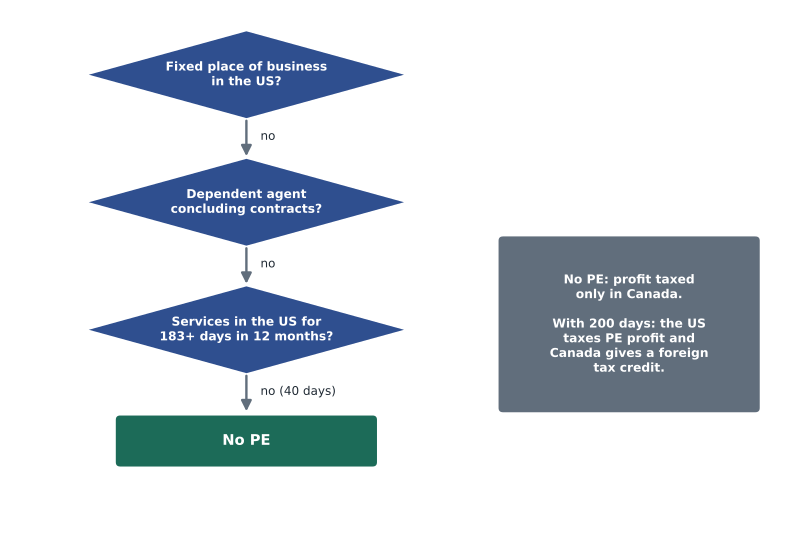
Canada has tax treaties with more than 90 countries, mostly based on the OECD Model Convention. A treaty does not create tax; it limits the tax each country can impose and provides relief from double taxation. Under the business profits article (Article VII of the Canada-United States treaty), a resident of one country is taxed by the other on business profits only if they are attributable to a permanent establishment (PE) there: a fixed place of business such as an office, branch or workshop, a building or construction site lasting more than 12 months, or a dependent agent who habitually concludes contracts. The Canada-United States treaty adds a services PE rule: services provided in the other country by an individual present there for 183 days or more in a 12-month period, or by the enterprise for 183 days or more on the same or connected projects, can create a PE. The treaty also caps withholding taxes and contains a limitation on benefits article. Canada has also adopted the OECD's Multilateral Instrument, which adds a principal purpose test to many of its other treaties.
Canadian businesses abroad: branches and foreign affiliates
A Canadian corporation can operate abroad through a branch or a subsidiary. A branch is part of the corporation, so its profits are included in Canadian income as earned, but they are not eligible for the small business deduction (the business is not carried on in Canada) or the provincial abatement (the income is not earned in a province), so the federal rate on them is 25 per cent before credits. Foreign income tax on the branch profits is creditable under subsection 126(2), limited to the Canadian tax on that income; unused business foreign tax credits carry back three years and forward ten. A foreign subsidiary in which the Canadian corporation holds at least 1 per cent, and with related persons at least 10 per cent, is a foreign affiliate. Its active business income is not taxed in Canada until it pays dividends, and dividends paid from 'exempt surplus', active business income earned in a country with which Canada has a treaty or tax information exchange agreement, are fully deductible under section 113, so they are effectively exempt. Dividends from taxable surplus are taxed with a credit for underlying foreign tax. Passive income of a controlled foreign affiliate, called foreign accrual property income (FAPI), is taxed in Canada as it is earned, to prevent deferral by parking investments offshore.
Transfer pricing and foreign reporting
When related parties in different countries trade with each other, the prices they use determine where profit is taxed. Section 247 requires transactions between a Canadian taxpayer and non-arm's length non-residents to be priced at arm's length, consistent with the OECD Transfer Pricing Guidelines, which the 2025 federal budget proposed to incorporate more explicitly. A 10 per cent penalty applies to large adjustments if the taxpayer did not make reasonable efforts to determine arm's length prices, evidenced by contemporaneous documentation; the budget proposed raising the threshold for the penalty from $5 million to $10 million and shortening the time to provide documentation on request from three months to 30 days. Canadian taxpayers must also file information returns: form T1135 if the total cost of their specified foreign property exceeds $100,000 at any time in the year, form T1134 for foreign affiliates and form T106 for transactions with non-arm's length non-residents exceeding $1 million. Penalties for late filing are significant even when no tax is owing.
Brandt Aerial Inc.'s contract in North Dakota
In 2027, Brandt Aerial Inc. inspects transmission lines in North Dakota for a US utility, earning $20,000 of profit on the $66,000 contract. Its crew is on site for 40 days. The program first tests the services PE rule, then considers a later, longer contract that does create a US PE, computing the foreign tax credit, and shows the Part XIII rates that would apply if the corporation paid dividends to non-resident shareholders. It ends with the size test for the global minimum tax.
# Brandt Aerial Inc. works in North Dakota: permanent establishment and the foreign tax credit
# (2026 rates; illustrative, federal tax only)
days_on_site = 40
pe = days_on_site >= 183          # Canada-US treaty services PE test (Article V(9)), simplified
us_profit = 20_000                # profit on the North Dakota inspection contract
print(f"Days on site: {days_on_site}. Services PE in the United States: {pe}")
print("No PE: the profit is taxable only in Canada, at Brandt Aerial's Canadian rates.")
print()
# Suppose a later contract runs 200 days and creates a PE
us_tax = 0.21 * us_profit + 0.0431 * us_profit       # federal 21% plus an assumed state rate
# Profit of a foreign PE is not from a business carried on in Canada (no SBD) and is not
# earned in a province (no 10% abatement, no Manitoba tax): 38% - 13% = 25% federal
cdn_rate_foreign_pe = 0.38 - 0.13
cdn_tax_on_us_income = cdn_rate_foreign_pe * us_profit
limit = cdn_tax_on_us_income                         # s. 126(2) limit, simplified
credit = min(us_tax, limit)
print(f"US tax on the PE's profit (federal + assumed state):  {us_tax:>9,.2f}")
print(f"Canadian tax otherwise payable on that profit (25%):  {cdn_tax_on_us_income:>9,.2f}")
print(f"Foreign business income tax credit allowed:           {credit:>9,.2f}")
print(f"Unused credit (carried back 3 or forward 10 years):  {us_tax - credit:>9,.2f}")
print()
# Part XIII withholding on dividends to a non-resident shareholder
for who, rate in (("No treaty", 0.25), ("US resident individual (treaty)", 0.15),
                  ("US company owning at least 10% (treaty)", 0.05)):
    print(f"Dividend of 10,000 to {who:<40} withholding {10_000 * rate:>7,.0f}")
print()
groups = {"Brandt Aerial Inc.": 0.6e6, "A multinational group": 2_000e6}
for g, revenue_eur in groups.items():
print(f"{g:<24} revenue EUR {revenue_eur:>15,.0f}: subject to the global minimum tax? {revenue_eur >= 750e6}")Days on site: 40. Services PE in the United States: False No PE: the profit is taxable only in Canada, at Brandt Aerial's Canadian rates. US tax on the PE's profit (federal + assumed state): 5,062.00 Canadian tax otherwise payable on that profit (25%): 5,000.00 Foreign business income tax credit allowed: 5,000.00 Unused credit (carried back 3 or forward 10 years): 62.00 Dividend of 10,000 to No treaty withholding 2,500 Dividend of 10,000 to US resident individual (treaty) withholding 1,500 Dividend of 10,000 to US company owning at least 10% (treaty) withholding 500 Brandt Aerial Inc. revenue EUR 600,000: subject to the global minimum tax? False A multinational group revenue EUR 2,000,000,000: subject to the global minimum tax? True
Forty days on site is far below the 183-day threshold, and Brandt Aerial Inc. has no fixed place of business in the United States, so under Article VII the United States cannot tax the profit; Canada taxes it as part of the corporation's active business income. The utility may still require the corporation to provide Form W-8BEN-E claiming treaty benefits, and the corporation may need to file a US protective return. If a later contract lasted 200 days and created a PE, the United States would tax the $20,000 of attributable profit, at an assumed combined federal and state rate of about 25.3 per cent, $5,062. Canada would also tax it: as income of a business not carried on in Canada and not earned in a province, it would bear federal tax at 25 per cent, $5,000, and the foreign business income tax credit would eliminate it, leaving $62 of excess credit to carry over. The Part XIII rates show why treaty planning matters to non-resident shareholders. Finally, Brandt Aerial Inc.'s revenue is far below the €750 million threshold, so the global minimum tax does not apply.
The global minimum tax
The OECD/G20 Inclusive Framework's Pillar Two establishes a global minimum tax of 15 per cent on the profits of multinational groups with consolidated revenue of at least €750 million in two of the four preceding years. Canada enacted it in the Global Minimum Tax Act, which received royal assent on 20 June 2024. The Act imposes a qualified domestic minimum top-up tax (QDMTT) on low-taxed Canadian entities of in-scope groups, an income inclusion rule (IIR) that taxes Canadian parent entities on low-taxed profits of their foreign subsidiaries, both for fiscal years beginning on or after 31 December 2023, and an undertaxed profits rule (UTPR) as a backstop for fiscal years beginning on or after 31 December 2024. The effective tax rate is computed jurisdiction by jurisdiction from financial statement income, with a substance-based carve-out for payroll and tangible assets. On 5 January 2026, the Inclusive Framework agreed on a 'side-by-side' package under which groups whose ultimate parent is in a jurisdiction with a qualified side-by-side regime, so far only the United States, are exempt from the IIR and UTPR for fiscal years beginning on or after 1 January 2026, though still subject to QDMTTs; the package also added new safe harbours. How Canada will implement it was still being worked out in late 2026. Canada also repealed its digital services tax in 2025, after announcing its rescission in June 2025. None of this affects Brandt Aerial Inc., but it affects every large Canadian multinational and its advisers.
Worked problem
A US subsidiary or a branch?
Suppose Brandt Aerial Inc. wins a multi-year contract in North Dakota and forms a US subsidiary, Brandt Aerial (ND) Inc., which earns $100,000 of active business profit, pays US federal and state tax of about $25,300, and pays the rest to its Canadian parent as a dividend. How is the dividend taxed?
Show solution
- Brandt Aerial (ND) Inc. is a foreign affiliate, and a controlled foreign affiliate, of Brandt Aerial Inc.
- Its income is active business income earned in a treaty country, so it adds to exempt surplus.
- The United States withholds 5 per cent on the dividend under Article X, because the parent owns at least 10 per cent: about $74,700 × 5% = $3,735.
- Brandt Aerial Inc. includes the dividend in income and deducts it in full under section 113 from exempt surplus, so it pays no Canadian tax on it.
- The total tax burden is the US corporate tax plus the 5 per cent withholding, about 29 per cent, all of it foreign; a branch, by contrast, would face Canadian tax on the profit with a credit for the US tax.
Answer: About $3,735 of US withholding and no Canadian tax, because of the section 113 deduction for exempt surplus.
Common mistakes
MistakeAssuming a foreign-incorporated company cannot be resident in Canada.
InsteadCentral management and control in Canada makes it resident under the common law.
MistakeForgetting Regulation 105 withholding on non-residents' services in Canada.
InsteadPayers must withhold 15 per cent unless a waiver is obtained.
MistakeApplying the small business deduction to foreign branch profits.
InsteadProfits of a business carried on outside Canada do not qualify, and get no abatement.
MistakeIgnoring T1135 because the foreign property earns no income.
InsteadThe filing depends on cost above $100,000, not income.
MistakeAssuming the global minimum tax applies to all corporations.
InsteadIt applies only to groups with consolidated revenue of €750 million or more.
Summary and key terms
- Corporations incorporated in Canada after 26 April 1965 are resident; others may be resident by central management and control.
- Non-residents are taxed on Canadian employment, business and taxable Canadian property, and pay Part XIII tax on passive income.
- Treaties tax business profits only if attributable to a PE; the Canada-US treaty includes a 183-day services PE rule.
- Foreign branch profits bear 25 per cent federal tax before foreign tax credits.
- Exempt surplus dividends from foreign affiliates are deductible under section 113; FAPI is taxed on accrual.
- Section 247 requires arm's length transfer prices; T1135, T1134 and T106 report foreign holdings and transactions.
- The Global Minimum Tax Act imposes a 15 per cent minimum tax on groups with €750 million of revenue.
- Brandt Aerial Inc. has no US PE on a 40-day contract.
- Central management and control
- The common-law test of corporate residence, based on where strategic decisions are made.
- Part XIII tax
- Withholding tax of 25 per cent on passive income paid to non-residents, reduced by treaty.
- Regulation 105 withholding
- Withholding of 15 per cent on fees paid to non-residents for services rendered in Canada.
- Foreign affiliate
- A non-resident corporation in which a Canadian holds at least 1 per cent and, with related persons, 10 per cent.
- Exempt surplus
- Active business earnings of a foreign affiliate in a treaty country, whose dividends are deductible under section 113.
- FAPI
- Foreign accrual property income, the passive income of a controlled foreign affiliate taxed on accrual.
- Permanent establishment (PE)
- A fixed place of business or other presence through which an enterprise carries on business in a treaty country.
- Pillar Two
- The OECD/G20 global minimum tax of 15 per cent for large multinational groups.
Practice problems
Work each problem on paper first, then reveal the answer to check.
A corporation incorporated in Delaware holds all of its board meetings in Winnipeg. Is it resident in Canada?
Show answer
Probably, under central management and control; the treaty tie-breaker would then make it US-resident because it was created there.
What rate of Part XIII tax applies to dividends paid to a US parent owning 100 per cent?
Show answer
5 per cent under the treaty.
Why is the federal rate on foreign branch profits 25 per cent?
Show answer
No SBD and no provincial abatement: 38% − 13% general rate reduction.
What is exempt surplus?
Show answer
Active business earnings of a foreign affiliate in a treaty or TIEA country.
When must a taxpayer file form T1135?
Show answer
When the total cost of specified foreign property exceeds $100,000 at any time in the year.
What does the services PE rule in the Canada-US treaty require?
Show answer
Services in the other country for 183 days or more in a 12-month period by an individual or on connected projects.
Which groups are subject to the Global Minimum Tax Act?
Show answer
Multinational groups with consolidated revenue of at least €750 million in two of the four preceding years.
In the subsidiary example, what Canadian tax applies to the dividend?
Show answer
None, because of the section 113 deduction.
Lesson quiz · 5 questions
Score 60% or more to complete this lesson.
Create a free account to save your progress, take quizzes and earn a certificate.