
ACCT-352 · Lesson 1 of 12 · 26 min
Business structures and how they are taxed
ACCT-351 taught the taxation of individuals: employment, business and property income, capital gains, deductions, credits and the personal return. This course moves to the businesses that individuals own and the vehicles they use to own them. It covers how corporations compute and pay tax, why Canadian-controlled private corporations are taxed so differently from public companies, how corporate and personal tax fit together through integration, how owner-managers decide between salary and dividends, how property moves into and out of corporations without immediate tax, how partnerships and trusts are taxed, how the goods and services tax and harmonized sales tax work, the basics of cross-border business, the rules that limit aggressive planning, and the compliance calendar that ties it all together. The law is mainly the Income Tax Act, the Excise Tax Act for GST/HST, the Income Tax Regulations, tax treaties, provincial statutes and the case law that interprets them.
Tax law changes often and its application depends on facts. Rates and thresholds are those published for 2026, checked in October 2026, and the examples assume they apply unchanged to the 2027 year in which the invented business operates. Confirm current figures with the CRA, the Department of Finance or a qualified tax professional before relying on them.
We continue to follow the Brandt family from ACCT-351. Early in 2027 Leah Brandt leaves Red River Instruments to run her drone business full time after winning a three-year inspection contract with Northgate Utilities, an invented regional utility. On 1 January 2027 she incorporates Brandt Aerial Inc. under Manitoba's corporations statute and transfers the assets of her proprietorship to it. She becomes the sole director and shareholder and draws a salary. During the year she and Dev Mehta, a software developer, also form SkyGrid Data, a general partnership that processes aerial survey data, and her accountant suggests a family trust and an estate freeze once the business has grown. Each lesson adds a piece: Brandt Aerial Inc.'s taxable income and corporate tax, its investment income and dividends, Leah's remuneration, the partnership, the trust, GST/HST, a contract in North Dakota and the planning, and lesson 12 assembles the 2027 corporate return and Leah's personal tax. All people, businesses and numbers are invented.
The main forms of business organization
A business can be carried on directly by an individual, through a partnership with others, through a corporation, or through a trust. The legal form determines who owns the business assets, who is liable for its debts and, for tax purposes, who pays tax on its profits. Canadian tax law follows the legal form closely: a corporation is a separate taxpayer, a partnership is not, and a trust is taxed as an individual. Unlike the United States, Canada has no general election that lets an owner choose how an entity is taxed. If you want corporate treatment, you must incorporate, and if you incorporate, the corporation is taxed as a corporation.
| Form | Liability of owners | Who pays income tax | Federal return |
|---|---|---|---|
| Sole proprietorship | Unlimited | The owner, on business income | T1 with form T2125 |
| General partnership | Unlimited and joint | Each partner on a share of income | T5013 information return if required; partners file T1 or T2 |
| Limited partnership | Limited partners limited to their investment | Each partner; losses limited to the at-risk amount | T5013 |
| Corporation | Limited to shares, unless guaranteed | The corporation; shareholders on dividends | T2 |
| Trust | The trustee holds title; beneficiaries are not liable | The trust, or beneficiaries on amounts paid or payable to them | T3 |
Sole proprietorships
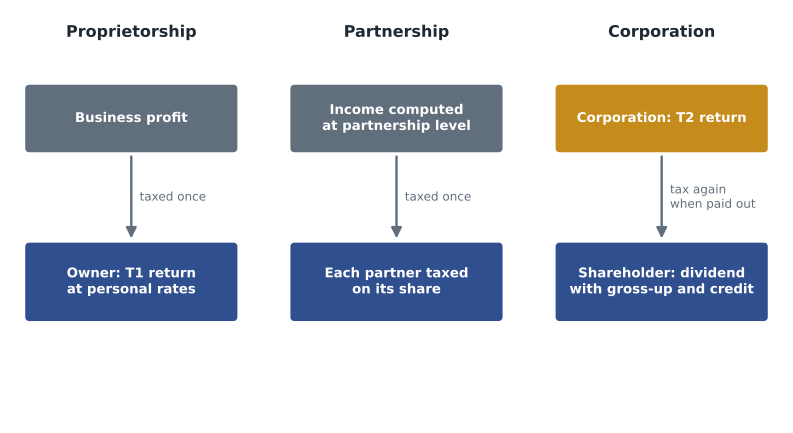
A sole proprietorship is not a separate entity. The individual owns the assets, signs the contracts and is personally liable for the debts. The profit is business income computed under section 9, reported on form T2125 with the owner's T1 return and taxed at the owner's graduated rates, which reach 50.4 per cent in Manitoba for 2026. A loss reduces the owner's other income in the year and can be carried back three years or forward twenty. The owner pays both halves of CPP on self-employed earnings, can contribute to an RRSP based on earned income, and keeps all of the after-tax profit. That simplicity is the advantage: there is no separate return, no second layer of tax and no need to decide how to pay the owner. The disadvantages are personal liability and the fact that every dollar of profit is taxed at personal rates in the year earned, whether the owner spends it or reinvests it.
Partnerships
A partnership is a relationship between persons carrying on a business in common with a view to profit, as the provincial partnership acts put it. It is not a separate taxpayer. Section 96 computes income at the partnership level as if the partnership were a separate person resident in Canada and then allocates it to the partners, who include their shares on their own returns whether or not the cash is distributed. A general partnership exposes every partner to unlimited liability for partnership debts; a limited partnership protects limited partners who stay out of management, and a limited liability partnership protects professionals against the negligence of their partners. Lesson 7 covers partnerships in detail, including SkyGrid Data.
Corporations
A corporation is a legal person separate from its shareholders. It owns its assets, it alone is liable for its debts unless a shareholder has guaranteed them, and it files its own T2 return and pays its own tax. Shareholders are taxed only when the corporation pays them: dividends are grossed up and earn a dividend tax credit, salaries are employment income, and gains on selling shares are capital gains. Corporations can be incorporated federally under the Canada Business Corporations Act or under a provincial statute; for tax purposes the important distinctions are not where a corporation was incorporated but what kind of corporation it is.
The Act distinguishes several kinds of corporation. A public corporation has a class of shares listed on a designated stock exchange in Canada, or has elected or been designated to be one. A private corporation is a Canadian-resident corporation that is not public and is not controlled by public corporations. A Canadian-controlled private corporation (CCPC), defined in subsection 125(7), is a private corporation that is a Canadian corporation and is not controlled, directly or indirectly, in any manner whatever, by non-residents, public corporations or a combination of them, and none of whose shares are listed on a designated stock exchange anywhere. Since 2022, the 'substantive CCPC' rules tax private corporations that are CCPCs in substance, but not in form, at CCPC rates on investment income, to stop owners from avoiding the refundable tax regime by arranging nominal non-resident control.
CCPC status matters because many of the most valuable provisions in the Act are reserved for CCPCs: the small business deduction, which reduces the combined federal and Manitoba rate on the first $500,000 of active business income to 9 per cent; the refundable tax system that integrates investment income; the lifetime capital gains exemption on qualified small business corporation shares; the enhanced refundable investment tax credit for scientific research; the extra month to pay the balance of tax; and the non-taxation of employee stock option benefits until the shares are sold. Brandt Aerial Inc. is a CCPC because Leah, a Canadian resident, controls it and its shares are not listed.
Trusts
A trust is a relationship in which a trustee holds property for beneficiaries. Subsection 104(2) treats a trust as an individual for tax purposes, so it files a T3 return and pays tax on income it keeps, at the top personal rate for most inter vivos trusts. Income that is paid or made payable to a beneficiary in the year is deductible by the trust and taxed to the beneficiary instead, keeping its character as a dividend or taxable capital gain where the trust designates it. Family trusts are widely used to hold shares of private corporations in estate freezes, though the tax on split income rules described in lesson 11 have greatly reduced their usefulness for spreading income. Lesson 8 covers trusts and estates.
Integration: the idea behind corporate tax
Canadian corporate tax is designed around the principle of integration. Ideally, income should bear the same total tax whether it is earned directly by an individual or earned by a corporation and paid out as a dividend. The dividend gross-up and tax credit carry this out: the gross-up adds back to the shareholder's income an amount representing the corporate tax assumed to have been paid, and the dividend tax credit gives the shareholder credit for it. Eligible dividends, paid from income taxed at the general rate, are grossed up by 38 per cent; other dividends, paid from income taxed at the small business rate, by 15 per cent. Integration is never perfect because actual provincial rates differ from the assumptions, but it is close enough that the choice between a proprietorship and a corporation usually turns on deferral, flexibility and other factors more than on the permanent tax cost.
A first comparison
The program below compares $100,000 of profit earned by a proprietor with no other income and the same profit earned by a CCPC that is entitled to the small business deduction. It applies the 2026 federal and Manitoba brackets, the basic personal amounts and, for the dividend, the gross-up and the federal and Manitoba dividend tax credits. To keep the comparison simple, it ignores CPP on self-employed earnings.
# Proprietorship or corporation? $100,000 of business profit in Manitoba, 2026 rules
# (illustrative; federal and Manitoba income tax, CPP on self-employment ignored)
FED = [(58_523, 0.14), (117_045, 0.205), (181_440, 0.26), (258_482, 0.29), (float('inf'), 0.33)]
MB = [(47_000, 0.108), (100_000, 0.1275), (float('inf'), 0.174)]

def bracket(x, br):
    tax, lo = 0.0, 0.0
    for hi, r in br:
        if x > lo:
            tax += (min(x, hi) - lo) * r
        lo = hi
    return tax

def personal(ordinary=0.0, nonelig_div=0.0):
    """Federal and Manitoba tax on ordinary income plus non-eligible dividends."""
    grossed = nonelig_div * 1.15
    taxable = ordinary + grossed
    fed = bracket(taxable, FED) - 0.14 * 16_452 - 0.090301 * grossed
    mb = bracket(taxable, MB) - 0.108 * 15_780 - 0.007835 * grossed
    return max(0.0, fed) + max(0.0, mb)

profit = 100_000
sole = personal(ordinary=profit)
corp_tax = 0.09 * profit                    # 9% federal small business rate, 0% Manitoba
retained = profit - corp_tax
later = personal(nonelig_div=retained)      # all of it paid out later as a dividend
print(f"Profit earned in the business                {profit:>10,.0f}")
print(f"A. Proprietorship: personal tax now          {sole:>10,.0f}  ({sole / profit:.1%})")
print(f"B. Corporation: corporate tax now            {corp_tax:>10,.0f}  ({corp_tax / profit:.1%})")
print(f"   Cash left in the corporation              {retained:>10,.0f}")
print(f"   Tax deferred while the cash stays there   {sole - corp_tax:>10,.0f}")
print(f"   Personal tax if paid out as a dividend    {later:>10,.0f}")
print(f" Total corporate and personal tax {corp_tax + later:>10,.0f} ({(corp_tax + later) / profit:.1%})")Profit earned in the business 100,000 A. Proprietorship: personal tax now 24,522 (24.5%) B. Corporation: corporate tax now 9,000 (9.0%) Cash left in the corporation 91,000 Tax deferred while the cash stays there 15,522 Personal tax if paid out as a dividend 16,014 Total corporate and personal tax 25,014 (25.0%)
The proprietor pays $24,522, or 24.5 per cent, as soon as the profit is earned. The corporation pays only $9,000. If Leah does not need the cash, the remaining $91,000 stays in the corporation and $15,522 of tax is deferred until it is paid out. When it is eventually paid as a non-eligible dividend, she pays $16,014 of personal tax, for a total of $25,014, about $490 more than the proprietorship. That small difference is integration at work, slightly imperfect. The large difference is timing: the corporation lets profit that is reinvested in the business bear only 9 per cent. That deferral, together with limited liability, is why most growing private businesses in Canada incorporate.
Choosing a structure
Tax is only one factor in choosing a structure, but the tax factors are well known. In favour of incorporating are the deferral on profits kept in the business, the lifetime capital gains exemption available on a sale of qualified small business corporation shares, flexibility in timing income by choosing when to pay salaries and dividends, and the ability to bring family members in as shareholders for estate planning. Against incorporating are the costs of a second set of financial statements and returns, the fact that losses are trapped in the corporation and cannot offset the owner's other income, the tax on split income rules that block most income splitting with family members who are not active in the business, and the risk that personal-use assets held in the corporation create shareholder benefits. A start-up expecting losses often begins as a proprietorship and incorporates once it is profitable, transferring its assets tax-free under section 85 as Leah does.
| Factor | Proprietorship | CCPC | Partnership |
|---|---|---|---|
| Tax on profit kept in the business | Personal rates, up to 50.4% | 9% on active business income up to $500,000 | Partners' personal rates |
| Losses | Offset other income | Trapped in the corporation | Allocated to partners (limited partners: at-risk rules) |
| Paying the owner | Draws are not deductible | Salary or dividends, chosen each year | Draws are not deductible |
| Lifetime capital gains exemption | Not available on business assets | Available on qualified small business corporation shares | Not on a partnership interest |
| Compliance | T2125 only | T2, financial statements, payroll, minute book | T5013 if required |
Worked problem
A start-up loss
Dev Mehta expects his software venture to lose $40,000 in its first year and earn $90,000 a year afterwards. He also has $85,000 of employment income in the first year. Should he start as a proprietorship or a corporation?
Show solution
- As a proprietor, the $40,000 loss offsets his employment income in year 1, reducing taxable income from $85,000 to $45,000.
- His marginal federal rate falls from 20.5 per cent to 14 per cent across that range, and Manitoba tax falls too; the saving is roughly $12,400 of combined federal and Manitoba tax in year 1.
- In a corporation, the $40,000 is a non-capital loss that can only reduce the corporation's future income, which would otherwise be taxed at just 9 per cent: about $3,600 of tax saved, and later.
- Once the business is profitable he can transfer it to a corporation under section 85 without immediate tax.
Answer: Start as a proprietorship to use the loss against his salary, then incorporate.
Common mistakes
MistakeThinking a corporation always saves tax.
InsteadA CCPC defers tax on retained profit; paid-out profit bears about the same total tax as a proprietorship because of integration.
MistakeAssuming partnerships file tax returns and pay tax.
InsteadPartnerships are not taxpayers; income is computed at the partnership level and taxed to the partners.
MistakeBelieving an owner can elect how a corporation is taxed.
InsteadCanada has no check-the-box system; a corporation is taxed as a corporation.
MistakeDeducting losses of a corporation on the owner's personal return.
InsteadCorporate losses stay in the corporation as non-capital losses.
MistakeIgnoring CCPC status when a non-resident investor is admitted.
InsteadControl by non-residents or public corporations ends CCPC status and its benefits.
Summary and key terms
- Canada taxes businesses according to their legal form; there is no elective classification.
- Proprietors and partners are taxed on business income at personal rates; partnerships are not taxpayers.
- Corporations are separate taxpayers filing T2 returns; shareholders are taxed on dividends.
- A CCPC is a private Canadian corporation not controlled by non-residents or public corporations.
- CCPCs get the small business deduction, refundable investment taxes and the LCGE on qualifying shares.
- Integration aims to equalize tax on income earned directly and through a corporation.
- Incorporation mainly defers tax on retained profits; losses are trapped in the corporation.
- Brandt Aerial Inc. is a CCPC owned by Leah from 1 January 2027.
- Canadian-controlled private corporation (CCPC)
- A private Canadian corporation not controlled by non-residents or public corporations and with no listed shares.
- Public corporation
- A Canadian-resident corporation with a class of shares listed on a designated stock exchange in Canada, or elected or designated as public.
- Small business deduction
- A reduction of corporate tax on a CCPC's active business income up to the business limit.
- Substantive CCPC
- A private corporation that would be a CCPC but for nominal non-resident control or a similar arrangement, taxed like a CCPC on investment income.
- Partnership
- A relationship between persons carrying on business in common with a view to profit; not a taxpayer.
- Deferral
- Postponing tax by keeping income in a corporation taxed at a low rate.
- Integration
- The principle that income should bear similar total tax whether earned directly or through a corporation.
- Flow-through
- Taxation of an entity's income directly to its owners rather than to the entity.
Practice problems
Work each problem on paper first, then reveal the answer to check.
Name three benefits reserved for CCPCs.
Show answer
For example the small business deduction, refundable taxes on investment income, the LCGE on QSBC shares, the enhanced SR&ED credit and deferral of stock option benefits.
In the comparison program, how much tax is deferred if the corporation keeps all of its after-tax profit?
Show answer
$15,522.
Why is the total tax on income paid out of a CCPC close to the tax on the same income earned directly?
Show answer
Integration: the gross-up and dividend tax credit give the shareholder credit for the corporate tax.
Does a partnership pay tax on its income?
Show answer
No; income is computed at the partnership level and taxed to the partners.
A Canadian private corporation is controlled by a US resident. Is it a CCPC?
Show answer
No; control by a non-resident disqualifies it.
Why might a start-up begin as a proprietorship?
Show answer
To deduct early losses against the owner's other income, then incorporate under section 85.
Which form does a trust file?
Show answer
The T3 return.
What are the gross-up rates for eligible and other dividends?
Show answer
38 per cent and 15 per cent.
Lesson quiz · 5 questions
Score 60% or more to complete this lesson.
Create a free account to save your progress, take quizzes and earn a certificate.