
MELC-211 · Lesson 9 of 12 · 19 min
Contracts and builders' liens in Yukon
▶ Video coming soon A video version of this lesson is on the way.
Tagish Lake Electric will spend months of the year working before it is paid. Contracts set out what it will be paid and when; Yukon's builders' lien legislation gives it security against the land if payment does not come. This lesson explains what a contract for electrical work should cover, how builders' liens work in general terms, what a Yukon contractor should confirm in the current Act before relying on it, and where prompt payment law stands.
A note before we start. We could not open the current consolidated text of Yukon's Builders Lien Act while preparing this course, so this lesson describes how lien legislation works and what to check, rather than quoting deadlines or holdback amounts. Lien rights are strict: a lien filed a day late is usually lost. Read the current Act on the Yukon laws site and get legal advice before filing.
What a contract for electrical work should cover
Many small electrical jobs in Yukon start with a phone call and end with an invoice. That works until something goes wrong. A written contract, even a one-page one, sets out the terms that matter when there is a dispute.
| Clause | Why it matters | Rena's practice |
|---|---|---|
| Scope of work | Defines what is and is not included | Lists the circuits, devices and equipment; excludes patching and painting |
| Price and payment schedule | Sets when money is due | Deposit, progress payments at rough-in and service, balance on final approval |
| Permit and inspection | Makes clear who takes the permit and pays fees | Tagish Lake Electric takes the permit; the fee is a line in the price |
| Changes | Prevents disputes over extras | Written change orders signed before extra work starts |
| Holdback | States whether the owner retains part of each payment | Follows the Act and states when holdback is released |
| Delays and access | Covers weather, other trades and site access | Allows time for inspection notice and winter conditions |
| Warranty | Sets the period and what it covers | One year on workmanship; manufacturer warranties passed through |
MELC-106 covers contract law in depth. This lesson focuses on the Yukon points: who takes the permit, how inspection timing affects the schedule, and how liens and holdback fit.
How builders' liens work
Every Canadian province and territory has legislation that gives people who improve land a lien, a claim against the land itself, for the value of the work and materials they supplied. Yukon's statute is the Builders Lien Act. The idea is simple: an owner whose land has been improved should not keep the benefit while the people who did the work go unpaid.
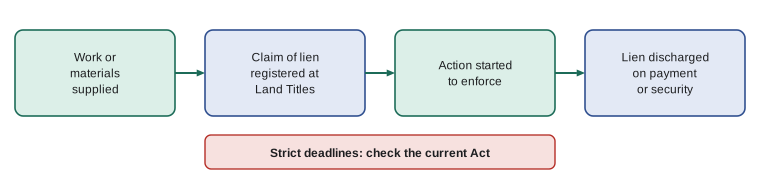
Lien legislation generally works in four stages:
- A right arises. A contractor, subcontractor, worker or supplier who provides work or materials for an improvement to land gets a lien for the unpaid amount, usually limited to what is owed under its contract.
- The lien is registered. To protect the lien, the claimant files a claim of lien against the title to the land, in Yukon at the Land Titles Office, within a time limit set by the Act.
- The lien is enforced. If the debt is not paid, the claimant must start a court action to enforce the lien within a further time limit, or the lien expires.
- The lien is discharged. When the debt is paid or security is posted, the lien is removed from the title.
Holdback
Most Canadian lien statutes require owners and contractors to hold back a portion of each payment for a period after the work is completed. The holdback is a fund that protects subcontractors and suppliers further down the chain. If an owner pays the full amount without retaining the holdback and a subcontractor later files a lien, the owner may have to pay twice up to the holdback amount.
We could not confirm Yukon's current holdback amount or release period from the Act's text. Rena's contracts say simply that holdback will be retained and released as required by the Builders Lien Act, and Jonas checks the current Act before the first job. On a job where Tagish Lake Electric is a subcontractor, he tracks the holdback the general contractor is retaining from each payment, and diarizes the date it becomes payable.
Deadlines: the reason liens fail
Most lien claims that fail do so on time. The clock usually starts from completion of the work, the last supply of materials, or a similar event defined in the Act, and the period is measured in days, not months. A contractor who waits to see whether the customer will pay eventually can run out the clock.
Rena's rule, from Bill: if a payment is more than 30 days late, find out when the lien period ends, and talk to a lawyer while there is still time. Being ready to file is often enough to get paid.
from datetime import date, timedelta

# Planning only: replace LIEN_DAYS with the period in the current Act.
LIEN_DAYS = None
last_work = date(2027, 8, 14)
invoice_due = date(2027, 9, 13)
today = date(2027, 10, 15)

days_late = (today - invoice_due).days
print("Invoice is", days_late, "days late")
if LIEN_DAYS is None:
    print("Lien period not set: read the current Builders Lien Act today")
else:
    deadline = last_work + timedelta(days=LIEN_DAYS)
print("Planning lien deadline:", deadline, "-", (deadline - today).days, "days left")Invoice is 32 days late Lien period not set: read the current Builders Lien Act today
The script deliberately refuses to guess the period. That is the habit we want: never rely on a remembered number for a lien deadline.
Worked problem
The Marwell subcontract
Tagish Lake Electric is a subcontractor on a commercial fit-up in the Marwell industrial area. The general contractor has paid the first progress claim but not the second, and the owner says it has paid the general contractor in full. Rena finished her work six weeks ago. What should she do?
Show solution
- Check the subcontract's payment terms and her records of work, change orders and invoices.
- Read the current Builders Lien Act to find the deadline for registering a claim of lien, and how it is measured from her last work.
- Find out whether the owner retained the holdback; if it did, there is a fund to claim against even though the owner says it has paid.
- Speak to a lawyer at once; if the deadline is close, the lawyer can prepare and register a claim of lien at the Land Titles Office.
- Keep talking to the general contractor; a lien often prompts payment, and it can be discharged when the debt is paid.
Answer: Find the deadline in the current Act now, get legal advice, and register a claim of lien in time if payment does not arrive.
Prompt payment: where Yukon stands
Several provinces, starting with Ontario, have passed prompt payment legislation that sets fixed times for owners to pay contractors and for contractors to pay subcontractors, often with fast-track adjudication of disputes. We found no Yukon prompt payment legislation in force when this course was prepared, and a law firm commentary from early 2026 on the Northwest Territories noted that its new lien statute did not include prompt payment provisions either.
Without prompt payment law, payment timing in Yukon depends on the contract. That makes the payment clause more important, not less. Rena's contracts set specific due dates, an interest rate on late payments and the right to suspend work after notice if payment is overdue. Check for new legislation before relying on this, because prompt payment is spreading across Canada.
Liens and the homeowner
Most of Tagish Lake Electric's early work will be for homeowners. A lien against a family home is a serious step, and Rena would rather not need one. The best protection is the contract: a deposit, progress payments that keep the amount at risk small, and a clear final payment on approval of the final inspection. When a homeowner disputes the bill, a conversation about the inspection report often settles it, because an approved installation is strong evidence that the work was done properly.
Getting paid without a lien
A lien is a last resort. Most payment problems are better solved earlier and more cheaply. Rena's approach starts before the job: she checks who she is contracting with, whether the customer owns the property, and on larger jobs whether financing is in place. She takes a deposit on residential work and bills at each inspection stage, so the amount at risk at any time is small.
When a payment is late, she follows a sequence. A friendly reminder a few days after the due date. A phone call a week later to ask whether there is a problem with the work. A written notice that sets a date for payment and mentions the contract's interest clause. And, if the lien period is getting close, a call to a lawyer. At each step she stays polite. Many late payments are caused by a customer's cash flow, a lost invoice or a disputed extra, and a calm conversation fixes most of them.
Disputes about extras
Disputes over extras are among the most common reasons contractors are not paid. The customer remembers asking for two more receptacles; the contractor remembers installing six more and moving the panel. A signed change order before the work starts prevents most of these disputes. Rena's change order form is short: what is being added or changed, the price or the basis for pricing, the effect on the schedule, and two signatures. On a residential job she will text a photo of the signed form to the customer the same day.
Liens on public and remote land
Lien rules can differ when the land is owned by a government, a First Nation or another public body, or when the work is on land that is not registered in the ordinary way. Yukon has a large amount of land held by governments and by First Nations under settlement agreements. Before relying on a lien for work on such land, a contractor should ask a lawyer whether a lien is available and how it would be enforced. On public projects, the contract may provide other protections, such as payment bonds, instead.
That is another reason Rena reads the contract before signing. On a job for a public owner, she wants to know whether there is a payment bond, how holdback is handled, and how disputes are resolved. Those terms, not the lien statute, may decide how she gets paid.
The common thread in all of this is preparation. A contractor who keeps clean records, uses written change orders, bills at each stage and knows where to find the lien deadline rarely needs to file a lien. When it does, it can file quickly and with evidence. Rena keeps a one-page note in the office of the steps to take when a payment is late, so that whoever is in the office that day knows what to do and when to call the lawyer.
Prevention is cheaper than enforcement, every time.
Common mistakes
MistakeWaiting to see if a late customer pays before checking the lien deadline.
InsteadLien periods are short and strict; check the current Act as soon as a payment is late.
MistakeQuoting a lien deadline from memory or from another province.
InsteadEach jurisdiction's Act differs; read Yukon's current Builders Lien Act.
MistakeAssuming prompt payment rules apply in Yukon.
InsteadWe found no Yukon prompt payment legislation; payment terms come from the contract.
MistakeStarting extra work on a verbal request.
InsteadUse signed change orders; disputes over extras are among the most common payment problems.
Summary and key terms
- A written contract should cover scope, price and payment, permits, changes, holdback, delays and warranty.
- Yukon's Builders Lien Act gives those who improve land a lien that must be registered and enforced within strict time limits.
- Holdback protects subcontractors and suppliers; confirm the current amount and release period in the Act.
- We found no Yukon prompt payment legislation; payment timing depends on the contract.
- When a payment is late, find the lien deadline at once and get legal advice.
- Builders lien
- A claim against land for the value of unpaid work or materials supplied to improve it.
- Claim of lien
- The document registered against title to protect a lien.
- Holdback
- A portion of each payment retained for a period after completion to protect those further down the chain.
- Discharge
- Removal of a lien from title after payment or posting of security.
- Prompt payment legislation
- Law that sets fixed payment times through the construction chain, in force in several provinces.
Practice problems
Work each problem on paper first, then reveal the answer to check.
Where is a claim of lien registered in Yukon?
Show answer
Against the title to the land at the Land Titles Office.
Why does an owner who ignores holdback risk paying twice?
Show answer
If a subcontractor files a lien, the owner may be liable up to the holdback amount even after paying the contractor in full.
Does Yukon have prompt payment legislation in force?
Show answer
We found none when this course was prepared; check for new legislation.
What is the most common reason a lien fails?
Show answer
It is registered or enforced too late.
Lesson quiz · 5 questions
Score 60% or more to complete this lesson.
Create a free account to save your progress, take quizzes and earn a certificate.