
MELC-211 · Lesson 2 of 12 · 19 min
Licence classes, accredited representatives and qualifications
▶ Video coming soon A video version of this lesson is on the way.
Rena knows what kind of work she wants Tagish Lake Electric to do: houses, renovations, heat pumps, small commercial fit-ups, and the occasional service upgrade on a rural property. The next question is which licence fits that work, and what the company must show to hold it. This lesson walks through how the Yukon regulation organizes contractor licences, the idea of the accredited representative, and how a certificate of qualification fits in.
Licences come in classes
The Electrical Protection Regulation organizes contractor licences into classes identified by letter. Section 4 sets out the general rules for every licence, and the class determines the scope of work. The chief inspector's administration notes put it simply: contractors are permitted only under the class they are licensed for.
The regulation itself describes some classes in detail and refers to others by letter. Two are worth knowing by name.
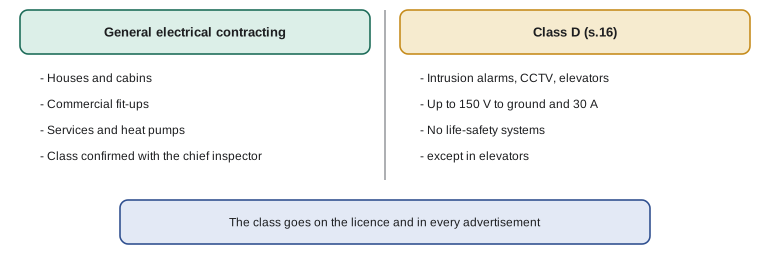
- Class D is a limited class. Section 16 lists the systems it covers, such as intrusion alarm systems, closed-circuit television and elevator installations. It restricts Class D work to installations no more than 150 volts to ground and no more than 30 amperes, and excludes life-safety systems, except within elevator installations.
- Class E is referred to in section 3(2)(b) of the regulation.
The regulation printed to 2015 does not set out, in one table, the full list of classes and what each allows, and we could not confirm the current list from an official web page. Rena's approach is the right one: decide what work the company will do, then ask the chief inspector which class covers it. The answer goes on the application and, once granted, on the licence and in every advertisement.
For general construction work of the kind Tagish Lake Electric plans, the company needs an unrestricted class: one that covers residential and commercial installations at the voltages and currents Rena works with. A limited class like Class D would not let her take a permit for a house.
Class D in more detail
Class D is useful to understand even if you never hold it, because it shows how the regulation draws limits. Section 16(1) lists the systems; section 16(2) limits the voltage and current and keeps Class D away from life-safety systems; section 16(3) limits staffing on site to no more than one helper per qualified person, with the helper under continuous supervision.
Those three ideas, a list of systems, an electrical limit and a supervision ratio, are the tools a licensing system uses whenever it wants to let specialists work without a full trade licence. If Tagish Lake Electric ever subcontracts security or camera work, Rena will want the subcontractor to hold a licence whose class covers that work.
| Class D rule | Section | In practice |
|---|---|---|
| Listed systems only | 16(1) | Alarm, CCTV, elevator and similar listed systems |
| No more than 150 V to ground and 30 A | 16(2) | No general branch-circuit or service work |
| No life-safety systems except in elevators | 16(2) | Fire alarm work needs another class |
| One helper per qualified person, continuously supervised | 16(3) | Small crews only |
The accredited representative
The regulation recognizes that a licence is often held by a company, and that the company itself has no trade qualifications. It solves this with the accredited representative. Under section 4(4), an applicant who does not personally have the qualifications for the licence class must name an accredited representative who does. Section 1 defines an accredited representative by reference to the qualifications in section 13(3) of the Act.
We could not read the current text of section 13(3) of the Act from an official source while preparing this course, so we will not state its exact wording. In plain terms, the accredited representative is the qualified person whose qualifications support the company's licence. For a general class, expect the chief inspector to look for a qualified electrician with relevant experience; ask the office exactly what it requires for the class you want.
Tagish Lake Electric Ltd. is a corporation. It has no certificate of its own, so it will name Rena as its accredited representative. Jonas, who handles the money, does not need trade qualifications; Rena does.
Keeping the chief inspector informed
Two rules in section 4 keep the register accurate.
- Section 4(5): the licence holder must promptly notify the chief inspector of any change in its accredited representative.
- Section 4(6): an accredited representative who leaves a licensed contractor must notify the chief inspector in writing.
The duty runs both ways. If Rena ever left Tagish Lake Electric, both she and the company would have to tell the chief inspector. The company would then need a new accredited representative with the right qualifications, or it would no longer meet the conditions for its class.
Worked problem
The founder retires
Northern Lights Electric holds a licence. Its founder, who has always been its accredited representative, plans to retire in March. Two of his employees are certified electricians: one with fifteen years in the trade, the other certified last year. What should the company do?
Show solution
- The company's licence depends on having an accredited representative with the qualifications for its class (s.4(4)).
- When the founder leaves, the company must promptly notify the chief inspector (s.4(5)), and the founder must notify in writing (s.4(6)).
- The company should ask the chief inspector, before March, whether the experienced electrician meets the qualifications for its class, and name him as the new accredited representative.
- The recently certified electrician may not yet have the experience the chief inspector expects; the company should not assume.
Answer: Plan the change before the departure, confirm the successor's qualifications with the chief inspector, and file both notices.
Bill tells Rena that this is where small northern firms stumble. The founder is the only person who has ever dealt with the inspection office. Nobody else knows the account number, the bond, or that the licence depends on one person. Rena adds a line to her company binder: who our accredited representative is, and who would replace her.
The certificate of qualification
The contractor licence sits on top of trade qualifications. In Yukon, electrician (construction and industrial) is a trade for which you need to be licensed. The usual route is apprenticeship ending in a certificate of qualification, with or without a Red Seal endorsement. Yukon also lets experienced workers challenge the certificate exam: the government's page says you need one and a half times the required apprenticeship hours for the trade to sit it.
Rena's certificate, with its Red Seal, proves she can do the work. The company licence lets Tagish Lake Electric take out permits for that work. The two are different documents, issued by different parts of government, and both have to be kept current.
# Challenge route: Yukon asks for 1.5 times the required apprenticeship hours.
def challenge_hours(apprenticeship_hours):
    return apprenticeship_hours * 1.5

def ready_to_challenge(logged, apprenticeship_hours):
    need = challenge_hours(apprenticeship_hours)
    return logged >= need, need - logged

# Example only: use the hours Yukon sets for the trade.
trade_hours = 7200
for name, logged in [("Tomas", 11500), ("Kieran", 4200)]:
    ok, short = ready_to_challenge(logged, trade_hours)
    if ok:
        print(f"{name}: {logged} hours logged, enough to apply to challenge")
    else:
print(f"{name}: {logged} hours logged, about {short:.0f} more needed")Tomas: 11500 hours logged, enough to apply to challenge Kieran: 4200 hours logged, about 6600 more needed
The 7,200-hour figure in the code is an example value. The hours the apprenticeship office sets for the electrician trade are what count; check them on the designated trades information sheet before you advise anyone.
Advertising and the register
Section 4(7) requires the class and licence number to appear in any advertisement. That covers the side of a truck, a website, a newspaper ad and a social media post. Section 4(1) requires the chief inspector to keep a register of licence holders, their classes, their standing and their accredited representatives, open to the public free of charge.
The register is the customer's tool. A homeowner in Riverdale who wants to check that a contractor is licensed for the work can ask. It is also Rena's tool: before she hires a subcontractor, she can confirm its class and standing.
| Rule | Section | What Rena does |
|---|---|---|
| Name an accredited representative if the applicant lacks the qualifications | 4(4) | Names herself for Tagish Lake Electric Ltd. |
| Notify changes of accredited representative promptly | 4(5) | Keeps a succession note in the binder |
| Representative leaving must notify in writing | 4(6) | Would file her own notice if she left |
| Class and licence number in every advertisement | 4(7) | Adds them to the truck decal and website footer |
| Public register of licence holders | 4(1) | Checks subcontractors before hiring |
Choosing the class for Tagish Lake Electric
Rena writes down the company's planned work: new houses and renovations; service changes up to 200 amperes; heat pump and baseboard circuits; small commercial units with three-phase 120/208 volt panels; rural services with long underground runs; and EV chargers. None of that fits a limited class. She will ask the chief inspector for the class that covers general residential and commercial work, and confirm that it includes three-phase work at the voltages she expects.
She also notes two things she will not do at first: fire alarm verification work and anything in a hazardous location. If those come up, she will either confirm that her class allows them and that she has the competence, or subcontract to someone who does.
When the accredited representative leaves
The accredited representative is a single point of failure for a corporate licence. If Rena left Tagish Lake Electric, the company would still exist, but it would no longer have the qualified person its licence relies on. Section 4(5) requires the chief inspector to be told promptly of a change. What happens next is for the office to decide, but the company should expect to name a new qualified person before it takes new permits.
Bill tells a story about a contractor in Whitehorse whose only qualified electrician moved south in the middle of the summer. The owner, who was not an electrician, kept taking jobs for two weeks before anyone told the office. He spent the rest of the season fixing the consequences. The lesson Rena takes from it is succession planning: Tomas holds a Red Seal too, and the company's records show he could step in if needed. She also writes the notice letter in advance and keeps it in the licence folder, so Jonas could send it the same day.
Questions to ask about classes
Because we could not confirm the full current list of classes from an official source, Rena writes down the questions she wants answered before she files. Which class covers general residential, commercial and industrial work? Does that class have limits on voltage, current or building type? What does the office need to see to prove the accredited representative's qualifications for that class? Can the class be changed later, and how? The answers go into the licence folder with the date and the name of the person she spoke to.
Common mistakes
MistakeApplying for a limited class to save money, then quoting general work.
InsteadA contractor may only take permits within its licensed class. Match the class to the work.
MistakeForgetting to notify the chief inspector when the accredited representative leaves.
InsteadSection 4(5) requires the licence holder to notify promptly; section 4(6) requires the departing representative to notify in writing.
MistakeLeaving the licence number off the truck or website.
InsteadSection 4(7) requires the class and licence number in any advertisement.
MistakeTreating a certificate of qualification as a company licence.
InsteadThe certificate qualifies a person; the contractor licence is held by the business and depends on an accredited representative.
Summary and key terms
- Yukon contractor licences come in classes; a contractor may take permits only within its class.
- Class D is a limited class for listed systems such as alarms, CCTV and elevators, capped at 150 volts to ground and 30 amperes.
- An applicant without the qualifications must name an accredited representative who has them (s.4(4)).
- Changes of accredited representative must be reported by both the company and the person (s.4(5) and (6)).
- The class and licence number must appear in every advertisement, and the public register lists every licence holder.
- Licence class
- The category on a contractor licence that defines the scope of work the contractor may take permits for.
- Class D
- A limited Yukon licence class for listed systems, capped at 150 volts to ground and 30 amperes.
- Accredited representative
- The qualified person named to support a licence when the applicant lacks the qualifications.
- Certificate of qualification
- The trade certificate earned by apprenticeship or challenge exam; Yukon's electrician trade requires one.
- Register
- The public list of licence holders, classes, standing and accredited representatives kept by the chief inspector.
Practice problems
Work each problem on paper first, then reveal the answer to check.
A Class D contractor is asked to replace a 100-ampere residential panel. Can it take the permit?
Show answer
No. Class D is limited to listed systems at no more than 150 volts to ground and 30 amperes.
Under the challenge route, how many hours would a worker need if the trade requires 6,400 apprenticeship hours?
Show answer
9,600 hours, one and a half times 6,400.
Name two places where the class and licence number must appear.
Show answer
Any advertisement, for example a truck decal and a website.
Who must notify the chief inspector when an accredited representative leaves a company?
Show answer
Both: the company promptly under s.4(5), and the representative in writing under s.4(6).
Lesson quiz · 5 questions
Score 60% or more to complete this lesson.
Create a free account to save your progress, take quizzes and earn a certificate.