
MELC-211 · Lesson 11 of 12 · 19 min
Renewal, records and staying current
▶ Video coming soon A video version of this lesson is on the way.
Getting a licence is a single event. Keeping it is a yearly routine, and staying good at the work is a career-long one. This lesson covers the annual renewal, the things that can block it, the records a Yukon contractor should keep, and how to stay current with a Code that changes every three years and a set of territorial bulletins that change more often than that.
The annual renewal
Section 4(8) of the regulation makes a contractor licence valid for one year. The office's administration notes say licences must be renewed each year and that no new permits are issued until the licence is renewed. A lapse is therefore not a paperwork problem. It stops every new permit for the company, and on a busy summer schedule that can mean idle crews within a week.
We found no published continuing education requirement for Yukon electrical contractor licence renewal. That may change, and the office may ask questions at renewal about changes in the business. Plan on renewal being an administrative step that depends on a clean record, not a test.
What can block a renewal
The administration notes and the regulation point to several things that can stand in the way of a smooth renewal:
- Unpaid re-inspection fees, which the notes say may lead to a licence not being renewed.
- A permit account that is not in good standing, which stops permits under s.14.
- A change of accredited representative that was never reported under s.4(5).
- A lapsed licence bond, since the bond is a condition of the licence under s.4(3).
- A suspension or withdrawal of privileges that has not been resolved.
| Issue | Effect | Fix before renewal |
|---|---|---|
| Unpaid re-inspection fee | Renewal may be refused | Pay or dispute promptly with the office |
| Account in arrears | No permits issued | Reconcile monthly and pay |
| Unreported representative change | Licence details are wrong | Notify the chief inspector in writing |
| Bond expired | A licence condition is not met | Renew the bond with the surety |
A renewal calendar
Jonas keeps one calendar for the dates that matter to the licence. Some come from the licence itself and some from other law covered in this course.
from datetime import date, timedelta

licence_expiry = date(2028, 2, 14)
bond_expiry = date(2028, 2, 28)
annual_permit_issued = date(2027, 10, 3)   # hotel maintenance permit

def annual_permit_expiry(issued):
    # s.11: before October, expires Dec 31 of that year; from Oct 1, Dec 31 of the next year
    year = issued.year + (1 if issued.month >= 10 else 0)
    return date(year, 12, 31)

events = {
    "Licence renewal": licence_expiry,
    "Licence bond renewal": bond_expiry,
    "Annual permit expiry": annual_permit_expiry(annual_permit_issued),
}
for name, when in sorted(events.items(), key=lambda kv: kv[1]):
print(f"{name}: {when} (remind {when - timedelta(days=45)})")Licence renewal: 2028-02-14 (remind 2027-12-31) Licence bond renewal: 2028-02-28 (remind 2028-01-14) Annual permit expiry: 2028-12-31 (remind 2028-11-16)
The annual permit rule is a good example of a date that is easy to get wrong. The hotel permit issued on October 3, 2027 runs to the end of 2028, not 2027, because section 11 extends permits issued on or after October 1 into the following year.
Records worth keeping
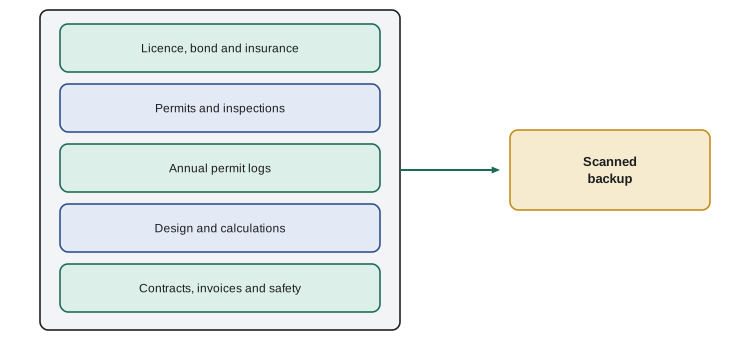
Records protect the licence and the business. They answer the inspector's questions, support a lien claim, defend against a claim years later and make the annual renewal routine. Rena and Jonas keep:
- Licence, bond and insurance documents, with renewal dates.
- The permit log: permit number, address, value, fee, dates and final approval.
- Inspection reports and declarations for every job.
- Annual permit logs of alterations, which section 11 requires the holder to keep and produce on request.
- Load calculations, single-line diagrams and design notes, especially for solar, EV and service upgrades.
- Contracts, change orders, invoices and payment records.
- Safety records: hazard assessments, training, incident reports and WSCB correspondence.
How long to keep them depends on the purpose. Tax law sets retention periods for financial records, and limitation periods for claims run for years. Rena keeps job files for the life of the company in scanned form. Storage is cheap; a missing inspection report in a dispute is not.
Staying current with the Code
The Canadian Electrical Code Part I is revised on a three-year cycle. Yukon adopted the 2024 edition with effect from April 1, 2025, announced in Bulletin 25-01. Each new edition changes rules contractors use every week, and Yukon's adoption may come with territorial variations or transition rules. Read the adoption bulletin for each new edition, and confirm which edition applies to a job that straddles the effective date.
Between editions, Yukon's Building Safety branch issues bulletins. Recent ones include final operational tests (25-03), EV supply equipment (25-04) and a new metering guide with changes to temporary and rural services (26:01). Each bulletin can change what an inspector expects on the next job.
Rena's routine is simple:
- Check the bulletin page on yukon.ca once a month and after any phone call where an inspector mentions a new rule.
- Print each new bulletin, initial it after reading, and brief the crew at the next morning meeting.
- Keep the utility's service and metering requirements for ATCO Electric Yukon and Yukon Energy current.
- Take a Code update course when a new edition is adopted, even though we found no renewal requirement for it.
Worked problem
The bulletin nobody read
In autumn 2025, Tomas installs an outdoor EV charger at a Porter Creek house. He mounts it on the garage wall beside the driveway, with no bollard, and uses a unit rated only to minus 25 degrees. The inspector fails it. Why?
Show solution
- Bulletin 25-04, issued in September 2025, sets Yukon expectations for EV supply equipment.
- It calls for mechanical protection where the charger may be struck by a vehicle, for example a clearance distance, a mounting height or bollards.
- It also calls for outdoor equipment rated for minus 40 degrees.
- Tomas had not seen the bulletin; the fix is to add protection, replace the unit and pay any re-inspection fee.
- The company fix is the monthly bulletin check and crew briefing.
Answer: The installation did not meet Bulletin 25-04 on mechanical protection and cold rating; a bulletin routine prevents a repeat.
Growing the licence
Renewal is also the moment to look ahead. After 12 months of active Yukon contracting, Tagish Lake Electric may be able to apply for declaration authority (Lesson 4). If Rena wants a hotel maintenance contract, an annual permit becomes part of the business. If the company expands into fire alarm or solar work, the permit requirements in Lesson 6 apply. And if Rena ever steps away, the accredited representative rules in Lesson 2 decide what happens to the licence.
Bill's last piece of advice on renewal: keep a one-page summary of the year, with permits taken, inspections passed first time, re-inspections and why, incidents and what changed. It takes an hour, it makes the renewal easy, and it shows where the next year's training should go.
A year in the life of the licence
It helps to see the whole year at once. Tagish Lake Electric's licence was issued in February. In March, the bond and insurance renewals were diarized beside it. In April and May, the building season began, and the permit account filled up. In June, Jonas noticed a re-inspection charge from a Porter Creek job and paid it the same week. In August, a new bulletin on metering arrived and Rena briefed the crew. In October, the company took an annual permit for a hotel, and Jonas noted that it would run to the end of the following year. In December, the company's first-year summary was drafted. In January, the renewal reminders started. In February, the licence was renewed without a problem, because every issue that could have blocked it had been cleared as it arose.
That is the point of a renewal routine. Renewal is easy when nothing has been left to pile up. It is hard when a year of small problems surfaces at once.
Digital records and backups
Most of Tagish Lake Electric's records start on a phone: photos of rough-in before cover-up, scanned declaration forms, emails from the office, signed change orders. Jonas has a simple rule. Every record goes into the job folder in the company's cloud storage on the day it is created, with the permit number in the file name. Photos of rough-in are particularly valuable. If an owner later opens a wall, or a dispute arises about what was installed, a dated photo of the work before cover-up is often the best evidence there is.
A backup is only useful if it works. Twice a year Jonas picks a random old job and tries to find every document in its file. If anything is missing, he fixes the process, not just the file.
Learning from the inspector
Inspectors are a source of training as well as a check. Each correction notice is a free lesson on what the office expects. Rena reads every inspection report, including the ones for jobs that passed, and keeps a running list of comments. Every quarter she reviews the list with the crew. A comment that appears twice becomes a line in the company's checklist. Over time, the list of comments gets shorter, and the first-time pass rate rises. That record is also what the company will point to when it applies for declaration authority.
Courses and professional networks
Although we found no continuing education requirement for licence renewal, there are good reasons to keep learning. Code update courses after each new edition, manufacturer training on new equipment such as EV chargers and solar inverters, and safety courses on arc flash and lockout all make the crew better. Yukon's electrical community is small, and contractors, inspectors and suppliers often know one another. Attending industry events and information sessions the office holds is a way to hear about changes early and to ask questions informally.
Rena also stays in touch with the apprenticeship side. Kieran's progress through his apprenticeship is part of the company's future, and the trades training system in Yukon is where the next qualified electricians will come from.
Planning for the end
Every licence eventually ends, through retirement, sale or closure. A contractor who plans for that keeps its records in order, tells the office of changes on time, and makes sure customers with ongoing work, such as annual permit holders, are not left without an electrician. Bill retired with every file in order, and the contractor who bought his customer list still calls him with questions. That is what a well-kept licence looks like at the end.
Rena's own learning plan for the first three years is short: a Code update course when the next edition is adopted, manufacturer training on the EV chargers and heat pumps her customers ask for most, a refresher in arc flash and lockout every few years, and a business course in estimating and cash flow. None of it is required for renewal. All of it shows up in the quality of the work and in the company's numbers.
She also blocks one afternoon a month in the calendar for reading: new bulletins, inspection comments, and anything the office or the WSCB has published since the last month. It is the cheapest training the company has.
Jonas adds a final step to the renewal routine: once the new licence arrives, he updates the truck decals, website and quote template if anything on the licence has changed, and files the old licence in the records drawer. Advertising must show the class and licence number, so a renewal that changes either needs the advertising changed too.
Common mistakes
MistakeLetting the licence lapse in the middle of the season.
InsteadNo new permits are issued until renewal; diarize the expiry with reminders.
MistakeAssuming an annual permit issued in October expires that December.
InsteadUnder s.11, permits issued on or after October 1 run to December 31 of the following year.
MistakeRelying on last year's knowledge of Yukon bulletins.
InsteadBulletins change inspection expectations; check the page monthly.
MistakeThrowing out job files once the customer pays.
InsteadRecords support liens, defend claims and answer inspectors; keep them, scanned if needed.
Summary and key terms
- A contractor licence runs for one year (s.4(8)); no new permits are issued until it is renewed.
- Unpaid re-inspection fees, an account in arrears, unreported changes or a lapsed bond can block renewal.
- We found no continuing education requirement for licence renewal in Yukon.
- Keep licence, permit, inspection, design, contract and safety records, including annual permit logs.
- Yukon adopted the 2024 Code from April 1, 2025; check bulletins monthly and brief the crew.
- Renewal
- The yearly step that keeps a one-year licence in force.
- Annual permit log
- The record of alterations, repairs and additions under an annual permit, kept under s.11.
- Bulletin
- A Building Safety notice that sets Yukon interpretations or requirements between Code editions.
- Effective date
- The date a new Code edition or rule begins to apply, such as April 1, 2025 for the 2024 Code.
- Limitation period
- The time within which a legal claim must be started.
Practice problems
Work each problem on paper first, then reveal the answer to check.
An annual permit is issued on September 20, 2027. When does it expire?
Show answer
December 31, 2027.
Name two things that could block a licence renewal.
Show answer
For example, unpaid re-inspection fees and a lapsed bond.
When did the 2024 Code take effect in Yukon?
Show answer
April 1, 2025, under Bulletin 25-01.
Which bulletin covers EV supply equipment?
Show answer
Bulletin 25-04.
Lesson quiz · 5 questions
Score 60% or more to complete this lesson.
Create a free account to save your progress, take quizzes and earn a certificate.