
MELC-211 · Lesson 1 of 12 · 18 min
How electrical licensing works in Yukon
▶ Video coming soon A video version of this lesson is on the way.
Rena Charlie has been a construction electrician in Whitehorse for nine years. She finished her apprenticeship in Yukon, wrote the interprovincial exam and earned her certificate of qualification with a Red Seal endorsement. For the last five years she has run crews for a mid-sized contractor on houses in Porter Creek and Whistle Bend, small commercial units in Marwell, and the odd cabin job out toward Carcross. This winter she and her partner Jonas Kaye are setting up their own company, Tagish Lake Electric Ltd. Before she quotes a single job, she wants to understand exactly how Yukon decides who may contract for electrical work.
This course follows Rena through that process. It is a companion to the Canadian core courses (MELC-101 to MELC-106), which teach the Code, calculations, wiring methods, grounding, special installations and the business side. This course adds what is particular to Yukon: the law, the licence, permits and inspections, Yukon's Code bulletins, liens, workplace safety and the habits that keep a licence in good standing.
One thing to settle at the start: Yukon does not have a master electrician licence, and we could find no published master electrician exam. What Yukon has is an electrical contractor licence, issued by the chief electrical inspector under the Electrical Protection Act and its regulation, plus a permit and inspection system that checks the work itself. This course is built around that real system. Where we could not confirm a detail from an official source, the lesson says so and tells you who to ask.
The law: one Act and one regulation
Two pieces of law do most of the work.
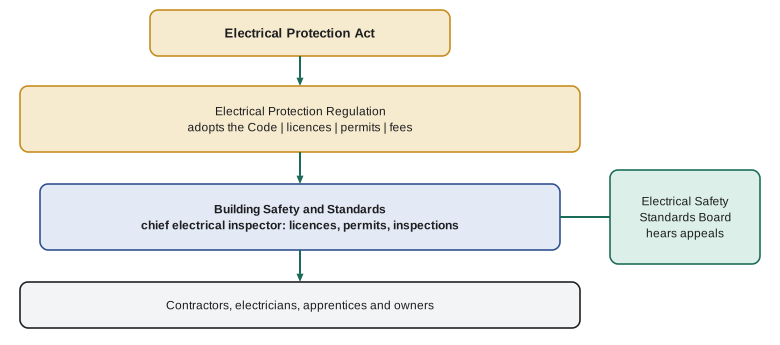
- The Electrical Protection Act (RSY 2002, c.65) is the statute. It creates the authority to inspect electrical installations, to license contractors, to issue permits and to make regulations. Section 9 deals with notice for inspections, and section 16 sets up the Electrical Safety Standards Board, which hears appeals.
- The Electrical Protection Regulation (O.I.C. 1992/017, amended by O.I.C. 2015/251) fills in the detail: contractor licences, bonds, declarations, permits, annual permits, owner permits, inspections and the fee schedule.
The regulation also adopts the Canadian Electrical Code, Part I, as the technical standard. Yukon announced the 2024 edition by Bulletin 25-01, effective April 1, 2025. Lesson 5 covers the Code and the Yukon bulletins that add to it.
Section numbers in this course refer to the regulation as printed to December 31, 2015, and to the Act as the government's own pages cite it. Laws change. Before you rely on a section number for anything that matters, check the current version on the Yukon government's legislation site or ask the Building Safety office.
Who runs the system
Electrical safety sits in the Department of Community Services, in the Building Safety and Standards branch. Within it, the chief electrical inspector is the person the regulation names for licensing decisions: applications for contractor licences go to the chief inspector, and the chief inspector keeps the public register of licence holders. Electrical inspectors carry out inspections across the territory.
The office takes permit applications in person at 2251 B 2nd Avenue in Whitehorse, and by email, fax or mail to Building Safety (C-8). Inspections are booked through the same office. Because Yukon is large and sparsely populated, inspectors travel, and the regulation's special inspection fee includes travel time from and back to the inspector's office. That matters when you price a job in Old Crow or Beaver Creek.
The other players
Several other organizations touch an electrical contractor's work in Yukon. None of them issues the contractor licence, but each can stop a job.
| Organization | What it does for an electrical contractor |
|---|---|
| Building Safety and Standards (Community Services) | Contractor licences, electrical permits, inspections, Yukon Code bulletins |
| Electrical Safety Standards Board | Hears appeals about suspended licences, withdrawn privileges and refused permits |
| Apprenticeship and trades (Education) | Apprenticeship, certificates of qualification, Red Seal |
| ATCO Electric Yukon and Yukon Energy | Service connections, metering, interconnection of generation |
| Workers' Safety and Compensation Board | Workers' compensation coverage, injury reports, occupational health and safety |
| City of Whitehorse and other municipalities | Building permits and business licences inside their boundaries |
The two utilities matter more than newcomers expect. ATCO Electric Yukon serves most customers directly, and Yukon Energy generates most of the power and serves some customers. Each has its own service and metering requirements, and Building Safety has issued bulletins that tie the Code to them, such as Bulletin 26-01 on a new metering guide and changes to temporary and rural residential services. Lesson 6 returns to this.
What the licence actually controls
In practice, the contractor licence controls three things.
- Permits. A licensed electrical contractor can take out electrical permits for customers. Without a licence, the only other route to a permit is the owner permit for a homeowner wiring their own home, which Lesson 6 explains.
- Scope. A contractor may only take permits for work within the class it is licensed for. The class is printed on the licence and must appear in advertising, with the licence number.
- Declarations. Some contractors may declare that an installation complies with the Code, so that the inspector can approve work by declaration rather than by visit. The regulation sets conditions for that privilege, which Lesson 4 covers.
The licence does not, on its own, make anyone an electrician. Who may physically do electrical work is a trade question as well as a licensing one: electrician (construction and industrial) is a trade for which Yukon requires a licence, earned through apprenticeship or a challenge exam and a certificate of qualification. Rena's own certificate is the foundation; the company licence sits on top of it.
A worked example: three people, three routes
Worked problem
Who can take out a permit?
Three people want to wire something in Whitehorse. Rena wants to wire a new house for a customer under Tagish Lake Electric. Her neighbour Doug, a retired teacher, wants to add circuits in the single-family house he lives in. Doug's son-in-law, a certified electrician from Alberta visiting for the summer, offers to do a rental suite in Doug's basement. Who can get a permit, and how?
Show solution
- Rena: once Tagish Lake Electric holds a contractor licence in the right class, it can apply for the permit for the new house.
- Doug: an owner permit is possible if he occupies the house as his dwelling, passes the inspector's examination, and the job is single phase, no more than 150 volts to ground and 200 amperes, outside any hazardous location.
- The son-in-law: a certificate of qualification lets him work as an electrician for a licensed contractor, but he holds no Yukon contractor licence, so he cannot take out the permit himself.
- The rental suite: the government's permit page says that if any part of the home is a rental unit, the owner must hire an electrical contractor.
Answer: Rena's company can take the permit for the new house. Doug may qualify for an owner permit for his own home, but not for the rental suite, which needs a licensed contractor.
Bill Hartwell, a retired Whitehorse contractor who has agreed to mentor Rena, tells her that the rental-suite rule catches people every spring. Owners assume that because they live upstairs the whole house is theirs to wire. The permit office sees it differently.
How this course is organized
| Lessons | Topic |
|---|---|
| 1 to 4 | The system, licence classes, applying, and how competence is checked |
| 5 and 6 | The Code as adopted in Yukon, and permits and inspections |
| 7 and 8 | The licensed contractor's duties, bonding, insurance and the business |
| 9 and 10 | Contracts and builders' liens, and workplace safety and compensation |
| 11 and 12 | Renewal and records, and a readiness review |
Each lesson ends with a short quiz. The final exam is a mixed review. There is no official Yukon exam for this course to imitate, so the questions test the knowledge a new contractor needs on the job and when dealing with the inspection office.
A first look at fees
Permit fees in Yukon are calculated from the value of the installation, under the schedule in section 18 of the regulation. Lesson 6 covers the full schedule. Here is a first taste: a short calculator for the lower brackets, which most residential jobs fall into. The brackets come from the government's permit page and the regulation; always check the current schedule before you quote.
def permit_fee(value):
    # Yukon electrical permit fee for installations up to 10,000 dollars (schedule, s.18).
    if value <= 500:
        return 25.00
    if value <= 1000:
        # 27.50 to 37.50 in 2.50 steps for each 100 dollars (or part) over 500
        steps = -(-(value - 500) // 100)
        return 25.00 + 2.50 * steps
    if value <= 3000:
        return 37.50 + 3.00 * (-(-(value - 1000) // 100))
    if value <= 10000:
        return 97.50 + 1.50 * (-(-(value - 3000) // 100))
    raise ValueError("use the full schedule for larger jobs")

for job, value in [("Porter Creek panel change", 2800), ("Cabin add-on circuits", 950),
                   ("Basement suite", 7400)]:
print(f"{job}: value {value} -> permit fee {permit_fee(value):.2f}")Porter Creek panel change: value 2800 -> permit fee 91.50 Cabin add-on circuits: value 950 -> permit fee 37.50 Basement suite: value 7400 -> permit fee 163.50
The calculator rounds each partial hundred up to a full hundred. That is the usual way these schedules are applied, but if the office's own calculation differs, the office's number wins.
Why the territory runs its own system
Yukon's population is small and spread over a very large area. Most people live in Whitehorse, and many communities are hours apart by highway, with Old Crow reachable only by air. That geography shapes the electrical system in ways a southern contractor may not expect. One territorial office handles licensing, permits and inspections for the whole territory. Inspectors travel long distances, so notice periods and clear directions matter. And several communities run on diesel generation rather than the hydro grid, which is why the territory restricts electric heat in those places.
The same geography explains why Yukon relies so heavily on the trade certificate and on inspection rather than on a separate master exam. A small office cannot run an exam program like Alberta's or Ontario's, but it can review applications carefully, inspect every permitted job, and give experienced local contractors the privilege of declaring their own work. Understanding that design makes the rest of this course easier to remember: most rules exist to keep the inspection system working across a large territory.
Reading the law yourself
The Act and the regulation are published on the Yukon laws website. The regulation is short, and every contractor should read it once from start to finish. Read it with a highlighter and mark the sections this course cites: section 4 on licences, section 5 on inspections and declarations, section 11 on annual permits, section 14 on accounts, section 15 on owner permits and section 18 on fees. When an inspector or the office cites a section, you will know where to find it. Bill keeps his copy in the truck with the Code book, and he says it has settled more arguments than the Code has.
Common mistakes
MistakeCalling the Yukon licence a master electrician licence.
InsteadYukon licenses electrical contractors through the chief electrical inspector; we found no master electrician licence or exam.
MistakeAssuming an owner can wire a rental suite in their own house.
InsteadIf any part of the home is a rental unit, the government's permit page says the owner must hire a licensed electrical contractor.
MistakeTreating a certificate of qualification as a contractor licence.
InsteadThe certificate qualifies the person to work in the trade; the contractor licence lets a business take out permits.
MistakeQuoting remote jobs without travel costs for inspection.
InsteadSpecial inspections are charged by the hour plus travel, and time includes travel from and back to the inspector's office.
Summary and key terms
- Electrical safety in Yukon rests on the Electrical Protection Act and the Electrical Protection Regulation.
- The chief electrical inspector, in Community Services' Building Safety and Standards branch, licenses contractors and keeps the public register.
- The licence controls permits, scope by class, and the privilege of declaring work.
- The Electrical Safety Standards Board hears appeals about licences and refused permits.
- The 2024 Canadian Electrical Code took effect in Yukon on April 1, 2025, under Bulletin 25-01.
- Electrical Protection Act
- The Yukon statute that governs electrical installations, contractor licences, permits and inspections.
- Electrical Protection Regulation
- O.I.C. 1992/017, the regulation that sets licence, permit, inspection and fee rules.
- Chief electrical inspector
- The official who receives licence applications, issues licences and keeps the register.
- Electrical Safety Standards Board
- The appeal board created under section 16 of the Act.
- Owner permit
- A permit for a homeowner to wire their own single-family dwelling, subject to conditions and an examination.
Practice problems
Work each problem on paper first, then reveal the answer to check.
Which official receives applications for an electrical contractor licence?
Show answer
The chief electrical inspector, under section 4(2) of the regulation.
Which body hears an appeal if a contractor's licence is suspended?
Show answer
The Electrical Safety Standards Board, under section 16 of the Act.
On what date did the 2024 Canadian Electrical Code take effect in Yukon?
Show answer
April 1, 2025, according to Bulletin 25-01.
A homeowner lives upstairs and rents out the basement suite. Can they get an owner permit to wire the suite?
Show answer
No. The government's permit page says that if any part of the home is a rental unit, the owner must hire an electrical contractor.
Lesson quiz · 5 questions
Score 60% or more to complete this lesson.
Create a free account to save your progress, take quizzes and earn a certificate.