
MELC-211 · Lesson 5 of 12 · 19 min
The Canadian Electrical Code as adopted in Yukon
▶ Video coming soon A video version of this lesson is on the way.
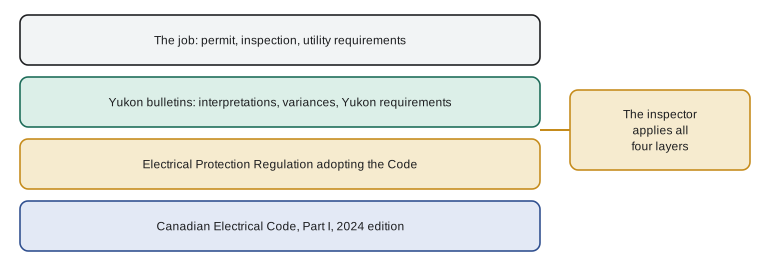
The Canadian Electrical Code, Part I, is the technical rulebook for electrical work across Canada. Each province and territory adopts it by law, and most add their own amendments, interpretations and bulletins. Yukon adopts the Code through the Electrical Protection Regulation, and the chief electrical inspector publishes numbered bulletins that explain Yukon-specific requirements, interpretations and variances. This lesson covers which edition applies, how the bulletins work, and the Yukon requirements Rena must build into every quote.
The core courses teach the Code itself. This lesson is about the Yukon layer on top. As everywhere in this course, it cites rule numbers and describes requirements in its own words. It does not reproduce Code text. Keep your own copy of the edition in force, and read the bulletins themselves.
Which edition applies
Bulletin 25-01, Adopting the 2024 Edition of the Canadian Electrical Code, announced the adoption of the 2024 edition in Yukon effective April 1, 2025. Before that, Bulletin 22-1 adopted the 2021 edition. The pattern is typical: Canada publishes a new edition on a regular cycle, and Yukon adopts it by bulletin and regulation some months later.
Which edition applies to a particular job depends on the transition rules in the adopting documents. We could not read the full transition wording of Bulletin 25-01 while preparing this course. For a job permitted near an adoption date, read the bulletin itself or ask the office which edition the inspector will apply.
Section 19 of the regulation, added in 2015, deals with access to the Code. The Code is a copyrighted standard sold by CSA Group; the regulation's reference to access does not mean you can work without your own copy. Every licensed contractor should own the current edition.
How Yukon bulletins work
Building Safety publishes bulletins numbered by year and sequence: 22-1, 22-2 and so on, then 24-01, 25-01 and, most recently, 26:01. The government's page describes them as Yukon-specific information on regulations and processes, variances to the Code, interpretations and general advice. Some change what the Code requires in Yukon; others explain how the office will apply a rule; others are practical warnings.
| Bulletin | Title |
|---|---|
| 22-1 | Adopting the 2021 Canadian Electrical Code |
| 22-6 | Roof-mounted PV installs |
| 22-7 | Underground installations |
| 22-8 | Meter-mounted transfer switches |
| 22-9 | Unsupervised electrical work |
| 22-12 | Energy storage systems and letters of assurance |
| 23-2 | Panelboards in dwelling units |
| 24-02 | Permit application requirements |
| 25-01 | Adopting the 2024 Edition of the Canadian Electrical Code |
| 25-02 | Overhead services: service mast requirements |
| 25-03 | Final safety and operational testing |
| 25-04 | Electric vehicle supply equipment |
| 26:01 | New metering guide and changes to temporary and rural residential service installations |
Rena prints the full list and keeps a binder with every current bulletin, sorted by number. When a new bulletin appears, she reads it the same week and adds a one-line note to her quote template if it changes what she prices.
Yukon requirements that change your quote
Several Yukon requirements, described in the chief inspector's administration notes and bulletins, affect almost every residential job.
- Vehicle heater receptacle. Each single dwelling needs an exterior 20-ampere receptacle for a vehicle heater on a dedicated circuit. In a territory where winter mornings reach minus 40, a block heater outlet is not optional.
- Future EV conduit. Each single dwelling also needs a 1-inch conduit from the main panel to a parking space, for a future EV charger. The notes cite Bulletin 22-1 for these two requirements.
- Service conductors inside a building. The notes say main service conductors may not run more than three metres inside a structure.
- Meter bases. Round-type meter bases are not accepted for reuse in panel upgrades.
- Electric heat in diesel communities. Electric heat is prohibited in diesel-powered communities unless the utility grants special permission. The notes list Burwash, Beaver Creek, Destruction Bay, Old Crow, Swift River and Watson Lake.
None of these is exotic, but each one costs money, and a quote that leaves them out either loses money or fails inspection. Rena adds a Yukon block to her residential quote template: heater receptacle and circuit, EV conduit, service entry location, meter base replacement on upgrades, and a check of the community's power source before quoting any electric heat.
Electric vehicle supply equipment
Bulletin 25-04, issued by the chief electrical inspector in September 2025, collects Yukon's expectations for EV supply equipment. It covers:
- Load calculations. When adding load to an existing system, a load calculation must be completed and included with the permit application. If capacity is short, or the calculation is not done, an EV energy management system may be used, and the permit application must say whether it monitors the service conductors or a branch circuit.
- Mechanical protection under Rule 2-200. Options include keeping the equipment at least 1 metre from vehicles, mounting the equipment and wiring at least 1 metre above grade, or installing barriers such as curbs, bollards set at least 1.5 metres below grade, jersey barriers or guard rails, with bollards no more than 1.5 metres apart centre to centre.
- Temperature rating. Outdoor equipment must be rated for minus 40 degrees Celsius or colder; equipment rated higher is limited to heated indoor locations.
- Adjustable settings. A reduced amperage setting can be used for the load calculation only on fixed-in-place equipment, with the setting permanently marked and access to the adjustment restricted.
- Receptacles. The overcurrent device must match the receptacle rating, citing Rule 26-700, and the receptacle must be permanently labelled for EV use, citing Rule 86-306.
Worked problem
An EV charger at a Riverdale condo
A condo board in Riverdale asks Tagish Lake Electric to install a 40-ampere outdoor EV charger for one owner. The building's service has limited spare capacity. What does Rena need for the permit and the install?
Show solution
- Do a load calculation for the existing service and include it with the permit application (Bulletin 25-04).
- If the calculation shows too little capacity, propose an EV energy management system and state on the application whether it monitors the service conductors or a branch circuit.
- Choose equipment rated for minus 40 degrees Celsius or colder, because it is outdoors.
- Plan mechanical protection: the parking stall layout puts the charger within 1 metre of the bumper, so she prices two bollards no more than 1.5 metres apart, set at least 1.5 metres below grade.
Answer: Permit with load calculation (or an energy management system), a minus 40 rated unit, and bollards for protection.
Checking a quote against the Yukon list
Rena writes a small checker for residential quotes. It is not a substitute for reading the bulletins; it is a reminder of the Yukon items that are easy to forget.
YUKON_ITEMS = {
    "heater_receptacle": "Exterior 20 A vehicle heater receptacle on a dedicated circuit",
    "ev_conduit": "1-inch conduit from main panel to a parking space",
    "meter_base": "Replace round meter base on panel upgrades",
    "diesel_heat_check": "Confirm community power before quoting electric heat",
}
DIESEL = {"Burwash", "Beaver Creek", "Destruction Bay", "Old Crow", "Swift River", "Watson Lake"}

def check(quote):
    missing = [YUKON_ITEMS[k] for k in ("heater_receptacle", "ev_conduit") if not quote.get(k)]
    if quote.get("panel_upgrade") and not quote.get("meter_base"):
        missing.append(YUKON_ITEMS["meter_base"])
    if quote.get("electric_heat") and quote["community"] in DIESEL:
        missing.append("Utility permission needed for electric heat in " + quote["community"])
    return missing

q = {"community": "Watson Lake", "heater_receptacle": True, "ev_conduit": False,
     "panel_upgrade": True, "meter_base": False, "electric_heat": True}
for item in check(q):
print("Check:", item)Check: 1-inch conduit from main panel to a parking space Check: Replace round meter base on panel upgrades Check: Utility permission needed for electric heat in Watson Lake
On this Watson Lake quote, the checker flags three items: the missing EV conduit, the meter base, and electric heat in a diesel community. Rena would rather find those at her desk than on site.
Panels, underground and other bulletins
Other bulletins deal with particular installations: panelboards in dwelling units (23-2), underground installations (22-7), roof-mounted PV (22-6), energy storage systems and letters of assurance (22-12), overhead service masts (25-02) and meter-mounted transfer switches (22-8). Read the bulletin before you design or quote that kind of work. The administration notes add related rules: solar installations need their own permit with a detailed single-line diagram, roof-mounted solar needs the building permit number, and the office may require a building permit or an engineer's letter of assurance before approving an electrical permit for a structure.
Keeping a Code book that matches the law
The Code book a contractor carries is only as good as the notes in it. In Yukon, the Code as adopted is the published edition plus the territory's bulletins and administrative rules. Rena keeps her 2024 Code with tabs at every rule that a Yukon bulletin affects: the vehicle heater receptacle requirement, the EV conduit, the service conductor length inside a building, the EV equipment rules in Bulletin 25-04, and the rules around temporary and rural services in Bulletin 26:01. Next to each tab she writes the bulletin number in pencil, so she can update it when a bulletin is replaced.
We do not reproduce Code text in this course, and you should not rely on a summary of it. Buy the current edition from CSA Group and read the rules themselves. What this course adds is the Yukon layer: knowing which rules the territory has changed, added to or interpreted, and where to find the bulletin that says so.
When the edition changes mid-job
A new edition takes effect on a fixed date, but jobs do not start and stop neatly around it. A house designed and permitted in early 2025 may still be under construction months after April 1, 2025. Which edition applies? The answer depends on the transition rules the office sets, which we could not read in full from Bulletin 25-01. Common approaches in other jurisdictions tie the edition to the date the permit was issued or the date the design was submitted. In Yukon, ask the office for the rule and note the answer in the job file.
The practical habit is to write the applicable Code edition on every permit application and quote. If an inspector disagrees, the conversation starts from a clear record.
Bulletins as a business tool
Bulletins are not just rules to follow; they are information about what inspectors are seeing. Bulletin 25-03 on final operational tests was prompted by a real installation where 240 volts was connected to a 120-volt receptacle. Bulletin 25-04 on EV equipment reflects how quickly chargers have become a common job. A contractor who reads each bulletin and asks why it was issued gets an early view of the problems the office is trying to fix, and can make sure its own crew is never the example in the next one.
Rena also reads bulletins for business opportunities. The rule requiring conduit to the parking area for a future EV charger means every new house is a future EV charger job. Tagish Lake Electric's quote template for new homes includes a line offering to install the charger itself when the owner is ready.
When in doubt about whether a bulletin applies, phone the office before the work, not after the inspection. A two-minute call costs nothing; a failed inspection costs a return trip.
Common mistakes
MistakeQuoting a house without the vehicle heater receptacle and EV conduit.
InsteadYukon requires both on each single dwelling; price them in.
MistakeReusing a round meter base on a panel upgrade.
InsteadYukon does not accept round-type meter bases for reuse in panel upgrades.
MistakeQuoting electric heat in Old Crow or Watson Lake without checking.
InsteadElectric heat is prohibited in the listed diesel-powered communities unless the utility grants permission.
MistakeInstalling an outdoor EV charger rated only to minus 30.
InsteadBulletin 25-04 requires minus 40 degrees Celsius or colder for outdoor units.
Summary and key terms
- The 2024 Canadian Electrical Code took effect in Yukon on April 1, 2025 (Bulletin 25-01).
- Yukon bulletins add interpretations, variances and Yukon-specific requirements; keep them all.
- Single dwellings need an exterior 20 A vehicle heater receptacle and a 1-inch EV conduit to a parking space.
- Service conductors may not run more than three metres inside a structure, and round meter bases are not reused in upgrades.
- Bulletin 25-04 sets EV expectations: load calculation or energy management, minus 40 rating outdoors, mechanical protection and labelling.
- Bulletin
- A numbered notice from the chief electrical inspector on Yukon-specific requirements, interpretations or advice.
- Vehicle heater receptacle
- The exterior 20 A receptacle on a dedicated circuit required at each single dwelling.
- EV energy management system
- Equipment that limits EV charging load to stay within available capacity.
- Diesel-powered community
- A community supplied by diesel generation, where electric heat needs utility permission.
- Letter of assurance
- An engineer's letter confirming a design or installation, which the office may require.
Practice problems
Work each problem on paper first, then reveal the answer to check.
Which bulletin adopted the 2024 Code in Yukon, and when did it take effect?
Show answer
Bulletin 25-01, effective April 1, 2025.
What two Yukon-specific items does every single dwelling need for vehicles?
Show answer
An exterior 20 A heater receptacle on a dedicated circuit, and a 1-inch conduit from the main panel to a parking space.
How far apart may EV protection bollards be, centre to centre?
Show answer
No more than 1.5 metres.
Name three communities where electric heat needs utility permission.
Show answer
For example Old Crow, Watson Lake and Beaver Creek.
Lesson quiz · 5 questions
Score 60% or more to complete this lesson.
Create a free account to save your progress, take quizzes and earn a certificate.