
MELC-211 · Lesson 10 of 12 · 19 min
Occupational health and safety law for electrical contractors
▶ Video coming soon A video version of this lesson is on the way.
Electrical work is one of the trades where a single mistake can kill. Yukon's safety law puts duties on every employer, supervisor and worker, and it sets specific steps for reporting when someone is hurt. This lesson covers who administers that law, the employer's core duties, the reporting rules for serious incidents and injuries, and how Tagish Lake Electric builds a safety program small enough to use and strong enough to matter.
Who administers safety law in Yukon
In Yukon, a single body handles both workplace safety and workers' compensation: the Workers' Safety and Compensation Board (WSCB). Its governing statute, the Workers' Safety and Compensation Act, brought together the compensation and occupational health and safety rules that used to sit in separate acts. Detailed safety rules sit in regulations made under the Act, including general safety and electrical safety requirements.
The WSCB inspects workplaces, investigates serious incidents, issues orders and administers compensation claims. For a contractor, that means the same organization collects assessments, receives injury reports and may arrive on site after an incident.
Duties at a glance
Safety law in every Canadian jurisdiction follows a similar pattern, and Yukon's is no exception. The employer carries the broadest duty: to ensure, so far as reasonably practicable, the health and safety of its workers and of others affected by its work. Supervisors must make sure workers under them work safely. Workers must follow safe practices and use the protective equipment provided. Everyone has the right to refuse work they reasonably believe is dangerous.
| Party | Core duty | What it looks like at Tagish Lake Electric |
|---|---|---|
| Employer | Ensure the health and safety of workers so far as reasonably practicable | Written procedures, training, equipment and enforcement |
| Supervisor | Make sure workers follow safe procedures | Rena or Tomas checks lockout before work starts |
| Worker | Work safely, use protective equipment, report hazards | Kieran wears arc-rated clothing and reports damaged tools |
| Everyone | Right to refuse dangerous work | No one is punished for stopping to ask |
We could not confirm the current thresholds for joint health and safety committees or safety representatives in Yukon. A small contractor should ask the WSCB which applies once it has a few workers.
Reporting serious incidents
Section 57 of the Workers' Safety and Compensation Act requires employers to report certain serious events to the WSCB immediately. These include a worker's death or serious injury, an injury that results in admission to hospital, the collapse or failure of a structure or equipment, and a major release of a hazardous substance. Section 58 requires the employer to investigate and prepare a report.
Immediate means immediately: by phone, as soon as people are safe and emergency services have been called. The scene should not be disturbed except to rescue people, prevent further injury or protect property, until the WSCB allows it.
Reporting injuries for compensation
Separate from serious incident reporting, the compensation side of the Act sets reporting duties for workplace injuries. A worker must tell the employer of an injury within a reasonable time (s.87). The employer must give the board written notice of an injury within 3 days of learning of it (s.89). Late reports can affect the claim and can bring penalties.
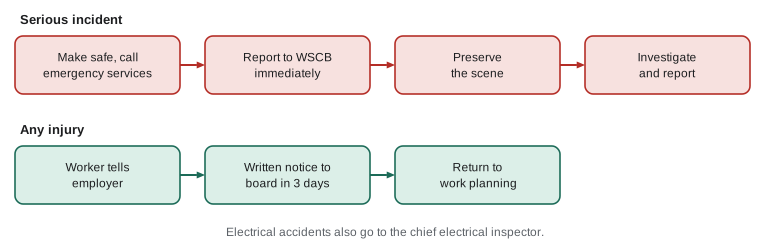
Remember that electrical accidents also go to the chief electrical inspector, under the administration notes covered in Lesson 7. A shock injury on a job may therefore need three reports: to the WSCB immediately if it is serious, a written injury notice within 3 days, and a report to the chief electrical inspector.
Worked problem
The shock at the Riverdale condo
Kieran is helping Tomas install an EV charger at a Riverdale condo. He touches a conductor he thought was dead and receives a shock that throws him back against a wall. He seems fine, but Tomas sends him to the hospital to be checked, and he is admitted overnight for heart monitoring. What reports does Tagish Lake Electric need to make?
Show solution
- Admission to hospital is one of the events section 57 lists, so the employer must report to the WSCB immediately.
- Under section 58 the employer must investigate and prepare a report; the scene should be preserved except as needed for safety.
- Under section 89, the employer gives the board written notice of the injury within 3 days of learning of it.
- Under the administration notes, the electrical accident is reported to the chief electrical inspector.
- Internally, the company reviews why the conductor was live: whether lockout was applied and verified, and whether the circuit was identified correctly.
Answer: Immediate report to the WSCB, investigation, written notice within 3 days, and a report to the chief electrical inspector.
Bill tells Rena the hardest part is not the paperwork. It is the conversation the next morning about what went wrong. A company that treats every shock as a near miss worth investigating is a company that does not have the second, worse one.
Electrical hazards: the core controls
The Code sets installation rules; safety law sets how workers must be protected while they do the work. Without quoting regulation text, the core controls for electrical work are well established:
- De-energize and lock out wherever possible, and verify absence of voltage with a tested meter before touching conductors.
- Where work on or near energized equipment cannot be avoided, assess shock and arc flash hazards, plan the work, and use the right protective equipment and insulated tools.
- Keep approach distances from overhead lines, which matters on rural Yukon properties where the service drop crosses the yard.
- Use ground fault protection on temporary power and cords on construction sites.
- Plan for cold: gloves that fit inside rubber insulating gloves, batteries that fail at low temperatures, and ice on ladders and roofs.
CSA Z462, the Canadian standard on workplace electrical safety, is the reference most contractors use for arc flash and energized work practices. We do not reproduce it here; buy the current edition.
A safety program a small company can use
A three-person company does not need a binder of 200 pages. It needs a few documents that people actually use. Rena's safety program fits in a folder in each truck:
program = {
    "Safety policy signed by the owner": "one page",
    "Hazard assessment for each job": "a form filled in at the start of each job",
    "Lockout and verification procedure": "two pages with photos",
    "Energized work permit": "used only when de-energizing is not possible",
    "Emergency plan for remote sites": "nearest clinic, satellite messenger, check-in times",
    "Incident and injury reporting steps": "who to call, in what order",
    "Training records": "one row per worker",
}
for item, form in program.items():
    print(f"{item}: {form}")
print(len(program), "documents in the truck folder")Safety policy signed by the owner: one page Hazard assessment for each job: a form filled in at the start of each job Lockout and verification procedure: two pages with photos Energized work permit: used only when de-energizing is not possible Emergency plan for remote sites: nearest clinic, satellite messenger, check-in times Incident and injury reporting steps: who to call, in what order Training records: one row per worker 7 documents in the truck folder
The remote-site plan is the most Yukon-specific item. A cabin job off the Klondike Highway may be hours from a hospital and outside cellular coverage. Rena's crews carry a satellite messenger, set check-in times with Jonas, and know where the nearest health centre is before they leave Whitehorse.
Working alone and in the cold
Working alone is a recognized hazard in safety law across Canada, and an electrical contractor whose apprentice is finishing a job at a remote cabin needs a procedure for it: regular check-ins, a way to call for help, and rules on what work may not be done alone. Energized work is the obvious example; Rena never allows it alone. Cold stress is the other Yukon hazard. Work-rest schedules, warm-up shelters and watching each other for signs of frostbite and hypothermia are part of winter work. Ask the WSCB for its current guidance on both.
Training and competence
Safety law expects employers to make sure workers are trained for the work they do and supervised until they are competent. For an electrical contractor, that means more than a trade certificate. Each worker needs training on the company's own procedures: how lockout is applied and verified, when an energized work permit is needed, what protective equipment to use, and what to do in an emergency at a remote site. Training should be recorded, and refreshed when procedures change or when an incident shows a gap.
Rena keeps a simple training matrix: one row per worker, one column per procedure, with the date each was trained and by whom. When Kieran moves from first to second year, the matrix shows what he has been trained on and what is next. When a general contractor asks for proof of training before letting the crew on site, Jonas can send it the same day.
Subcontractors and the prime contractor
On a construction site with several employers, safety law usually gives one party overall coordination duties, often called the prime contractor or the constructor depending on the jurisdiction. In Yukon, the general contractor on a larger project will normally hold that role. Tagish Lake Electric still has its own duties to its own workers, but it must also follow the site's rules, attend orientation, and report hazards to the party coordinating safety.
When Tagish Lake Electric is the only contractor on a job, such as a service upgrade at a house, the coordination duty may fall to it. Rena asks at the start of every job who is coordinating safety on the site, and writes the answer in the job file.
Return to work
When a worker is injured, the employer's duties do not end with the reports. Compensation law in Yukon includes obligations about returning injured workers to suitable work. For a small contractor, that might mean light duties in the shop, material handling, or helping Jonas with permits while an injury heals. Ask the WSCB about the current obligations for an employer of your size, and plan for them before you need to. A worker who returns to suitable work recovers faster, and the company keeps a trained person.
Safety as a selling point
General contractors and property managers increasingly ask about a subcontractor's safety record before awarding work. A clean record, a written program and proof of training win jobs. Rena includes a one-page safety summary with every commercial quote.
Finally, safety law applies to the owner too. Rena is a working owner, and she can be injured on the job like anyone else. She asks the WSCB whether she, as a director of the company, is covered automatically or needs to apply for coverage, and she makes sure the answer is in writing. Many small-business owners only discover they are not covered after an injury, when it is too late to change.
Ask before the season starts, not after an accident has already happened on a job.
Common mistakes
MistakeWaiting until the next day to report a hospital admission.
InsteadSection 57 requires immediate reporting of serious injuries and hospital admissions.
MistakeSending the written injury notice a week later.
InsteadEmployers must give the board written notice within 3 days of learning of an injury (s.89).
MistakeReporting only to the WSCB after an electrical shock.
InsteadElectrical accidents are also reported to the chief electrical inspector.
MistakeTesting for voltage with an untested meter.
InsteadVerify the meter on a known source before and after testing for absence of voltage.
Summary and key terms
- The Workers' Safety and Compensation Board administers both workplace safety and compensation in Yukon.
- Employers must ensure worker health and safety so far as reasonably practicable; supervisors and workers have their own duties.
- Serious injuries, deaths, hospital admissions, structural failures and major releases are reported to the WSCB immediately (s.57), followed by an investigation (s.58).
- Workers tell employers of injuries within a reasonable time (s.87); employers give the board written notice within 3 days (s.89).
- A small company's safety program should include lockout, hazard assessment, energized work rules and a remote-site emergency plan.
- WSCB
- The Workers' Safety and Compensation Board, which administers safety and compensation in Yukon.
- Serious incident
- An event such as a death, serious injury, hospital admission or structural failure that must be reported immediately.
- Lockout
- Isolating energy sources and securing them with locks before work.
- Arc flash
- A release of energy from an electrical arc that can cause burns and blast injuries.
- Right to refuse
- A worker's right to refuse work they reasonably believe is dangerous.
Practice problems
Work each problem on paper first, then reveal the answer to check.
An apprentice is admitted to hospital after a shock. How soon must the employer report to the WSCB?
Show answer
Immediately (s.57).
Within how many days must an employer give the board written notice of an injury?
Show answer
Within 3 days of learning of it (s.89).
Name two items in a small contractor's safety program.
Show answer
For example, a lockout procedure and a remote-site emergency plan.
Which Canadian standard is the usual reference for arc flash practices?
Show answer
CSA Z462.
Lesson quiz · 5 questions
Score 60% or more to complete this lesson.
Create a free account to save your progress, take quizzes and earn a certificate.