
MELC-211 · Lesson 4 of 12 · 18 min
Declaration authority and how competence is checked
▶ Video coming soon A video version of this lesson is on the way.
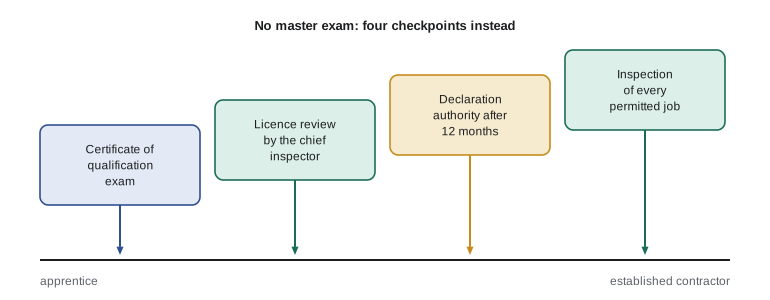
In provinces like Alberta and Ontario, a candidate proves competence once, at a master electrician exam. Yukon works differently. We found no published contractor or master exam. Instead, competence is checked at several points: the trade certificate, the chief inspector's review of the licence application, the conditions for the privilege of declaring work, and an inspection system that looks at installations job by job. This lesson explains each checkpoint, and then gives Rena a way to test herself on the things no checkpoint asks about.
Checkpoint one: the trade certificate
Every qualified electrician on Rena's crew has passed an exam: the certificate of qualification exam, usually the interprovincial Red Seal exam for construction electricians. That exam covers the Code, theory, installation methods and safety in depth. It is the strongest test of technical knowledge in the system, and Yukon builds on it rather than repeating it.
Checkpoint two: the licence review
The chief inspector reviews each licence application, including the accredited representative's qualifications. The regulation as printed does not describe a written exam for contractor licences, and we could not confirm that the office sets one. If it does for your class, the office will tell you. Plan for questions about your experience and the work you intend to do, and have records ready.
Checkpoint three: the privilege of declaring work
The most interesting checkpoint in the Yukon system is declaration authority. Under section 5 of the regulation, an authorized contractor may declare that an installation complies with the Code. When a contractor declares work, the inspector may still inspect, or may assign an approval number and a cover-up date at least three days out. If no inspection happens by the cover-up date, the work may proceed, though an inspector can still order corrections later.
Not every licence holder may declare. Section 5(6) sets conditions. To declare installations as complying, a contractor needs:
- experience in the class of work being declared;
- proven knowledge of the Code;
- 12 months of active contracting in Yukon before applying; and
- a licence for that class of work.
The phrase proven knowledge of the Code is the closest thing in the regulation to an exam requirement. The regulation does not say how knowledge is proven. It may be shown through the trade certificate, an interview, a record of clean inspections, or something else the office decides. Ask before you apply.
The 12 months of active Yukon contracting means a brand-new company cannot declare in its first year. Every installation will be inspected in the ordinary way. Rena builds that into her schedule: in year one, every stage waits for an inspector.
Checkpoint four: inspection
Every permitted job is subject to inspection. Section 5(1) requires the person doing the work to have it inspected or approved at each stage that would become impractical to inspect later, and at completion. Section 5(7) says installations may not be concealed until approved, permitted by declaration, or covered by an annual permit. Wiring that is covered without approval can be ordered exposed; the office's administration notes say the authority may order sections of building or earth removed.
Inspection is the checkpoint that never stops. A contractor who passed every exam twenty years ago is still inspected on Monday. And because re-inspections caused by unfinished or unsatisfactory work are charged to the contractor, poor work shows up on the invoice as well as the report.
A worked example: the first year
Worked problem
Declaring in year one
Tagish Lake Electric receives its licence in March 2027. In June, a builder asks Rena to declare the rough-in on six townhouses so the drywallers can start without waiting for an inspector. Can she?
Show solution
- Declaration authority under s.5(6) requires 12 months of active contracting in Yukon before applying.
- Tagish Lake Electric has been contracting for about three months.
- Rena's personal years with her former employer do not make the new company eligible; the condition is framed around the contractor applying for the privilege.
- Every rough-in must be inspected in the ordinary way; she requests inspections with at least 72 business hours' notice and plans the drywall start accordingly.
Answer: No. In its first year the company cannot declare; she books inspections and tells the builder.
We treat the 12-month condition as applying to the company because the regulation frames it around the contractor. If you are in a borderline case, such as an experienced contractor reorganizing an existing business, ask the chief inspector.
Testing yourself where no checkpoint asks
Even with four checkpoints, there are things nobody tests before you hang out your sign: Yukon's own rules, the business side, and the practical judgement that separates a good journeyperson from a contractor who keeps a licence for thirty years. Bill gives Rena a self-assessment he wishes he had been given. It scores her on ten areas, from 0 (no idea) to 3 (could teach it), and flags anything below 2.
areas = {
    "Yukon Act and regulation basics": 2,
    "Licence classes and accredited representatives": 3,
    "Permit fees and the schedule": 1,
    "Inspection stages and notice": 3,
    "Yukon Code bulletins (heater receptacle, EV conduit, diesel communities)": 1,
    "Load calculations for service upgrades": 3,
    "Builders' lien basics": 1,
    "Workers' compensation and injury reporting": 2,
    "Bond, insurance and contracts": 1,
    "Records and renewal": 2,
}
weak = [a for a, s in areas.items() if s < 2]
total = sum(areas.values())
print(f"Score {total} out of {3 * len(areas)}")
print("Study first:")
for a in weak:
print(" -", a)Score 19 out of 30 Study first: - Permit fees and the schedule - Yukon Code bulletins (heater receptacle, EV conduit, diesel communities) - Builders' lien basics - Bond, insurance and contracts
Rena's weak areas are exactly the ones this course covers in Lessons 5 to 11: fees, Yukon bulletins, liens and the business side. Her strong areas, inspection stages and load calculations, come from years of doing the work.
What the inspector is really checking
Bill's advice on inspections is simple. The inspector is checking three things: that the work matches the Code as adopted in Yukon, including the bulletins; that the permit matches the work; and that the paperwork matches both. A missing declaration form, an illegible permit number or a load calculation that does not match the panel schedule makes the inspector's job harder, and the office's notes say incomplete or illegible paperwork is not processed.
| What fails | Why | Prevention |
|---|---|---|
| Work covered before approval | Section 5(7) prohibits concealment without approval | Book inspections at each stage; do not let other trades cover early |
| Paperwork incomplete or illegible | The office does not process it | Permit number, signature and owner contact on every form |
| Load calculation missing on hot tub or EV permits | Required before issue | Attach the calculation to the application |
| Unfinished work at a booked inspection | Re-inspection fee charged to the contractor | Run the final test checklist before booking (Bulletin 25-03) |
Bulletin 25-03 deserves a mention here. The chief electrical inspector issued it in June 2025 after a job where 240 volts was connected to a 120-volt receptacle. It asks contractors to run quick operational checks, verifying the voltage and function of devices, before requesting a final inspection. It takes ten or fifteen minutes. Rena makes it part of every final.
Building a record for declaration authority
Declaration authority is earned, and the record that earns it starts on the first day. The regulation asks for proven knowledge of the Code and experience in the class, and the office will judge both partly on what it sees from your jobs. A company whose first year shows inspections passed first time, clean paperwork and no concealment is in a much stronger position than one with a pile of re-inspection charges.
Rena tracks four numbers each month: permits taken, inspections requested, inspections passed first time, and re-inspections with the reason for each. After twelve months she will have a simple record she can show the office. She also keeps the inspector's comments, good and bad, in the job files, because a pattern of small corrections tells her where the crew needs training.
months = [
    # (permits, inspections, passed first time)
    (3, 5, 4), (4, 8, 7), (6, 11, 11), (7, 14, 13), (8, 15, 15), (6, 12, 12),
]
inspections = sum(m[1] for m in months)
passed = sum(m[2] for m in months)
rate = passed / inspections
print(f"Six months: {inspections} inspections, {passed} passed first time")
print(f"First-time pass rate: {rate:.0%}")Six months: 65 inspections, 62 passed first time First-time pass rate: 95%
The numbers are invented, but the trend is what an inspector would hope to see: a few early misses, then clean inspections as the crew learns what Yukon inspectors look for.
Why declarations are a privilege
It helps to see declaration authority from the office's side. Every declared job is one the inspector may not visit. In a territory where some jobs are a day's drive away, that frees inspectors to spend time on the work most likely to have problems: owner permits, new contractors, complex installations. The office can only do that if it trusts the declaring contractor. A contractor who abuses the privilege does not just risk its own authority; it makes the office less willing to extend the same trust to others. That is why the regulation sets conditions, and why the chief inspector can withdraw the privilege.
Preparing for an interview
If the office does ask to speak with Rena about her qualifications, either for the licence or for declaration authority, she wants to be ready. She reviews the regulation's key sections, the Yukon bulletins from the last three years, the inspection stages and notice rules, and the special Yukon installation requirements: the vehicle heater receptacle, the conduit for a future EV charger, the limit on service conductors inside a building and the diesel community rules. She also prepares two or three examples of difficult jobs and how she solved them. None of this is a formal exam, but a contractor who can talk about these things clearly makes the office's decision easy.
Bill adds one more point about competence. The trade certificate proves what an electrician knew on the day of the exam. Yukon's system keeps checking after that day, which is fairer to customers than a single exam would be. An electrician who stops learning will show it at inspection, and the office will see the pattern before any customer is hurt.
For Rena, that means the habits she builds now are the real test. A clean permit file, a crew that runs final checks without being told, and an inspector who rarely needs to write anything on the report are the evidence that will matter when she applies for declaration authority. No exam would show the office as much.
Inspection results are also useful feedback for the crew, not only for the office.
Common mistakes
MistakeAssuming a new company can declare work from day one.
InsteadDeclaration authority requires 12 months of active Yukon contracting, proven Code knowledge, class experience and a licence for the class (s.5(6)).
MistakeTreating a declaration as the end of inspection.
InsteadThe inspector may still inspect, and can order corrections even after the cover-up date passes.
MistakeBooking a final inspection without testing devices.
InsteadBulletin 25-03 asks for voltage and function checks before requesting a final; unfinished work draws re-inspection fees.
MistakeBelieving there is no competence check because there is no master exam.
InsteadCompetence is checked at the trade certificate, the licence review, declaration authority and every inspection.
Summary and key terms
- Yukon has no published master or contractor exam; competence is checked at four points.
- The certificate of qualification exam is the main test of technical knowledge.
- Declaration authority under s.5(6) needs class experience, proven Code knowledge, 12 months of active Yukon contracting and the right licence class.
- Declared work may get an approval number and a cover-up date at least three days out, and can still be inspected.
- Inspection at each stage, and no concealment without approval, apply to every permitted job.
- Declaration
- A contractor's statement that an installation complies with the Code, allowed only to authorized contractors.
- Declaration authority
- The privilege, under s.5(6), of declaring installations compliant.
- Approval number
- A number assigned by the inspector to declared work, posted at the site.
- Cover-up date
- The date, at least three days out, after which declared work may be covered if no inspection has occurred.
- Proven knowledge of the Code
- One condition for declaration authority; the regulation does not say how it is proven.
Practice problems
Work each problem on paper first, then reveal the answer to check.
List the four conditions in s.5(6) for declaring installations.
Show answer
Experience in the class of work, proven Code knowledge, 12 months of active Yukon contracting before applying, and a licence for the class.
A declared rough-in gets a cover-up date of Thursday and no inspector comes. May the drywall go up Friday?
Show answer
Yes, the work may proceed after the cover-up date, but an inspector can still order corrections.
How long does Bulletin 25-03 estimate the final operational checks take?
Show answer
About 10 to 15 minutes.
Why can't Tagish Lake Electric declare work in its first year?
Show answer
It has not completed 12 months of active contracting in Yukon.
Lesson quiz · 5 questions
Score 60% or more to complete this lesson.
Create a free account to save your progress, take quizzes and earn a certificate.