
MELC-211 · Lesson 8 of 12 · 18 min
Bonding, insurance and running the business
▶ Video coming soon A video version of this lesson is on the way.
A licence lets Tagish Lake Electric take permits. It does not keep the company solvent, protect it when something goes wrong, or win it work. This lesson covers the money side of a Yukon electrical contractor: the bond the regulation requires, the insurance the market expects, workers' compensation registration, the permit account, municipal licensing, and the quoting habits that matter in a territory where the next job may be five hours up the highway.
The bond the regulation requires
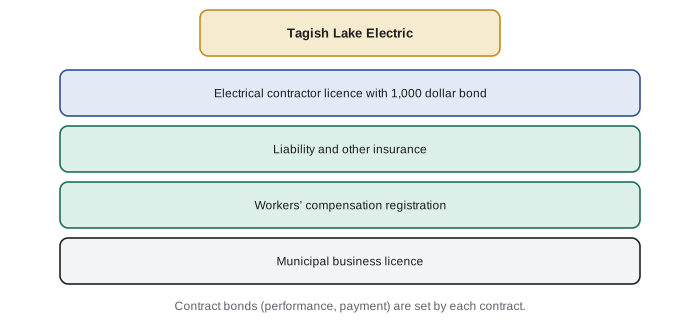
Section 4(3) of the Electrical Protection Regulation requires a contractor licence applicant to provide a bond of 1,000 dollars, forfeitable to the Government of Yukon. A bond is a three-party promise. The contractor (the principal) promises to meet its obligations; a surety company guarantees that promise; and the government (the obligee) can claim against the bond if the contractor fails. If the surety pays, it will look to the contractor to repay it. A bond is therefore not insurance for the contractor. It is security for the government, backed by the contractor's own credit.
The amount is small, and a broker can usually arrange it quickly. The practical points are to keep it in force for as long as the licence is held, to keep the bond document with the licence records, and to diarize its renewal date alongside the licence renewal. Jonas puts both on the same page of the company calendar.
| Feature | Licence bond | Liability insurance |
|---|---|---|
| Required by the regulation | Yes, 1,000 dollars (s.4(3)) | Not named in the regulation we read |
| Who it protects | The Government of Yukon | The contractor, against claims by others |
| Who pays in the end | The contractor repays the surety | The insurer, subject to the deductible and policy terms |
| Typical source | A surety, through a broker | An insurer, through a broker |
Performance and payment bonds on larger jobs
Separate from the licence bond, some owners, especially public bodies and larger general contractors, ask trade contractors for performance bonds or labour and material payment bonds on bigger projects. A performance bond guarantees the work will be completed; a payment bond guarantees that the contractor's own workers and suppliers will be paid. These are set by the contract, not by the Electrical Protection Regulation. A new company may find sureties cautious until it has a few years of financial statements, so Rena and Jonas start building that record from the first year.
Insurance the market expects
We found no insurance requirement in the regulation itself. That does not mean a contractor can do without it. General contractors, property managers, the City and many homeowners will ask for a certificate of insurance before work starts, often naming them as additional insureds. The usual covers for an electrical contractor are:
- Commercial general liability, for injury to others and damage to their property arising from the work.
- Tools and equipment cover, for the truck contents, meters and the generator.
- Commercial auto insurance for company vehicles, which in Yukon means thinking about winter driving on long highways.
- Errors and omissions or professional liability, if the company does design work such as load calculations and single-line diagrams for solar permits.
Contract terms decide how much cover is enough. Rena reads the insurance clause in every contract before she signs, and Jonas sends the broker any contract that asks for limits above the company's policy.
Workers' compensation registration
The moment Tagish Lake Electric hires Tomas and Kieran, it becomes an employer under the Workers' Safety and Compensation Act. Employers register with the Workers' Safety and Compensation Board and pay assessments based on payroll. General contractors often ask for proof that a subcontractor's account is in good standing before they pay. Lesson 10 covers the reporting duties and safety law in detail; for now the business point is that assessments are a cost to price into every job, like wages and materials.
Municipal business licences
The City of Whitehorse requires businesses operating within its boundaries to hold a business licence. Other municipalities may have their own rules. We did not confirm current fees or whether an out-of-town contractor needs a licence for a single job, so Jonas checks with each municipality before the first job there.
The permit account and cash flow
Section 14 of the regulation lets contractors hold an account for permit fees and says permits are not issued if the account is not in good standing. For a small company, permit fees are not large, but a missed payment can stop every new job at once. Jonas reconciles the account monthly and pays re-inspection charges as soon as they arrive, because the administration notes say unpaid re-inspection fees may lead to non-renewal of the licence.
Cash flow is the bigger risk. In the Yukon building season, a contractor may buy panels, wire and heaters in May and not be paid until August. The customer's payment terms, any holdback the contract allows, and the time it takes the general contractor to pay all matter. Lesson 9 covers liens, the main legal tool when payment does not come.
Quoting in Yukon
A Yukon quote has a few lines a southern quote may not. The permit fee is one; the fee schedule bases it on the value of materials and labour. Travel is another. The permit fee itself excludes travel and accommodation, but the contractor's own costs for travel do not disappear. And if the office has to send an inspector on a special inspection, charged at 50 dollars an hour plus travel, the cost may come back to the contractor.
Rena's quote template has separate lines for labour, materials, the permit fee, crew travel and accommodation, and a contingency for return trips when a re-inspection is needed.
import math

def permit_fee(value):
    if value <= 500:
        return 25.00
    if value <= 1000:
        return 25.00 + 2.50 * math.ceil((value - 500) / 100)
    if value <= 3000:
        return 37.50 + 3.00 * math.ceil((value - 1000) / 100)
    if value <= 10000:
        return 97.50 + 1.50 * math.ceil((value - 3000) / 100)
    return 202.50 + 1.00 * math.ceil((value - 10000) / 100)  # up to 50,000

labour, materials = 6200, 4900
travel_days, crew, day_rate_travel = 2, 2, 380
value = labour + materials
fee = permit_fee(value)
travel = travel_days * crew * day_rate_travel
contingency = 0.05 * value
total = value + fee + travel + contingency
print(f"Installation value: {value:,.2f}")
print(f"Permit fee: {fee:,.2f}")
print(f"Crew travel and lodging: {travel:,.2f}")
print(f"Contingency: {contingency:,.2f}")
print(f"Quote total before tax: {total:,.2f}")Installation value: 11,100.00 Permit fee: 213.50 Crew travel and lodging: 1,520.00 Contingency: 555.00 Quote total before tax: 13,388.50
The example is a heating and service upgrade for a client in Watson Lake. The numbers are invented, but the structure is the point: the permit fee is based on the installation value, while travel and contingency sit outside it.
Worked problem
The Watson Lake heating job
A client in Watson Lake asks Tagish Lake Electric to replace an oil furnace with electric baseboard heat throughout a house. What business and licensing questions should Rena ask before quoting?
Show solution
- Watson Lake is one of the communities the administration notes list where electric heat is prohibited without the utility's permission, because the community is served by diesel generation.
- She must ask the client whether the utility has given permission, or tell the client it is needed before work can proceed.
- If permission is given, she quotes labour, materials, the permit fee based on the installation value, and travel and accommodation as separate lines.
- She also checks whether a load calculation is needed for the service and builds the inspection schedule around 72 business hours' notice and the inspector's travel.
Answer: Confirm the utility's permission for electric heat first, then quote with the permit fee and travel shown separately.
Records that protect the business
Jonas keeps four sets of records: the permit log, the inspection log, the bond and insurance folder, and the job files with contracts, change orders and invoices. Each is useful for licensing, and each protects the company if a customer disputes payment or a claim arrives years later. Lesson 11 returns to records and how long to keep them.
Pricing a job so the business survives
Many new contractors fail not because their work is poor but because their prices are too low. In Yukon, the costs that are easy to forget are travel time, accommodation, freight on materials, winter productivity losses, inspection waiting time and the return trip for a correction. A price that covers wages and materials but not those costs loses money on every remote job.
Rena builds her hourly rate from the bottom up. She starts with each worker's wage, adds payroll costs including WSCB assessments, then adds overhead: the truck, tools, insurance, the bond, the permit account, the office, software and Jonas's time. She divides overhead by the hours the company expects to bill, not the hours it expects to work, because time spent driving, quoting and waiting is not billable. Finally, she adds a profit margin, because profit is what pays for the next truck and carries the business through a slow winter.
wage = 42.00
payroll_costs = 0.18 * wage         # assessments, vacation pay and other costs, example only
overhead_per_year = 145000
billable_hours = 3 * 1500          # three people, about 1,500 billable hours each
overhead_per_hour = overhead_per_year / billable_hours
cost_per_hour = wage + payroll_costs + overhead_per_hour
rate = cost_per_hour * 1.15        # 15 cent on the dollar profit, example only
print(f"Cost per billable hour: {cost_per_hour:.2f}")
print(f"Charge-out rate: {rate:.2f}")Cost per billable hour: 81.78 Charge-out rate: 94.05
Every number in the script is an example. The point is the method: a rate built from real costs is defensible when a customer asks why it is higher than the rate of the contractor who went out of business last year.
Winter and the building season
The Yukon building season is short. Much new construction is done between late spring and early autumn, and much of the work outside that window is service calls, renovations and heating problems. A contractor's cash flow follows the season: heavy spending on materials and wages in the summer, payments that may not arrive until autumn, and a quieter winter. Jonas plans for it with a line of credit arranged before the season starts, deposits on larger jobs, and progress billing at each inspection stage.
Using an accountant and a lawyer
A small company does not need a lawyer on retainer, but it does need one to review its standard contract terms once and to call when a payment dispute might become a lien. It needs an accountant to set up the books, advise on the business form and file tax returns. Rena budgets for both in the first year. She would rather pay for an hour of advice than learn the rules from a mistake.
Finally, Rena reviews her prices every spring, before the season starts. Wage rates, fuel, insurance premiums and material costs all move. A price that was right last year may be losing money this year, and the start of the season is the only time customers expect a new rate sheet. She keeps the old and new rates side by side so she can explain the change to repeat customers.
Common mistakes
MistakeTreating the licence bond as insurance.
InsteadThe bond protects the government; if the surety pays, the contractor repays it.
MistakeStarting work without a certificate of insurance on file.
InsteadMany contracts require one before work; check the insurance clause before signing.
MistakeForgetting workers' compensation when the first employee starts.
InsteadEmployers register with the WSCB and pay assessments based on payroll.
MistakeQuoting electric heat in a diesel community without asking about the utility.
InsteadThe administration notes prohibit electric heat in listed diesel communities without the utility's permission.
Summary and key terms
- The regulation requires a 1,000 dollar licence bond forfeitable to the Government of Yukon (s.4(3)).
- Insurance is not named in the regulation, but contracts and customers expect general liability and other covers.
- Employers register with the Workers' Safety and Compensation Board and pay assessments on payroll.
- The permit account must be in good standing for permits to issue (s.14).
- Yukon quotes should show the permit fee, travel and contingency, and check diesel community rules for electric heat.
- Principal
- In a bond, the contractor whose obligations are guaranteed.
- Surety
- The company that guarantees the principal's obligations.
- Obligee
- The party protected by a bond; for the licence bond, the Government of Yukon.
- Performance bond
- A contract bond guaranteeing that the work will be completed.
- Payment bond
- A contract bond guaranteeing that the contractor's workers and suppliers will be paid.
Practice problems
Work each problem on paper first, then reveal the answer to check.
Who is the obligee on the licence bond?
Show answer
The Government of Yukon.
Is liability insurance required by the Electrical Protection Regulation?
Show answer
We found no such requirement, but contracts and customers commonly require it.
A job has an installation value of 2,500 dollars. What is the permit fee?
Show answer
37.50 plus 3.00 for each 100 over 1,000: 15 hundreds, so 37.50 plus 45.00 equals 82.50 dollars.
Name one community where electric heat needs the utility's permission.
Show answer
For example Watson Lake, Old Crow or Beaver Creek.
Lesson quiz · 5 questions
Score 60% or more to complete this lesson.
Create a free account to save your progress, take quizzes and earn a certificate.