
MELC-211 · Lesson 6 of 12 · 18 min
Permits, inspections and the inspection authority
▶ Video coming soon A video version of this lesson is on the way.
Permits and inspections are where the licence meets the job. Every installation Tagish Lake Electric does will start with a permit and end with an inspector's approval, and the way Rena handles both will decide how fast her jobs move and how much they cost. This lesson covers who may hold a permit, how fees are calculated, annual and temporary permits, the stages of inspection, notice, declarations, re-inspection charges and the utility connection at the end.
Who may hold an electrical permit
The government's permit page names two groups: licensed electrical contractors hired to do the work, and homeowners who have passed the homeowner's electrical test and are wiring their principal residence. Section 15 of the regulation sets the owner permit conditions in more detail:
- the applicant occupies, or will occupy, the premises as a dwelling;
- the applicant passes the inspector's examination and shows they can do the work to the Code;
- the building is standalone, or separated from other occupancies by a fire wall or fire separation;
- the work is not in a hazardous location; and
- the installation is no more than 150 volts to ground, single phase and 200 amperes.
If an owner permit is cancelled, section 15(2) says the owner must either hire a licensed contractor to complete the work to an inspector's satisfaction or have the installation disconnected or removed. That is a common source of work for contractors: finishing a homeowner's half-done basement.
Applying for a permit
Permit applications go to Building Safety (C-8) in person at 2251 B 2nd Avenue in Whitehorse, by email, by fax or by mail. Bulletin 24-02 covers permit application requirements. The administration notes add specific rules:
- Hot tub and EV charger permits need a load calculation before the permit is issued.
- Solar installations need a separate permit with a detailed single-line diagram; roof-mounted solar also needs the building permit number.
- The office may require a building permit or a structural engineer's letter of assurance before approving an electrical permit for a structure.
- Fire alarm work requires an electrical permit, and the installer must make sure a building permit is in place, complete system verification and send copies to the building inspector.
- Incomplete or illegible paperwork is not processed: include the permit number, a signature and the owner's contact information.
How fees are calculated
Section 18(2) bases the permit fee on the customer's cost of materials and labour for the installation. It excludes approved generators, current-consuming equipment, and travel or accommodation. Work an owner supplies themselves is priced as if a contractor did it, and inspectors may verify costs. The schedule then sets the fee by bracket.
| Installation value | Fee |
|---|---|
| 500 dollars or less | 25.00 |
| 501 to 1,000 | 25.00 plus 2.50 for each 100 or part over 500 (27.50 to 37.50) |
| 1,001 to 3,000 | 37.50 plus 3.00 per 100 over 1,000 |
| 3,001 to 10,000 | 97.50 plus 1.50 per 100 over 3,000 |
| 10,001 to 50,000 | 202.50 plus 1.00 per 100 over 10,000 |
| 50,001 to 500,000 | 602.50 plus 0.75 per 100 over 50,000 |
| 500,001 to 3,000,000 | 3,377.50 plus 0.25 per 100 over 500,000 |
| Over 3,000,000 | 15,877.50 plus 0.10 per 100 over 3,000,000 |
The government's page writes the 10,001 to 50,000 bracket as 1 dollar per 100 over 50,000, which looks like a typo; the base amounts only add up if the rate applies over 10,000, as the table shows. The minimum permit fee is 25 dollars.
Section 18(4) doubles the inspection fee when no permit was obtained before work began. The administration notes say applications submitted after work has started are assessed at double the normal fee, citing Bulletin 12-1. Bill puts it simply: the permit is the cheapest thing on the job, until you forget it.
import math

BRACKETS = [  # (upper limit, base, rate per 100 over the lower limit, lower limit)
    (3000, 37.50, 3.00, 1000),
    (10000, 97.50, 1.50, 3000),
    (50000, 202.50, 1.00, 10000),
    (500000, 602.50, 0.75, 50000),
    (3000000, 3377.50, 0.25, 500000),
]

def permit_fee(value, late=False):
    if value <= 500:
        fee = 25.00
    elif value <= 1000:
        fee = 25.00 + 2.50 * math.ceil((value - 500) / 100)
    else:
        for top, base, rate, low in BRACKETS:
            if value <= top:
                fee = base + rate * math.ceil((value - low) / 100)
                break
        else:
            fee = 15877.50 + 0.10 * math.ceil((value - 3000000) / 100)
    return fee * 2 if late else fee

for job, value, late in [("Riverdale EV charger", 4200, False),
                         ("Marwell shop fit-up", 38500, False),
                         ("Basement suite started without permit", 9000, True)]:
print(f"{job}: {permit_fee(value, late):.2f}")Riverdale EV charger: 115.50 Marwell shop fit-up: 487.50 Basement suite started without permit: 375.00
Annual permits
For facilities with ongoing minor alterations, section 11 provides annual permits. The application names the qualified electrician, or the contractor and their certificate or registration number, who will perform or supervise all work. One permit is needed for each independent building, and the holder keeps a written log of alterations, repairs and additions, produced on request. If the named electrician or contractor leaves, the permit ends automatically, and both the holder and the electrician must notify the chief inspector in writing. Permits issued before October expire on December 31 of the same year; those issued on or after October 1 expire on December 31 of the following year. The schedule sets the fee at 50 dollars per building.
Rena hopes to land maintenance work at a Whitehorse hotel. An annual permit naming Tagish Lake Electric would let her crew make small changes without a permit each time, as long as every change goes in the log.
Temporary services and connections
Temporary residential service permits cost 25 dollars for three months, renewable at the same fee; commercial temporary services are 50 dollars for twelve months. Section 6 makes temporary connection permits valid for 90 days, renewable once for 90 days at the inspector's discretion, after which supply must be cut off if not renewed. Bulletin 24-01 covers safe use of temporary power, and Bulletin 26:01 announced changes to temporary and rural residential service installations along with a new metering guide.
Inspections: stages, notice and declarations
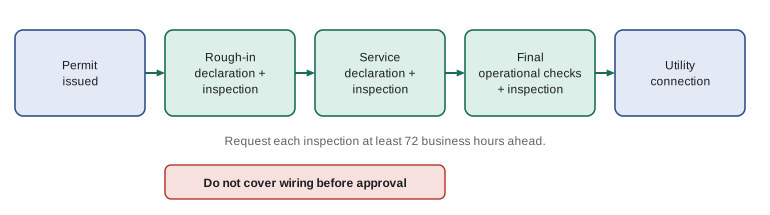
Section 5(1) requires work to be inspected or approved at each stage that would be impractical to inspect later, and at completion. In practice, the government's page names three stages: rough-in wiring, service wiring and final finish wiring. Contractors submit an electrical declaration form with the required information at each stage; homeowners phone with their permit number. Requests need at least 72 business hours' notice before the requested inspection date. Section 9 of the Act governs notice, and the contractor must make sure someone is on site to give the inspector access.
Wiring must not be covered until a declaration is submitted and a passed inspection report is received. Otherwise, the administration notes say, the authority may order sections of building or earth removed. For declared work by an authorized contractor, the approval number and cover-up date must be posted at the site (s.5(5)).
Re-inspections and special inspections
Re-inspections caused by unfinished or unsatisfactory work are charged to the contractor: 25 dollars per building under the schedule (s.5(8) and s.18). A special inspection costs 50 dollars an hour plus travel expenses, with time counted from and back to the inspector's office (s.18(7)). A wrong address or insufficient location information triggers a special inspection (s.18(5)), as does any inspection without a set fee (s.18(6)).
Worked problem
The wrong turn
Tagish Lake Electric requests a rough-in inspection for a cabin off the Klondike Highway but gives only a lot number with no directions. The inspector spends an extra two and a half hours finding the site, including the drive back. What could the office charge?
Show solution
- A wrong address or insufficient location information triggers a special inspection (s.18(5)).
- Special inspections are 50 dollars an hour plus travel expenses, counting travel from and back to the office (s.18(7)).
- Two and a half hours at 50 dollars is 125 dollars, plus travel expenses.
Answer: About 125 dollars plus travel expenses. Give clear directions, a site contact and a phone number on every remote request.
Utilities and connection
After approval, the utility connects the service. ATCO Electric Yukon and Yukon Energy each publish service and metering requirements, and Building Safety's Bulletin 26:01 points to a new metering guide. Electrical accidents must be reported to the chief electrical inspector. Relocated or upgraded mobile homes need CSA certification, plus approval and inspection reports for any modification to the factory wiring.
Planning inspections around Yukon distances
Inspection timing is easy in Whitehorse and harder everywhere else. A rough-in in Riverdale can be inspected within a few days of the notice period. A rough-in at a cabin near Carcross or on the Alaska Highway may need to fit the inspector's travel schedule. Rena's scheduling rule is to request each inspection as soon as she can predict the date the work will be ready, with the full 72 business hours' notice, and to call the office for remote jobs to ask whether the inspector will be in the area.
She also gives every remote request the same information: the permit number, the civic address or lot and plan, written directions from the nearest highway kilometre marker, a site contact with a phone number that works on site, and a note about access, such as a locked gate or a road that needs a high-clearance vehicle. That is the cheapest way to avoid the special inspection charge in the wrong-turn example.
Grouping work to reduce cost
Travel is the largest hidden cost in Yukon electrical work. A crew that drives to Haines Junction for a rough-in, back to Whitehorse, then out again for the service and again for the final spends more time on the highway than on the job. Rena groups work where she can: rough-in and service in one trip when the job allows it, and remote finals scheduled for days when she has other work in the same area. She tells customers at the quote stage that inspection timing can affect the schedule, and she prices at least one return trip for a correction.
A permit file for every job
Every job at Tagish Lake Electric has a permit file, paper or digital, with the same contents in the same order: the permit, the load calculation and single-line diagram if required, each declaration form and inspection request, each inspection report, any correction notice and the evidence that it was fixed, and the final approval. Jonas checks the file before invoicing the final payment. If the final approval is not in the file, the invoice waits. That single habit has stopped the company from billing for jobs that were not yet approved, which protects both the customer relationship and the company's position if a dispute arises later.
Jonas also keeps a short list of the jobs waiting for inspection, with the date each request went in and the date the notice period ends. He checks it every morning. If a requested inspection has not happened by the expected date, he calls the office the same day, rather than letting the job sit.
Common mistakes
MistakeCovering rough-in before the inspection report is received.
InsteadSection 5(7) prohibits concealment without approval; the authority can order the building opened.
MistakeApplying for the permit after the work starts.
InsteadThe fee doubles when work begins before a permit (s.18(4); Bulletin 12-1).
MistakeBooking an inspection for tomorrow.
InsteadRequests need at least 72 business hours' notice.
MistakeLeaving directions off a remote inspection request.
InsteadInsufficient location information triggers a special inspection at 50 dollars an hour plus travel.
Summary and key terms
- Licensed contractors and qualifying homeowners may hold electrical permits; rental units need a contractor.
- Fees are based on the value of materials and labour and set by bracket; the minimum is 25 dollars, doubled if work started first.
- Annual permits cover minor ongoing work in one building, with a log and a named electrician; the fee is 50 dollars per building.
- Inspections are needed at rough-in, service and final, with at least 72 business hours' notice and a declaration form from contractors.
- Re-inspections cost 25 dollars per building; special inspections cost 50 dollars an hour plus travel.
- Owner permit
- A permit for an occupying homeowner who passes the inspector's examination, within s.15 limits.
- Annual permit
- A permit under s.11 covering minor alterations in one building for the permit year, with a log.
- Declaration form
- The contractor's form submitted with each inspection request.
- Re-inspection fee
- The charge for an additional inspection caused by unfinished or unsatisfactory work.
- Special inspection
- An inspection charged by the hour plus travel, for example after a wrong address.
Practice problems
Work each problem on paper first, then reveal the answer to check.
What is the permit fee for a 2,800 dollar installation?
Show answer
37.50 plus 3.00 for each 100 over 1,000: 18 hundreds, so 37.50 plus 54.00 equals 91.50 dollars.
An annual permit is issued on October 15, 2027. When does it expire?
Show answer
December 31, 2028.
How much notice does an inspection request need?
Show answer
At least 72 business hours before the requested date.
What must a homeowner do if their owner permit is cancelled?
Show answer
Hire a licensed contractor to complete the work to an inspector's satisfaction, or have the installation disconnected or removed.
Lesson quiz · 5 questions
Score 60% or more to complete this lesson.
Create a free account to save your progress, take quizzes and earn a certificate.