
MELC-211 · Lesson 7 of 12 · 18 min
Duties and responsibilities of the licensed electrical contractor
▶ Video coming soon A video version of this lesson is on the way.
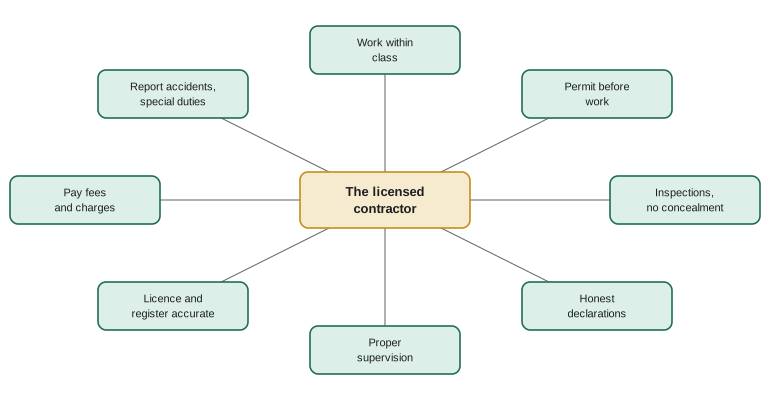
A contractor licence is a privilege with duties attached. Some of those duties are written into the Electrical Protection Act and Regulation; some come from the chief inspector's administration notes and bulletins; some come from the plain fact that the contractor's name is on the permit. This lesson gathers them in one place, explains what happens when they are not met, and shows how Rena turns them into habits at Tagish Lake Electric.
Duty 1: work within your class
Contractors are permitted only under the class they are licensed for. If Tagish Lake Electric is asked to do something outside its class, the right answers are to decline, to subcontract to a contractor whose class covers it, or to ask the chief inspector whether the class can be changed. Taking a permit for work outside the class is not an option.
Duty 2: permit before work
The permit comes first. The fee doubles if work starts before the permit, and work done without a permit may have to be opened up for inspection. Rena's rule for her crew is short: no permit number, no tools out of the truck. For emergency repairs, she phones the office first thing the next business day and applies, and she keeps a note of the time she started.
Duty 3: inspections and no concealment
Section 5(1) requires work to be inspected or approved at each stage that would become impractical to inspect later, and at completion. Section 5(7) prohibits concealing an installation until it is approved, permitted by declaration, or covered by an annual permit. On a busy site, the electrician is often the trade that holds up the drywall crew, and the pressure to cover early is real. The contractor's duty is to hold the line.
That duty includes making sure someone is on site to give the inspector access, as the administration notes require under section 9 of the Act, and that every inspection request is accompanied by a completed declaration form.
Duty 4: honest declarations
For contractors who hold declaration authority, a declaration is a statement to the government that the installation complies with the Code. The inspector may rely on it and let the work be covered without a visit. A false or careless declaration undermines the whole system that lets good contractors move quickly. Rena is a year away from declaration authority, but she writes a rule in her binder now: never declare work you have not personally checked or had checked by someone you trust and supervise.
Duty 5: supervise properly
The regulation sets supervision rules for limited classes, such as Class D's one helper per qualified person under continuous supervision (s.16(3)). Building Safety has also issued Bulletin 22-9, Unsupervised electrical work. We could not read its content while preparing this course, so we will not state its rules; read it, and confirm with the office what supervision it requires for apprentices and helpers.
Independently of any bulletin, apprenticeship rules govern what an apprentice may do and how closely they must be supervised. Kieran Pope, Rena's second-year apprentice, will always work under a qualified electrician. Rena plans crews so that no apprentice is ever alone on an energized installation.
| Crew member | Status | What Rena allows |
|---|---|---|
| Rena Charlie | Red Seal electrician, accredited representative | All work; signs declarations once eligible |
| Tomas Ruiz | Red Seal electrician from BC | All work under the company's permits |
| Kieran Pope | Second-year apprentice | Work under a qualified electrician only |
| Summer labourer | No trade status | Material handling and clean-up only |
Duty 6: keep the licence and register accurate
The licence holder must notify the chief inspector promptly of any change in accredited representative (s.4(5)); the class and licence number must appear in advertising (s.4(7)); and the licence must be renewed each year. Jonas keeps the company's legal name, address and contact details current with the office, because a notice sent to an old address is still a notice.
Duty 7: pay what the system charges
Permit fees, re-inspection charges and special inspection charges are part of the cost of doing business. Permits are not issued if the contractor's account is not in good standing (s.14), and the administration notes say unpaid re-inspection fees may lead to non-renewal. A contractor who disputes a charge should raise it with the office promptly, not ignore it.
Duty 8: report accidents and special installations
The administration notes say electrical accidents must be reported to the chief electrical inspector. They also set duties for particular work:
- Fire alarm work requires an electrical permit; the installer makes sure a building permit is in place, completes system verification and sends copies to the building inspector.
- Relocated or upgraded mobile homes need CSA certification, with approval and inspection reports for any changes to factory wiring.
- Day home inspections check smoke and CO alarms under the National Building Code, tamper-resistant receptacles, ground fault protection within 1.5 metres of sinks and for trace heaters, and that the system is in good repair; further visits for deficiencies need a new permit issued to a licensed contractor.
- Section 5(9) of the regulation requires each residence to have residential safety alarms under the Fire Safety Regulation, 2015.
When duties are not met
The system has several responses. The inspector can order corrections. Re-inspections are charged to the contractor. Work covered without approval can be ordered opened. The office can refuse new permits when the account is not in good standing. And the chief inspector can withdraw a contractor's privileges, such as declaration authority, or suspend a licence.
The Electrical Safety Standards Board, created under section 16 of the Act, hears appeals about the withdrawal of a contractor's privileges, the suspension of a contractor's licence, and the denial of permits to homeowners and unlicensed electricians. Its five members are appointed by Order-in-Council: two licensed electrical contractors, one electrical engineer and two qualified electricians. It is administered by Community Services and meets as needed.
The Act also creates offences. We could not confirm the current penalty amounts from an official source, so we do not state them. What matters for planning is that the consequences of ignoring duties start with time and money and can end with the licence.
Worked problem
A suspension appeal
An inspector finds that a contractor has repeatedly covered rough-in before approval and has declared work that did not comply. The chief inspector withdraws the contractor's declaration privileges and suspends its licence. The contractor believes the decision was too harsh. What can it do?
Show solution
- The Electrical Safety Standards Board hears appeals about withdrawn privileges and suspended licences (Act, s.16).
- The contractor should ask the office how to file an appeal and what time limit applies; we could not confirm the time limit, so it should ask immediately.
- While the licence is suspended, it cannot take new permits; it should tell its customers and arrange for another licensed contractor where jobs cannot wait.
- It should also fix the underlying problem: stop covering early and stop declaring work it has not checked.
Answer: Appeal to the Electrical Safety Standards Board, quickly, and fix the practices that caused the suspension.
Turning duties into habits
Rena's binder has a one-page checklist that every job folder starts with. Jonas prints it on yellow paper so it stands out.
job_checklist = [
    ("Permit number recorded before work starts", True),
    ("Class covers this work", True),
    ("Inspection requested 72 business hours ahead, with declaration form", True),
    ("Nothing covered before approval", True),
    ("Apprentice supervised by a qualified electrician", True),
    ("Final operational checks done (Bulletin 25-03)", False),
    ("Account in good standing", True),
]
open_items = [item for item, done in job_checklist if not done]
print(f"{len(job_checklist) - len(open_items)} of {len(job_checklist)} items done")
for item in open_items:
print("Still to do:", item)6 of 7 items done Still to do: Final operational checks done (Bulletin 25-03)
Bill says the checklist is not about distrust. It is about the fact that on a cold February day with a builder shouting about drywall, even good electricians forget things.
Duties to the customer
The regulation's duties run mostly to the government: permits, inspections, declarations, fees. A contractor also has duties to its customers, from the contract and from the general law. The most important is to do the work competently and to the Code as adopted in Yukon. Others follow from it: to explain what a permit is and why it is needed, to tell the customer when an inspection finds a problem, to fix that problem at the contractor's cost when the fault is the contractor's, and to hand over the final inspection approval when the job is done.
Customers in Yukon often do not know that electrical work needs a permit, or that work on a rental unit needs a contractor. Explaining this is part of the job. Rena's quote includes a short paragraph that says Tagish Lake Electric will take the permit, arrange the inspections and give the customer the final approval. It costs nothing to include and heads off the most common misunderstandings.
Duties to other trades
On a construction site, the electrician's schedule affects everyone. The duty not to conceal work before approval means other trades may have to wait. The best way to manage that is to tell the general contractor early when inspections are booked and what the earliest cover-up date is likely to be. A contractor that communicates the inspection schedule is a contractor general contractors want to hire again, even when the answer is that the drywall has to wait.
There is also a duty to the trades who come after: to label panels clearly, to leave circuit directories accurate, and to make sure that no one is exposed to energized conductors left in an unsafe state. A mislabelled breaker can injure an apprentice years later.
Duties that continue after the job
Some duties do not end when the final inspection passes. If a contractor later learns that an installation it did is unsafe, it should tell the owner and fix it. If an electrical accident happens at a site where it worked, it may need to answer questions from the chief electrical inspector or the WSCB. And for annual permits, the log of alterations is a continuing record that the holder must keep and produce on request. Rena's view is simple: the company's name is on the permit forever, so the company acts as if the work is always its own.
A culture of duty
Bill has seen two kinds of contractors in thirty years. The first treats duties as rules to get around. The second treats them as the way good work is done. The first kind spends its time arguing with inspectors and paying re-inspection fees. The second kind gets declaration authority, keeps it, and finds that inspectors trust its work. Rena wants Tagish Lake Electric to be the second kind, and she knows that the habit has to start in year one, when nobody is watching except the inspector.
She writes that habit into the company's onboarding: every new hire reads this list of duties on the first day, and signs that they have read it.
Common mistakes
MistakeLetting the drywall crew cover rough-in because the inspector is late.
InsteadConcealment without approval breaches s.5(7) and can lead to an order to open the work.
MistakeLeaving an apprentice alone on an energized installation.
InsteadApprentices work under a qualified electrician; read Bulletin 22-9 and the apprenticeship rules.
MistakeIgnoring a re-inspection charge you disagree with.
InsteadUnpaid charges can stop permits and renewal; raise disputes promptly with the office.
MistakeWaiting to appeal a suspension.
InsteadContact the office at once about appealing to the Electrical Safety Standards Board.
Summary and key terms
- Work within the licence class and take the permit before work starts.
- Have work inspected at each stage and never conceal it before approval.
- Make declarations honestly and supervise apprentices and helpers properly.
- Keep the register accurate, pay fees and charges, and report electrical accidents to the chief electrical inspector.
- The Electrical Safety Standards Board hears appeals about withdrawn privileges, suspended licences and refused permits.
- Withdrawal of privileges
- Removing a contractor privilege such as declaration authority.
- Suspension
- Temporary removal of the right to act under a licence.
- Electrical Safety Standards Board
- The five-member appeal board under s.16 of the Act.
- Residential safety alarms
- The alarms each residence must have under the Fire Safety Regulation, 2015 (s.5(9)).
- System verification
- The check of a fire alarm system after installation, with copies sent to the building inspector.
Practice problems
Work each problem on paper first, then reveal the answer to check.
Who sits on the Electrical Safety Standards Board?
Show answer
Two licensed electrical contractors, one electrical engineer and two qualified electricians.
A customer asks Tagish Lake Electric to install CCTV only. Its class covers general work. Any licensing concern?
Show answer
Confirm that its class covers the work; if it does, it may take the permit.
To whom must electrical accidents be reported?
Show answer
The chief electrical inspector.
Name two things a day home inspection checks.
Show answer
For example smoke and CO alarms, tamper-resistant receptacles, or ground fault protection within 1.5 metres of sinks.
Lesson quiz · 5 questions
Score 60% or more to complete this lesson.
Create a free account to save your progress, take quizzes and earn a certificate.