
MELC-211 · Lesson 3 of 12 · 19 min
Applying for an electrical contractor licence
▶ Video coming soon A video version of this lesson is on the way.
With the class chosen, Rena and Jonas turn to the application itself. This lesson covers what the regulation requires of every applicant, the practical documents to gather, the bond, the permit account, and the timing that keeps a new company from losing its first jobs to paperwork. It also covers what we could not confirm, so you know which questions to put to the office before you file.
What the regulation requires
Section 4 of the Electrical Protection Regulation sets the core requirements for a contractor licence.
| Requirement | Section | Notes |
|---|---|---|
| Apply to the chief inspector | 4(2) | Use the office's current application form |
| Name an accredited representative if the applicant lacks the qualifications | 4(4) | For a corporation, the qualified person the company relies on |
| Provide a bond of 1,000 dollars | 4(3) | Forfeitable to the Government of Yukon |
| Licence term of one year | 4(8) | Renewed each year |
| Class and licence number in advertising | 4(7) | Plan decals and the website before launch |
The bond is the one piece of security the regulation itself names. It is a small amount compared with bonds in some provinces, but it is still a condition of the licence, and the regulation makes it forfeitable to the territorial government. Lesson 8 discusses how bonds work and how they differ from insurance.
We could not find an official web page that lists the current licence fee or every document the office asks for. Rena phones Building Safety and asks three questions before she starts: what form to use, what the current fee is, and what proof of qualifications and experience the office wants for the class she has chosen.
The documents to gather
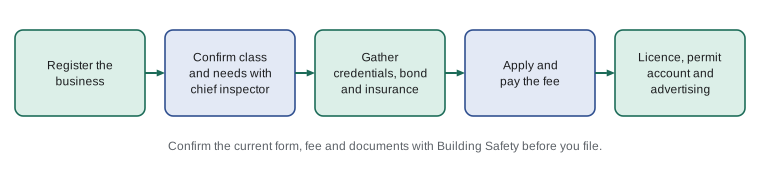
Whatever the form asks for, a sensible applicant gathers these in advance:
- Business registration. Tagish Lake Electric Ltd. is incorporated in Yukon, so Jonas has the certificate of incorporation and the registered office address. A sole proprietor or partnership would need its own business name registration where required.
- The accredited representative's credentials. Rena's certificate of qualification with Red Seal endorsement, and a record of her years in the trade with employer letters if asked.
- The bond. Arranged through an insurance broker or surety; the broker issues the bond document naming the Government of Yukon.
- Insurance certificates. Not named as a licensing condition in the regulation we read, but customers, general contractors and the City will ask. Lesson 8 covers this.
- Workers' compensation registration. If the company will have workers, it must register with the Workers' Safety and Compensation Board. Lesson 10 covers this.
- A municipal business licence where required. The City of Whitehorse licenses businesses operating within its boundaries; check its current rules.
The permit account
Section 14 of the regulation allows contractors to hold an account for paying permit fees. It also says permits are not issued if the account is not in good standing. For a busy contractor, an account saves time: the office can bill permits against it instead of taking payment each time.
The flip side is that an unpaid account stops new permits. The office's administration notes add that unpaid re-inspection fees may lead to a licence not being renewed. Jonas sets up a monthly reconciliation: every permit issued, every re-inspection charge, every payment. He is the person in the company who keeps the account in good standing, even though Rena is the accredited representative.
Timing
The licence runs for one year (s.4(8)). The office's notes say licences must be renewed each year and that no new permits are issued until renewal. That has two consequences for a new company.
- Apply well before the first job. A customer who signs in February expects work to start when the snow allows. If the licence is not issued, no permit can be taken, and the job waits.
- Diarize the renewal date from day one. A lapse stops permits on every job in the company, not just new ones that day.
We could not confirm a published processing time. Rena allows several weeks, and she tells her first customers that the start date depends on the licence.
from datetime import date, timedelta

issued = date(2027, 2, 15)          # example issue date
expires = issued.replace(year=issued.year + 1) - timedelta(days=1)
reminders = [expires - timedelta(days=d) for d in (60, 30, 10)]

print("Licence issued:", issued)
print("Planning expiry (one-year term):", expires)
for r in reminders:
print("Renewal reminder:", r, "-", (expires - r).days, "days before expiry")Licence issued: 2027-02-15 Planning expiry (one-year term): 2028-02-14 Renewal reminder: 2027-12-16 - 60 days before expiry Renewal reminder: 2028-01-15 - 30 days before expiry Renewal reminder: 2028-02-04 - 10 days before expiry
The expiry date above is a planning date based on a one-year term from issue. The licence document shows the actual expiry; use that.
Sole proprietor, partnership or corporation
The regulation speaks of applicants and licence holders without forcing a business form. The choice matters for liability, tax and succession, and MELC-106 covers it in depth. For licensing, the key point is the accredited representative: a sole proprietor who is a qualified electrician may hold the licence on their own qualifications, while a partnership or corporation will name a qualified person.
| Business form | Who supports the licence | Licensing point to watch |
|---|---|---|
| Sole proprietor | The owner, if qualified | If the owner is unavailable, the business has no back-up |
| Partnership | A qualified partner or employee | Partnership changes may need notice |
| Corporation | A named accredited representative | Notify the chief inspector of any change in representative |
A worked example: the sale of a business
Worked problem
Buying an existing contractor
Rena hears that a small contractor in Dawson City is for sale, with a truck, tools and a customer list. The owner says his licence goes with the business. Is that right?
Show solution
- A licence is issued to the licence holder after the chief inspector reviews the application, including the accredited representative.
- If the business is sold as assets, the buyer is a different legal person and needs its own licence.
- If the corporation itself is sold as shares, the licence holder stays the same, but its accredited representative will change when the owner leaves, and the chief inspector must be told (s.4(5) and (6)).
- Either way, the buyer should contact the chief inspector before closing.
Answer: Do not assume a licence transfers with a business. Confirm with the chief inspector before buying.
Rena decides the Dawson City business is not for her this year, but she files the lesson: in a small market, someone will offer her a business again.
A checklist before you file
| Item | Done? |
|---|---|
| Class confirmed with the chief inspector for the planned work | |
| Current application form and fee confirmed | |
| Business registered; registered office address ready | |
| Accredited representative named, with certificate and experience records | |
| 1,000 dollar bond arranged with a surety | |
| Liability insurance quote in hand | |
| Workers' compensation registration if hiring | |
| City business licence if operating in Whitehorse | |
| Truck decal and website ready to show class and licence number |
What Jonas does while Rena waits
While the application is with the office, Jonas builds the paperwork the company will need every week: a permit log listing each permit number, address, value and fee; an inspection log with request dates and results; a filing system for declarations and inspection reports; and a simple quote template that adds the permit fee and, for remote jobs, a line for inspection travel. None of this is required by the regulation in that form, but every item in it is something the office or a customer will ask about sooner or later.
He also opens a folder for the bond and the insurance certificates, with renewal dates on the cover. Bill laughs when he sees it. In thirty years, he says, the thing that most often stopped his jobs was not the Code. It was an expired certificate nobody had noticed.
Talking to the office before you file
Yukon's Building Safety branch is small, and the people who answer the phone are often the people who will review your file. A short, organized call before you file is worth more than a long application that misses something. Rena prepares for the call the way she would prepare for a site meeting. She has her certificate number ready, a one-paragraph description of the work Tagish Lake Electric will do, the business name exactly as registered, and a list of questions written down so she does not forget any.
She asks what class fits the planned work, what proof of qualifications and experience the office wants, what the current fee is and how to pay it, how the bond must be worded, how long processing usually takes in the spring, and whether the office will set up a permit account at the same time. She writes the answers down with the date and the name of the person she spoke to. If an answer later turns out to be different, she has a record of what she was told.
Changes after the licence is issued
A licence describes a business at a moment in time. Businesses change: they move, add partners, change their names, or hire and lose qualifying electricians. Sections 4(5) and 4(6) of the regulation require notice of certain changes, including a change in accredited representative. Beyond what the regulation requires, it is good practice to tell the office about any change that affects the details on the licence or the register, such as a new legal name, a new address or a new phone number. A notice sent to the wrong address is still a notice.
Jonas keeps a change log in the licence folder. Each entry records what changed, when, and when the office was told. At renewal time he reads it from the top, so nothing is missed. Bill thinks this is overkill for a three-person company. Rena reminds him that he once told her the thing that stopped his jobs most often was not the Code, but paperwork nobody had noticed.
If the application is refused or delayed
If the office refuses or delays an application, the first step is to ask why, in writing if possible. Most problems are fixable: a missing document, a bond in the wrong wording, a class that does not match the planned work. Where the problem is the qualifications of the accredited representative, the company may need to name someone else. Where a contractor believes a decision about its licence was wrong, Lesson 7 explains the role of the Electrical Safety Standards Board, which hears appeals about suspended licences and withdrawn privileges.
Bill's last word on applications is about tone. The office sees many files, and the ones that move quickly are complete, legible and consistent: the same business name on every document, the same address, the same certificate number. Jonas reads the whole package aloud once before it goes in, which sounds old-fashioned but catches the typos that a quick scan misses.
Common mistakes
MistakeStarting work on a signed contract before the licence is issued.
InsteadNo licence means no permit; plan start dates around the licence.
MistakeAssuming a licence transfers when a business is bought.
InsteadConfirm with the chief inspector; an asset buyer needs its own licence, and a share sale still changes the accredited representative.
MistakeLetting the permit account fall behind.
InsteadPermits are not issued if the account is not in good standing (s.14), and unpaid re-inspection fees may block renewal.
MistakeRelying on an old fee or form from a colleague.
InsteadConfirm the current form, fee and documents with Building Safety before you file.
Summary and key terms
- Applications go to the chief inspector (s.4(2)), with an accredited representative if needed (s.4(4)).
- The regulation requires a 1,000 dollar bond forfeitable to the Government of Yukon (s.4(3)).
- Licences run for one year (s.4(8)) and must be renewed before new permits are issued.
- A permit account must be in good standing for permits to issue (s.14).
- Confirm the current form, fee and documents with the office; we found no published fee or processing time.
- Bond
- A surety document guaranteeing an amount to the Government of Yukon if the contractor fails its obligations; 1,000 dollars under s.4(3).
- Permit account
- An account with the office for paying permit fees; permits stop if it is not in good standing.
- Licence term
- One year under s.4(8).
- Asset sale
- A sale of a business where the buyer acquires assets but not the seller's legal identity or licence.
- Share sale
- A sale of the shares of a corporation, which keeps the same legal entity.
Practice problems
Work each problem on paper first, then reveal the answer to check.
What bond amount does the regulation require for a contractor licence?
Show answer
1,000 dollars, forfeitable to the Government of Yukon (s.4(3)).
A contractor's permit account is two months overdue. What happens to new permit applications?
Show answer
Permits are not issued while the account is not in good standing (s.14).
A licence was issued on May 3, 2027. Using a one-year term, what is the planning expiry date?
Show answer
May 2, 2028; confirm against the date on the licence.
Name two documents an applicant should gather besides the application form.
Show answer
For example, the accredited representative's certificate of qualification and the bond.
Lesson quiz · 5 questions
Score 60% or more to complete this lesson.
Create a free account to save your progress, take quizzes and earn a certificate.