
MELC-210 · Lesson 9 of 12 · 20 min
Contracts and mechanics' liens in Newfoundland and Labrador
▶ Video coming soon A video version of this lesson is on the way.
Every electrical job is a contract, whether it is a one-page quote for a heat pump circuit or a hundred-page subcontract for a school. And on most construction work, one statute stands behind the contract to protect people who improve land and do not get paid: the Mechanics' Lien Act, RSNL 1990, chapter M-3. Newfoundland and Labrador still uses the older name; most other provinces now call these builders' liens or construction liens. This lesson covers the contract basics a contractor needs, the holdback the Act requires, how to register and enforce a lien, the short deadlines, and the current status of prompt payment reform in the province.
Lien law is technical and its deadlines are unforgiving. This lesson explains the framework so that a contractor recognizes when to act. It is not legal advice. When a lien is in play, talk to a lawyer early, because a lien that is registered or enforced a day late is simply lost.
Contract basics
A contract does not have to be long to be good. It does need to say clearly what will be done, for what price, by when, and what happens when things change. Leonard's checklist for every contract, from a service call to a commercial subcontract, has six items.
- Scope. What work is included and, just as important, what is excluded: patching and painting, permits, fixtures supplied by the customer, utility charges.
- Price and payment. A fixed price, unit rates or time and materials; the payment schedule; any deposit; and how holdback will be handled.
- Schedule. Start and completion dates, and what happens if the site is not ready.
- Changes. How extra work is requested, priced and approved in writing before it is done.
- Standards. That work will meet the Canadian Electrical Code as adopted and will be done under permit and inspected.
- Warranty and disputes. What the contractor warrants, for how long, and how disagreements will be handled.
Krista builds a one-page standard quote for small residential jobs and a set of standard qualifications she attaches to every commercial bid. The qualifications list her assumptions: the service size, who supplies fixtures, the number of inspections included, and that changes will be priced and approved in writing.
Worked problem
A change order done right
Halfway through a basement renovation, the homeowner asks Krista to add a hot tub circuit and a subpanel in the garage. How should she handle it?
Show solution
- Stop and price the change before doing it: labour, materials, the extra permit work and any added inspection.
- Write a change order describing the work, the price and any effect on the schedule.
- Get the homeowner's signature, or written approval by email, before starting the extra work.
- Check whether the permit covers the change or the Government Service Centre needs to be told about the added scope (Lesson 6).
Answer: Price it, write it, get written approval, and update the permit if needed, all before doing the extra work.
What a lien is
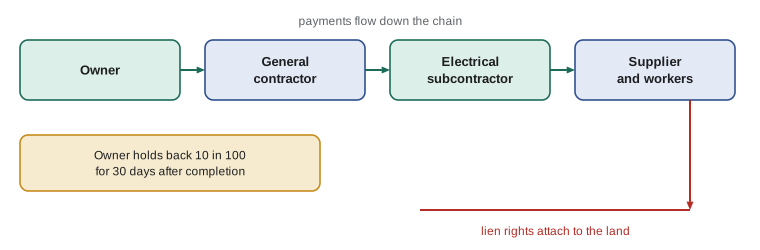
A mechanics' lien gives a contractor, subcontractor, supplier or worker who has done work or supplied materials to improve land a claim against that land for the unpaid amount. It is security: if the lien is properly registered and enforced, the land can be sold by court order to pay it. Because a lien attaches to the owner's land even when the owner has paid the general contractor, the Act also requires the owner to hold back part of every payment, so that money is available for those further down the chain.
The holdback
Section 12(1) of the Act requires the person primarily liable on a contract, usually the owner, to retain 10 in every 100 dollars of the value of the work and materials, for 30 days after the work is completed or abandoned. Payments made in good faith up to the remaining 90 in every 100, before the owner receives written notice of a lien, discharge the lien to that extent (section 12(6)). After the 30-day period, the owner may pay out the holdback unless proceedings to enforce a lien have started (section 12(7)).
For a subcontractor like Walsh Electrical, the holdback means two things. First, cash will arrive later: on a 100,000 dollar subcontract, 10,000 dollars will not be paid until at least 30 days after completion. Second, the holdback is what protects Walsh Electrical's own lien rights if the general contractor fails to pay.
# Holdback on progress payments under the Mechanics' Lien Act (10 in 100).
HOLDBACK = 0.10
progress = [18_000, 32_000, 27_000, 23_000]   # value of work certified each month, illustrative
total_paid = total_held = 0
for month, value in enumerate(progress, 1):
    held = value * HOLDBACK
    total_paid += value - held
    total_held += held
    print(f"month {month}: work {value:7,d}  paid {value - held:9,.0f}  held {held:7,.0f}")
print(f"held back until 30 days after completion: {total_held:,.0f} dollars")month 1: work 18,000 paid 16,200 held 1,800 month 2: work 32,000 paid 28,800 held 3,200 month 3: work 27,000 paid 24,300 held 2,700 month 4: work 23,000 paid 20,700 held 2,300 held back until 30 days after completion: 10,000 dollars
What completion means
Many deadlines in the Act run from completion. Section 2(1)(a.1) defines completion of the contract as substantial performance, not necessarily total performance. Section 2(2) says a contract is substantially performed when the work, or a substantial part of it, is ready for use or is being used for its intended purpose, and the cost of completing or correcting the remaining work is no more than 3 in 100 of the first 250,000 dollars of the contract price, 2 in 100 of the next 250,000 dollars, and 1 in 100 of the balance.
Worked problem
Is the strip mall substantially performed?
The electrical subcontract for the Clarenville strip mall is 620,000 dollars. The units are in use, and the remaining deficiencies would cost about 11,500 dollars to correct. Has the subcontract been substantially performed?
Show solution
- First 250,000 dollars at 3 in 100: 7,500 dollars.
- Next 250,000 dollars at 2 in 100: 5,000 dollars.
- Balance of 120,000 dollars at 1 in 100: 1,200 dollars.
- Threshold: 7,500 + 5,000 + 1,200 = 13,700 dollars. The remaining work, about 11,500 dollars, is below it, and the work is in use.
Answer: Yes. The remaining work costs less than the 13,700 dollar threshold and the units are in use, so the contract appears substantially performed, which starts the 30-day clocks.
# Substantial performance threshold under s. 2(2) of the Mechanics' Lien Act.
def threshold(price):
    first = min(price, 250_000) * 0.03
    second = min(max(price - 250_000, 0), 250_000) * 0.02
    rest = max(price - 500_000, 0) * 0.01
    return first + second + rest

for price in (90_000, 300_000, 620_000):
print(f"contract {price:8,d}: remaining work must cost no more than {threshold(price):9,.0f}")contract 90,000: remaining work must cost no more than 2,700 contract 300,000: remaining work must cost no more than 8,500 contract 620,000: remaining work must cost no more than 13,700
Registering a lien
Section 22 sets the registration deadlines, and they are short.
- A contractor or subcontractor may register a claim of lien before or during the contract, or within 30 days after the contract is completed or abandoned (section 22(1)).
- A supplier of materials, within 30 days after the last materials are placed or furnished (section 22(2)).
- A person supplying services, within 30 days after the service is completed (section 22(3)).
- A worker claiming wages, within 30 days after the last work was done (section 22(4)).
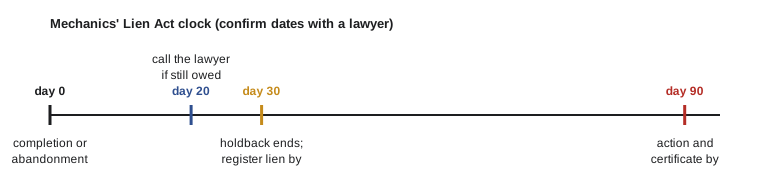
An unregistered lien ends when the registration period expires (section 23(1)). Thirty days passes quickly, especially when a general contractor is promising that payment is coming next week. Leonard's rule was to diarize the 30-day date for every job on the day of substantial performance and to call a lawyer no later than day 20 if money was still owing.
Enforcing a lien
Registration alone does not keep a lien alive. Section 24(1), read with section 23, provides that a registered lien ceases to exist 90 days after the work is completed or the materials are placed, unless within that time an action is started to enforce it and a certificate of the action is registered. Once an action is started, the statement of claim must be served within 30 days after it is filed (section 30(3)).
| Step | Deadline under the Act | Section |
|---|---|---|
| Owner keeps holdback | 30 days after completion or abandonment | 12(1) |
| Contractor or subcontractor registers claim of lien | Within 30 days after completion or abandonment | 22(1) |
| Worker registers wage lien | Within 30 days after last work | 22(4) |
| Start action and register certificate of action | Within 90 days after completion | 24(1) |
| Serve statement of claim | Within 30 days after filing | 30(3) |
# Diarize lien dates from a substantial performance date.
from datetime import date, timedelta

completed = date(2027, 3, 12)    # illustrative
print("holdback period ends:      ", completed + timedelta(days=30))
print("last day to register lien: ", completed + timedelta(days=30))
print("action + certificate by:   ", completed + timedelta(days=90))
print("call the lawyer no later than", completed + timedelta(days=20))holdback period ends: 2027-04-11 last day to register lien: 2027-04-11 action + certificate by: 2027-06-10 call the lawyer no later than 2027-04-01
Workers' wages
The Act gives workers special protection. Section 16(1) gives a worker's lien for wages priority over other liens arising from the same contractor or subcontractor, up to 30 days' wages, drawn from the holdback. Section 16(2) lets a worker enforce a lien on an incomplete contract by a notice of motion returnable in four days. Section 3 makes agreements that waive the Act's protection for workers void, with limited exceptions. For a contractor, the practical lesson is simple: pay wages on time, every time. A crew that is not paid has strong, fast remedies.
Prompt payment and adjudication
Several provinces, including Ontario, Saskatchewan, Nova Scotia and Manitoba, have passed prompt payment legislation that sets deadlines for paying proper invoices down the construction chain, often with fast-track adjudication of disputes. Newfoundland and Labrador has consulted on prompt payment and on modernizing the Mechanics' Lien Act. A national law firm's September 2025 review reported that the consultation had received extensive industry support, and a What We Heard report on the Act was released in August 2024, but we could not find prompt payment legislation in force in the province when this course was prepared. Watch for changes, because a new statute could change both payment timing and the lien deadlines in this lesson.
Protecting yourself in practice
- Know the owner. Before starting work, find out who owns the land; the lien attaches to the land, not to the general contractor.
- Keep records. Delivery slips, timesheets, daily reports and change orders prove the value and timing of the work.
- Bill on time. Late invoices make it harder to show what was owing when.
- Diarize completion. Note the substantial performance date and the 30-day and 90-day dates for every job.
- Act early. If payment is late, get legal advice well before the 30-day registration deadline.
Common mistakes
MistakeWaiting for the general contractor's promise of payment until day 35.
InsteadA contractor's lien must be registered within 30 days after completion or abandonment, or it is lost.
MistakeRegistering a lien and then doing nothing.
InsteadA registered lien ceases 90 days after completion unless an action is started and a certificate of action registered.
MistakeCalling these builders' liens and looking for a Builders' Lien Act.
InsteadNewfoundland and Labrador's statute is the Mechanics' Lien Act, RSNL 1990, c M-3.
MistakeAssuming prompt payment deadlines apply as in Ontario.
InsteadWe could not find prompt payment legislation in force in the province; confirm the current law.
Summary and key terms
- Every job needs a clear contract covering scope, price, schedule, changes, standards and warranty.
- The Mechanics' Lien Act requires the owner to hold back 10 in 100 of the value of work for 30 days after completion or abandonment (s. 12(1)).
- Completion means substantial performance, tested against a 3, 2 and 1 in 100 scale on the contract price (s. 2(2)).
- Contractors and subcontractors must register a lien within 30 days after completion (s. 22(1)), and start an action with a certificate of action within 90 days (s. 24(1)).
- Workers' wage liens have priority up to 30 days' wages from the holdback (s. 16); prompt payment legislation was not found in force.
- Mechanics' lien
- A claim against land for unpaid work or materials that improved it.
- Holdback
- The 10 in 100 the owner must retain for 30 days after completion.
- Substantial performance
- Completion under the Act, when work is ready for use and remaining work falls below the statutory threshold.
- Claim of lien
- The document registered to preserve a lien.
- Certificate of action
- The certificate registered to show an action to enforce a lien has been started.
- Prompt payment
- Legislation setting deadlines for paying proper invoices down the construction chain.
Practice problems
Work each problem on paper first, then reveal the answer to check.
How much must the owner hold back under section 12(1), and for how long?
Show answer
10 in 100 of the value of the work and materials, for 30 days after completion or abandonment.
Within what time must a subcontractor register a claim of lien?
Show answer
Within 30 days after the contract is completed or abandoned (s. 22(1)).
What is the substantial performance threshold for a 300,000 dollar contract?
Show answer
7,500 + 1,000 = 8,500 dollars.
What happens to a registered lien if no action is started within 90 days of completion?
Show answer
It ceases to exist, under section 24(1).
Lesson quiz · 5 questions
Score 60% or more to complete this lesson.
Create a free account to save your progress, take quizzes and earn a certificate.