
MELC-210 · Lesson 3 of 12 · 19 min
The Electrical Contractor's Registration Certificate
▶ Video coming soon A video version of this lesson is on the way.
In Newfoundland and Labrador the Electrical Contractor's Registration Certificate does the job that a contractor licence does in other provinces. It is the document that lets a business be issued electrical permits, advertise electrical contracting and, if it is designated, certify its own work through a contractor representative. This lesson explains what the certificate is, the three classes the Electrical Regulations create, who qualifies for each, and what the registration does and does not prove.
The rules sit in section 6 of the Electrical Regulations (NLR 120/96). They are short, and every word matters. A contractor who knows exactly what section 6 says can answer most questions about registration without phoning anyone, and knows exactly what to tell the Chief Electrical Inspector when the business changes.
What the certificate does
The government's electrical licensing page states the core rule: an electrical permit may only be issued to a person who is the holder of an Electrical Contractor's Registration Certificate. Registered contractors may also apply for permits online through the province's electrical portal using their contractor registration number. The registration therefore sits in front of almost everything a contractor does.
- Permits. Only a registered contractor may be issued an electrical permit for contracting work. The narrow exceptions, such as a certified journeyperson working on their own property, are covered in Lesson 6.
- Advertising. Section 4(3) of the regulations allows only registered contractors to advertise electrical contracting, and requires the registered name and registration number to appear in the advertisement.
- Self-certification. A registered contractor that has a representative designated under section 7 may certify all or part of its own installations, subject to audit. That designation appears on the registration certificate itself. Lesson 7 explains the program.
- Public listing. The government publishes a list of active registered electrical contractors. Customers, general contractors and inspectors use it to check that a business is registered.
Krista checks the published list on the day she starts planning. It runs to many pages, with names she knows from Harbour Arm and from trade school. She wants Walsh Electrical Ltd. on it before her first quote goes out.
The three classes
Section 6 creates three classes of registration. Each is defined by the electrical certificate held by the applicant or by someone the applicant employs.
- Restricted. Section 6(1) allows a restricted registration for an individual who holds an electrical certificate and is not barred, or for a company that employs a holder of an electrical certificate. This is the entry class: a newly certified journeyperson, or a company employing one, qualifies.
- Unrestricted. Section 6(2) allows an unrestricted registration for an individual who holds an electrical certificate and has at least two years of experience as its holder, or for a company that employs such a person. The two-year threshold is measured from the original date of issue on the qualifying certificate.
- Residential. Section 6(3) allows a residential registration for holders of a valid registration in an older residential category under the 1994 rules, or for holders of a certificate of qualification that the Chief Electrical Inspector accepts. In practice this class serves contractors whose qualification is limited to residential work.
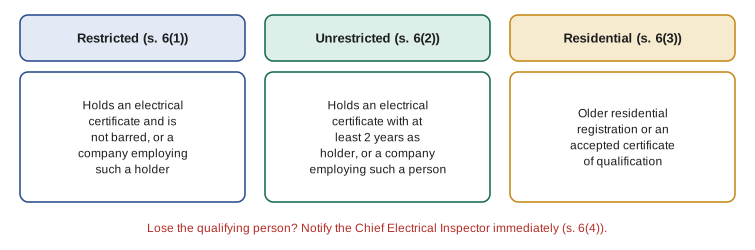
The regulations do not spell out, in section 6, every limit on what each class may do. Restrictions are written on the certificate itself, and the Chief Electrical Inspector decides how each class applies. Leonard's advice is simple: read your certificate, and if a job looks like it might fall outside it, ask the Government Service Centre before you quote, not after you have started.
| Class | Who qualifies (s. 6) | Typical use |
|---|---|---|
| Restricted | Holder of an electrical certificate, not barred, or a company employing one | A newly certified journeyperson starting out |
| Unrestricted | Holder with at least two years as holder, or a company employing one | An established contractor doing a full range of work |
| Residential | Older residential registration, or an accepted certificate of qualification | Contractors qualified for residential work only |
Individuals and companies
Each class can be held either by an individual or by a company. That choice has real consequences.
When an individual is registered, the registration rests on that individual's own electrical certificate. If Krista registered as a sole proprietor, the registration would follow her personally. When a company is registered, the registration rests on the company's employment of a qualifying certificate holder. Walsh Electrical Ltd. will be registered on the strength of employing Krista, and the company itself becomes the registered contractor.
The company route brings a duty that catches many businesses by surprise. Section 6(4) requires a company to notify the Chief Electrical Inspector immediately if it stops meeting the employment requirement, for example because its only qualifying journeyperson has left. The company cannot quietly keep taking permits while it looks for a replacement.
Worked problem
When the qualifying journeyperson leaves
Two years from now, Walsh Electrical has grown. Krista is still the qualifying person on the registration, but she plans a six-month maternity leave. Derek, who has held his certificate for more than two years, will run the crews. What should the company do?
Show solution
- The registration rests on the company employing a holder of an electrical certificate. Krista on leave is still an employee, but she will not be available to supervise or answer for the work.
- Derek also meets the requirements for the unrestricted class, so the company can still meet the employment requirement through him.
- The safest step is to contact Government Services before the leave starts, explain the arrangement and, if asked, update the registration to show Derek as the qualifying person.
- If no qualifying person were employed at all, section 6(4) would require the company to notify the Chief Electrical Inspector immediately.
Answer: The company keeps meeting the employment requirement through Derek, and should tell Government Services about the change before it happens.
What registration proves, and what it does not
A registration certificate proves that the business is entitled to be issued electrical permits and to advertise electrical contracting, and that it has a qualifying certificate holder behind it. It does not prove much else.
- It does not prove insurance. The provincial registration page does not mention insurance or a bond. Customers, general contractors and lenders usually require proof of liability insurance, and Lesson 8 covers what to carry.
- It does not prove good workmanship. Every installation still needs a permit and is still inspected, or certified by a designated representative and audited.
- It does not prove WorkplaceNL coverage. Registration with WorkplaceNL is a separate obligation for any business with workers, covered in Lesson 10.
- It does not replace municipal or business requirements. Business names, corporate registration, tax accounts and municipal business permits are all separate.
Krista's first large customer, a general contractor building a strip mall in Clarenville, asks her for four things before awarding the electrical subcontract: her registration number, a certificate of insurance, a WorkplaceNL clearance letter and a list of staff with their certificates. Only the first comes from the Electrical Regulations.
Fees and additional registrations
The province publishes the fees. An Electrical Contractor's Registration Certificate costs 200 dollars per year for one registration, and 60 dollars per year for each additional registration. HST does not apply. Fees can change, so check the current figure on the government's page before applying.
Additional registrations matter for larger businesses and for related companies. A contractor that operates under more than one registration, for example two related companies or separate registrations for different classes of work, pays the lower fee for each one beyond the first. A small business like Walsh Electrical will start with one.
# Annual registration fees under the published schedule (check current fees).
FIRST = 200       # dollars per year, first registration
ADDITIONAL = 60   # dollars per year, each additional registration

def annual_fee(registrations):
    if registrations < 1:
        return 0
    return FIRST + ADDITIONAL * (registrations - 1)

for n in (1, 2, 3, 5):
print(f"{n} registration(s): {annual_fee(n):4d} dollars per year")1 registration(s): 200 dollars per year 2 registration(s): 260 dollars per year 3 registration(s): 320 dollars per year 5 registration(s): 440 dollars per year
Barred applicants and the not-barred condition
Section 6(1) includes a short phrase with a long reach: the individual must hold an electrical certificate and not be barred. A person whose certificate has been suspended or cancelled, or who has been disqualified under the regulations, cannot use that certificate to qualify a business while the bar is in place. Lesson 11 covers the Chief Electrical Inspector's powers to suspend and cancel certificates, and the one-year disqualification of a representative under section 13.
For a contractor hiring a qualifying person, the lesson is to check. A certificate that looks valid on paper may be subject to a suspension the employer does not know about. Asking Government Services to confirm a person's standing before relying on their certificate is a simple precaution.
A registration plan for Walsh Electrical
Krista and Leonard work out the plan together. The company will apply for an unrestricted registration, because Krista has held her certificate for seven years and the company wants to quote commercial work as well as houses. Krista will be the qualifying person. Derek's certificate will be on file as a backup. The company will not advertise, print truck lettering or post on social media until the registration number arrives, and every advertisement after that will show the registered name and number.
| Step | Who | Done when |
|---|---|---|
| Incorporate Walsh Electrical Ltd. | Mark and the company lawyer | Certificate of incorporation received |
| Gather certificate copies (original issue date shown) | Krista | Copies scanned and filed |
| Apply for an unrestricted Electrical Contractor's Registration Certificate | Krista | Application and fee submitted |
| Receive the registration number | Government Services | Certificate in hand |
| Add the number to the truck, website and quotes | Mark | All advertising shows name and number |
Choosing the right class for your business
The class of registration is a business decision as well as a legal one. A company that plans to do only houses may be tempted by a narrower class, but the market has a way of offering the job just outside the line: the small commercial fit-up, the church hall, the fish plant maintenance contract. Turning that work down, or worse, taking it on the wrong class, costs more than registering in the right class from the start.
Krista's reasoning is typical. She has held her certificate for seven years, so she meets the unrestricted threshold in section 6(2) comfortably. The Clarenville strip mall subcontract is commercial work, and Leonard has warned her that much of the steady money in the region is in commercial service and maintenance. An unrestricted registration lets the company quote all of it.
The class also shapes the company's staffing risk. A registration rests on a qualifying person, and a business registered on one person's certificate is only as secure as that person's health and loyalty. Before applying, list who in the business could qualify it, and how long each has held their certificate. If the answer is one name, write a contingency plan, and revisit it every time someone joins or leaves.
Finally, keep the class in view when advertising. A truck lettered with promises of industrial work, or a website offering services the class does not allow, invites questions under section 4(3) that a careful contractor never needs to answer.
Common mistakes
MistakeTreating the registration as proof of insurance.
InsteadThe registration rules do not cover insurance; customers and general contractors require it separately.
MistakeContinuing to take permits after the only qualifying journeyperson leaves the company.
InsteadSection 6(4) requires the company to notify the Chief Electrical Inspector immediately.
MistakeApplying for the unrestricted class on a certificate held for eighteen months.
InsteadThe unrestricted class needs at least two years as the holder of an electrical certificate.
MistakePrinting truck lettering before the registration number arrives.
InsteadOnly registered contractors may advertise, and ads must show the registered name and number.
Summary and key terms
- The Electrical Contractor's Registration Certificate is required before a business can be issued electrical permits.
- Section 6 creates restricted, unrestricted and residential classes, each based on an electrical certificate held by the applicant or an employee.
- The unrestricted class requires at least two years as the holder of an electrical certificate.
- A registered company must notify the Chief Electrical Inspector immediately if it stops employing a qualifying certificate holder (s. 6(4)).
- Registration costs 200 dollars per year, plus 60 dollars per additional registration, with no HST; it does not prove insurance or WorkplaceNL coverage.
- Restricted registration
- The class available to a holder of an electrical certificate, or a company employing one.
- Unrestricted registration
- The class requiring at least two years as the holder of an electrical certificate.
- Residential registration
- The class for older residential registrations and accepted certificates limited to residential work.
- Qualifying person
- The certificate holder whose qualification supports a company's registration.
- Barred
- Prevented, for example by suspension or disqualification, from relying on a certificate.
- Additional registration
- A further registration held by the same contractor, charged at the lower annual fee.
Practice problems
Work each problem on paper first, then reveal the answer to check.
Which section of the Electrical Regulations creates the three registration classes?
Show answer
Section 6.
What does a registered company have to do if its only qualifying journeyperson quits?
Show answer
Notify the Chief Electrical Inspector immediately, under section 6(4).
What is the published annual fee for three registrations held by one contractor?
Show answer
200 + 60 + 60 = 320 dollars per year.
A general contractor asks for proof of insurance. Does the registration certificate prove it?
Show answer
No. Insurance is a separate requirement, usually set by contract.
Lesson quiz · 5 questions
Score 60% or more to complete this lesson.
Create a free account to save your progress, take quizzes and earn a certificate.