
MELC-210 · Lesson 10 of 12 · 18 min
Occupational health and safety law for electrical contractors
▶ Video coming soon A video version of this lesson is on the way.
Electrical contracting is one of the trades where a single mistake can kill. The Code protects the people who will use an installation; occupational health and safety law protects the people who build it. In Newfoundland and Labrador that law is the Occupational Health and Safety Act and its regulations, enforced by the OHS Division of Digital Government and Service NL, together with the workers compensation system run by WorkplaceNL under the Workplace Health, Safety and Compensation Act. This lesson covers the employer's duties, safety committees and representatives, the reporting deadlines, electrical hazard control, and workers compensation.
The thresholds and deadlines below were checked against WorkplaceNL's OHS guide and reporting pages in late 2026. Safety law changes, and the regulations contain far more detail than one lesson can cover. Read the current Act and regulations, and use WorkplaceNL's guidance, when building your own safety program.
The employer's general duty
Like every Canadian safety statute, the Occupational Health and Safety Act places a general duty on employers to ensure, so far as reasonably practicable, the health, safety and welfare of their workers. Workers, supervisors, contractors and suppliers have duties too. For a small electrical contractor, the general duty turns into concrete obligations: safe work procedures, training, supervision, proper tools and personal protective equipment, and a way for workers to raise concerns.
Leonard's company never had a serious injury in thirty-four years. He put it down to three habits: every job started with a five-minute hazard talk, every circuit was treated as live until he had personally tested it dead, and anyone could stop the job without having to justify it. Krista adopts all three, and writes them into the company's safety manual on day one.
Committees, representatives and designates
The Act sets up worker participation in safety, scaled to the size of the workplace.
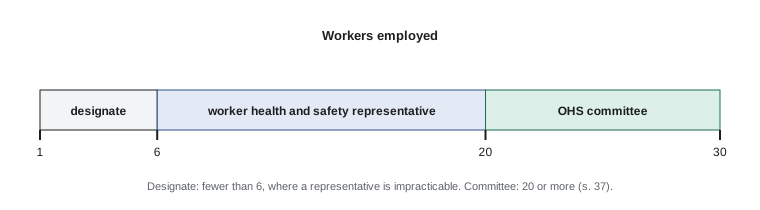
- Where 20 or more workers are employed, an occupational health and safety committee is required (section 37). It has between 2 and 12 members, at least half of whom must be workers not connected with management, and it meets at least once every three months during regular working hours.
- Where fewer than 20 workers are employed, a worker health and safety representative is required (section 41).
- Where fewer than six persons are engaged and a representative is impracticable, a designate may be appointed instead (section 42).
| Workers employed | Worker participation required |
|---|---|
| 20 or more | OHS committee, 2 to 12 members, at least half workers, meeting every 3 months |
| Fewer than 20 | Worker health and safety representative |
| Fewer than 6, where a representative is impracticable | A designate may be appointed |
Walsh Electrical starts with four people: Krista, Derek, Jordan and Mark. Krista asks Derek to act as the company's worker representative, gives him time each month for the role, and pays for his training. When the company grows past 20 workers, it will need a committee.
Reporting to the OHS Division
The reporting rules are strict, and the first one is immediate.
- An accident that causes serious injury or death, or that had reasonable potential to do so, must be reported to the OHS Division immediately by phone (Act section 54(1)). WorkplaceNL's guide lists the Division's 24-hour line as 709-729-4444.
- The committee, worker representative or designate must also be told immediately (section 54(2)).
- A written report of a serious injury is due to the OHS Division within 3 days (regulations section 10(2)).
- A fatality is reported by phone immediately, with a written follow-up within 5 days (regulations section 10(3)).
- If the Division does not investigate, the employer must investigate with the committee or representative and send the report (regulations section 10(5)).
- Damage to utilities must be reported to the utility owner without delay (regulations section 11). For an electrical contractor who hits a buried cable or damages an overhead line, this is a routine but important duty.
The scene of a serious accident should be left undisturbed, except to rescue people or prevent further harm, until an OHS officer allows otherwise. Krista prints the 24-hour number on a card in every truck, next to the utility emergency numbers.
| Event | Who to tell | When |
|---|---|---|
| Serious injury or death, or an accident with reasonable potential for it | OHS Division by phone; committee, representative or designate | Immediately |
| Serious injury | OHS Division, in writing | Within 3 days |
| Fatality | OHS Division, written follow-up | Within 5 days |
| Work-related injury needing medical treatment | WorkplaceNL, Form 7 | Within 3 days of the injury |
| Damage to a utility | The utility owner | Without delay |
| New project lasting 30 days or more | OHS Division, written notice | Before work begins |
Project notices and work refusals
Section 8 of the regulations requires written notice to the OHS Division before starting a new project that will last 30 days or more. On larger jobs the general contractor usually gives this notice for the site, but an electrical contractor acting as the prime contractor on its own project needs to give it.
Workers have the right to refuse work they have reasonable grounds to believe is dangerous. If a refusal cannot be resolved inside the workplace, the OHS Division must be notified; where notice is given orally, it must be confirmed in writing within 5 days (regulations section 5). A contractor who punishes a worker for a legitimate refusal breaks the law.
Electrical hazards
The OHS regulations contain detailed rules on electrical safety, lockout and work near energized equipment and overhead lines. The core principles every electrical contractor applies are these.
- De-energize and lock out. Isolate, lock and tag the energy source, and test to confirm it is dead before work begins. Every worker who works on the equipment applies their own lock.
- Test before touch. Use a properly rated tester, prove it on a known live source before and after, and treat every conductor as live until tested.
- Energized work only when justified. Work on or near energized parts only where de-energizing is not feasible, with a written procedure, qualified workers and the right protective equipment. CSA Z462, the Canadian workplace electrical safety standard, is the usual reference for arc flash and shock risk assessment.
- Overhead lines and buried services. Keep required clearances from overhead lines, and locate underground utilities before digging. Damage to a utility must be reported to its owner.
- Temporary power and portable tools. Use ground fault protection on construction sites, inspect cords and tools, and keep temporary panels closed and labelled.
Worked problem
A near miss on a service change
On a service change in Shoal Harbour, Jordan begins removing a meter base cover before Derek has confirmed that the utility has disconnected the supply. Derek stops him. No one is hurt. What should Krista do?
Show solution
- Treat it as a near miss with reasonable potential for serious injury. Under section 54(1), an accident with that potential must be reported immediately; decide with the representative whether this event meets that test, and if in doubt, call the OHS Division.
- Investigate with Derek as the worker representative: why did Jordan start early? Was the step clear in the job plan?
- Fix the cause: add a hold point in the service change procedure, where no one opens the meter base until the journeyperson has confirmed and tested that the supply is disconnected.
- Record the event and the corrective action, and talk it through with the whole crew at the next hazard talk.
Answer: Investigate, fix the procedure, record the event, and report to the OHS Division if the event had reasonable potential for serious injury.
Workers compensation with WorkplaceNL
WorkplaceNL provides no-fault compensation for workers injured on the job and, in return, employers generally cannot be sued by their workers for those injuries. Employers register with WorkplaceNL, report payroll and pay assessments according to their industry classification. General contractors commonly ask subcontractors for a clearance letter showing their WorkplaceNL account is in good standing, because an unpaid subcontractor's assessments can sometimes fall on the contractor who hired them.
The injury reporting rule is short and strict. WorkplaceNL requires the Employer's Report of Injury, Form 7, to be submitted online through its Connect service within three days of the injury, where the injury happened at work, on company property or on company business and requires medical treatment (Workplace Health, Safety and Compensation Act, section 65(1)). Time away from work is not required for the report to be due.
# Reporting deadlines after a workplace injury (check the current law before relying on them).
from datetime import date, timedelta

injured = date(2027, 5, 18)                    # illustrative
serious = True
print("WorkplaceNL Form 7 due by:", injured + timedelta(days=3))
if serious:
print("OHS Division: phone immediately; written report due by:", injured + timedelta(days=3))WorkplaceNL Form 7 due by: 2027-05-21 OHS Division: phone immediately; written report due by: 2027-05-21
Krista keeps Form 7 instructions in the office file and makes sure Mark has access to Connect, so that a report can be filed even if she is on a job site.
A safety program for a small contractor
A written safety program does not need to be thick, but it must be real. Walsh Electrical's first version fits in a binder and covers: the company's safety policy, roles and the worker representative, hazard assessment for common jobs, lockout and testing procedures, energized work rules, overhead line and digging procedures, first aid and emergency numbers, incident reporting and investigation, training records, and a monthly review with Derek.
Training and records
A safety program is only as good as the training behind it and the records that prove it happened. Every worker should be trained in the company's procedures before they rely on them, and again whenever a procedure changes. Krista keeps a simple training record for each person: what training, when, by whom, and when it should be refreshed. It covers first aid, lockout, fall protection where the work calls for it, and the WHMIS training required for workers who handle hazardous products.
Records matter because memory fails and people leave. After an incident, the first questions an OHS officer, an insurer or a lawyer will ask are what the worker had been trained to do and whether the company can prove it. A training record written at the time answers both questions.
First aid and emergency planning
The OHS regulations set first aid requirements that depend on the number of workers and the distance to medical help, which matters in a province where many jobs are hours from a hospital. Each site should have a first aid kit suited to the crew, a trained first aider where the rules require one, and a written plan that says how an injured worker would be taken to care.
For remote work, the plan needs more thought: cell coverage, the nearest clinic, road conditions in winter and who to call. Krista adds a line to every job plan naming the nearest medical facility and how long it takes to reach it.
Common mistakes
MistakeWaiting until the end of the day to call about a serious injury.
InsteadSection 54(1) requires the OHS Division to be notified immediately.
MistakeFiling Form 7 only when a worker misses time.
InsteadWorkplaceNL requires Form 7 within three days for injuries needing medical treatment, whether or not time is lost.
MistakeAssuming a crew of nine needs a full safety committee.
InsteadA committee is required at 20 or more workers; below 20, a worker representative is required.
MistakeOpening a meter base before confirming the utility has disconnected the supply.
InsteadIsolate, lock out where applicable, and test dead before touching any conductor.
Summary and key terms
- Employers have a general duty to protect workers' health, safety and welfare under the Occupational Health and Safety Act.
- A committee is required at 20 or more workers; a representative below 20; a designate may be used below 6 where a representative is impracticable.
- Serious injuries and deaths, and accidents with reasonable potential for them, are reported to the OHS Division immediately (s. 54(1)); written reports follow within 3 days, or 5 days for a fatality.
- WorkplaceNL's Form 7 is due within three days of an injury that needs medical treatment.
- Electrical hazard control rests on lockout, testing dead, justified energized work under CSA Z462 practices, and care around overhead and buried utilities.
- OHS Division
- The provincial body that enforces the Occupational Health and Safety Act.
- Worker health and safety representative
- The worker who represents workers on safety where fewer than 20 are employed.
- Form 7
- WorkplaceNL's Employer's Report of Injury.
- Lockout
- Isolating and locking an energy source so equipment cannot be energized during work.
- CSA Z462
- The Canadian standard on workplace electrical safety, including arc flash.
- Clearance letter
- A WorkplaceNL letter showing an employer's account is in good standing.
Practice problems
Work each problem on paper first, then reveal the answer to check.
At what number of workers is an OHS committee required?
Show answer
20 or more (s. 37).
A worker is injured on Tuesday and sees a doctor. When is Form 7 due?
Show answer
Within three days of the injury, so by Friday.
Who must be told immediately, besides the OHS Division, after a serious accident?
Show answer
The committee, worker representative or designate (s. 54(2)).
A crew damages a buried cable while digging. What reporting duty applies?
Show answer
Report the damage to the utility owner without delay (regulations s. 11).
Lesson quiz · 5 questions
Score 60% or more to complete this lesson.
Create a free account to save your progress, take quizzes and earn a certificate.