
MELC-210 · Lesson 8 of 12 · 19 min
Setting up the business: insurance, bonding and registration
▶ Video coming soon A video version of this lesson is on the way.
A registration certificate lets a business be issued electrical permits. It does not make the business a business. Before Walsh Electrical Ltd. quotes its first job, it needs a legal form, a bank account, tax accounts, a WorkplaceNL account, insurance, and a plan for the bonds that larger customers will ask for. This lesson works through those pieces in the order a new Newfoundland and Labrador contractor usually meets them.
Much of this lesson is general business practice rather than provincial electrical law, and the details depend on the business's size, its customers and its advisers. Where we could not confirm a provincial requirement, the lesson says so. Before making decisions, talk to an accountant, a lawyer and an insurance broker who work with contractors.
Choosing a legal form
A contracting business in the province usually takes one of three forms.
- Sole proprietorship. The owner and the business are the same legal person. It is simple and cheap to set up, but the owner is personally liable for the business's debts and claims, and the contractor registration rests on the owner's own certificate.
- Partnership. Two or more people carry on business together. Each partner can be personally liable for the partnership's obligations, so a written partnership agreement is essential.
- Corporation. The company is a separate legal person. Shareholders' personal liability is generally limited to their investment, although directors can be personally liable for some obligations, such as unremitted payroll deductions and HST, and lenders often ask owners for personal guarantees. A registered company qualifies for contractor registration by employing a certificate holder.
Krista and Mark choose a corporation, mainly to separate the business's risks from their house and savings. Their lawyer explains that the corporation will not shield Krista from liability for her own negligence as a tradesperson, and that the company's insurance is what really protects them when something goes wrong on a job.
| Form | Set-up effort | Personal liability | Registration rests on |
|---|---|---|---|
| Sole proprietorship | Low | Unlimited | The owner's own certificate |
| Partnership | Low to moderate | Generally unlimited for each partner | A partner or employee certificate holder |
| Corporation | Moderate | Generally limited, with exceptions for directors | An employed certificate holder |
Registrations that come with a business
Lesson 4 listed the registrations that run alongside the electrical contractor registration. Here is what each involves.
- Registry of Companies and Deeds. A corporation is incorporated, and a business name registered, through the provincial registry. Annual returns keep a corporation in good standing; a company that misses them can be struck off, which would also undermine its contractor registration.
- Canada Revenue Agency. The business needs a business number, a payroll account before paying employees, and an HST account. HST registration is mandatory once taxable sales pass the federal small supplier threshold, and many contractors register from the start because commercial customers expect HST invoices.
- WorkplaceNL. Employers register with WorkplaceNL and pay assessments based on their payroll and industry classification. Lesson 10 covers coverage and injury reporting.
- Municipal permits. Some towns and cities require a business permit or licence, and many require a building permit for construction projects. Check the rules in each municipality where the business works.
Mark builds a compliance calendar with every filing date: payroll remittances, HST returns, WorkplaceNL payroll reports, the corporation's annual return and the electrical contractor registration renewal. A missed date on any of them can cost money, and some can cost the business its standing.
Insurance: what the law requires and what customers require
The provincial registration page does not mention insurance, and the Electrical Regulations do not set an insurance requirement for registration. That does not make insurance optional in practice. Customers, general contractors, property managers, lenders and public owners almost always require proof of insurance before a contractor sets foot on site, and a single serious claim could end an uninsured business.
| Coverage | What it protects against | Who usually asks |
|---|---|---|
| Commercial general liability (CGL) | Claims for property damage and injury to others caused by the business's work | Almost every customer and general contractor |
| Completed operations | Claims arising after the job is finished, such as a fire traced to the wiring | Usually part of CGL; general contractors check for it |
| Tools and equipment | Theft or damage to the business's tools and stock | The business itself; lenders on financed equipment |
| Commercial auto | Vehicles used for business | Required by law for vehicles; check business use is covered |
| Professional or errors and omissions | Design errors, where the contractor designs systems | Owners on design-build work |
| Builder's risk | Damage to the work under construction | Often arranged by the owner or general contractor |
Contract documents often set minimum limits, for example a CGL limit of a few million dollars per occurrence, and require the customer or general contractor to be named as an additional insured. Krista's broker suggests a 2 million dollar CGL policy to start, and warns her that some larger commercial customers will ask for 5 million. The broker also explains the certificate of insurance: a one-page summary the broker issues to each customer who asks, showing the coverage, limits and any additional insureds.
Worked problem
Meeting a contract's insurance clause
The general contractor for the Clarenville strip mall sends a subcontract requiring CGL of at least 5 million dollars per occurrence, completed operations coverage for two years after completion, the general contractor named as an additional insured, and 30 days' advance written notice of cancellation. Walsh Electrical's policy has a 2 million dollar limit. What should Krista do before signing?
Show solution
- Compare each requirement with the policy: the limit is short by 3 million dollars; completed operations is included; the additional insured endorsement and cancellation notice need to be added.
- Ask the broker for a quote to raise the limit, often through an umbrella policy, and to add the endorsements.
- Price the extra premium into the bid, because it is a real cost of this job.
- Sign only once the broker can issue a certificate that meets every requirement.
Answer: Raise the limit, add the endorsements, price the cost into the bid, and sign only when the certificate of insurance matches the subcontract.
Bonds
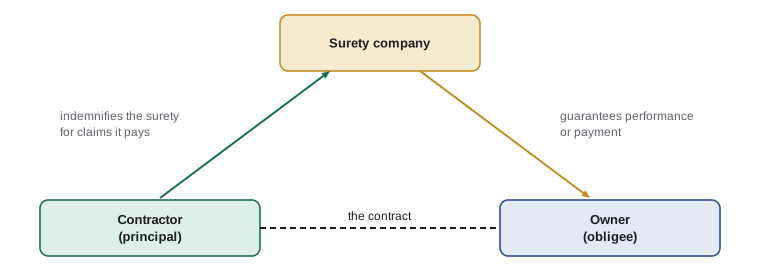
A surety bond is a three-party promise: the surety company guarantees to the owner that the contractor will do something, such as perform the contract or pay its suppliers. Unlike some provinces, Newfoundland and Labrador's Electrical Regulations do not require a contractor bond for registration. Bonds still appear in the business, mostly on larger and public projects.
- Bid bond. Guarantees that a contractor who wins a tender will sign the contract and provide the required performance and payment bonds.
- Performance bond. Guarantees that the contractor will complete the work according to the contract, often for a share of the contract price.
- Labour and material payment bond. Guarantees that the contractor will pay its workers, subcontractors and suppliers, protecting those down the chain.
Bonding capacity depends on the business's finances, track record and the owners' personal guarantees, and a new company usually starts with modest capacity. Leonard's advice is to meet a surety broker early, before a bonded tender appears, and to keep clean financial statements from the first year, because the surety will read them.
# Rough bond costs for a bonded job (illustrative rates; ask a surety broker for real ones).
contract = 180_000          # dollars, illustrative
performance_share = 0.5     # bond amount as a share of contract, set by the tender
rate_per_1000 = 12          # illustrative premium, dollars per 1,000 of bond amount

bond_amount = contract * performance_share
premium = bond_amount / 1000 * rate_per_1000
print(f"bond amount:  {bond_amount:10,.0f} dollars")
print(f"premium est.: {premium:10,.0f} dollars")bond amount: 90,000 dollars premium est.: 1,080 dollars
Bond premiums are usually far smaller than the bond amount, but they are a real cost and belong in the bid. The surety also expects indemnity: if it pays a claim, it will look to the contractor and the owners to repay it.
Money basics for a new contractor
Most new contracting businesses that fail do so because of cash, not workmanship. A few basics help.
- Separate accounts. Keep business money in a business bank account from the first day.
- Deposits and progress billing. On larger jobs, bill as work progresses, according to the contract, rather than waiting for the end.
- Holdbacks. On construction contracts, the owner keeps back part of each payment under the Mechanics' Lien Act, as Lesson 9 explains. Plan cash flow knowing that money will arrive later.
- Trust funds. Payroll deductions and HST collected are not the business's money. Keep them aside so they can be remitted on time.
- Job costing. Track labour, materials and permits against each job so you know which kinds of work actually make money.
Mark sets up job costing from the start. For each job he records hours, materials, permit fees, inspection fees and any re-work. After three months, the numbers show that small service calls make more per hour than Krista expected, while one new-house contract, priced too tightly, barely broke even.
A start-up plan for Walsh Electrical
| Item | Status in month one |
|---|---|
| Corporation and bank account | Done |
| Electrical contractor registration (unrestricted) | Applied, number pending |
| CRA business number, payroll and HST accounts | Done |
| WorkplaceNL employer account | Done before Jordan and Derek start |
| CGL 2 million dollars with completed operations; tools; auto | Bound; certificates on request |
| Surety broker meeting | Booked for month three |
| Job costing and compliance calendar | Set up by Mark |
Pricing so the business survives
Many new contractors price jobs the way they were paid as employees: hours times a wage, plus materials. That leaves out everything an employer used to pay for. The business must also recover vehicle costs, tools, insurance, WorkplaceNL assessments, the registration fee, office costs, the owner's unbillable time spent quoting and on paperwork, and a margin for profit and risk.
Mark builds a simple overhead budget for the first year and divides it by the hours the crew is likely to bill. The result tells Krista how much overhead each billable hour must carry before she adds labour, materials and profit. The first estimate is rough, but the job costing he set up will sharpen it within a few months.
# Overhead per billable hour (illustrative figures for a small contractor).
overhead = {
    "vehicles": 26_000, "insurance": 9_500, "tools": 6_000,
    "office and phones": 7_200, "accounting and legal": 5_000,
    "registration and permits not billed": 1_300, "training and Code books": 2_500,
}
billable_hours = 3 * 1_500          # three billable people, illustrative
total = sum(overhead.values())
print(f"annual overhead:            {total:8,.0f} dollars")
print(f"overhead per billable hour: {total / billable_hours:8.2f} dollars")annual overhead: 57,500 dollars overhead per billable hour: 12.78 dollars
The number is not a price; it is a floor under one. A business that bids below its overhead per hour is paying to work, however busy it looks.
Getting good advice early
Leonard's last piece of business advice is to pay for advice before it is needed. An accountant who works with trades can set up the books and the tax accounts properly; a lawyer can review the standard contract and explain lien rights; a broker can match insurance to the work the business actually does. Each costs far less at the start than after a problem.
Common mistakes
MistakeAssuming the contractor registration proves the business is insured.
InsteadRegistration does not cover insurance; customers require proof of insurance separately.
MistakeTreating HST and payroll deductions as working capital.
InsteadThey are held for the government; directors can be personally liable for unremitted amounts.
MistakeWaiting for a bonded tender before talking to a surety.
InsteadBonding takes time and financial statements; meet a surety broker early.
MistakeSigning a subcontract without checking its insurance clause.
InsteadCompare limits, endorsements and notice terms with the policy, and price any extra cost into the bid.
Summary and key terms
- A contracting business may be a sole proprietorship, partnership or corporation; a corporation limits owners' liability with important exceptions.
- Alongside electrical registration, a business needs Registry of Companies and Deeds, CRA (business number, payroll, HST), WorkplaceNL and any municipal registrations.
- The Electrical Regulations and the registration page do not require insurance or a bond for registration, but customers almost always require insurance.
- Common coverages are CGL with completed operations, tools, auto, and professional liability where the contractor designs.
- Bid, performance and payment bonds appear on larger and public projects; bonding capacity depends on finances and track record.
- CGL
- Commercial general liability insurance, covering damage and injury to others.
- Additional insured
- A person, such as a general contractor, added to the contractor's policy for a job.
- Certificate of insurance
- A broker-issued summary of coverage given to customers as proof.
- Surety bond
- A guarantee by a surety company that the contractor will perform or pay.
- Performance bond
- A bond guaranteeing completion of the contract.
- Labour and material payment bond
- A bond guaranteeing payment of workers, subcontractors and suppliers.
Practice problems
Work each problem on paper first, then reveal the answer to check.
Does a corporation protect Krista from liability for her own negligent work?
Show answer
Not entirely; it limits shareholder liability, but she can still be liable for her own negligence, which is why insurance matters.
Which bond protects subcontractors and suppliers?
Show answer
The labour and material payment bond.
Name three registrations a new contracting company needs besides the electrical registration.
Show answer
Any three of: Registry of Companies and Deeds, CRA business number, payroll account, HST account, WorkplaceNL, municipal permit.
Do the Electrical Regulations require a bond for contractor registration?
Show answer
No. Bonds come from contracts and tenders, not from the registration rules.
Lesson quiz · 5 questions
Score 60% or more to complete this lesson.
Create a free account to save your progress, take quizzes and earn a certificate.