
MELC-210 · Lesson 2 of 12 · 19 min
Certificates of qualification and who may do electrical work
▶ Video coming soon A video version of this lesson is on the way.
Contractor registration in Newfoundland and Labrador rests on one document: the journeyperson certificate of qualification. Without one, held either by the applicant or by an employee, no business can be registered as an electrical contractor, and without registration no business can be issued electrical permits. This lesson explains where that certificate comes from, who issues it, which trades are compulsory, what an apprentice may do, and how certification connects to the Electrical Regulations.
Two bodies of law meet here. Apprenticeship and trade certification are run by the Apprenticeship and Trades Certification Division (ATCD) of the Department of Immigration, Population Growth and Skills. The Electrical Regulations, administered by Government Services, then use the certificate as the qualification behind every contractor registration. A contractor needs to understand both, because a staffing decision made under one body of law can change what the business may do under the other.
Compulsory trades
Most trades in the province are voluntary: a person may do the work without a certificate, although certification helps with wages and mobility. A small group of trades is different. The ATCD describes compulsory trades as those where public or employee safety could be at risk, and anyone working in a compulsory trade must hold a certificate of qualification or be a registered apprentice with the Division.
There are five compulsory trades in Newfoundland and Labrador: boom truck operator, construction electrician, residential electrician, mobile crane operator and tower crane operator. Two of the five are electrical. For a contractor, that is the most important fact in this lesson: electrical work in these trades is not something an unregistered helper or a handy labourer may do, no matter how closely supervised.
| Compulsory trade | Relevance to an electrical contractor |
|---|---|
| Construction electrician | The main trade for commercial, industrial and residential electrical work |
| Residential electrician | A narrower trade limited to residential work |
| Boom truck operator | Relevant when lifting poles, transformers or large equipment |
| Mobile crane operator | Relevant for large equipment lifts |
| Tower crane operator | Mainly large building sites |
Leonard tells Krista to think of compulsory certification as a floor that applies to every person on a job, separate from the registration that applies to the business. A registered contractor that lets an uncertified, unregistered worker do construction electrician work breaks the certification rules, even if the permit, the inspection and the workmanship are all in order.
How a journeyperson certificate is earned
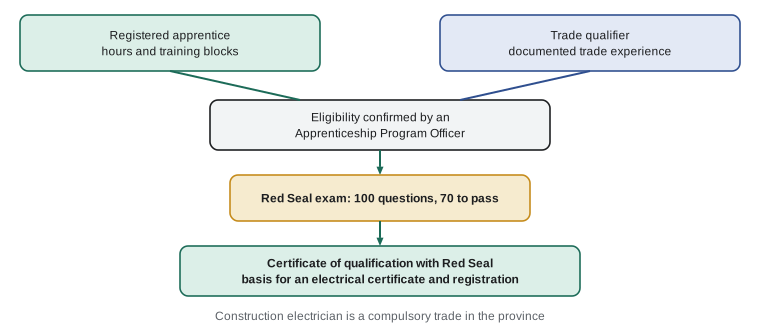
There are two main paths to a construction electrician certificate of qualification. The first is apprenticeship: a person registers as an apprentice, works under the supervision of certified journeypersons, completes the technical training blocks set out in the plan of training, logs the required hours, and then writes the certification exam. The second is the trade qualifier route for experienced workers who did not complete an apprenticeship in the province but can document enough experience in the trade. In both cases, an Apprenticeship Program Officer confirms that the candidate is eligible before the exam is booked through a regional office.
Construction electrician is a Red Seal trade. According to the ATCD's current study guide, Red Seal exams have between 100 and 150 multiple-choice questions, and the construction electrician exam currently has 100. A candidate who scores 70 or more out of 100 receives a Newfoundland and Labrador certificate of qualification with a Red Seal endorsement. Results are mailed about seven to ten days after the exam. The number of questions can change, so the guide advises checking with a regional office before writing.
Krista went through the apprenticeship route. She remembers the exam well: one hundred questions, a long morning, and the relief of a 78. Her Red Seal endorsement matters beyond the province. Because it is recognized across Canada, it would let her work in other provinces as a journeyperson, although each province decides for itself what a contractor needs.
From certificate of qualification to electrical certificate
The Electrical Regulations use their own term. Section 5 deals with an electrical certificate, and the definitions in section 2 tie that certificate to an electrical qualification certificate, such as an interprovincial or provincial journeyperson certificate of qualification. In practice, the certificate of qualification is what the Chief Electrical Inspector looks at when deciding whether an applicant, or an applicant's employee, qualifies a business for contractor registration.
The registration application asks for a copy of the individual's valid certificate of qualification, showing its expiry date where it has one and its original date of issue. The original date of issue matters for one class in particular: the unrestricted registration requires at least two years as the holder of an electrical certificate. Krista's certificate is seven years old, so the date shows she is well past that threshold.
Worked problem
Reading a certificate for registration purposes
Derek's certificate of qualification shows an original issue date of June 2023. Krista asks whether Derek, on his own, could qualify a business for an unrestricted registration in November 2026.
Show solution
- The unrestricted class in section 6(2) needs an individual who has held an electrical certificate for at least two years.
- From June 2023 to November 2026 is three years and five months.
- Derek's certificate therefore meets the two-year threshold, assuming it has been valid throughout and he is not barred.
Answer: Yes. Derek's certificate is more than two years old, so a business employing him could qualify for the unrestricted class on his certificate.
# How long has each person held a certificate of qualification?
from datetime import date

def years_held(issued, on):
    months = (on.year - issued.year) * 12 + (on.month - issued.month)
    if on.day < issued.day:
        months -= 1
    return months / 12

today = date(2026, 11, 10)
staff = {"Krista": date(2019, 6, 14), "Derek": date(2023, 6, 2), "new hire": date(2025, 5, 20)}
for name, issued in staff.items():
    held = years_held(issued, today)
    status = "meets" if held >= 2 else "below"
print(f"{name:9s} {held:4.1f} years -> {status} the two-year threshold")Krista 7.3 years -> meets the two-year threshold Derek 3.4 years -> meets the two-year threshold new hire 1.4 years -> below the two-year threshold
The new hire in the example has held a certificate for about a year and a half. A business could still be registered in the restricted class on that certificate, but not the unrestricted class, until the two-year mark passes.
What an apprentice may do
Registered apprentices are the normal way into the trade, and almost every electrical contractor in the province trains them. An apprentice may do construction electrician work, but only as part of the apprenticeship. That means three things in practice.
- Supervision. An apprentice works under the direction of a certified journeyperson. The plan of training describes the level of supervision expected as the apprentice progresses; a first-year apprentice needs far closer supervision than a fourth-year apprentice.
- Ratios. Section 4(6) of the Electrical Regulations says the ratio of apprentices to journeypersons on electrical work must follow the approved plan of training. A contractor who sends three apprentices to a job with one journeyperson may break both the apprenticeship rules and the Electrical Regulations.
- Records. Apprentices log their hours and the tasks they complete. A contractor should support accurate logbooks and release apprentices for their technical training blocks, because those hours count toward the apprentice's certification.
Jordan, Krista's third-year apprentice, is capable and careful. Even so, Krista schedules him so that he is always on a site with either her or Derek. When both journeypersons are booked elsewhere, Jordan does shop work, picks up materials or attends training, rather than working alone on a live job.
| Situation | Allowed? | Why |
|---|---|---|
| Third-year apprentice wires a basement with a journeyperson on site | Yes | Apprentice work under supervision, within the ratio |
| Apprentice finishes a job alone because the journeyperson left early | No | Compulsory trade work without the required supervision |
| Labourer who is not registered pulls wire under direction | No | Construction electrician is compulsory; the worker is neither certified nor registered |
| Two apprentices with one journeyperson, where the plan allows it | Depends | Must follow the ratio in the approved plan of training |
Working outside your trade
The residential electrician trade is narrower than construction electrician. A residential electrician's certificate covers residential work; it does not by itself qualify the holder for commercial or industrial installations. Krista's construction electrician certificate covers both. If she hires a residential electrician, she must keep that person on residential jobs unless the person is also registered as an apprentice in the construction trade or holds that certificate as well.
The same logic applies to related trades. Industrial electricians, powerline technicians and instrumentation technicians have their own certificates and scopes. A contractor who mixes crews should know exactly which certificate each person holds and what it allows, and should keep a copy of each certificate on file. When the Chief Electrical Inspector or an inspector asks who did a piece of work, the answer should be immediate.
Mobility and out-of-province workers
Because construction electrician is a Red Seal trade, a journeyperson certified in another province with a Red Seal endorsement can usually have that certification recognized in Newfoundland and Labrador, and the reverse is also true. The details, such as what paperwork the Division needs and how long recognition takes, are set by the ATCD and by national labour mobility agreements. A contractor hiring from Nova Scotia, Alberta or anywhere else should confirm recognition with the Division before the new hire starts trade work.
Mobility matters most in two situations. The first is hiring: an experienced electrician moving home from Fort McMurray may be ready to work on the first day, provided the paperwork is in order. The second is out-of-province work: a Newfoundland and Labrador contractor bidding on a job in Nova Scotia or New Brunswick must meet that province's rules, which differ from this province's registration system. Priya's world in Alberta, with its master electrician exam, is a reminder that each province's system has to be learned on its own terms.
Keeping certification records
Leonard's habit, built over three decades, was to keep a single sheet for every worker: name, trade, certificate number, original date of issue, any expiry date, apprentice registration number and level, and the date the record was last checked. It took ten minutes per hire and saved him hours whenever a question came up. Krista copies the idea. Her records also support Lesson 4's registration application, which needs a copy of the qualifying certificate, and Lesson 11's duty to notify the Chief Electrical Inspector if the qualifying journeyperson leaves.
Working with apprentices day to day
A certificate of qualification is also a licence to teach. Once Walsh Electrical hires Jordan, Krista and Derek become responsible for the hours, tasks and supervision that will one day earn him his own certificate. Section 4(6) of the Electrical Regulations ties apprentice supervision to the ratio set by the plan of training, so the number of apprentices a crew can carry depends on the number of certified journeypersons on it, not on how busy the business is.
Good practice is simple and easy to neglect. Sign the apprentice's logbook or record of hours promptly and honestly, because those records are what the Apprenticeship and Trades Certification Division relies on. Match the work to the tasks the apprentice still needs, rather than leaving them on the same rough-in for a year. Release them for their technical training blocks without making them feel it costs them their job. And never send an apprentice to work alone on tasks the plan of training says must be supervised.
Common mistakes
MistakeLetting a capable labourer do electrical work because the journeyperson is nearby.
InsteadConstruction electrician is a compulsory trade: the worker must be certified or a registered apprentice, not just supervised.
MistakeIgnoring the apprentice ratio when the schedule gets tight.
InsteadSection 4(6) of the Electrical Regulations ties apprentice ratios to the approved plan of training.
MistakeSending a residential electrician to a commercial job.
InsteadA residential electrician's certificate covers residential work; commercial work needs the construction electrician trade.
MistakeAssuming an out-of-province Red Seal can start work immediately.
InsteadConfirm recognition with the ATCD before the new hire does trade work.
Summary and key terms
- The journeyperson certificate of qualification, issued through the ATCD, is the qualification behind every contractor registration.
- Construction electrician and residential electrician are two of the province's five compulsory trades; workers must be certified or registered apprentices.
- The Red Seal construction electrician exam currently has 100 multiple-choice questions, with 70 needed to pass, according to the ATCD study guide.
- Apprentices work under supervision, within the ratio in the approved plan of training (Electrical Regulations s. 4(6)).
- The original date of issue on a certificate matters for the unrestricted registration class, which needs two years as a holder.
- ATCD
- The Apprenticeship and Trades Certification Division, which runs apprenticeship and trade certification.
- Compulsory trade
- A trade in which only certified journeypersons and registered apprentices may work.
- Trade qualifier
- An experienced worker who qualifies to write the certification exam without completing an apprenticeship in the province.
- Red Seal endorsement
- The interprovincial standard endorsement on a certificate, recognized across Canada.
- Plan of training
- The document that sets out an apprenticeship, including training blocks and supervision ratios.
- Electrical certificate
- The certificate under the Electrical Regulations that is based on a journeyperson certificate of qualification.
Practice problems
Work each problem on paper first, then reveal the answer to check.
Name the two electrical trades among the province's compulsory trades.
Show answer
Construction electrician and residential electrician.
What score is needed to pass the Red Seal construction electrician exam?
Show answer
70 out of 100, according to the ATCD study guide.
Which section of the Electrical Regulations ties apprentice ratios to the plan of training?
Show answer
Section 4(6).
A worker's certificate was first issued in March 2025. In November 2026, does it meet the two-year threshold for the unrestricted class?
Show answer
No. It has been held for about one year and eight months.
Lesson quiz · 5 questions
Score 60% or more to complete this lesson.
Create a free account to save your progress, take quizzes and earn a certificate.