
MELC-210 · Lesson 12 of 12 · 16 min
Readiness review: a practice test for new contractors
▶ Video coming soon A video version of this lesson is on the way.
In some provinces a new electrical contractor must pass a business and law exam before it can be licensed. Newfoundland and Labrador does not set a contractor exam. A business is registered on the strength of a certificate holder's qualification, and from then on its competence is tested by permits, inspections, audits, customers and the law. That means no one will check what the owner knows about liens, safety reporting or registration duties until something goes wrong. This lesson gives you a way to check yourself first: a practice test in four parts, a map from each kind of question to the document that answers it, and a checklist for the week before the first permitted job.
Treat the review as seriously as an exam. Set aside a quiet evening, close the course notes, and answer from the documents you would really use: the Canadian Electrical Code as adopted in the province, the Electrical Regulations, Government Services' electrical pages and fee policy, the Mechanics' Lien Act, the Occupational Health and Safety Act and regulations, WorkplaceNL's employer guidance and your own company procedures. Then mark your answers against Lessons 1 to 11. A sensible personal standard is the one the Red Seal exam uses: 70 out of 100 on each part.
Krista's kitchen-table test
Three weeks before Walsh Electrical opens, Leonard drives over from Gander with a shoebox of index cards. He has written forty questions in four piles: who may work and register, permits and inspections, contracts and money, and safety and compliance. He gives Krista an evening, the documents she will keep in the truck, and no phone. She scores 31 out of 40. Most of her misses are in the contracts pile: she had assumed lien deadlines ran from the day of the invoice, and that the owner could pay out the full holdback the day after completion.
She spends the next week on Lesson 9, reads the Mechanics' Lien Act itself, and asks her lawyer two questions she had been avoiding. Leonard writes a fresh pile of ten contract questions. She gets nine. His point is not the score. It is that she found her weak area at the kitchen table, before a general contractor or a lien claimant found it for her.
Part 1: Who may work and register
These questions test Lessons 1 to 4. Answer each in a sentence or two.
- Which Act and which regulations govern electrical work and contractor registration in the province?
- Does the province set an exam for electrical contractors? What does a business need instead before it can be issued permits?
- Name the three classes of Electrical Contractor's Registration Certificate and what each allows.
- How long must the qualifying person have held their certificate for an unrestricted registration?
- Is construction electrician a compulsory trade in the province? Who administers apprenticeship and certification?
- How many questions are on the Red Seal construction electrician exam, and what is the pass mark?
- What is the yearly registration fee, and the fee for each additional registration?
- What must the contractor do immediately if the qualifying employee leaves?
- Which other registrations does a new contracting company need besides its electrical registration?
- Can a journeyperson take out a permit for work on their own property without a contractor registration?
Part 2: The Code, permits and inspections
These questions test Lessons 5 to 7, with the Code and the regulations open.
- How does section 4(4) of the Electrical Regulations bring the Canadian Electrical Code into force, and what does 'as amended' mean for a contractor?
- When must a permit be taken out, how long is it valid, and where must it be kept?
- Which jobs require plans to be submitted with the permit application?
- Calculate the permit fee for a 200 ampere residential service, using the published rate per ampere and the minimum fee.
- What is a maintenance permit, who may hold one, and what records must be kept?
- In the ordinary route, what must the contractor do when work is complete?
- What are the qualifications for a designated representative under section 7(2)?
- What must be submitted before a contractor with a representative issues a connection authorization?
- What is the published fee for an additional residential inspection, and for a commercial re-inspection during regular hours?
- Why might a connection be refused even when the wiring is correct?
# Check your Part 2 fee answer (published policy rates; confirm current fees).
amps = 200
rate = 1.20          # dollars per ampere, residential
minimum = 60         # dollars
fee = max(amps * rate, minimum)
print(f"permit fee: {fee:.2f} dollars")permit fee: 240.00 dollars
Part 3: Contracts and money
These questions test Lessons 8 and 9.
- Which business form limits the owners' personal liability, and what does it not protect them from?
- Do the Electrical Regulations require insurance or a bond for registration? Who requires them in practice?
- Name the three common construction bonds and what each guarantees.
- How much must an owner hold back under the Mechanics' Lien Act, and for how long?
- Within how many days must a lien be registered, and what happens if no action is started within 90 days?
- How is substantial performance defined in the Act?
- Can a subcontractor sign away its lien rights in its subcontract?
- Is there a prompt payment law in force in the province? What is its status?
- What should a contractor do before doing extra work a customer asks for partway through a job?
- Which amounts collected by the business are held in trust and must never be used as working capital?
Part 4: Safety and compliance
These questions test Lessons 10 and 11.
- At what workforce size is an OHS committee required, and what is required below that size?
- When must a serious injury be reported to the OHS Division, and when is the written report due?
- When is WorkplaceNL's Form 7 due, and does the worker need to miss time?
- Which projects need written notice to the OHS Division before work begins?
- What reporting duty applies when a crew damages a buried utility?
- What are the steps of a lockout, in order?
- Which standard guides arc flash risk assessment in Canada?
- Which sections of the Electrical Regulations allow suspension, cancellation and disqualification?
- Which Act sets the penalties for offences under the Electrical Regulations?
- What should a representative do after an audit finding?
Marking and what to do with weak areas
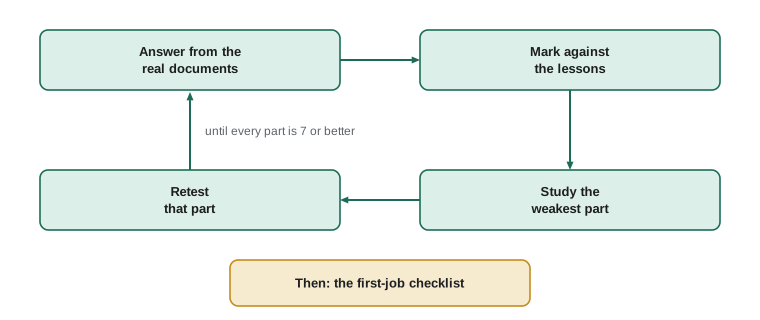
Mark each part out of ten. For any part below seven, go back to the lessons that part tests, then to the source documents themselves, and write ten fresh questions on the areas you missed, or ask a mentor to write them. Retest only that part. Repeat until every part is at seven or better.
# Score each part and flag the ones to study again.
scores = {"Who may work": 9, "Code and permits": 8, "Contracts and money": 5, "Safety and compliance": 9}
for part, s in scores.items():
    flag = "study again" if s < 7 else "ready"
    print(f"{part:24s} {s:2d}/10  {flag}")
print("total:", sum(scores.values()), "out of", 10 * len(scores))Who may work 9/10 ready Code and permits 8/10 ready Contracts and money 5/10 study again Safety and compliance 9/10 ready total: 31 out of 40
Where to find each answer
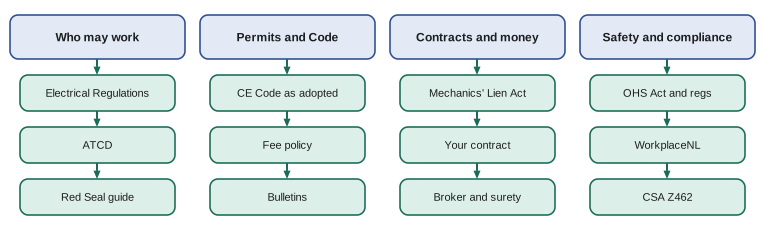
The skill the practice test really builds is knowing where to look. Every question in it can be answered from a short list of documents.
| Kind of question | Where to look |
|---|---|
| Registration, classes, permits, representatives, discipline | Electrical Regulations, NLR 120/96, and Government Services' electrical pages |
| Installation rules | The Canadian Electrical Code as adopted and amended in the province, and provincial bulletins |
| Permit and inspection fees | Government Services' published electrical fees policy |
| Who may do trade work, apprentices, certificates | The Apprenticeship and Trades Certification Division |
| Holdbacks, liens, substantial performance | Mechanics' Lien Act, RSNL 1990 c M-3, and your lawyer |
| Safety duties, committees, reporting | Occupational Health and Safety Act and regulations, and WorkplaceNL's OHS guide |
| Injury reporting and assessments | WorkplaceNL employer pages and the Workplace Health, Safety and Compensation Act |
| Insurance and bonds | Your contracts, your broker and your surety |
The first-job checklist
The week before the first permitted job, Krista works through this list with Mark. Every line must be ticked before a permit is applied for.
| Area | Check |
|---|---|
| Registration | Certificate received; class covers the job; number on quotes and advertising |
| Qualifying person | Named; contingency person identified |
| Permit | Application ready; plans attached if required; fee calculated |
| Inspections | Stages confirmed with the Government Service Centre; booked in the schedule |
| Contract | Written; scope, price, payment terms, holdback and change process stated |
| Insurance | CGL and completed operations in force; certificate issued if requested |
| WorkplaceNL | Account in good standing; clearance letter available |
| Safety | Hazard assessment done; lockout kit and tester in the truck; emergency numbers posted |
| Records | Job file opened; job costing set up |
On November 10, 2026, Walsh Electrical opens its first permit, for a panel upgrade and basement wiring at the Shoal Harbour house. Every line on the checklist is ticked. Leonard sends a one-line text: "Now the real exam starts. Good luck."
After the first job
The readiness review does not end when the first permit is closed. Six months after opening, Krista repeats a shorter version of the test, this time with questions drawn from what actually happened: the deficiencies the inspectors wrote, the contract clause she had to negotiate, the near miss at the meter base, and the payment that arrived late. The questions she cannot answer tell her where the business's procedures still have gaps.
She also reviews the numbers Mark has gathered: how many inspections passed first time, how many permits are open and how old they are, how long customers take to pay, and how the actual cost of each job compared with its quote. Each figure points to a habit worth keeping or a procedure worth changing.
Building a support network
No new contractor should work alone. Leonard is Krista's mentor, but the network she builds in her first year is wider: an accountant, a lawyer and a broker who know contracting; the inspectors at the Government Service Centre, who are a source of answers as well as inspections; suppliers who will explain new equipment; and other contractors in the region, who can share work, lend a hand on a big job and warn of a customer who does not pay.
Industry associations, Code update courses and supplier training sessions are where much of that network forms. Krista budgets a few days a year for them, and treats the time as part of staying compliant, because it is where she first hears about new Code editions, new bulletins and changes in how the rules are applied.
Finally, Krista gives back. When Jordan finishes his apprenticeship and starts talking about one day running his own shop, she hands him the same shoebox of index cards Leonard brought to her kitchen table, with a few new cards of her own. The review is a habit, and habits are passed on by the people who keep them.
Common mistakes
MistakeAssuming that, with no contractor exam, there is nothing to prepare for.
InsteadPermits, inspections, audits, contracts and safety law test the business every day.
MistakeAnswering the practice test from memory.
InsteadAnswer from the real documents, because that is how you will work.
MistakeStudying only the parts you already know well.
InsteadSpend your time on the part with the lowest score, then retest it.
MistakeApplying for the first permit before the checklist is complete.
InsteadTick every line first: registration, insurance, WorkplaceNL, contract and safety.
Summary and key terms
- Newfoundland and Labrador does not set a contractor exam; a structured self-review fills the gap.
- The practice test has four parts: who may work and register, Code and permits, contracts and money, and safety and compliance.
- Aim for at least 7 out of 10 on each part, and restudy and retest any part below that.
- Every answer comes from a short list of sources: the Electrical Regulations, the Code as adopted, the fee policy, the ATCD, the Mechanics' Lien Act, OHS law and WorkplaceNL.
- Complete the first-job checklist before applying for the first permit.
- Readiness review
- A structured self-test of the knowledge a new contractor needs, in the absence of a contractor exam.
- Question-to-document map
- A table linking each kind of question to the source that answers it.
- First-job checklist
- The list of items that must be in place before the first permit is applied for.
- Qualifying person
- The certificate holder on whom the registration rests.
- Retest
- A fresh set of questions on a weak area, taken after further study.
- Mentor
- An experienced contractor who helps a new one prepare and review.
Practice problems
Work each problem on paper first, then reveal the answer to check.
Does Newfoundland and Labrador require an exam before contractor registration?
Show answer
No. Registration rests on a certificate holder's qualification.
A part score is 6 out of 10. What should you do?
Show answer
Restudy the lessons and sources for that part, then retest it.
Where do you look for the holdback rules?
Show answer
The Mechanics' Lien Act, RSNL 1990 c M-3.
Name four items on the first-job checklist.
Show answer
Any four of: registration, qualifying person, permit, inspections, contract, insurance, WorkplaceNL, safety, records.
Lesson quiz · 5 questions
Score 60% or more to complete this lesson.
Create a free account to save your progress, take quizzes and earn a certificate.