
MELC-210 · Lesson 4 of 12 · 19 min
Applying for, renewing and keeping your registration
▶ Video coming soon A video version of this lesson is on the way.
Registering as an electrical contractor in Newfoundland and Labrador is not hard, but it is easy to do in the wrong order, and a business that gets the order wrong can lose weeks. This lesson walks through the application, the documents Government Services asks for, what happens after you apply, how renewal works through the province's electrical portal, and the habits that keep a registration in good standing year after year.
Everything here was checked against the government's published pages in late 2026. Forms change, portal screens change, and fees change more often than people expect. Treat the steps below as a map, and confirm the details with Government Services or your nearest Government Service Centre before you rely on them.
Before you apply
Leonard's first piece of advice is to settle the shape of the business before filling in a single form, because the registration will be issued in the name of whoever applies. If Krista applies as an individual and later incorporates, the company will need its own registration. If she incorporates first, the company can be registered from the start, with Krista as the qualifying person.
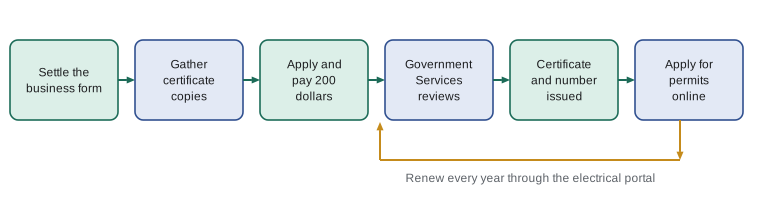
Krista and Mark decide to incorporate. Their lawyer files the articles of incorporation with the Registry of Companies and Deeds, and Walsh Electrical Ltd. receives its certificate of incorporation in about two weeks. Only then does Krista start the contractor registration, so that the legal name on the application exactly matches the company's registered name.
- Settle the legal form: individual, partnership or corporation. Lesson 8 compares them.
- Register the business or incorporate, so the applicant's legal name is fixed.
- Decide which registration class to apply for, based on the qualifying person's certificate (Lesson 3).
- Gather copies of the qualifying certificate, showing the original date of issue and any expiry date.
- Decide whether the business will apply for a contractor representative designation now or later (Lesson 7).
The application
The government's registration page lists what an application needs. The applicant applies in writing and must hold, or employ a holder of, a journeyperson's certificate of qualification in electrical construction. The application package is short.
| Item | Why it is needed |
|---|---|
| Completed Application for Electrical Contractor Registration | Identifies the applicant, the class requested and the qualifying person |
| Copy of the valid certificate of qualification, with expiry date (if any) and original date of issue | Shows the qualification behind the registration and, for the unrestricted class, the two years as holder |
| The applicable fee | 200 dollars per year for one registration, 60 for each additional one, no HST |
The page also links a contractor representative declaration form, which belongs to the representative program in section 7 of the Electrical Regulations. A business that does not intend to certify its own work does not need it at the start.
Krista fills in the application on a Sunday evening with Mark checking every field. The class: unrestricted. The applicant: Walsh Electrical Ltd. The qualifying person: Krista Walsh, with her certificate number and its original issue date in June 2019. She attaches a clear scan of the certificate, pays the 200 dollar fee, and submits it on Monday morning.
What happens next
After an application arrives, Government Services checks that the qualifying certificate is valid, that the holder is not barred, that the class requested matches the certificate, and that the fee is paid. If something is missing, such as a certificate copy that does not show the original issue date, the application waits until it is supplied. The province does not publish a processing time, so a business should apply well before it needs its first permit.
When the registration is approved, the business receives its Electrical Contractor's Registration Certificate, with a registration number and any restrictions or designations written on it. The business then appears on the government's published list of registered electrical contractors, which the province updates from time to time.
With the number in hand, the business can open an account on the province's electrical portal and apply for permits online. The portal currently offers applications for new non-commercial permits, new commercial permits and permit extensions, as well as contractor registration renewal. Registered contractors need their registration number and a valid email address to use it.
Worked problem
Planning around processing time
Krista wants to start her first paid job, a basement renovation in Clarenville, on the first Monday of next month. She submits her registration application today, three and a half weeks before. Is that enough time?
Show solution
- The province does not publish a processing time for registrations.
- After registration, she still needs to apply for and receive the electrical permit for the basement, because work cannot start until the permit is issued (Lesson 6).
- A missing document would add delay at either step.
- Leonard's rule of thumb from experience is to allow several weeks for registration and to apply for the first permit as soon as the number arrives.
Answer: It may be enough, but it is tight. Krista tells the customer the start date depends on her registration and the permit, and she calls the Government Service Centre to ask about current timing.
Renewal
The registration fee is charged per year, and the government provides an online application to renew the contractor electrical certificate through the electrical portal. The Electrical Regulations themselves do not set a renewal term in section 6, so the renewal cycle and any renewal notices come from Government Services' administration. A contractor should note the renewal date on the certificate and renew before it, not after.
Letting a registration lapse has immediate consequences. Without a current registration, the business cannot be issued new permits, may not advertise electrical contracting, and risks being removed from the published list that customers and general contractors check. Leonard once let his renewal slip by three weeks during a busy summer; two permit applications bounced, a job started late, and a customer threatened to hold back payment.
# Renewal reminders: warn 60 and 30 days before a registration expires.
from datetime import date, timedelta

renewal_due = date(2027, 11, 30)        # illustrative; read yours from the certificate
for days in (60, 30, 7):
    remind_on = renewal_due - timedelta(days=days)
    print(f"Reminder {days:2d} days before: {remind_on.isoformat()}")
print("Renew online through the electrical portal before", renewal_due.isoformat())Reminder 60 days before: 2027-10-01 Reminder 30 days before: 2027-10-31 Reminder 7 days before: 2027-11-23 Renew online through the electrical portal before 2027-11-30
Keeping the registration accurate
A registration is only as good as the facts behind it. Several changes should prompt a call or an update to Government Services.
- The qualifying person leaves or can no longer act. Section 6(4) requires a company to notify the Chief Electrical Inspector immediately if it stops meeting the employment requirement.
- The business changes its legal form. A sole proprietor who incorporates, or a partnership that becomes a company, needs the registration to match the new legal person.
- The business changes its name or address. Advertisements must show the registered name, so the registration and the trading name must agree.
- The business wants a different class. A restricted registration whose qualifying person passes the two-year mark may be upgraded to unrestricted; ask how the change is made.
- A representative is appointed or leaves. The representative designation appears on the certificate, so changes must be reported (Lesson 7).
Krista keeps a one-page registration file: the certificate, the renewal date, the qualifying person, the representative status, and a log of every contact with Government Services with the date, the name of the person she spoke with, and what was agreed. When questions come up years later, the log answers them.
Related registrations that are not the contractor registration
New contractors sometimes assume that once the electrical registration arrives, they are fully set up. They are not. Several other registrations run alongside it, each with its own rules and its own office.
| Registration | Office | When it is needed |
|---|---|---|
| Corporation or business name | Registry of Companies and Deeds | Before trading under the name |
| Business number and payroll account | Canada Revenue Agency | Before paying employees |
| HST account | Canada Revenue Agency | Once taxable sales pass the small supplier threshold, or earlier by choice |
| Employer account | WorkplaceNL | Before workers start |
| Municipal business permit | The town or city | Where the municipality requires one |
The HST point surprises many tradespeople. The contractor registration fee itself carries no HST, but the business's own sales do once it registers for HST, and registration becomes mandatory once taxable sales pass the federal small supplier threshold. Mark sets up the HST account from the start, because Walsh Electrical's commercial customers expect HST invoices and will want to claim input tax credits.
Getting help
Government Services publishes a list of Government Service Centre offices by region, and a general information line for Government Services in St. John's. The registration, permit and representative pages each list the forms and the governing law: the Public Safety Act and the Electrical Regulations. When a question is about a specific job, the regional Government Service Centre that will inspect it is usually the best first call.
Leonard has one more tip. Write down the question before calling, and confirm any important answer by email. An inspector's verbal advice is helpful, but a written answer protects the business if the same question comes up during an inspection or a dispute.
A checklist for the first month
| Week | Task |
|---|---|
| 1 | Incorporate or register the business name; set up the business bank account |
| 1 | Scan the qualifying certificate showing the original issue date |
| 2 | Submit the contractor registration application and fee |
| 2 | Register with WorkplaceNL and the Canada Revenue Agency |
| 3 | Arrange liability insurance; collect the certificate of insurance |
| 3-4 | Receive the registration number; open the electrical portal account |
| 4 | Apply for the first permit; add the registered name and number to all advertising |
Keeping the registration file
Every contractor should keep a single registration file, paper or electronic, that someone other than the owner can find in an emergency. Mark keeps Walsh Electrical's in a shared folder, with a printed copy in the office. It holds the registration certificate and its number, copies of the certificates of every qualifying person and the dates they were first issued, the application as submitted, receipts for each year's fee, any correspondence with Government Services, and a one-page note of who to call and what to do if the qualifying person leaves.
The file pays for itself the first time something changes. When a customer's lender asks for proof of registration, it is a two-minute task. When the renewal reminder arrives, the receipts show what was paid last year. When a new journeyperson joins, their certificate goes into the file on day one, so the business always knows who could qualify it.
Keep contact details current as well. A renewal notice sent to an old email address or a former office does not excuse a lapse. Krista sets a calendar reminder 60 days before the renewal date, and a second one at 30 days, and treats the renewal like any other bill that cannot be missed.
The file is also the first thing an auditor, insurer or prospective buyer of the business will ask about. A tidy file says that the business takes its obligations seriously.
Common mistakes
MistakeRegistering as an individual and then trading through a newly formed company.
InsteadThe registration must match the legal person that contracts and applies for permits; incorporate first or update the registration.
MistakeSending a certificate copy that does not show the original date of issue.
InsteadThe application asks for the original issue date, which matters for the unrestricted class.
MistakeLetting the registration lapse during a busy season.
InsteadWithout a current registration the business cannot be issued permits or advertise; renew before the due date.
MistakeAssuming the contractor registration covers WorkplaceNL and tax accounts.
InsteadEach is a separate registration with a separate office.
Summary and key terms
- Settle the business's legal form first, so the registration is issued to the right legal person.
- The application needs the completed form, a copy of the qualifying certificate showing the original issue date and any expiry, and the fee.
- Once registered, a contractor uses its registration number to apply for permits and renew through the province's electrical portal.
- Renew before the due date; a lapsed registration stops permits and advertising.
- Report changes such as a departing qualifying person (s. 6(4)), a new legal form, a new name or a representative change.
- Electrical portal
- The province's online system for contractor renewals, permit applications and extensions.
- Registration number
- The number shown on the registration certificate, used for permits and advertising.
- Original date of issue
- The date a certificate of qualification was first issued, used to measure years as holder.
- Small supplier threshold
- The federal sales level above which HST registration becomes mandatory.
- Registry of Companies and Deeds
- The provincial office that registers corporations and business names.
- Government Service Centre
- A regional office that handles permits, inspections and local questions.
Practice problems
Work each problem on paper first, then reveal the answer to check.
List the three items the registration application needs.
Show answer
The completed application form, a copy of the valid certificate of qualification showing any expiry date and the original issue date, and the fee.
Which online system handles renewals and permit applications?
Show answer
The province's electrical portal.
Why should Krista incorporate before registering?
Show answer
So the registration is issued to the company that will contract and apply for permits.
Name two registrations that are separate from the contractor registration.
Show answer
Any two of: business or corporate registration, CRA business number and payroll, HST, WorkplaceNL, municipal business permit.
Lesson quiz · 5 questions
Score 60% or more to complete this lesson.
Create a free account to save your progress, take quizzes and earn a certificate.