
MELC-210 · Lesson 6 of 12 · 18 min
Electrical permits, plans and permit fees
▶ Video coming soon A video version of this lesson is on the way.
The electrical permit is the heart of the system. Every installation that the Electrical Regulations cover starts with one, and the permit ties together the registered contractor, the job site, the inspection and, at the end, the connection of power. This lesson covers when a permit is needed, who may hold one, what goes with the application, the rules that apply while the permit is open, maintenance permits for large facilities, and the province's published fee schedule.
The rules come from sections 8 and 9 of the Electrical Regulations and from Government Services' permit and fee pages. As with every lesson in this course, confirm current forms and fees before relying on them.
When a permit is needed
Section 8(1) of the Electrical Regulations is blunt: a permit is required before any electrical installation or repair work begins. The government's permit page lists the kinds of work that need approval before they start.
- Wiring in residential buildings and sites.
- Wiring in public buildings, and in industrial or commercial sites and buildings.
- Private electricity generation installations, such as a home solar system or a standby generator.
- Apparatus such as generators, transformers, switchboards and large storage batteries.
The important word in section 8(1) is before. A permit applied for after the work has started does not fix the breach, and covering work before it is inspected creates a second problem, because the inspector may order it uncovered. Leonard has seen contractors lose a week of drywall over a permit that was opened on the Monday for work that started the Friday before.
Who may hold a permit
The government's permit page states that electrical permits are only issued to registered electrical contractors, with two exceptions.
- An individual or organization may request a Government Service Centre inspection to assess an existing electrical system or to reconnect electrical service. This is an inspection request, not a permit for new contracting work.
- A certified journeyperson electrician may obtain a permit for work on their own property, by providing their Red Seal certificate.
Section 8(9) of the regulations also gives the Chief Electrical Inspector discretion to issue a permit to a homeowner who holds an electrical certificate, or to a homeowner to facilitate an inspection. This is discretionary, not a right. A homeowner who is not certified cannot simply take out a permit and hire an unregistered helper, and a registered contractor must never ask a customer to take out a permit for work the contractor will actually do.
| Who | May they be issued a permit? | Basis |
|---|---|---|
| Registered electrical contractor | Yes | Permits are issued to registration holders |
| Certified journeyperson, own property | Yes, with Red Seal certificate | Government Services' permit page |
| Homeowner, not certified | Only at the Chief Inspector's discretion, to facilitate inspection | Section 8(9) |
| Unregistered tradesperson for a customer | No | Contracting work needs a registration |
| Any person wanting an existing system checked | Inspection on request, not a new-work permit | Section 10(5) and the permit page |
The application
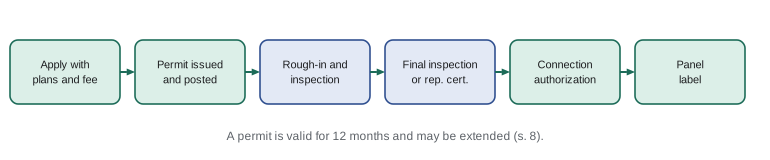
A permit application needs three things: a completed application form, detailed electrical plans for all commercial permits, and the fee listed on the application. Section 8(3) of the regulations adds that plans and specifications must be submitted for work other than on a single-family dwelling. Registered contractors may apply online through the electrical portal for new non-commercial permits, new commercial permits and permit extensions.
Plans matter more than many new contractors expect. A commercial application with a vague sketch will sit until better drawings arrive. Krista's commercial applications include a single-line diagram, a panel schedule, the service size and the load calculation, and the name of any engineer whose stamped drawings the job is built to.
Rules while the permit is open
Section 8 sets several rules that apply once the permit is issued.
- Validity. A permit is valid for 12 months (section 8(4)). If the work will take longer, apply for an extension through the portal before the permit expires.
- Posting. The permit must be posted on the site until the work is complete (section 8(6)). Krista keeps a clear plastic sleeve in every truck for this.
- Labelling. A permanent label must be affixed to the service panel (section 8(7)). The label links the installation to its permit long after the job is finished.
- Other legislation. Under section 8(2), the Chief Electrical Inspector may refuse to issue a permit, or to authorize a connection, until other applicable legislation is satisfied. A building that lacks a required municipal approval, for example, may not be connected.
These rules seem small, but inspectors check them. An unposted permit or a missing label is the kind of thing that turns a routine inspection into a return visit.
Maintenance permits
Large facilities such as hospitals, plants, schools and malls do routine electrical maintenance every week. Opening a permit for each lamp ballast or worn receptacle would be impractical, so section 9 creates the maintenance permit.
- Who. An owner or operator who employs a holder of an electrical certificate may apply in writing (section 9(1)).
- How long. A maintenance permit is valid for 12 months (section 9(1)).
- What it covers. Routine maintenance and the replacement of worn or broken parts (section 9(2)). It does not cover new installations or alterations, which still need ordinary permits.
- Records. The holder must keep a record of repairs for two years (section 9(4)).
- Cancellation. The Chief Electrical Inspector may cancel it (section 9(3)).
The published fee for a maintenance permit is 60 dollars per building. Maintenance permits belong to the facility owner, not to a contractor, but contractors meet them all the time: a contractor hired to add a new circuit in a hospital needs its own ordinary permit, even though the hospital's in-house electricians work under a maintenance permit.
The fee schedule
Government Services publishes a fee policy. The main features are below; check the current policy before quoting, because fees change.
| Type of work | How the fee is set (published policy) |
|---|---|
| Residential: new premises, rewires, service changes, temporary or pole services, garages and sheds | 1.20 dollars per ampere of service size |
| Residential minor work: emergency repairs, reconnection, service relocation, panel replacement, upgrades without a service change | Minimum fee of 60 dollars |
| Electric sign | Flat 72 dollars |
| Furnace; deep or shallow well pump | Flat 90 dollars each |
| Carnival or exhibition special permit | Flat 180 dollars |
| Commercial and industrial | Tiered on the total cost of the electrical work, minimum 60 dollars |
| Maintenance permit | 60 dollars per building |
| Permit extension; requested or additional residential inspection | 60 dollars plus HST each |
| Commercial special inspections and re-inspections | 108 dollars per hour plus expenses; outside regular hours, time and a half with a three-hour minimum |
For commercial work the policy uses tiers. Work costing 500 dollars or less pays the 60 dollar minimum. In the middle tiers, the fee is a base amount plus a rate per 100 dollars of work above the tier's lower limit: from 2,001 to 5,000 dollars, it is 240 dollars plus 2.40 dollars for each 100 dollars over 2,000; from 5,001 to 50,000 dollars, it is 312 dollars plus 1.20 dollars for each 100 dollars over 5,000. Larger jobs follow further tiers in the policy.
Worked problem
Pricing two permits
Krista is quoting a new 200 A house in Shoal Harbour and a 38,000 dollar electrical fit-out for a shop in the Clarenville strip mall. What permit fees should she build into each quote?
Show solution
- House: 200 A at 1.20 dollars per ampere is 200 x 1.20 = 240 dollars.
- Shop: 38,000 dollars falls in the 5,001 to 50,000 tier.
- Amount over 5,000 is 33,000 dollars, which is 330 units of 100 dollars.
- Fee = 312 + 330 x 1.20 = 312 + 396 = 708 dollars.
Answer: About 240 dollars for the house and 708 dollars for the shop, under the published policy. Krista checks the current policy before sending the quotes.
# Permit fee estimator using the published policy features (check the current policy).
import math

def residential(amps):
    return max(60, round(amps * 1.20, 2))

def commercial(cost):
    if cost <= 500:
        return 60
    if 2001 <= cost <= 5000:
        return 240 + 2.40 * math.ceil((cost - 2000) / 100)
    if 5001 <= cost <= 50000:
        return 312 + 1.20 * math.ceil((cost - 5000) / 100)
    raise ValueError("check the policy for this tier")

for amps in (100, 200, 400):
    print(f"house, {amps} A service: {residential(amps):7.2f} dollars")
for cost in (450, 3500, 38000):
print(f"commercial work of {cost:6,d} dollars: {commercial(cost):7.2f} dollars")house, 100 A service: 120.00 dollars house, 200 A service: 240.00 dollars house, 400 A service: 480.00 dollars commercial work of 450 dollars: 60.00 dollars commercial work of 3,500 dollars: 276.00 dollars commercial work of 38,000 dollars: 708.00 dollars
The estimator rounds partial hundreds up, which is a common way to apply per-100 rates; check how the Government Service Centre rounds before treating the figures as exact. It also refuses tiers it does not know, rather than guessing.
Extensions, cancellations and changes of scope
Jobs change. A house becomes a house with a detached garage; a shop fit-out adds a second panel; a project stalls over winter. Three habits keep the permit in step with the job.
- Extend before expiry. A permit is valid for 12 months; an extension costs 60 dollars plus HST and is applied for online.
- Report changes of scope. If the job grows beyond the permit, for example a larger service or added buildings, contact the Government Service Centre before doing the extra work. An additional permit or a revised fee may be needed.
- Close out cleanly. A permit left open on a finished job causes trouble later, when the customer sells the house or a lender asks for the certificate of inspection. Make sure every job ends with a final inspection or a representative certification.
Pricing permits and inspections into a quote
Permit fees are small compared with labour and materials, but they belong in every quote, and so does the cost of the time spent applying, preparing plans and meeting inspectors. A quote that leaves them out quietly turns into a discount.
For a residential service, the published policy charges 1.20 dollars per ampere, with a 60 dollar minimum. A 200 ampere service upgrade therefore carries a 240 dollar permit fee, and a 100 ampere service 120 dollars. Small single items, such as a sign, a furnace or a well pump, carry their own flat fees under the policy. If the job is likely to need an extra residential inspection, add the 60 dollars plus HST that the policy charges for it.
# Permit fee for a residential service under the published policy (confirm current rates).
def residential_fee(amps, rate=1.20, minimum=60):
    return max(amps * rate, minimum)

for amps in (40, 100, 200):
print(f"{amps:4d} A -> {residential_fee(amps):7.2f} dollars")40 A -> 60.00 dollars 100 A -> 120.00 dollars 200 A -> 240.00 dollars
Tracking open permits
Every open permit is a promise to finish and close the job. A permit is valid for 12 months under section 8, and an extension carries a fee. Krista keeps a list of open permits with the date each was issued, the inspections still to come and the date it will expire. Once a month she reviews the list with Mark, and any permit more than nine months old gets a phone call to the customer to plan the remaining work.
Common mistakes
MistakeStarting work on Friday and applying for the permit on Monday.
InsteadSection 8(1) requires the permit before any electrical installation or repair work begins.
MistakeAsking the homeowner to take out the permit for the contractor's work.
InsteadPermits for contracting work go to registered contractors; homeowner permits are discretionary and limited.
MistakeLeaving the permit in the truck instead of posting it.
InsteadSection 8(6) requires the permit to be posted on site until the work is complete.
MistakeUsing a maintenance permit for a new circuit in a facility.
InsteadMaintenance permits cover routine maintenance and replacement of worn parts only; new work needs an ordinary permit.
Summary and key terms
- A permit is required before any electrical installation or repair work begins (s. 8(1)).
- Permits for contracting work are issued only to registered contractors; a certified journeyperson may get a permit for their own property.
- Commercial applications need detailed plans; work other than single-family dwellings needs plans and specifications (s. 8(3)).
- A permit is valid for 12 months, must be posted on site, and a permanent label goes on the service panel.
- Residential fees are 1.20 dollars per ampere of service, with a 60 dollar minimum; commercial fees are tiered on the cost of the work; maintenance permits cost 60 dollars per building.
- Electrical permit
- The approval that must be issued before electrical installation or repair work starts.
- Maintenance permit
- A 12-month permit for an owner employing a certificate holder to do routine maintenance.
- Permit extension
- An extension of a permit beyond its 12-month validity, applied for online.
- Panel label
- The permanent label affixed to the service panel under section 8(7).
- Fee policy
- Government Services' published schedule of electrical permit fees.
- Change of scope
- Growth or change in the work beyond what the permit covers.
Practice problems
Work each problem on paper first, then reveal the answer to check.
What is the published permit fee for a new house with a 100 A service?
Show answer
100 x 1.20 = 120 dollars.
How long is an electrical permit valid?
Show answer
12 months, under section 8(4).
What must a maintenance permit holder keep, and for how long?
Show answer
A record of repairs, for two years (s. 9(4)).
Using the published tiers, what is the fee for commercial work costing 4,000 dollars?
Show answer
240 + 2.40 x 20 = 288 dollars.
Lesson quiz · 5 questions
Score 60% or more to complete this lesson.
Create a free account to save your progress, take quizzes and earn a certificate.