
MELC-210 · Lesson 5 of 12 · 19 min
The Canadian Electrical Code as adopted in Newfoundland and Labrador
▶ Video coming soon A video version of this lesson is on the way.
The Canadian Electrical Code, Part I (CSA C22.1) is written by a national committee and published by CSA Group, but it has no legal force anywhere until a province or territory adopts it. In Newfoundland and Labrador, the Electrical Regulations do the adopting. This lesson explains how the Code becomes law in the province, which edition applies, how provincial bulletins and interpretations fit around it, the rule on certified equipment, and how special permission works for unusual equipment. It does not teach the Code itself; the core courses in this program, MELC-101 to MELC-105, do that.
As always in this series, no Code text or tables are reproduced. Rule numbers are cited and explained in our own words. Have your own copy of the current edition, with any provincial amendments, open when you work through this lesson.
How the Code becomes law
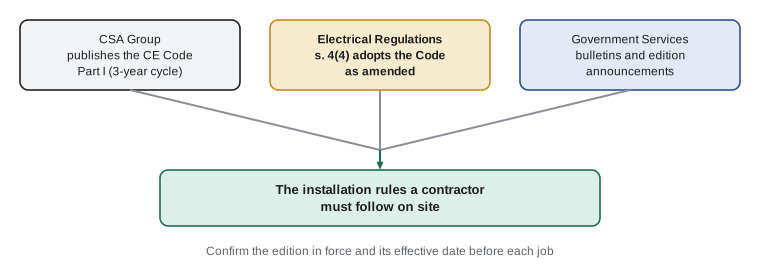
Section 4(4) of the Electrical Regulations sets the Canadian Electrical Code, Part I, as amended, as the standard for electrical work in the province. Two features of that wording matter.
- It adopts the Code as a standard for all electrical work. Every installation covered by the regulations must meet it, whether it needs a permit, is done under a maintenance permit or is certified by a contractor representative.
- It refers to the Code as amended, rather than naming a single edition in the regulation itself. When a new edition is published and the province moves to it, the regulation's wording does not need to change. The province announces which edition is in force, and when, through Government Services.
The second point means a contractor cannot answer the question which edition applies by reading the regulation alone. Krista has to look at the province's electrical bulletins and announcements, and at the edition dates that industry bodies track.
Which edition applies
The current national edition is the 2024 Canadian Electrical Code, Part I, the 26th edition. Electro-Federation Canada, an industry association that tracks adoption across the country, lists Newfoundland and Labrador as having adopted the 2024 edition in July 2024, making it one of the first provinces to move to the new edition. We could not find the province's own announcement while preparing this course, so confirm the edition and its effective date with Government Services or the electrical bulletins page before relying on it.
Transition rules matter as much as the effective date. Provinces usually say which edition applies to permits issued, or work started, before and after the change. A contractor bidding a job today that will be permitted next year should ask which edition will apply when the permit is issued. When a new edition is announced, the transition rule is the first thing to look for in the bulletin.
| Province or territory | Edition listed | Listed adoption |
|---|---|---|
| Newfoundland and Labrador | 2024 | July 2024 |
| Nova Scotia | 2024 | July 2024 |
| Prince Edward Island | 2024 | October 2024 |
| New Brunswick | 2024 | July 2026 |
| Quebec | 2021 (with Quebec amendments) | September 2026 |
The table shows why a contractor working near a border, or across several provinces, needs to check each one. A Labrador contractor who also takes work in Quebec, for example, would be working to different editions on the two sides of the border.
What changed in 2024, in outline
Each new edition brings hundreds of changes, most of them small. The 2024 edition continued the move toward electrical vehicle charging, energy storage and solar installations, revised rules on ground fault and arc fault protection, and updated many tables. The core courses cover the technical detail. For a contractor, the practical lesson is to update training, design templates and quoting assumptions whenever a new edition comes into force, and to make sure every journeyperson and apprentice has access to the current book.
Krista buys the 2024 edition for the office and a second copy for the truck, and books Derek and Jordan onto a code update course offered through the trade school in the fall. She also reviews the panel schedules and load calculation spreadsheets she will reuse, because a template built on an old edition can carry outdated assumptions into every new quote.
Bulletins and interpretations
Government Services publishes electrical bulletins. Bulletins can announce Code adoption, explain how the Chief Electrical Inspector applies a rule, set out administrative procedures, or address recurring installation problems. A contractor should treat bulletins as part of the rule book.
- Read every new bulletin when it is issued, and keep a file of current ones.
- When a bulletin interprets a rule, follow the interpretation on jobs in the province even if another province reads the rule differently.
- When a bulletin sets a procedure, such as how to apply for something or what documents to submit, build it into the office routine.
Rule 2-004 of the Code itself expects installations to be done under permits and inspected as the inspection authority requires, and the Electrical Regulations supply the provincial detail. When the Code leaves a decision to the authority having jurisdiction, the Chief Electrical Inspector and the inspectors at the Government Service Centres are that authority in Newfoundland and Labrador.
Certified equipment
Section 4(5) of the Electrical Regulations requires electrical equipment that is sold or installed in the province to be certified by a certification organization accredited by the Standards Council of Canada. This matches the Code's own requirement, in rule 2-024, that equipment be approved. In practice, equipment must carry a recognized certification mark, or have been field evaluated and labelled by an accredited inspection body.
The rule bites hardest with imported and online purchases. Krista's customers increasingly order light fixtures, EV chargers and heat pump controls online, and some of those products carry no Canadian certification mark. Leonard's advice is firm: check the mark before you install anything a customer supplies. An uncertified product can fail inspection, and installing it may break the regulations.
Worked problem
A customer-supplied charger
A customer in Clarenville has bought an EV charger online and asks Krista to install it. The box shows a European conformity mark but no Canadian certification mark. What should she do?
Show solution
- Section 4(5) requires equipment installed in the province to be certified by an organization accredited by the Standards Council of Canada.
- A European conformity mark is not a Canadian certification mark.
- Krista explains that she cannot install the charger unless it is certified or field evaluated by an accredited body, and offers to supply a certified charger instead.
- She notes the conversation in the customer file, in case the customer later claims she refused work without reason.
Answer: Do not install it as is. Either have it field evaluated by an accredited body, if that is practical and the customer agrees to the cost, or install a certified product.
Special permission for specialized equipment
Some equipment is so specialized that only the manufacturer's own staff can install and maintain it: medical imaging systems, some industrial process equipment, elevators and certain communications systems. Sections 4(1)(d) and 4(2) of the Electrical Regulations allow employees or agents of a company that supplies and maintains highly specialized equipment to apply to the Chief Electrical Inspector for permission to do that work. The permission covers only the work it specifies.
For an electrical contractor, special permission usually shows up on large commercial or institutional jobs. The contractor installs the building wiring and the supply to the equipment under its own permit, and the manufacturer's technicians connect and commission the equipment under their own permission. The contractor should know where its work ends and the manufacturer's begins, and should not assume the manufacturer's permission covers anything the contractor does.
The Code itself also contains a rule, 2-030, on deviations: where the inspection authority may allow an installation that departs from the Code if it is satisfied that safety is maintained. Requests of that kind go to the Chief Electrical Inspector and should be made in writing, with the reasons and supporting documents, before the work is done.
Keeping a Code library
Leonard's office had a shelf with the current Code, the previous edition, a binder of bulletins, the Electrical Regulations and the Mechanics' Lien Act. Krista keeps the same library, partly digital, and adds a simple rule: every quote and design notes the edition it was prepared under. If a job is delayed past an edition change, the note flags the design for review.
# Flag jobs whose design edition differs from the edition in force at permit time.
IN_FORCE = 2024          # confirm with Government Services before relying on it
jobs = [("Clarenville strip mall", 2024), ("Bonavista cabin", 2021), ("Shoal Harbour garage", 2024)]
for name, design_edition in jobs:
    flag = "OK" if design_edition == IN_FORCE else "REVIEW design against current edition"
print(f"{name:24s} designed to {design_edition}: {flag}")Clarenville strip mall designed to 2024: OK Bonavista cabin designed to 2021: REVIEW design against current edition Shoal Harbour garage designed to 2024: OK
A flagged job does not necessarily need major changes, but someone should check it against the edition in force before the permit application goes in.
Owning and using the Code
Owning the Code is a basic tool of the trade, as essential as a meter. A new contractor should keep a current copy in the office and make sure every crew can reach one on the job, whether printed or electronic. Older editions are worth keeping for reference when working on existing installations, but the edition in force when the work is done is the one that governs new work.
Using the Code well is a skill that grows with practice. The rules are organized by section, with general rules first and specific installations later, and the appendices contain explanatory notes that often clarify what a rule is meant to achieve. A good habit is to read the scope and the general rules of a section before looking up a specific rule, because the general rules often set conditions that change how the specific rule applies.
When the answer still is not clear, the right step is to ask the Government Service Centre before the work is done, not after the inspector has found it. Krista writes down the rule number, the question and the inspector's answer in the job file, so that the same question never has to be asked twice and the whole crew learns from every interpretation.
When editions change mid-job
Because section 4(4) adopts the Code as amended, a new edition can come into force while a contractor has jobs on the go. The transition arrangements for each edition are set when it is adopted, so a contractor should read the announcement and any bulletin carefully rather than assume. Questions worth settling for each open job are which edition applies, whether the permit date or the start of work decides it, and whether any changed rule affects equipment already ordered.
Krista keeps a short list of open permits with their dates, so that when a new edition is announced she can see at a glance which jobs might be affected and call the Government Service Centre about any that are close to the line.
Common mistakes
MistakeReading the Electrical Regulations alone to find the Code edition.
InsteadSection 4(4) adopts the Code as amended; the edition in force is announced by Government Services.
MistakeInstalling a customer-supplied product without a Canadian certification mark.
InsteadSection 4(5) requires equipment to be certified by an organization accredited by the Standards Council of Canada.
MistakeAssuming a manufacturer's special permission covers the contractor's wiring.
InsteadSpecial permission covers only the specified work; the contractor's work still needs its own permit.
MistakeIgnoring bulletins because they are not the Code.
InsteadBulletins announce adoption, interpret rules and set procedures; treat them as part of the rule book.
Summary and key terms
- Section 4(4) of the Electrical Regulations adopts the Canadian Electrical Code, Part I, as amended, as the standard for electrical work.
- The 2024 (26th) edition is listed by Electro-Federation Canada as adopted in the province in July 2024; confirm with Government Services.
- Government Services' electrical bulletins announce editions, interpret rules and set procedures.
- Section 4(5) requires equipment to be certified by an organization accredited by the Standards Council of Canada.
- Sections 4(1)(d) and 4(2) allow special permission for specialized equipment, limited to the work specified.
- CSA C22.1
- The Canadian Electrical Code, Part I, published by CSA Group.
- As amended
- Wording that adopts the Code as it is changed over time rather than naming one edition.
- Electrical bulletin
- A Government Services notice that announces, interprets or sets procedures under the Code and regulations.
- Certification mark
- A mark showing equipment is certified by an accredited certification organization.
- Special permission
- Permission from the Chief Electrical Inspector for specialized equipment work, limited to what it specifies.
- Authority having jurisdiction
- The body that enforces the Code; in this province, the Chief Electrical Inspector and the inspectors.
Practice problems
Work each problem on paper first, then reveal the answer to check.
Which section of the Electrical Regulations adopts the Canadian Electrical Code?
Show answer
Section 4(4).
Which edition does Electro-Federation Canada list as in force in Newfoundland and Labrador, and since when?
Show answer
The 2024 edition, since July 2024. Confirm with Government Services.
A customer supplies a light fixture with no Canadian certification mark. What rule applies?
Show answer
Section 4(5): equipment must be certified by an organization accredited by the Standards Council of Canada.
Who grants special permission for highly specialized equipment work?
Show answer
The Chief Electrical Inspector, under sections 4(1)(d) and 4(2).
Lesson quiz · 5 questions
Score 60% or more to complete this lesson.
Create a free account to save your progress, take quizzes and earn a certificate.