
MELC-210 · Lesson 1 of 12 · 22 min
How electrical work is regulated in Newfoundland and Labrador
▶ Video coming soon A video version of this lesson is on the way.
Every province regulates electrical work, and no two provinces do it the same way. In Newfoundland and Labrador the rules for electrical installations come from one short statute and one set of regulations: the Public Safety Act and the Electrical Regulations made under it, filed as Newfoundland and Labrador Regulation 120/96. The Act gives the provincial government the power to regulate electrical work and to appoint a Chief Electrical Inspector. The regulations do the detailed work: they adopt the Canadian Electrical Code, require a permit before electrical work starts, set out who may hold a permit, create the Electrical Contractor's Registration Certificate, and give the Chief Electrical Inspector the power to suspend or cancel certificates.
The single most important fact for anyone arriving at this course from the rest of the master electrician program is this: Newfoundland and Labrador registers electrical contractors, but it does not set a contractor exam. In Alberta, permits go to holders of a Master Electrician Certificate earned by passing a provincial exam. In Ontario, every licensed electrical contractor must employ a designated master electrician who has passed an exam set by the Electrical Safety Authority. Newfoundland and Labrador takes a different route. An electrical permit may be issued only to the holder of an Electrical Contractor's Registration Certificate, and that certificate is granted, on written application and payment of an annual fee, to a journeyperson electrician who holds a certificate of qualification, or to a company that employs one. The journeyperson certificate, earned through the trade certification exam, is the competence test. There is no separate contractor exam on top of it.
This course is therefore not an exam cram. It prepares a certified journeyperson electrician to register and run an electrical contracting business in Newfoundland and Labrador legally and well: how the certificate of qualification works and who may do electrical work, how the registration classes work, how the Code is adopted, how permits, fees and inspections work through the Government Service Centres, what the contractor representative program is, what the registered contractor answers for, and the contract, lien, safety and workers compensation law that surrounds every job. Lesson 12 closes with a readiness review in place of exam practice.
A word on sources. Everything in this course was checked in late 2026 against the provincial government's own pages, the published Electrical Regulations and Mechanics' Lien Act, WorkplaceNL's guidance and recognized legal summaries, and each lesson says where a detail is likely to change. Fees, forms and procedures change often. Before you register a business or rely on any deadline, confirm the current requirements with Government Services (part of Digital Government and Service NL), your nearest Government Service Centre, and the other bodies named in each lesson. As in the rest of the series, this course never reproduces the text or tables of the Canadian Electrical Code. Rule numbers are cited and explained in our own words.
Krista decides to go out on her own
Krista Walsh has been a Red Seal construction electrician for seven years. She apprenticed in Corner Brook, wrote her certification exam at the end of her apprenticeship, and has spent the last five years as a lead hand with Harbour Arm Electrical, a mid-size contractor in Mount Pearl. Her crews wire new houses, renovate older homes on the Avalon, fit out small commercial units and install heat pump circuits all over the northeast Avalon. For two years her customers have been asking whether she could take their jobs directly.
This spring she decides to start her own company, Walsh Electrical Ltd., based in Clarenville, where she grew up and where she sees steady work and few established contractors. Her husband, Mark Pike, keeps the books for a fishing supply business and will handle invoicing and payroll. Her old mentor, Leonard Hiscock, ran an electrical contracting company in Gander for thirty-four years before retiring, and he has promised to answer every question she brings him. A third-year apprentice from Harbour Arm, Jordan Penney, has asked to come with her, and an experienced journeyperson, Derek Abbott, will work for her three days a week.
Krista's cousin, Priya Raman, lives in Red Deer, Alberta, and has just written the Alberta Master Electrician Certificate exam. When Krista mentions her plans on a family call, Priya assumes Krista will have to write the same kind of exam. Krista isn't sure. Leonard is. In Newfoundland and Labrador, he tells her, there is no contractor exam. What matters is that the business holds an Electrical Contractor's Registration Certificate, that every permit is opened before work starts, that the work passes inspection, and that the business is set up properly. Krista has held her certificate of qualification for seven years. The legal gate is open as soon as she applies, pays the fee and receives her registration. Running the business properly is the hard part.
The law in two parts
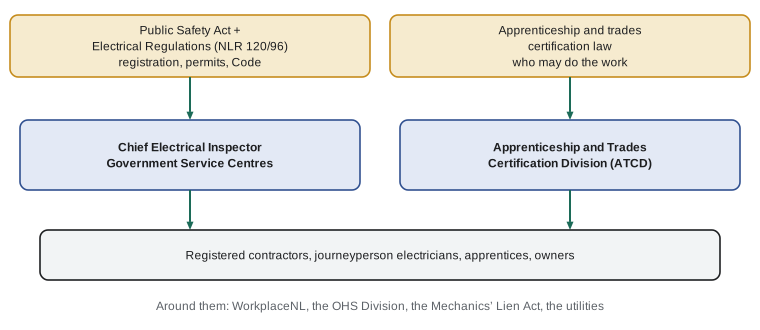
Leonard draws two boxes on the back of an invoice. The first box is about installations; the second is about people. Each shows up in different parts of a contractor's day.
- The Public Safety Act. This statute is the legal base for electrical safety in the province. It allows regulations to be made, provides for the appointment of inspectors and sets out the penalties for breaking the regulations. Section 15 of the Electrical Regulations makes any contravention an offence punishable on summary conviction under the Act.
- The Electrical Regulations (NLR 120/96). Made under the Act, these regulations adopt the Canadian Electrical Code Part I, as amended, as the standard for electrical work in the province (section 4). They require a permit before electrical work begins (section 8), create maintenance permits (section 9), create the Electrical Contractor's Registration Certificate and its classes (section 6), set up the contractor representative program (section 7) and give the Chief Electrical Inspector powers of suspension and cancellation (sections 11 to 13).
- Apprenticeship and trade certification law. A separate body of law, administered by the province's apprenticeship and trades certification office, governs apprenticeship, trade certification and the journeyperson certificate of qualification. The Electrical Regulations rely on it: an electrical certificate under the regulations requires an electrical certificate of qualification, such as an interprovincial (Red Seal) or provincial journeyperson certificate.
Leonard's point is that the first pair of laws is about installations and the businesses that do them, and the apprenticeship law is about individual workers. When a question begins with what an installation must meet, whether it needs a permit or how it is inspected, start with the Electrical Regulations. When it begins with who may do the work as a tradesperson, start with the apprenticeship and certification rules.
Who does what
Several organizations touch an electrical contractor's work. Krista writes them down as a set, because she knows she will be dealing with all of them in her first year.
- Government Services, Digital Government and Service NL. This branch of the provincial government administers the Electrical Regulations through the Chief Electrical Inspector. It registers electrical contractors, issues permits and maintenance permits, and publishes electrical bulletins and the list of registered contractors.
- The Government Service Centres. These regional offices receive permit applications, carry out electrical inspections, and issue connection authorizations and certificates of inspection on behalf of the Chief Electrical Inspector. Most of a contractor's day-to-day dealings are with the nearest Government Service Centre.
- The apprenticeship and trades certification office. Registers apprentices, runs trade certification exams and issues journeyperson certificates of qualification, including the construction electrician certificate that contractor registration depends on.
- The electric utilities. Newfoundland Power serves most customers on the island; Newfoundland and Labrador Hydro serves other areas, including much of Labrador and many rural and isolated systems. A utility connects or reconnects power once the electrical installation has been authorized; it does not issue electrical permits.
- WorkplaceNL and the OHS Division. WorkplaceNL provides workers compensation coverage and requires injury reports within three days. The Occupational Health and Safety Division enforces the Occupational Health and Safety Act and must be told immediately about serious injuries.
- Municipalities. Cities and towns issue building permits and business permits where they require them. A municipal building permit does not replace an electrical permit.
- The Registry of Companies and Deeds. Registers corporations and business names, which every contracting business needs before it starts trading.
| Organization | Main role for a contractor |
|---|---|
| Government Services (Chief Electrical Inspector) | Contractor registration, permits, bulletins, Code administration |
| Government Service Centres | Permit applications, inspections, connection authorizations |
| Apprenticeship and trades certification office | Certificates of qualification, apprentice registration |
| Newfoundland Power, NL Hydro | Connection of power once authorized |
| WorkplaceNL | Workers compensation coverage and injury reports |
| OHS Division | Workplace safety law and serious injury reports |
| Municipalities | Building permits and business permits |
| Registry of Companies and Deeds | Business and corporate registration |
Registration, not an exam
Krista's first instinct, after hearing about Priya's exam, is to look for the Newfoundland and Labrador equivalent of a contractor exam. Leonard stops her. The province's control point is the Electrical Contractor's Registration Certificate. The government's own electrical page says it plainly: an electrical permit may only be issued to a person who is the holder of an Electrical Contractor's Registration Certificate. No permit, no work, apart from the narrow exceptions Lesson 6 covers.
To hold the certificate, the applicant applies in writing and must hold, or employ a holder of, a journeyperson certificate of qualification in electrical construction. Section 6 of the Electrical Regulations creates three classes. A restricted certificate goes to an individual who holds an electrical certificate, or to a company that employs one. An unrestricted certificate goes to an individual who has held an electrical certificate for at least two years, or a company that employs such a person. A residential class covers holders of an older category of registration and certificates the Chief Electrical Inspector accepts. Lesson 3 explains each class and what it allows.
Compare that with Alberta, where Priya's certificate is a personal credential earned by a separate exam, and with Saskatchewan, where the business holds a contractor licence and needs a qualifying journeyperson and a bond. Newfoundland and Labrador sits between them. Like Saskatchewan, it registers the business and ties that registration to a certified journeyperson. Unlike Saskatchewan, the regulations do not require a contractor bond, and unlike Alberta, there is no exam.
| Province | What lets a business take out permits |
|---|---|
| Alberta | A Master Electrician Certificate, earned by passing a provincial exam |
| Ontario | An electrical contractor licence with a designated master electrician who passed an ESA exam |
| Saskatchewan | A contractor licence with a qualifying journeyperson (Red Seal held 2+ years) and a bond |
| Newfoundland and Labrador | An Electrical Contractor's Registration Certificate, tied to a certified journeyperson; no exam |
A worked example: who may do what
Worked problem
Matching people to permits and work
Walsh Electrical will have three people doing electrical work in its first month: Krista, Jordan the third-year apprentice, and Derek, a journeyperson who also does weekend work on his own. Who may apply for permits, and who may do the work?
Show solution
- Krista holds a journeyperson certificate of qualification, so Walsh Electrical Ltd. may apply for an Electrical Contractor's Registration Certificate based on her certificate. Once registered, it may apply for permits.
- Jordan may do electrical work as a registered apprentice, under supervision and within the apprentice-to-journeyperson ratio in the approved plan of training (section 4(6) of the regulations). He cannot hold a permit or work on his own as a contractor.
- Derek holds his own certificate of qualification, so he may do electrical work for Walsh Electrical. His weekend jobs are another matter: unless he holds his own contractor's registration, he cannot take permits for them, and work done without a permit is an offence.
- Advertising is also controlled. Section 4(3) of the regulations allows only registered contractors to advertise electrical contracting, and the advertisement must show the registered name and registration number.
Answer: Walsh Electrical may take out permits once it holds a registration certificate based on Krista's certificate of qualification. Jordan works under supervision; Derek's private weekend jobs need their own registration and permits.
A first look at the costs of compliance
Mark wants to know what the compliance side will cost before the company earns a cent. Leonard tells him the fixed items are modest compared with trucks and tools, but they recur every year and every job. The calculator below adds up a first-year compliance budget. The registration fee of 200 dollars a year is the province's published fee; the permit line uses the published residential rate of 1.20 dollars per ampere of service for a 200 A house. The other figures are illustrative and should be replaced with real quotes.
# First-year compliance budget for a new Newfoundland and Labrador contractor.
# Registration and the 200 A permit rate come from the provincial fee pages (check current fees);
# the other lines are illustrative only.
items = {
    "contractor registration (published, per year)": 200,
    "business registration (illustrative)": 300,
    "liability insurance (illustrative)": 2600,
    "WorkplaceNL assessment estimate (illustrative)": 2100,
    "new-house permits: 25 at 200 A x 1.20": round(25 * 200 * 1.20),
    "minor permits: 40 at the 60 minimum": 40 * 60,
}
for name, amount in items.items():
    print(f"{name:48s} {amount:7,d}")
print(f"{'total':48s} {sum(items.values()):7,d}")contractor registration (published, per year) 200 business registration (illustrative) 300 liability insurance (illustrative) 2,600 WorkplaceNL assessment estimate (illustrative) 2,100 new-house permits: 25 at 200 A x 1.20 6,000 minor permits: 40 at the 60 minimum 2,400 total 13,600
The permit lines grow with the volume of work. The contractor registration fee itself is small, and there is no bond required by the regulations, but the absence of an exam shifts more of the responsibility for doing things properly onto the business itself.
Why this structure matters
Most of the problems new contractors run into are not technical. They are administrative and legal: starting work before the permit is issued, covering wiring before it is inspected, letting an uncertified helper work alone, advertising before the registration arrives, assuming a homeowner can take out a permit for a contractor, or forgetting to tell the Chief Electrical Inspector when the only certified journeyperson leaves the company. Every one of those problems is easier to avoid if you can picture the law and the organizations around it.
The rest of the course builds that picture. Lesson 2 covers the certificate of qualification and who may do the work. Lessons 3 and 4 cover the registration certificate and how to get and keep it. Lessons 5 to 7 cover the Code as adopted, permits and fees, and inspections and the representative program. Lessons 8 to 10 cover the business, contract, lien and safety law. Lesson 11 covers the contractor's duties and discipline, and Lesson 12 is a readiness review.
Common mistakes
MistakeLooking for a Newfoundland and Labrador contractor exam or master electrician exam.
InsteadThere is none. The business needs an Electrical Contractor's Registration Certificate, granted on application to a certified journeyperson or a company that employs one.
MistakeAsking the utility for an electrical permit.
InsteadPermits come from Government Services through the Government Service Centres. Newfoundland Power or NL Hydro connects power once the work is authorized.
MistakeTreating a municipal building permit as covering the electrical work.
InsteadElectrical work needs an electrical permit under the Electrical Regulations; municipal building permits are separate.
MistakeAdvertising the new business before the registration certificate arrives.
InsteadOnly registered contractors may advertise electrical contracting, and ads must show the registered name and number.
Summary and key terms
- Electrical work in Newfoundland and Labrador is governed by the Public Safety Act and the Electrical Regulations (NLR 120/96).
- Government Services, through the Chief Electrical Inspector and the Government Service Centres, registers contractors, issues permits and inspects.
- There is no contractor exam; an electrical permit may be issued only to the holder of an Electrical Contractor's Registration Certificate.
- Registration is tied to a journeyperson certificate of qualification held by the applicant or an employee.
- Utilities connect power; WorkplaceNL, the OHS Division, municipalities and the Registry of Companies and Deeds each play a separate role.
- Electrical Regulations
- The regulations under the Public Safety Act (NLR 120/96) that adopt the Code and set permit and registration rules.
- Electrical Contractor's Registration Certificate
- The registration a business must hold before it can be issued electrical permits.
- Certificate of qualification
- The journeyperson trade certificate issued after the certification exam.
- Chief Electrical Inspector
- The provincial official responsible for administering the Electrical Regulations.
- Government Service Centre
- A regional government office that handles permits, inspections and connection authorizations.
- Electrical permit
- The permit that must be issued before electrical installation or repair work starts.
Practice problems
Work each problem on paper first, then reveal the answer to check.
Who issues electrical permits for a job in Clarenville?
Show answer
Government Services, through the Government Service Centre for the area; only a registered electrical contractor can be issued one.
Which regulations would you look in to find out when an electrical permit is required?
Show answer
The Electrical Regulations, NLR 120/96, made under the Public Safety Act.
Priya says Krista must pass a contractor exam before she can open permits. Is that right?
Show answer
No. Newfoundland and Labrador has no contractor exam; Krista's business needs an Electrical Contractor's Registration Certificate, granted on application.
Name the two main electric utilities in the province.
Show answer
Newfoundland Power and Newfoundland and Labrador Hydro.
Lesson quiz · 5 questions
Score 60% or more to complete this lesson.
Create a free account to save your progress, take quizzes and earn a certificate.