
MELC-210 · Lesson 11 of 12 · 19 min
Duties, discipline and staying compliant
▶ Video coming soon A video version of this lesson is on the way.
Getting registered is a single event. Staying registered is a habit. A Newfoundland and Labrador electrical contractor carries continuing duties under the Electrical Regulations: to keep a qualified certificate holder, to take out permits, to use certified equipment, to advertise honestly, to keep records and to renew on time. The Chief Electrical Inspector, in turn, has powers to suspend or cancel certificates and to disqualify representatives. This lesson gathers those duties in one place, explains how discipline works, and ends with a compliance routine a small business can actually keep.
The section references are to the Electrical Regulations, NLR 120/96, made under the Public Safety Act, as read in late 2026. Penalties for offences are set by the Public Safety Act and can change, so this lesson describes them generally. Check the current Act and regulations before relying on any detail.
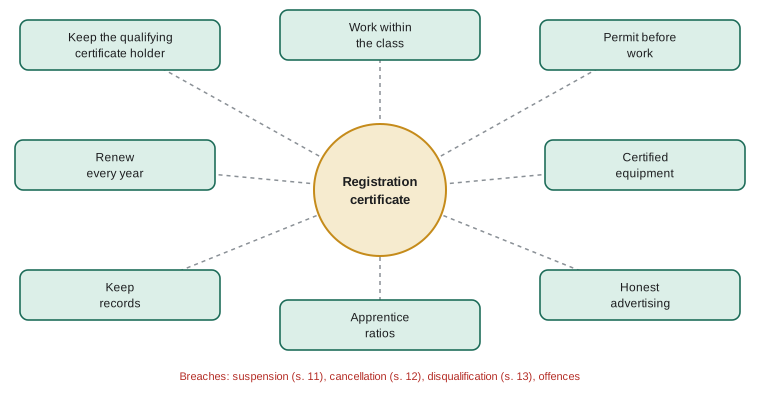
The continuing duties of a registered contractor
Most of these duties were introduced earlier in the course. Here they are as one list, because a contractor is expected to meet all of them all the time, not just at renewal.
- Keep the qualifying certificate holder. The registration rests on a person: the owner or an employee who holds the right certificate. If that person leaves, the contractor must notify the Chief Electrical Inspector immediately (section 6(4)), and the registration cannot simply carry on as if nothing had happened.
- Work within the class. An unrestricted, restricted or residential registration allows only the work its class allows (section 6). Taking a job outside the class is not a paperwork slip; it is work without the right registration.
- Take out a permit before work begins. Section 8 requires a permit before electrical work starts, posted at the site, with the panel labelled. Maintenance work at a plant or building is covered by a maintenance permit only where one has been issued (section 9).
- Use certified equipment. Section 4(5) requires electrical equipment to be certified by an organization accredited by the Standards Council of Canada, or otherwise approved.
- Advertise honestly. Section 4(3) controls how a contractor may advertise. Advertisements should name the registered business and must not suggest the business may do work its registration does not allow.
- Follow the apprentice ratios. Apprentices work under supervision in the ratio set by their plan of training (section 4(6)).
- Keep records. A maintenance permit holder keeps a record of repairs for two years (section 9(4)). Good practice is to keep permit, inspection and certification records for every job for much longer.
- Renew on time. The registration certificate is renewed yearly for the published fee. A lapse means the business cannot be issued permits until it is put right.
Losing the qualifying person
The most common way a small contractor drifts out of compliance is not a dramatic violation but a staffing change. Walsh Electrical is registered on Krista's own qualification. If she were seriously injured and off work for months, the company would still hold its registration, but the question of who is actually directing and certifying the work would become urgent. If a company registered on an employee's certificate loses that employee, section 6(4) requires immediate notice.
Krista and Leonard talk the scenario through. Derek is a certified journeyperson whose certificate was first issued in June 2023. As Lesson 2 showed, by November 2026 he has held it for more than the two years that section 6(2) asks of the qualifying person for an unrestricted registration. Krista writes a short contingency note: if she cannot work, Derek steps in as the qualifying person, and Mark notifies the Chief Electrical Inspector the same day.
# When does a journeyperson reach two years as a certificate holder?
from datetime import date

def two_years_after(d):
    return date(d.year + 2, d.month, d.day)

derek_cert = date(2023, 6, 2)       # from Lesson 2 (illustrative)
opening = date(2026, 11, 10)        # Walsh Electrical opens (illustrative)
reached = two_years_after(derek_cert)
print("Derek reaches 2 years as holder:", reached)
print("Reached before the business opens:", reached <= opening)Derek reaches 2 years as holder: 2025-06-02 Reached before the business opens: True
The arithmetic is trivial. The value is in doing it before the day it matters.
Suspension, cancellation and disqualification
The Electrical Regulations give the Chief Electrical Inspector three disciplinary tools.
- Suspension (section 11). A certificate, including a contractor's registration certificate, may be suspended for just cause. A suspension stops the holder from relying on the certificate for its duration.
- Cancellation (section 12). A certificate may be cancelled for just cause. A cancelled registration means the business can no longer be issued permits until it qualifies and registers again.
- Disqualification of a representative (section 13). A designated representative may be disqualified for one year, ending their ability to certify the contractor's work.
The regulations do not try to list every kind of just cause, and this course does not try either. The patterns that get contractors into trouble are easy to recognize: working without permits, working outside the registration class, certifying work not seen, covering work before a required inspection, continuing to operate after losing the qualifying person, and ignoring orders to correct deficiencies.
| Tool | Who it affects | Effect |
|---|---|---|
| Suspension (s. 11) | Certificate holders, including contractors | Certificate cannot be relied on for the period of suspension |
| Cancellation (s. 12) | Certificate holders, including contractors | Certificate ends; a new registration would be needed |
| Disqualification (s. 13) | Designated representatives | Cannot certify work for one year |
Offences
Breaking the Electrical Regulations can also be an offence under the Public Safety Act, prosecuted in provincial court. Fines and other penalties are set by the Act rather than the regulations, and they can be significant. Beyond the fine, a conviction can feed into a suspension or cancellation decision, can be raised by insurers at renewal, and can be used against the contractor in a civil claim after a fire or injury.
Leonard's view is blunt: the fine is the least of it. The real cost of a serious violation is the customer who never calls again, the general contractor who drops you from their bid list and the insurer who doubles your premium.
Responding to an order or an audit finding
Inspectors and auditors find problems; that is their job. What matters is the response.
Worked problem
An audit finding on a representative's job
Eighteen months after opening, Krista has been designated as Walsh Electrical's representative. A Government Service Centre audit of a residential job she certified finds a missing bonding jumper at the water service and an unlabelled circuit in the panel. What should she do?
Show solution
- Acknowledge the finding promptly and in writing, and fix both items at no cost to the customer.
- Ask the auditor to confirm the correction, or provide photos if that is acceptable.
- Find out why it happened: was the bonding jumper on the job checklist, and did she actually look at it before certifying?
- Update the checklist and her own certification routine so the same items cannot be missed again, and brief the crew.
Answer: Correct the work, confirm the correction, fix the cause in the procedure, and keep a record. A clean response to a minor finding builds trust in the representative's work.
Arguing with every finding, or fixing only the symptom, is how minor findings turn into a pattern, and a pattern is what leads to suspension or disqualification.
Keeping current with the Code and bulletins
Compliance is not only about paperwork. The Canadian Electrical Code is revised every three years, and the province may adopt each new edition with amendments and publish bulletins and interpretations in between. A contractor who wires to an old edition is out of compliance even with perfect paperwork.
- Watch for the adoption of each new Code edition and its effective date in Newfoundland and Labrador.
- Read Government Services' electrical bulletins and notices when they are issued.
- Budget for Code update training for every certificate holder in the business, and for new Code books.
- Pass changes on to the crew through toolbox talks, and update job checklists.
A compliance routine for Walsh Electrical
Mark turns the duties into a calendar and a checklist, which Krista reviews once a month.
| Frequency | Task |
|---|---|
| Every job | Permit before work; posted on site; inspections booked; records filed |
| Weekly | Open permits reviewed; deficiencies tracked; safety talk held |
| Monthly | Compliance checklist reviewed; maintenance permit records updated; advertising checked |
| Yearly | Registration renewed; insurance renewed; WorkplaceNL payroll reported; corporate annual return filed |
| Each Code cycle | New edition and amendments reviewed; training booked; checklists updated |
| Any staffing change | Qualifying person confirmed; Chief Electrical Inspector notified immediately if required |
Records worth keeping
Good records are the cheapest protection a contractor has. The regulations require some, such as the two-year repair record for a maintenance permit, but a careful business keeps far more. Walsh Electrical keeps, for every job: the contract and change orders, the permit and any plans, inspection results and deficiencies corrected, representative certifications once Krista is designated, photographs of work before it is covered, material invoices for major equipment, and the hours each person worked.
Keep them for a long time. Claims for defective work can arise years after a job, and the limitation periods that apply are set by general law, not by the electrical rules. Ask a lawyer how long to keep job files, and lean towards keeping them longer rather than shorter. Electronic storage makes that cheap; a photograph of a rough-in taken on the day can settle an argument a decade later.
When the business changes
Registration is tied to a particular business and a particular qualifying person, so changes to either deserve a call to Government Services. Incorporating a sole proprietorship, changing the company name, moving the business address, adding a partner, or changing who qualifies the business may each affect the registration. Losing the qualifying employee must be reported immediately under section 6(4); for other changes, ask Government Services what notice or new application they need, and do it before the change takes effect rather than at renewal.
The same discipline applies when the business wants to grow into new work. Before taking on a type of installation the business has not done before, check that the class covers it, that someone on the crew has the experience, and that the insurance policy does not exclude it.
Handling customer complaints
Complaints are a compliance issue as well as a customer service one. A homeowner who believes the work is unsafe may call the Government Service Centre, and an inspector may visit. The best defence is a prompt, respectful response: listen, look at the work, fix anything that is wrong, and explain clearly anything that is not. Record the complaint and the response in the job file. A contractor that treats every complaint as an opportunity to check its own work rarely sees a complaint turn into an order.
Krista adds one more habit after her first complaint. Every customer receives, at the end of the job, a short letter listing the work done, the permit number, the inspection or certification date and a phone number to call with any concern. Customers rarely call, but those who do call the contractor first, not the Government Service Centre, and the contractor gets the chance to put things right before anyone else is involved.
Common mistakes
MistakeCarrying on after the qualifying employee leaves.
InsteadSection 6(4) requires immediate notice to the Chief Electrical Inspector.
MistakeTaking an industrial job on a residential registration.
InsteadThe registration class limits the work the contractor may do.
MistakeLetting the registration lapse because the renewal reminder went to an old email address.
InsteadKeep contact details current and put the renewal on the compliance calendar.
MistakeTreating an audit finding as a one-off fix.
InsteadFix the cause as well as the item, and keep a record of the correction.
Summary and key terms
- A registered contractor must keep a qualifying certificate holder, work within its class, take permits before work, use certified equipment, advertise honestly, follow apprentice ratios, keep records and renew yearly.
- Losing the qualifying employee must be reported immediately (s. 6(4)).
- Certificates may be suspended (s. 11) or cancelled (s. 12) for just cause, and a representative may be disqualified for one year (s. 13).
- Breaches can also be offences under the Public Safety Act, with penalties set by that Act.
- Staying compliant includes keeping up with each Code edition, its provincial amendments and bulletins.
- Qualifying person
- The certificate holder on whom a contractor registration rests.
- Just cause
- A sufficient reason, such as a serious or repeated breach, for suspending or cancelling a certificate.
- Suspension
- A temporary stop on relying on a certificate.
- Cancellation
- The ending of a certificate.
- Disqualification
- The removal of a representative's designation, under section 13 for one year.
- Audit finding
- A deficiency found in a review of work certified by a representative.
Practice problems
Work each problem on paper first, then reveal the answer to check.
What must a contractor do immediately if its qualifying employee leaves?
Show answer
Notify the Chief Electrical Inspector (s. 6(4)).
How long does a representative's disqualification under section 13 last?
Show answer
One year.
Which Act sets the penalties for offences under the Electrical Regulations?
Show answer
The Public Safety Act.
Name three items on a yearly compliance calendar.
Show answer
Any three of: registration renewal, insurance renewal, WorkplaceNL payroll report, corporate annual return.
Lesson quiz · 5 questions
Score 60% or more to complete this lesson.
Create a free account to save your progress, take quizzes and earn a certificate.