
MELC-210 · Lesson 7 of 12 · 19 min
Inspections, connections and the contractor representative program
▶ Video coming soon A video version of this lesson is on the way.
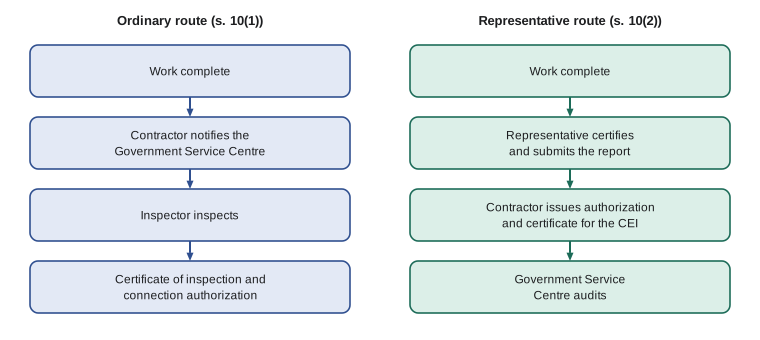
A permit opens a job; an inspection or a certification closes it. In Newfoundland and Labrador there are two ways an installation can be confirmed as meeting the Code. In the ordinary case, the contractor tells the Government Service Centre the work is complete, and an inspector inspects and certifies it. In the second case, a contractor that has a designated representative certifies its own work, subject to audit, and issues connection authorizations and certificates of inspection on behalf of the Chief Electrical Inspector. This lesson explains both routes, what happens when work fails, how power gets connected, and how a contractor can qualify for the representative program.
The rules come from sections 7 and 10 of the Electrical Regulations and from Government Services' page on the Electrical Contractor's Representative Inspection Report.
The ordinary route: inspection by the Government Service Centre
Section 10(1) sets out the ordinary route. Where a contractor does not have a representative, the contractor notifies the Government Service Centre when the work is complete, and the Centre inspects and certifies the work. In practice, many jobs also need inspections at earlier stages, such as rough-in before walls and ceilings are closed, and the Government Service Centre will tell the contractor which stages it wants to see.
Krista's habit, learned from Leonard, is to ask at the time of the permit which inspections the inspector expects for that kind of job, and to write them into the job schedule. For a new house, that usually means a rough-in visit before insulation and drywall and a final visit before occupancy. For a service change, it may be a single visit. Asking up front saves the awkward call when drywall is already on the truck.
- Notify on time. Tell the Government Service Centre as soon as a stage is ready, and give the inspector clear access.
- Keep the site ready. Have the permit posted, the panel schedule filled in, covers off where the inspector will want to look, and a person on site who knows the job.
- Do not cover uninspected work. Covering work before a required inspection invites an order to uncover it, at the contractor's cost.
When work fails
An inspector who finds a deficiency will tell the contractor what must be corrected. Minor items may be fixed and confirmed on the spot or at a quick return visit; larger problems may hold up the connection of power until they are corrected and re-inspected. The fee policy charges for extra visits: a requested or additional residential inspection costs 60 dollars plus HST, and commercial special inspections and re-inspections cost 108 dollars per hour plus expenses, at time and a half with a three-hour minimum outside regular hours.
Those fees are the smallest part of the cost. A failed inspection on a new house can delay the customer's move-in, the lender's draw and the next trade on site. Krista tracks every deficiency she receives, by type, so that she can fix the cause, not just the symptom.
# Count inspection deficiencies by type to find the causes worth fixing first.
from collections import Counter

deficiencies = [
    "box fill", "missing bonding jumper", "panel schedule blank", "box fill",
    "GFCI missing", "panel schedule blank", "box fill", "cable not secured",
]
for kind, n in Counter(deficiencies).most_common():
print(f"{kind:24s} {n}")box fill 3 panel schedule blank 2 missing bonding jumper 1 GFCI missing 1 cable not secured 1
Three box-fill deficiencies in a month tell Krista that someone on the crew is packing too many conductors into device boxes. A short toolbox talk and a box-fill table taped inside the truck door fix the cause.
Connection of power
A utility connects or reconnects power only when the installation has been authorized. In the ordinary route, the Government Service Centre issues the connection authorization and the certificate of inspection on behalf of the Chief Electrical Inspector. Under section 8(2), the Chief Electrical Inspector may refuse to authorize a connection until other applicable legislation has been satisfied, so a connection can also be held up for reasons that have nothing to do with the wiring.
Newfoundland Power and Newfoundland and Labrador Hydro each have their own procedures for scheduling connections, meter installations and after-hours reconnections. A contractor should know the utility's process for the area of each job, and should never energize, or let anyone else energize, a new installation before the authorization is in place.
The representative program
The contractor representative program lets a contractor certify all or portions of its own installations. Government Services describes it this way: contractors who have been designated under section 7 of the Electrical Regulations may certify their work, and the designation appears on the contractor's Electrical Registration Certificate. The certifications are subject to audit by the Government Service Centre, and no fee is charged for the representative inspection report.
The representative program is the reason the Government Service Centre does not need to inspect every single installation in a province with a large area and a scattered population. It puts responsibility for certifying routine work on qualified, experienced people inside registered contractors, and keeps the government's role as auditor.
| Feature | Ordinary route | Representative route |
|---|---|---|
| Who confirms the work | Government Service Centre inspector | The contractor's designated representative |
| Paperwork | Contractor notifies on completion | Representative submits the inspection report |
| Connection authorization and certificate of inspection | Issued by the Government Service Centre | Issued by the contractor on behalf of the Chief Electrical Inspector |
| Government role | Inspects | Audits; may require partial inspections |
| Fee for the report | Permit fees apply | No fee for the representative report |
Who can be a representative
Section 7(2) sets the qualifications for a representative. A representative must hold an electrical certificate, be employed by a registered contractor, and have either four years of relevant experience, or an engineering degree with two years of related experience and membership in the professional body. Section 7(1) also allows the Chief Electrical Inspector to require a contractor to certify work through an appointed representative.
When a representative is approved, section 7(4) provides that the representative receives a registration certificate stating the scope of work they may certify. Scope matters. A representative approved for residential work may not certify an industrial installation; a representative approved for some classes of work may still need the Government Service Centre for others.
Worked problem
Is Krista eligible to be a representative?
Krista has held her construction electrician certificate of qualification for seven years and has worked full-time in the trade throughout. Walsh Electrical Ltd. will be a registered contractor. Could she be designated as its representative?
Show solution
- She holds an electrical certificate based on her certificate of qualification.
- She will be employed by a registered contractor, Walsh Electrical Ltd.
- She has well over four years of relevant experience.
- She therefore appears to meet section 7(2). Designation is still at the Chief Electrical Inspector's discretion, and the scope will be written on her representative certificate.
Answer: On the facts, she appears to meet the qualifications in section 7(2). Whether, and for what scope, she is designated is decided by the Chief Electrical Inspector.
How a representative certifies work
When work certified by a representative is complete, section 10(2) requires the representative to certify it and submit a form to the Chief Electrical Inspector confirming that it complies with the Code. Government Services calls the form the Electrical Contractor's Representative Inspection Report, and requires it to be submitted before the contractor issues connection authorizations or certificates of inspection on behalf of the Chief Electrical Inspector.
Sections 10(3) and 7(9) allow partial inspections to be required even where a representative is in place. The Chief Electrical Inspector may want an inspector to see certain stages, certain kinds of work, or a sample of a new representative's jobs. A representative should never assume that designation means the Government Service Centre will not visit.
- Inspect your own work as an inspector would, against the Code, the regulations and current bulletins, not against what the crew says they did.
- Submit the report first, and only then issue the connection authorization or certificate of inspection.
- Keep records of every certification: what was checked, when, by whom, and any deficiencies corrected.
- Expect audits, and welcome them as a check on the crew's work.
When the representative system goes wrong
Self-certification carries real responsibility. Section 13 allows the Chief Electrical Inspector to disqualify a representative for one year, and sections 11 and 12 allow certificates to be suspended or cancelled for just cause, including a contractor's registration. A representative who certifies work they have not seen, or signs off on known defects to keep a customer happy, risks the business's registration as well as their own designation. Lesson 11 covers discipline in detail.
Leonard was a representative for twenty years. His rule was never to sign anything he had not looked at with his own eyes, and to treat each audit visit as a free second opinion. In twenty years he had two audit findings, both minor, and his designation was never questioned.
Should a new contractor apply?
For a brand-new business, the representative program is worth considering but not urgent. Leonard's advice to Krista is to spend the first year working through the ordinary route, learning how the local inspectors read the Code and building a record of clean inspections, and then to apply for designation with that record behind her. Krista agrees, and adds a note to her registration file to revisit the question in a year.
Preparing for an inspection visit
An inspector's visit is short, and a well-prepared site makes the most of it. Before each visit, Krista's crew walks the job with the inspector's eyes: the permit posted where it can be seen, the panel schedule filled in, device boxes accessible, bonding visible, cables secured and labelled, and the plans on site where plans were required. Someone who knows the job is there to answer questions, and the crew has the tools to open anything the inspector asks to see.
If the inspector writes a deficiency, the crew does not argue on site. They record exactly what was found, ask for the Code rule if it is not clear, and fix it promptly. Disagreements, when they happen, are taken up calmly afterwards, with the rule open on the table.
Working with the utility
The utility is the last step in every new service, and a contractor who knows its process saves the customer days. In most of the province that means Newfoundland Power; in many rural and Labrador communities it means Newfoundland and Labrador Hydro. Each has its own requirements for meter locations, service entrance details and scheduling, and each publishes guidance for contractors.
Leonard's advice is to read the utility's service requirements before quoting any service work, not after, and to book connections as early as the authorization allows. A missed connection date can leave a family without power on moving day, and the customer will remember the contractor, not the utility.
Common mistakes
MistakeEnergizing a new installation before the connection authorization is issued.
InsteadPower is connected only once the installation is authorized, through the inspector or a designated representative.
MistakeIssuing a connection authorization before submitting the representative inspection report.
InsteadGovernment Services requires the report to be submitted before the contractor issues connection authorizations or certificates of inspection.
MistakeCertifying work outside the scope on the representative certificate.
InsteadSection 7(4) limits a representative to the scope stated on their registration certificate.
MistakeAssuming a designated representative's jobs will never be inspected.
InsteadPartial inspections may be required (s. 10(3) and s. 7(9)), and all certifications are subject to audit.
Summary and key terms
- Without a representative, the contractor notifies the Government Service Centre on completion, and the Centre inspects and certifies the work (s. 10(1)).
- Re-inspection fees are 60 dollars plus HST for residential and 108 dollars per hour for commercial work, under the published policy.
- A designated representative may certify all or part of the contractor's work, subject to audit, with no fee for the report.
- A representative needs an electrical certificate, employment with a registered contractor, and four years of relevant experience, or an engineering degree with two years and professional membership (s. 7(2)).
- The representative inspection report must be submitted before the contractor issues connection authorizations or certificates of inspection.
- Certificate of inspection
- The document confirming an installation has been inspected or certified as meeting the Code.
- Connection authorization
- The authorization that allows the utility to connect or reconnect power.
- Contractor representative
- A qualified person designated under section 7 to certify a registered contractor's work.
- Representative Inspection Report
- The form a representative submits to confirm certified work complies with the Code.
- Audit
- The Government Service Centre's review of work certified by representatives.
- Partial inspection
- An inspection of part of a job, which may be required even where a representative is in place.
Practice problems
Work each problem on paper first, then reveal the answer to check.
Under the ordinary route, what must the contractor do when the work is complete?
Show answer
Notify the Government Service Centre, which then inspects and certifies the work (s. 10(1)).
List the qualifications for a representative under section 7(2).
Show answer
An electrical certificate, employment by a registered contractor, and four years of relevant experience, or an engineering degree with two years of related experience and professional membership.
What is the published fee for an additional residential inspection?
Show answer
60 dollars plus HST.
What must happen before a contractor with a representative issues a certificate of inspection?
Show answer
The representative inspection report must be submitted.
Lesson quiz · 5 questions
Score 60% or more to complete this lesson.
Create a free account to save your progress, take quizzes and earn a certificate.