
MELC-206 · Lesson 9 of 12 · 20 min
Contracts and legal construction hypothecs in Quebec
▶ Video coming soon A video version of this lesson is on the way.
Every other jurisdiction course in this program has a lesson on builders' liens or construction liens. Quebec is different, because its private law is civil law rather than common law. The Civil Code of Québec governs contracts, and the security that protects people who take part in construction is a legal hypothec, an hypothèque légale de la construction, rather than a lien under a separate statute. The goal is similar: to give unpaid contractors, subcontractors, workers and suppliers a claim on the property they improved. The mechanics are different, and the deadlines are short. This lesson covers both the contract side and the hypothec side, then the prompt payment regime that now applies to public construction contracts.
The Civil Code articles and procedures summarized here are the ones most often relevant to a small electrical contractor. Construction law is a specialty, and the deadlines have been the subject of many court decisions. When a significant amount is at stake, a contractor should get advice from a construction lawyer early, while the deadlines can still be met.
The contract of enterprise
In the Civil Code, a contract to carry out construction work is a contract of enterprise. The contractor undertakes to carry out physical work for a client for a price, and chooses the means of doing it, without a relationship of subordination to the client. The Code sets rules for the information the contractor must give, the price, changes, acceptance of the work and the contractor's liability for defects. Many of these rules can be supplemented by the written contract, but some protect clients and cannot be set aside.
Two kinds of price are common. A fixed price, or lump sum, is agreed in advance for the described work, and the contractor generally cannot claim more unless the work changes. An estimate on a cost basis gives the client a figure that the final price can differ from, within limits; a contractor who goes well beyond an estimate must be able to justify the increase. On small residential jobs, a clear written quote that states what is included and excluded prevents most disputes. Consumer protection rules also apply when the client is a consumer.
| Contract feature | Good practice for a small electrical contractor |
|---|---|
| Description of work | List what is included and what is excluded, with locations and quantities |
| Price | State whether it is a fixed price or an estimate, and what changes it |
| Changes | Get a written change order with price and time before doing extra work |
| Deposits | Take only a reasonable deposit and record it |
| Payment terms | State the schedule, the holdback if any, and the dates |
| Licence number | Show the licence number on the quote and contract |
Changes and extras
Most disputes on small jobs come from work that changed without a clear agreement. A client asks for six more receptacles during a visit, the crew installs them, and the invoice surprises the client. The fix is cheap: a short written change order, signed or confirmed by email, that describes the change, the price and any effect on the schedule. Émilie requires her lead hands to send a change order before any extra work over a small threshold, and to note smaller changes in the daily log with the client's approval.
On larger projects, the general conditions of the contract usually set the change process in detail, including notice periods for claims. Missing a contractual notice deadline can defeat an otherwise valid claim, so the project management répondant must know the conditions of every significant contract.
Holdbacks
Quebec has no statute that imposes a holdback on private construction contracts in the way Ontario's Construction Act or Alberta's prompt payment and lien statute does. Holdbacks are nevertheless common in practice: owners and general contractors often retain a share of each payment, frequently ten in every hundred dollars, until acceptance of the work or the end of the hypothec period. Where a holdback applies, it comes from the contract, so read the contract to know how much is retained, when it is released and what conditions apply.
The legal construction hypothec
The Civil Code gives a legal hypothec on an immovable to persons who took part in its construction or renovation: the architect, the engineer, the suppliers of materials, the workers, the contractor and the subcontractors. The hypothec secures the amounts owed for the work they did or the materials they supplied. It exists without a contract with the owner granting it, which is why it is called a legal hypothec. But it only survives if its holder takes the steps the Code requires within the deadlines.
The first deadline is the one most often missed. Article 2727 of the Civil Code requires the hypothec to be published, by registering a notice in the land register, within 30 days after the work is completed. A hypothec published after the deadline is invalid. Courts decide the completion date on the facts: completion generally occurs when the whole contracted work is done, including minor work that logically continues it, and correcting defects does not postpone it. There is one completion date for the whole project, even when there are several subcontractors, and abandonment of the site with no intention of returning can count as completion.
Persons who did not contract directly with the owner, such as subcontractors and suppliers, must also have denounced their contract to the owner, in writing, for the hypothec to protect them. Denunciation tells the owner who is working on the property, so that the owner can protect itself when paying the general contractor. A subcontractor that denounces its contract early protects work done from then on; work done before the denunciation may not be protected. Many subcontractors send the denunciation as soon as they sign their subcontract.
Once published, the hypothec must be enforced or it lapses. The Code requires its holder, within six months after the work is completed, to publish a prior notice of the exercise of a hypothecary right or to bring an action to have the claim recognized, and to publish a notice of that action. A hypothec that is not followed up within that period is extinguished. The hypothec also has a limit: it secures only the value added to the immovable by the work or materials, which is a common point of dispute when the amount claimed is large.
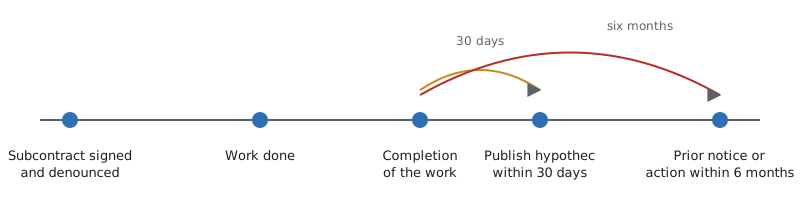
| Step | Who | When |
|---|---|---|
| Denounce the contract to the owner in writing | Subcontractors, suppliers and others without a contract with the owner | As early as possible, preferably when the subcontract is signed |
| Publish the hypothec in the land register | The holder of the claim | Within 30 days after the work is completed |
| Publish a prior notice of exercise, or sue and publish notice of the action | The holder of the published hypothec | Within six months after the work is completed |
Worked problem
An unpaid subcontract at a fourplex
Électrique Rivière-du-Nord is the electrical subcontractor on a fourplex for a general contractor. It denounced its subcontract to the owner in writing on the day it signed. The work on the whole building was completed on 15 August. On 1 September, the general contractor still has not paid the final 22,000 dollars. What deadlines matter?
Show solution
- Because the denunciation was sent when the subcontract was signed, the work done is covered by it.
- The hypothec must be published within 30 days after completion: by 14 September.
- If it is published in time, a prior notice of exercise must be published, or an action brought and noticed, within six months after completion: by 15 February.
- The amount secured is limited to the value the work added to the building.
Answer: Publish by 14 September, then act by 15 February, or the hypothec is lost.
from datetime import date, timedelta
import calendar

def add_months(d, months):
    y, m = divmod(d.month - 1 + months, 12)
    y, m = d.year + y, m + 1
    return date(y, m, min(d.day, calendar.monthrange(y, m)[1]))

completion = date(2026, 8, 15)
publish_by = completion + timedelta(days=30)
act_by = add_months(completion, 6)
print("Work completed:          ", completion)
print("Publish hypothec by:     ", publish_by)
print("Prior notice or action by:", act_by)Work completed: 2026-08-15 Publish hypothec by: 2026-09-14 Prior notice or action by: 2027-02-15
The calculator counts calendar days from the completion date in the example. In a real file the completion date itself is often disputed, so leave a margin and get legal advice before relying on a last-day calculation.
Prompt payment for public construction contracts
Quebec ran a prompt payment pilot project for public construction contracts from 2 August 2018 to 1 August 2021. A permanent regulation on payments and rapid dispute resolution for construction work contracts took effect on 8 September 2025. It sets up a mandatory payment schedule and allows disputes to be referred during the work to an accredited third-party decider, a tiers décideur, for a quick decision. The Minister of Justice designates the bodies that accredit deciders and keeps a register of accredited deciders.
The regime is aimed at public construction contracts and the subcontracts under them. It does not, as described on the government page reviewed for this course, apply to purely private contracts in the way Ontario's or Alberta's prompt payment statutes do. An electrical contractor working on a school, a hospital or another public project should read the payment and dispute provisions in the tender documents and the regulation, because the deadlines for invoices, notices of non-payment and referrals to a decider are short and are applied strictly.
Legal warranties
Beyond the contract price, the Civil Code makes contractors liable for certain defects after the work is accepted, including a warranty against the loss of the work caused by defects in design, construction or the ground for a period after the work ends, and a warranty against poor workmanship discovered within a shorter period. These warranties are separate from the licence bond's one-year window and can run longer. The details and periods are in the Code; the practical point is that a contractor's responsibility for an installation does not end when the invoice is paid.
Practical steps for an electrical subcontractor
Most small electrical contractors will never need to enforce a hypothec, but they should be ready to. A simple office routine covers most risks. When a subcontract is signed, send the denunciation to the owner in writing and keep proof of delivery. Track the expected completion date of the whole project, not just the electrical part. Invoice promptly and follow up overdue amounts early. If a significant amount is still unpaid as completion approaches, call a construction lawyer while the 30-day window is still open.
Owners also have tools. An owner who receives a denunciation can hold back from the general contractor the amounts owed to the denouncing subcontractor, or pay the subcontractor directly with the general contractor's agreement, to protect the property from a hypothec. Knowing this helps a subcontractor understand why a denunciation often leads to payment without any legal proceedings.
Retention and final payment
Where a contract provides for a holdback, the final payment usually depends on acceptance of the work and the end of the period during which hypothecs can be published. Read the contract for what triggers release, keep the documents that prove completion, and diarize the release date. A holdback that is never chased is sometimes never paid.
Common mistakes
MistakeCalling the Quebec remedy a builders' lien and looking for a lien statute.
InsteadQuebec uses the legal construction hypothec in the Civil Code.
MistakeWaiting until the job ends to send the denunciation.
InsteadSubcontractors and suppliers should denounce their contract to the owner in writing as early as possible.
MistakeCounting the 30 days from the last invoice date.
InsteadThe 30 days run from completion of the work, which courts decide on the facts.
MistakePublishing the hypothec and then doing nothing.
InsteadA prior notice or an action must follow within six months after completion, or the hypothec is extinguished.
Summary and key terms
- Construction contracts are contracts of enterprise under the Civil Code; clear written scope, price and change orders prevent most disputes.
- Holdbacks on private work come from the contract, not a statute.
- The legal construction hypothec protects those who took part in the work; non-contracting parties must denounce their contract to the owner.
- The hypothec must be published within 30 days after completion and followed by a prior notice or action within six months.
- Since 8 September 2025, a prompt payment and rapid dispute resolution regulation applies to public construction contracts.
- Contract of enterprise
- The Civil Code contract under which a contractor carries out physical work for a client for a price.
- Hypothèque légale de la construction
- A legal hypothec securing amounts owed to those who took part in construction or renovation.
- Denunciation
- Written notice to the owner of a contract by a party who did not contract with the owner directly.
- Prior notice of exercise
- The notice a hypothec holder publishes to begin enforcing the hypothec.
- Tiers décideur
- An accredited third-party decider who resolves payment disputes quickly under the public contracts regime.
Practice problems
Work each problem on paper first, then reveal the answer to check.
Within how many days after completion must a construction legal hypothec be published?
Show answer
30 days.
Within what period after completion must a prior notice be published or an action brought?
Show answer
Six months.
Who must denounce their contract to the owner?
Show answer
Those who did not contract directly with the owner, such as subcontractors and suppliers.
What does the hypothec secure, at most?
Show answer
The value added to the immovable by the work or materials.
When did Quebec's prompt payment and rapid dispute resolution regulation for public construction contracts take effect?
Show answer
8 September 2025.
Lesson quiz · 5 questions
Score 60% or more to complete this lesson.
Create a free account to save your progress, take quizzes and earn a certificate.